McDonnell-Douglas / Boeing F-15 Eagle

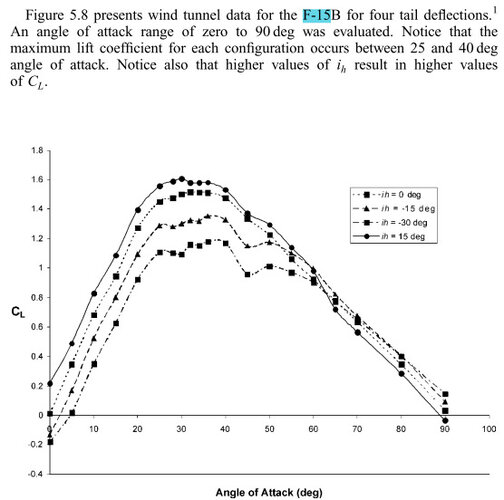
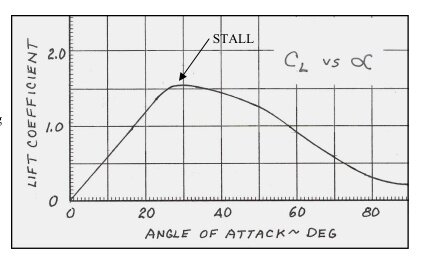
The F-15B lift coefficient figures are from this AIAA book, and references values from wind tunnel testing during the STOL/MTD program. The F-15 S/MTD (a modified F-15B, S/N 71-0290) has a drastically different configuration and planform with those massive canards (which are just Hornet stabilators) which explains why it's a different, steeper curve than the F-15 flight test data as seen in the AGARD report.

 
The F-15B lift coefficient figures are from this AIAA book, and references values from wind tunnel testing during the STOL/MTD program. The F-15 S/MTD (a modified F-15B, S/N 71-0290) has a drastically different configuration and planform with those massive canards (which are just Hornet stabilators) which explains why it's a different, steeper curve than the F-15 flight test data as seen in the AGARD report.

On the other hand In the essay F-15 Eagle--The Early Years, author Jack Abercrombie shows a polar that is noticeably similar to AIAA.

About AGARD, he first writes this :

In early 1977, Harold Altis, the VP in charge of Engineering Technology, requested that I prepare and
deliver a presentation to a NATO AGARD (North Atlantic Treaty Organization Advisory Group for Aerospace
Research and Development) Specialists Meeting to be held in Paris, France in October of that year. Although the
subject matter, dealing with performance, (“Flight Test Verification of Pre-Flight-Predicted Performance”) of the
F-15 was certainly not my favorite, I, of course, accepted the challenge.

Airplane “performance,” in the context used throughout the world-wide industry, deals mostly with aero-
dynamic drag along with thrust, weight, and fuel flow and their impact on such parameters as maximum speed,
maximum altitude, climb rate and acceleration, and range, etc. (These are the types of things that Program Manag-
ers and members of Congress think they understand). Within Aerodynamics organizations, “performance” is nor-
mally regarded as somewhat of a sub-discipline staffed by the appropriate specialists. Another sub-discipline,
“stability and control,” dealing with control system characteristics, maneuverability, flying qualities, etc. was the
subject of most of the preceding pages.

The key to successful airplane design is to achieve the proper blend of Performance with Stability and
Control. Unfortunately, the two sub-disciplines have a tradition of conflict with each other. An airplane with ex-
cellence in one arena may exhibit mediocrity in the other. For fighter airplanes, it has always been a conflict be-
tween “speed and range” versus “dog fighting...agility” —even well before World War II.

Although I was well-versed in performance (having com-
piled a handbook for estimating aerodynamic drag in the early
1960s which is still in use nearly 50 years later), I had chosen the
stability and control path as being more satisfying. Accordingly,
virtually all my F-15 detailed experience had been lacking in per-
formance—it was a real challenge to create the requested paper.

To compound the problem, F-15 Performance capabilities
were still classified SECRET. In addition, we considered the basic
drag data as Competition Sensitive—we didn’t want to show so
much that the drag basis could be reverse engineered by a com-
petitor.

But the most difficult challenge was to avoid disclosing
to the world that our Drag and Performance management had ne-
glected to use some key wind tunnel drag test data that would have
changed some of the pre-flight performance predictions. During
my short time while assigned to the Advanced F-15 program in 1971 (see Page 9), I had learned that our published
pre-flight drag basis in the supersonic, low angle of attack regions was grossly optimistic to the point, in my
opinion, of being irresponsible. Fortunately, there were no safety-of-flight issues involved, so no big fuss was
made at the time.

The previous paragraph is not intended to belittle the Drag and
Performance technical team—where it really mattered (performance
guarantees for high-g maneuvering acceleration and climb), the team did
a remarkable job. In the high-g regions, there were no analytical tech-
niques available to accurately assess the configuration complexities in
regions where there were mixed subsonic/supersonic flow fields with
local shock waves and regions of flow separation. And, in using a wind
tunnel test data basis, they were breaking new ground.

I composed the paper with a clear conscience. The complexi-
ties of the problem were defined, and the Classification and Competition
Sensitive issues were addressed by leaving scales off of the graphs and
disguising the ordinates. For the pre-flight predicted drag curves, I used
the wind tunnel test data that should have been included in the estimates
but was not.

As they used to say in the trade, “The paper was well received.” However, there was one individual who
expressed some skepticism—Gene Rooney, a Naval Air Systems Command civil servant and the leading govern-
ment expert on airplane drag and performance. Gene had been involved in the USN flight evaluation of the F-15
some five years before; he knew that things were not so rosy as might have been depicted based on his assessment
of the real airplane compared to our advertisements of the time. But he was kind and didn’t pursue the matter in
depth at that time. (A few years later, he wasn’t so
forgiving when he took McDonnell to task for being
too optimistic in performance predictions for the
AV-8B Harrier. By that time, I was the head of the
Aerodynamics Department and had to endure his
scathing comments in front of a large crowd. The
AV-8B project deserved his derision at the time; I
was merely in the line of fire. But between the two
of us, we brought about some much needed major
changes to McDonnell Program Management mo-
dus operandi—another story, another time).
 
Question;

Do ANY of the present Israeli F-15s ('Baz' and 'Ra´am') - so NOT the 'Advanced' / 'EX' variants on order, or those scheduled to receive updates - use F-110-GE-129 engines, or do they all have the F100-PW-220 and F-100-PW-229 engines installed?
As far as I (think) to know, all present Israeli F-15s use the P&W engines.

But in Belgian press, there is some fuzz about a Belgian company being a subcontractor for parts (turbine-blades) of the GE engine, and (in Belgian press) it is now reported/claimed Israeli F-15s used in strikes against Gaza would use GE-engines and therefore Belgium would have violated some weapons-export agreement to countries active in wars...

Edit:
I just discovered it is now also being reported, the Belgian subcontractor (Safran Aero Boosters) would supply parts for the P&W F100 engines..
So my question has suddenly become less relevant.
But I would still like to get a confirmation, if possible, that (as I assume) all present Israeli F-15s are equipped with P&W engines.
 
Last edited:
Interesting news for RAF Lakenheath in the uk, home of the European F-15E fleet:

"One thing that stuck out to me was the arrival of the F-35s at Lakenheath Air Base, and that once they are up and running, two Strike Eagle units will be returning stateside"


To be fair, it was more likely to have been a glitch in the Spada 2000 system they use, to which the Kuwaiti Patriot batteries are apparently also hooked into.

Some info on the baseline system (Kuwait seemingly uses a customised hardened underground based version):
 
Last edited:
It's really a weird event. Either it is a consequence of a lack of preparation or over regulating daily Operations, yes, Vietnam like

How can any of the 3 different Eagle have not attempted any avoiding maneuver? What led a Classic Hornet such freedom to target, launch at and shot down frontline USAF fighters without any of them apparently detecting the attack? What about their defensive suite? E-Eagle should have had a potent defensive suite if not EPAWSS. Is that a lack of sharing treat or IFF library resulting from the hasten and rather secretive war preparation process?

Airmen are also trained to scan their surroundings. OK the AIM-9X, AMRAAM are smokeless, but the launch should have been detected, at least by some of them.

Then their are the reports stating it's only material loss. But we can clearly see in shared picture an aircrew with a bloodied wound. An other on a very defensive footing. Ejections are not benign events. It might induce body lasting damages, career changes etc...

I am flabbergasted by the public media placid take on the storied depiction of the events. What next, an exclusive report on the amazing facilities of Tehran's Hilton?!
 
Last edited:
It was kinda fascinating to watch the uncrewed F-15 vertical touchdown capability on tonight's evening news. Still one of my all time fave planes...
 
Last edited:
It's really a weird event. Either it is a consequence of a lack of preparation or over regulating daily Operations, yes, Vietnam like

How can any of the 3 different Eagle have not attempted any avoiding maneuver? What led a Classic Hornet such freedom to target, launch and shot down frontvline USAF fighters without any of them apparently detecting the attack? What about their defensive suite? E-Eagle should have had a potent defensive suite if not EPAWSS. Is that a lack of sharing treat or IFF library resulting from the hasten and rather secretive war preparation process?

Airmen are also trained to scan their surroundings. OK the AIM-9X, AMRAAM are smokeless, but the launch should have been detected, at least by some of them.

Then their are the reports stating it's only material loss. But we can clearly see in shared picture an aircrew with a bloodied wound. An other on a very defensive footing. Ejections are not benign events. It might induce body lasting damages, carrier changes etc...

I am flabbergasted by the public media placid take on the storied depiction of the events. What next, an exclusive report on the amazing facilities of Tehran's Hilton?!
They could have been in relatively close formation (they were in Kuwait, returning from a mission) and all three fired at in rapid succession. One pilot appears to have lost part of his hand.


Again, seems the F-15s were at different altitudes, the lower one seemed to have been hit in the rear but the explosion was not very big, so let's say it was an AIM-9, was the supposed F-18 pilot blind and not seeing he's firing at a twin tail, twin engine fighter? Not even going into allegedly hitting the other 2, what was he doing, spamming AAM in every direction? Oh wait, they say it was 3 AAMs, 3 hits. This story is fishier than a fish in the sea.
 
Last edited:
This finally puts the F-15 is undefeated in A2A combat to rest... ;)
Doesn't really count when you're over friendly territory and it was an "ally". One, okay, but THREE? Don't know if Kuwaits legacy Hornets have multi-target simultaneous attack capability.
 
Don't know if Kuwaits legacy Hornets have multi-target simultaneous attack capability.

That should be straightforward with AIM-120s.

The Hornet had that capability back in 1991...

True but with AIM-7Ms it's a bit harder as they use SARH guidance and each target has to be illuminated.
 
Last edited:

Similar threads

Back
Top Bottom