Little-known American Rotary Wing Prototypes & Projects

On the back cover of this issue was an ad for Firestone Helicopters that has artwork for the GA-50.

Enjoy the Day! Mark

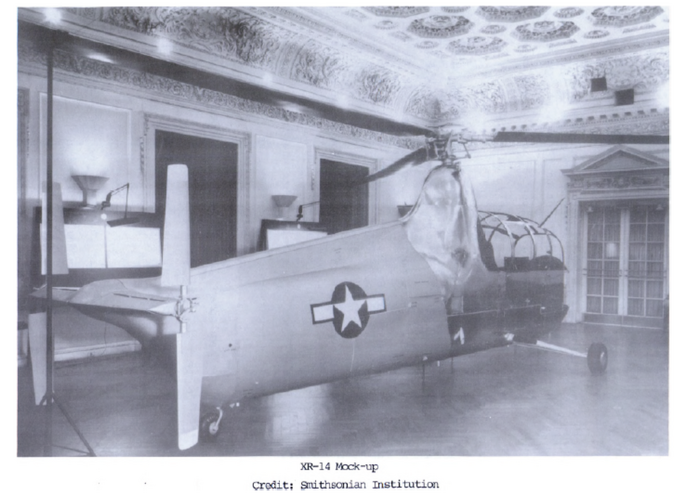
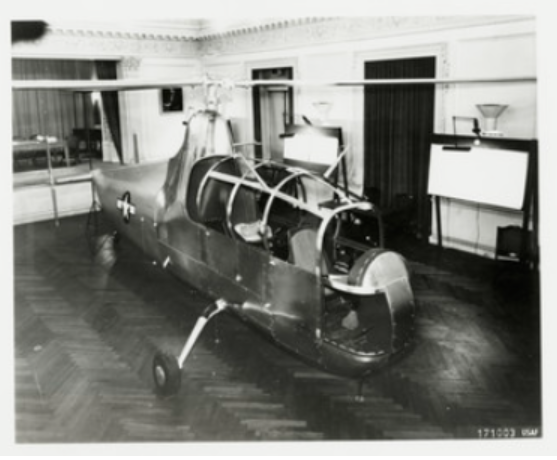
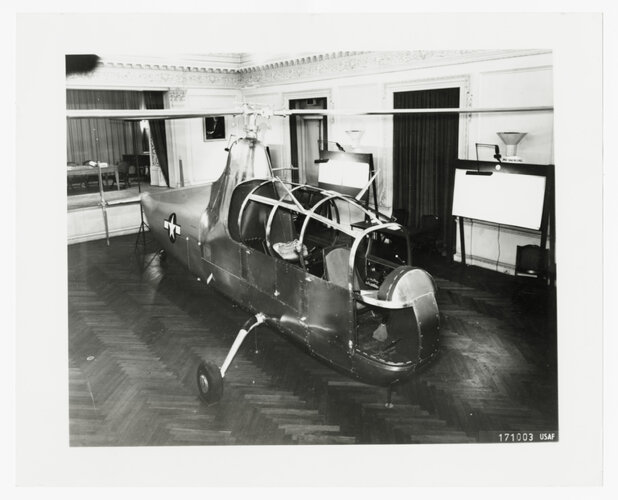
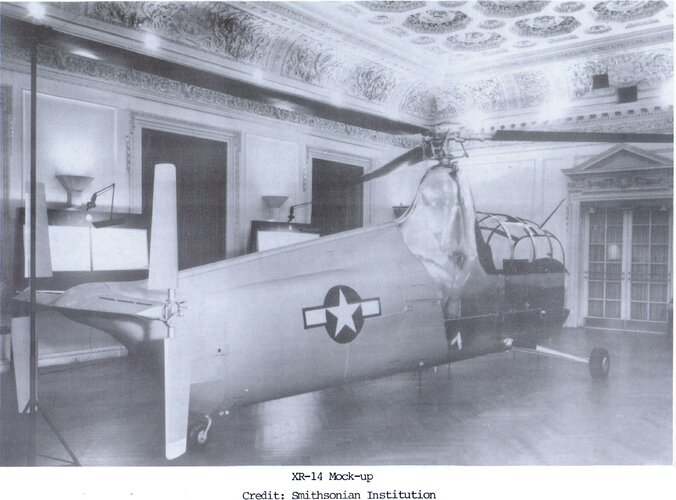
From these report and site,Firestone XR-14 mock-up.


Attachments

  • 14.png
    14.png
    1.4 MB · Views: 93
  • 15.png
    15.png
    348.4 KB · Views: 93
  • 16.png
    16.png
    860.6 KB · Views: 101
From these report and site,Firestone XR-14 mock-up.

Dear Hesham, I hope you don't mind if I leave here a bigger resolution pictures?
 

Attachments

  • ms364_129_23_002.jpg
    ms364_129_23_002.jpg
    694.4 KB · Views: 88
  • 132.jpg
    132.jpg
    1.7 MB · Views: 93
Hi,

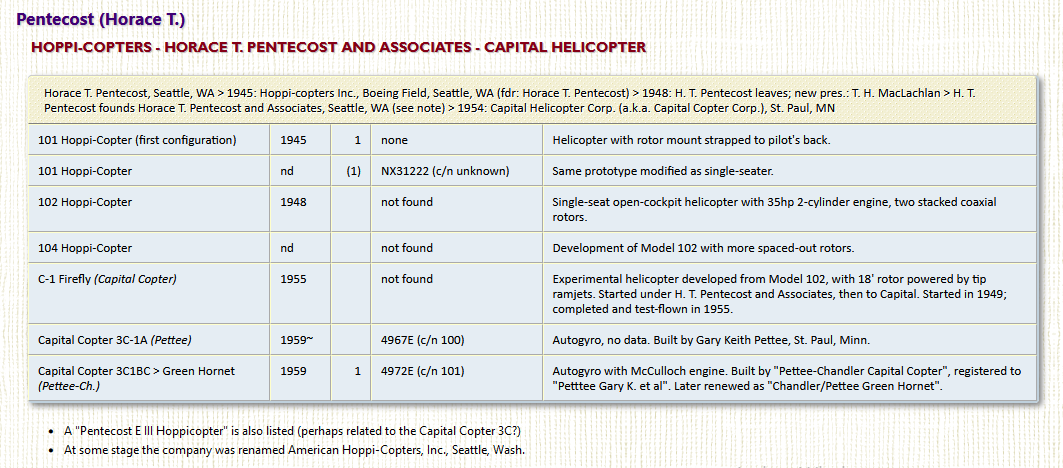
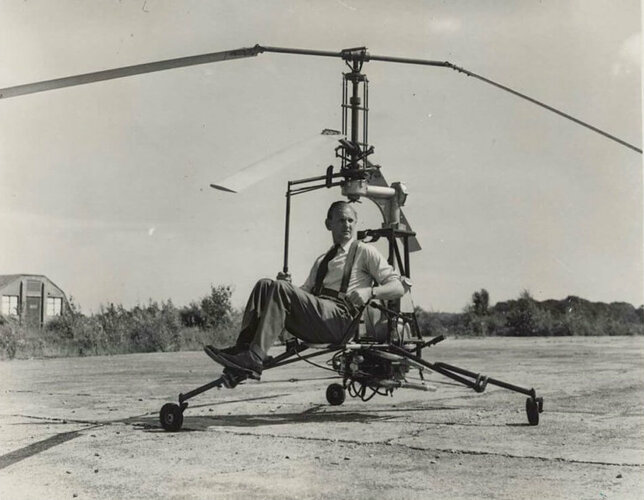
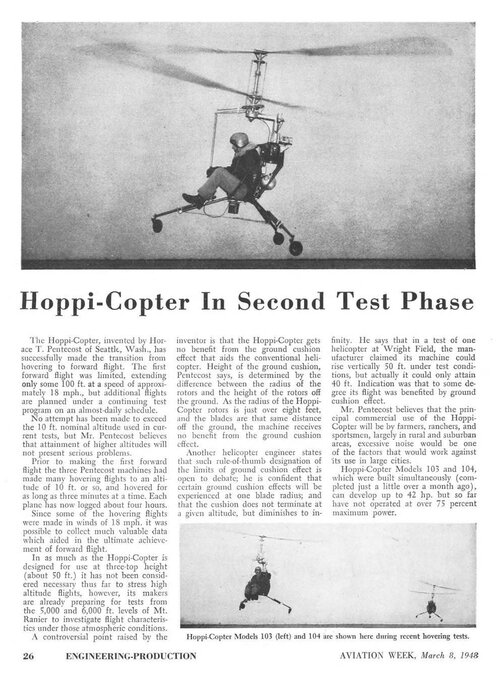
Mr. Horace T. Pentecost founded Hoppi-Copter Inc company,he designed the HX-1 or
Model-100,a one man copter with two contra-rotating rotors,followed by Model-101 &
Model-102,evolved into the 1950 experimental Firefly with an 18' rotor powered by
tip ramjets.

He also designed a very cheap single seat Helicopter,also there was a Model-103 and
Model-104.


Hi,

Hoppi-copter (1945) - The first helicopter designed by Horace T. Pentecost of Seattle was a "back-strap" model intended for military use. Later the American Hoppi-Copters Inc. built other models which had two coaxial rotors and a small engine of variable power depending on the version.

Hoppicopter “Firefly” (1950) - Single place model equipped with a two blades tip powered rotor. It seems that this model did some hovering flights in 1950.

 
May be of interest:

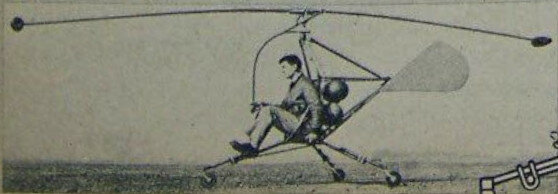
I came across also model 103 - I identify it with having an engine moved below main frame (clearly visible). Model 104 (if I recall correctly) was to be made in England in some cooperation, but I was never able to find any picture which will clearly indicate it as a separate thing)
 

Attachments

  • 1948-00-00-Jeff Evans-GB-f6800.jpg
    1948-00-00-Jeff Evans-GB-f6800.jpg
    73.7 KB · Views: 73
I came across also model 103 - I identify it with having an engine moved below main frame (clearly visible). Model 104 (if I recall correctly) was to be made in England in some cooperation, but I was never able to find any picture which will clearly indicate it as a separate thing)
Thanks a lot for this!
 
It's amazing what a random search after years can yield:
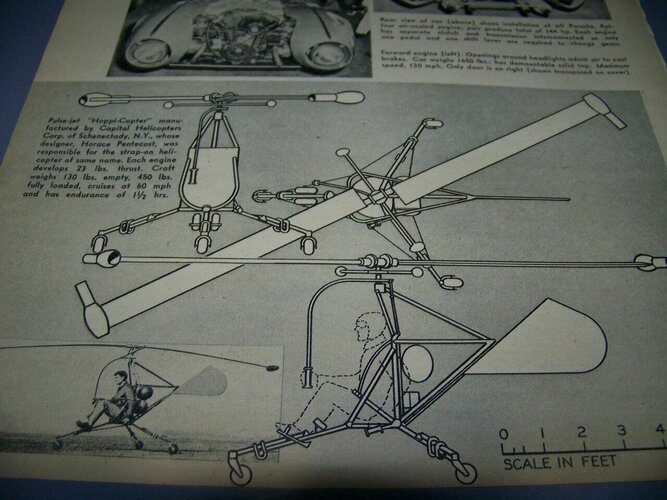
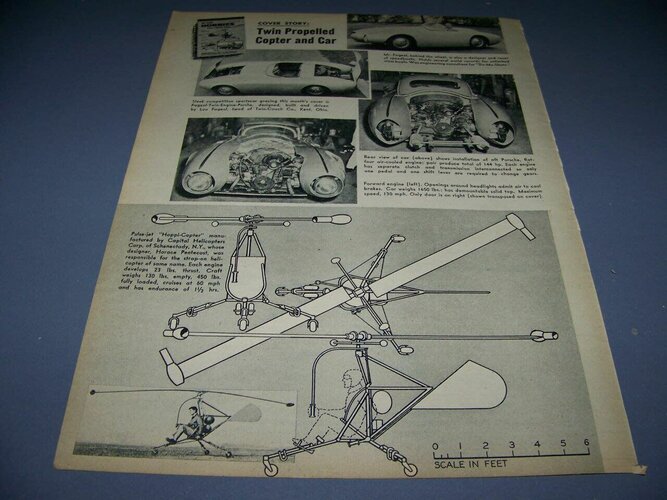
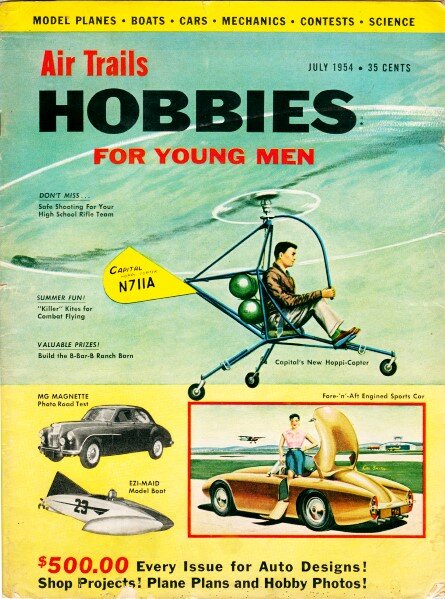
A pulse-jet Hoppi-copter made by the Capital Helicopters Corp.

In the post here:
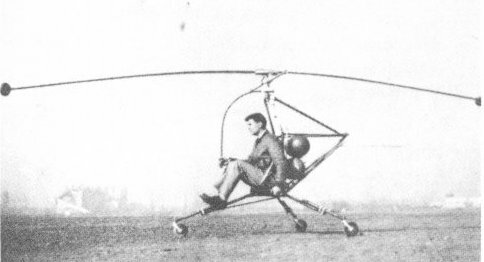
you can find picture of this machine (probably named C1 Firefly, picture also attached)

I tried to fix the perspective of the pictures from ebay and came out with that:
1_crop_fixed.jpg
The seller of this item is not very open about where it came from, but after some time I was able to trace down this article. It comes from magazine called Air Trails Hobbies For Young Men, issue from July 1954 (vol 42, No. 4). The article describing "Hoppi-Copter" (this is how it is called there) is on page 16.
air-trails-july-1954-cover.jpg
Finally, my summary so far:
 

Attachments

  • s-l1600.jpg
    s-l1600.jpg
    194.1 KB · Views: 78
  • s-l16002.jpg
    s-l16002.jpg
    186.5 KB · Views: 64
  • Nemeth_Antitorque_.JPG
    Nemeth_Antitorque_.JPG
    17.5 KB · Views: 68
Last edited:
May be of interest:

I came across also model 103 - I identify it with having an engine moved below main frame (clearly visible). Model 104 (if I recall correctly) was to be made in England in some cooperation, but I was never able to find any picture which will clearly indicate it as a separate thing)
This is not straight forward. I Just came on the couple of articles in Aviation Week archives and one said that Model 102 "will" be the production version of currently-being-tested tripod version of Hoppicopter. Like year later an article depicts model 103 (which in my mind was model 102 - with just a battery hanging below pilot) and on the right on the bottom picture is shown flying model 104 - but this is hard to identify - I seems not to have an engine below the pilot like in the version I used to call 103
 

Attachments

  • Aviation_Week_1948-03-08_0013.jpg
    Aviation_Week_1948-03-08_0013.jpg
    273.5 KB · Views: 95
I gather the only major difference about Model 104 was the more spaced-out rotors.
 
I gather the only major difference about Model 104 was the more spaced-out rotors.
This may also be true, but I still have some other doubts on models 102 -103 - 104.

I am diving a bit deeper right now, and shortly I will post my recent findings and doubts. This thread however is getting occupied by Hoppi-copters too much so I will create a new one dedicated to Mr Pentecost helicopter endeavours
 
This is the first time I remember seeing this compound helicopter from Grumman. Anyone have any other information?

I suspect the model coaxial lurking behind it is an early Sikorsky LHX.
Grumman never created an attack helicopter that I ever heard of.
 
Two really crazy U.S. Army helicopter projects from the 1960s:

I believe I have found evidence of illicit drug use at the Rock Island Arsenal US Army installation.
The offenses appear to have taken place between 1961 and 1965, when these conceptual renderings were created.
Sadly, I’ve got little to no detailed information about either one.
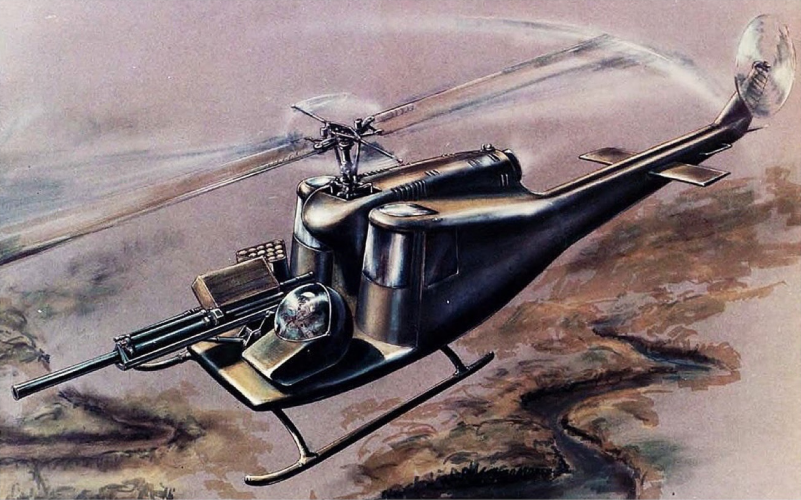
The first is a conceptual version of the Bell UH-1 Iroquois (“Huey”) helicopter that is outfitted with a massive, 105-millimeter “Gun Launcher.”
In this concept, the gun is so massive, it takes up half of the helicopter’s former cabin and cockpit space, and the brave pilot is left to cram themselves into a tiny capsule the size of an enclosed go-kart.
It’s anyone’s guess how the airframe and associated components would hold up to the onslaught of 105-millimeter gunfire, and one wonders whether the artist was ever able to fully recover from the high they were apparently on when coming up with this concept.
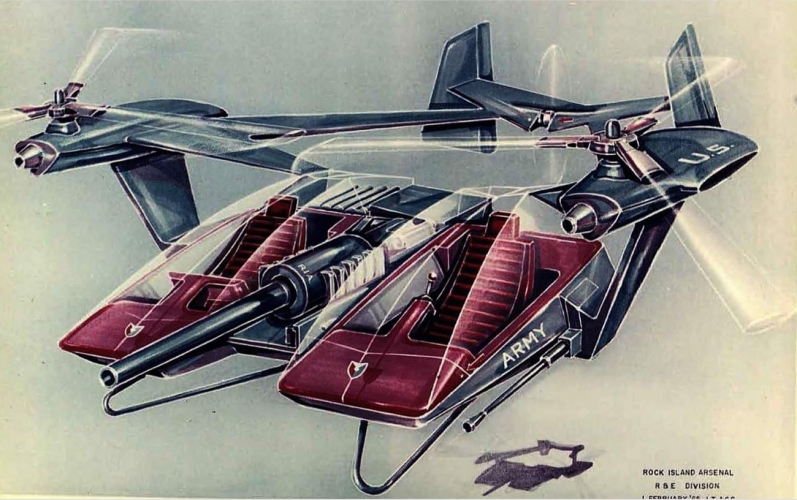
The second concept is easier to understand. While it also is equipped with a comically massive gun, the striking appearance and sleek, fully-transclucent dual canopies were obviously designed specifically for G.I. Joe.
Sadly, neither of these concepts ever made it off of the drawing board.
Source: Jason McDowell's Facebook page
 

Attachments

  • 1750585918524.png
    1750585918524.png
    1.7 MB · Views: 72
  • 1750585960544.png
    1750585960544.png
    1.6 MB · Views: 79
Last edited:
Oops! The first one rang a bell, but I had no memories of the second one.

By the way, hesham, I've noticed duplication of info is a pet peeve of yours, but in fact, having the same pictures or aircraft in two different places of the forum is not such a big deal, really. Moderators even have a button enabling them to copy a post from one topic to another, which means that, although it is rare, there can sometimes be a good reason to duplicate information.
 
This designer is so weird, from report a165902
 

Attachments

  • 3.png
    3.png
    62 KB · Views: 49
  • 4.png
    4.png
    53 KB · Views: 44
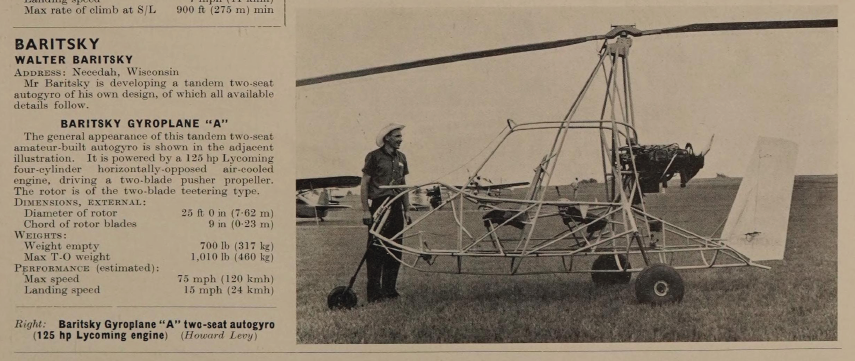
From JAWA 1966-1967,

here's a Gyroplane A,from Mr. Baritsky.
 

Attachments

  • 2.png
    2.png
    519.1 KB · Views: 40
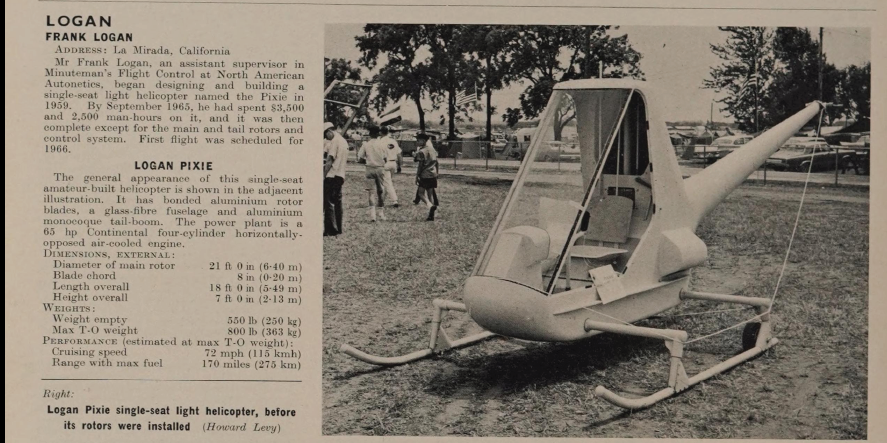
Also from JAWA 1966-1967,

here's Mr. Frank Logan and his product Pixie helicopter.
 

Attachments

  • 1.png
    1.png
    741.3 KB · Views: 32
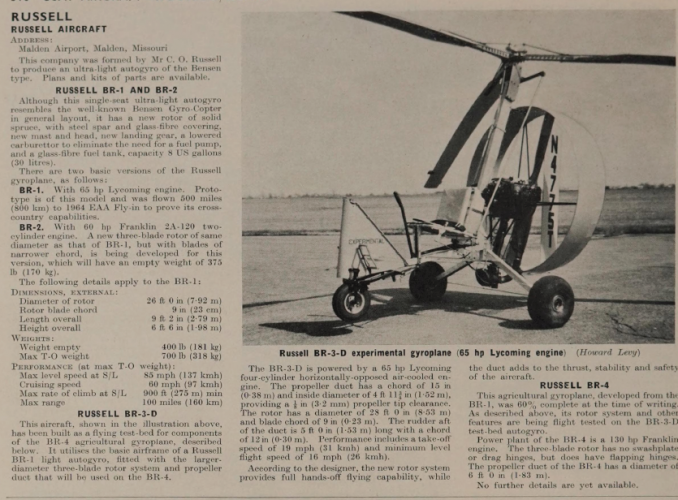
USA Russell theBR-1 and BR-2 were a single seat ultra-light autogyros, designed in
early 1960s,the BR-3-D was built as a flying test-bed for components of the
BR-4 agricultural version.

From JAWA 1966-1967
 

Attachments

  • 3.png
    3.png
    870.7 KB · Views: 34
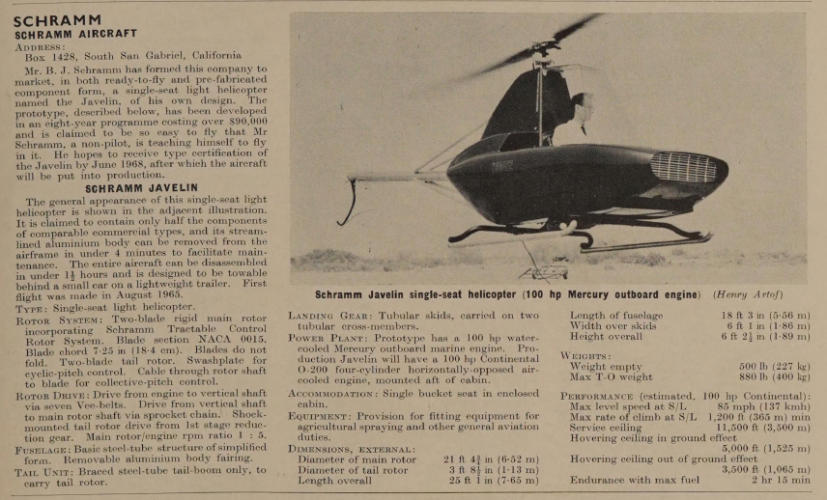
Rotorway Schramm Javelin :single seat amateur-built helicopter,it had
a tubular steel structure with a formed aluminium body
shell and was powered by a 100 hp Mercury powerboat
engine.

From JAWA 1966-1967
 

Attachments

  • 4.png
    4.png
    785.2 KB · Views: 41
From the site on my dear Stingray,

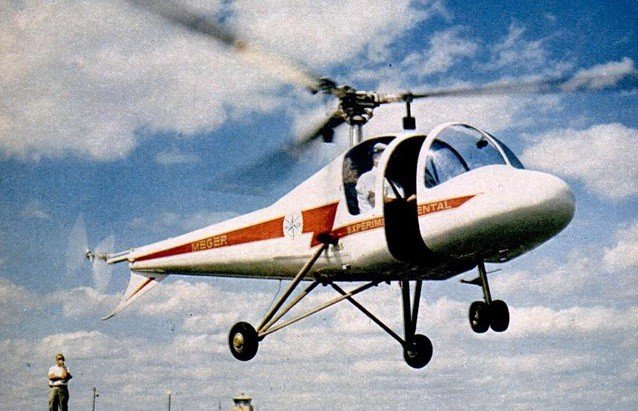
Meger Heli-Star helicopter
Operations with Enstrom and a test pilot for Hiller, began designing this highperformance two-seater in 1969, which first flew on an FAA experimental C-of-A on March 25, 1971. To reduce cost, Enstrom gearboxes and cut-down main rotor blades are used, together with some of the tubular main structure. The fuselage is very sleek and blended with a deep tail-boom. The fully-articulated three-blade rotor is mounted on a tubular mast. Two-blade teetering tail rotor protected by a faired skid. Threewheel landing gear with nose wheel.

Powerplant is a 200 h.p., 149kW Lycoming HIO-360-C1A. The cabin is entered by sliding the canopy and nose forward. Rotor dia 29ft 6in, 900m, length 29ft, 8 84m, height 8ft 2in, 2-40m; weight empty 1,4501b, 657kg, max 2,1001b, 952kg; max speed 100kt, 185km/hr, econ cruise 78kt, 145km/hr; max climb 1,000ft/min, 51m/sec; service ceiling 13,000ft, 3,950m, hover ceiling i.g.e. 5,500ft, 1,675m.
 

Attachments

  • 1.jpg
    1.jpg
    98.8 KB · Views: 14
  • 2.jpg
    2.jpg
    16.2 KB · Views: 16
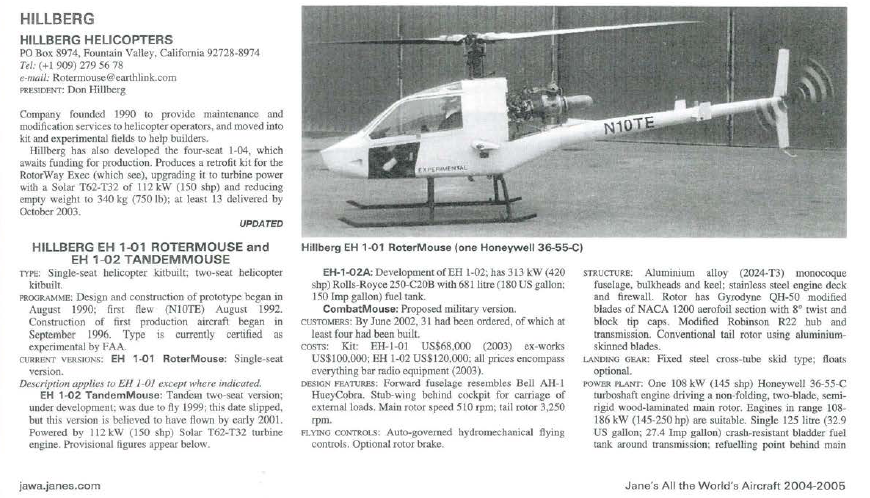
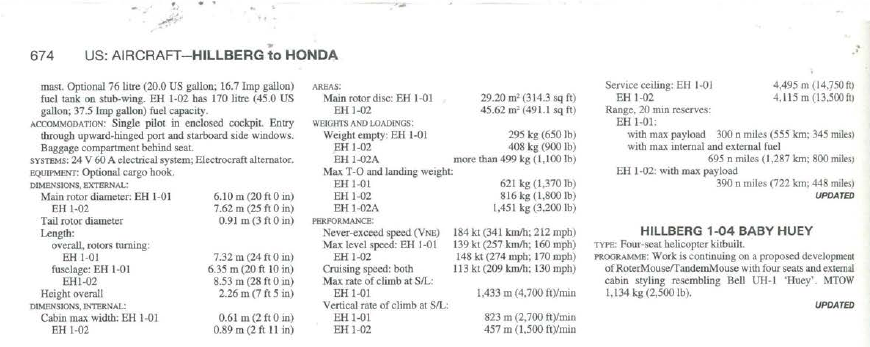
From JAWA 2004-2005,

Hillberg EH 1-01 Rotermouse and EH 1-02 Tandemmouse.
 

Attachments

  • 2.png
    2.png
    468.8 KB · Views: 15
  • 3.png
    3.png
    197.8 KB · Views: 18
From my dear Stingray and his site,

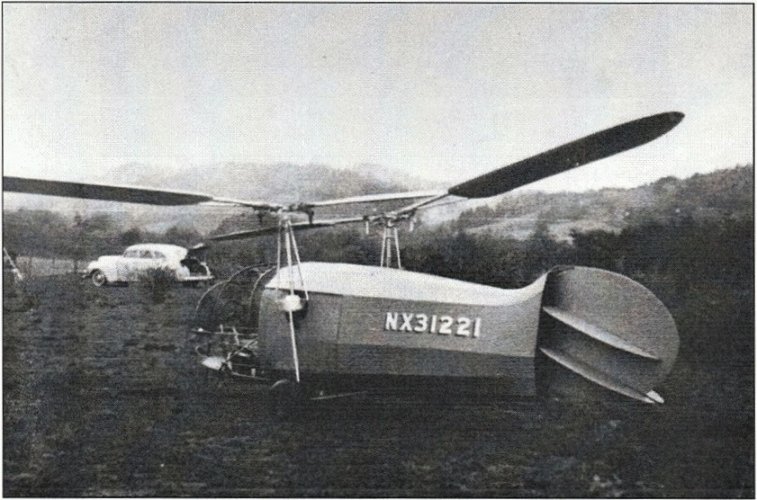
Ralph A. Chapman (1903-1968) was an engineer, successful industrialist, and inventor from Corvallis, Oregon, who specialized in machinery and composite wood fabrication (you can find some of his patents online). The Chapman House was a notable example of his work, designed by architect James J. Gathercoal and built in 1950 to demonstrate the versatility of Chapman's "Chapco board", a composite wood-fiber hardboard of his making. I also found his name attached to the companies Chapco (later Evanite Fiber Corporation) which was his hardboard plant, Beaver Cabinet Works, Ralph Chapman Industries which produced cabinets and refrigeration units for local businesses, the bituminous fiber pipe manufacturing plant Blacfiber Pipe Company in 1955 (bought by The Brown Company in 1956), Chapman Manufacturing Co., and Chapman Forest Utilization, Inc. (CFU).

Around 1939 he was inspired to experiment with helicopter designs, after watching a 1938 newsreel featuring a Focke-Wulf helicopter in flight, believing he could design a machine that was smaller and more efficient. His work was hindered in the early 40's due to restrictions imposed around the beginning of World War II, which prevented test-flying prototypes, but he continued afterwards and experimented with different configurations. His last design was completed in 1946 and achieved a successful take-off, though it suffered from vibration problems. Concluding the design as impractical, Chapman would abandon his work on helicopters and pursued other endeavors.

The second helicopter prototype (attached), NX31221, achieved several hover tests near the ground before it was dismantled in 1946. It was a synchropter type, which utilized an intermeshing rotor system that eliminated the need of a tail rotor. Directional control was achieved via ducted airflow to slanted vanes at the tail-end, a method that was also later researched by Hughes Helicopters.

Special thanks to drejr and Hesham for their initial research work on this design, and Oregon Aviation Historical Society for the picture. If any of my own additional research work on this is incorrect (as in, if I've confused different people by the name Ralph Chapman in the above historical context, and have the wrong person depicted below)
 

Attachments

  • 2.jpg
    2.jpg
    151.8 KB · Views: 27
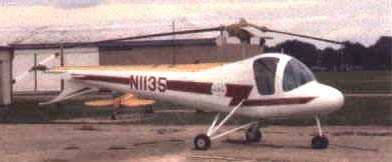
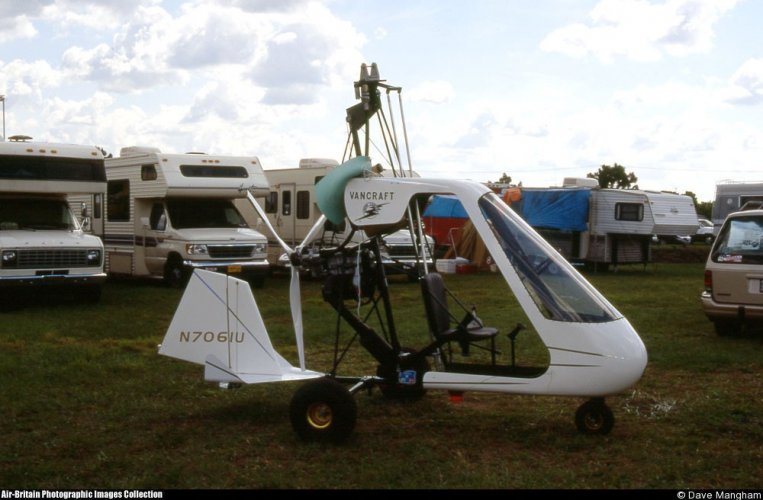
Was this Vancraft Vortex from Canada ?.
 

Attachments

  • 6.jpg
    6.jpg
    132.2 KB · Views: 24
Was this Vancraft Vortex from Canada ?.

No, it is American ... and should be moved to another thread.
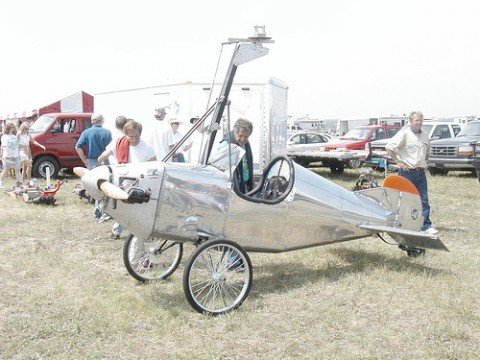
If you were imagining that Vancraft might relate to Vancouver, BC, ... it doesn't. The name came from its Oregon-based designer, Jim Vanek.
 
I don’t know if anyone has talked about this one yet: the XH-26 Jet Jeep. It was a small, toy-like helicopter that was designed to be airdropped to downed pilots. It used pulsejets rather than a conventional engine to power it, cutting the weight to under 300 pounds. It was able to be assembled by 2 people in just 20-40 minutes with only basic tools. Despite being insanely small it had a ceiling of around 7000 feet and a speed of up to 80 MPH (128 KMH) It was cancelled because the pulsejets created a lot of noise, potentially exposing a downed pilot in enemy territory.
 
From my dear Stingray and his site,

Key West Conchcord
 

Attachments

  • 2.jpg
    2.jpg
    46.9 KB · Views: 19

Attachments

  • 2.jpg
    2.jpg
    32.3 KB · Views: 21
Also from the site of my dear Stingray,

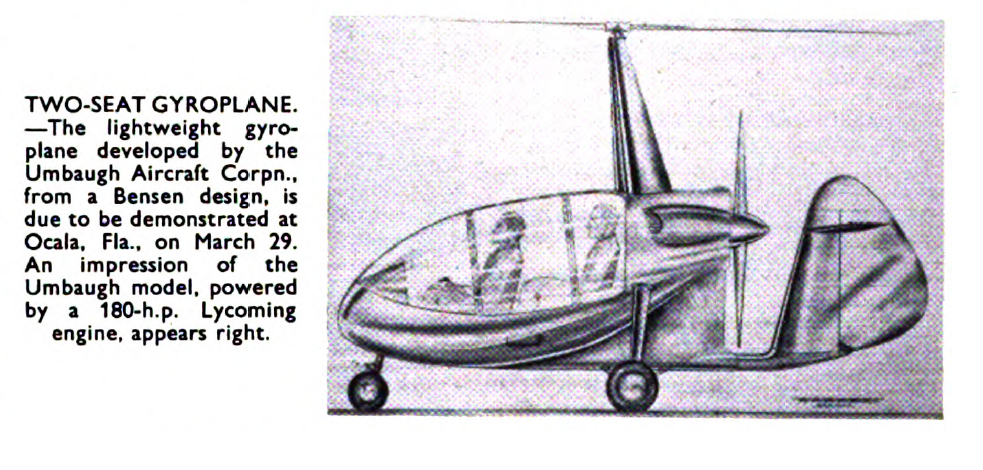
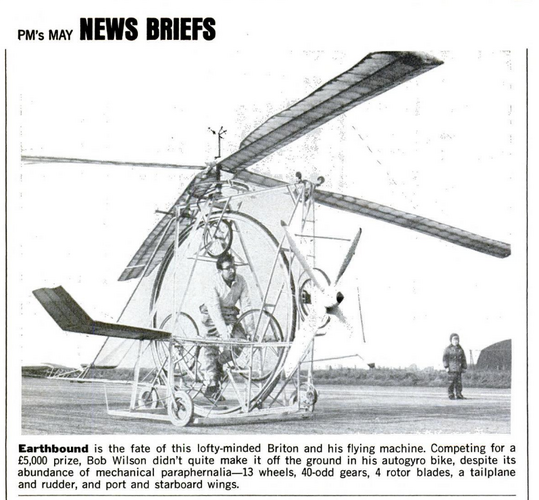
George Pate and his autogyro
 

Attachments

  • 3.jpg
    3.jpg
    54.5 KB · Views: 26

Similar threads

Back
Top Bottom