My 144-inch number was wrong. I have this (from: The Central Intelligence Agency and Overhead Reconnaissance: The U-2 and OXCART Programs, 1954-1974) It went from 240 inch F/L to 200 inch then 120 inch, then back to 180 inch.
I have to keep reminding myself that when we're talking cameras the number is always Focal Length, but for Telescopes it's objective size (lens or mirror diameter)
 
A few years ago I talked to some former Kodak guys who worked on KH-11 and other programs. They didn't really talk about KH-11, but they told me some interesting stories about mirror production and related things. One of the interesting stories was about why Kodak did not win the bid for the Hubble Space Telescope. As it was explained to me, Kodak's experience with the KH-11 actually hurt them. The reason was that they were already aware of the difficulties of developing a large mirror telescope, so when they put in their bid to NASA, they bid what they believed it would actually require to do it right. The problem is that NASA did not ask for all of those things, so they included things that drove up the cost and they lost the bid to Perkin-Elmer. P-E then screwed up on the Hubble mirror. I may write up some of this someday. I really wish NRO would just declassify something about the KH-11. But it's possible that the last ones in that series are still operating, so they may not want to do that.

Did your Kodak guys discuss film, Blackstar, or just the optics?

If I understand correctly, the most powerful 4K and 8K digital cinema cameras available still cannot reach the image resolution and color reproduction of 70mm movies like Ben-Hur (1959) and 2001: A Space Odyssey (1968). Some directors (like Quentin Tarantino and Christopher Nolan) continue to prefer shooting with 70mm film, although all technical progress for decades has been in digital image sensors. I heard that before spy satellites too moved to digital, the NRO funded a then-top-secret research program in the 1970s for Kodak to substantially increase the resolution of film, which I suppose included further tightening the film grain beyond anything Hollywood had. I think NRO's satellites shot stills rather than movies, but perhaps a version of Kodak's declassified technical improvements could now carry over to new, improved cinema film stock. Then Tarantino, or Nolan, or another with deep pockets, instead of using cameras and film from before he was born, could shoot with truly 21st-century film, with results on screen as much above Ben-Hur and Space Odyssey as those were above 1940s black & white movies.
 
I have to keep reminding myself that when we're talking cameras the number is always Focal Length, but for Telescopes it's objective size (lens or mirror diameter)
Yep me too. NRO mirror diameters came in three sizes
- 44 inch (KH-7 & KH-8)
- 72 inch (KH-10, MOL a.k.a DORIAN)
- 94 inch (KH-11)

-----------------

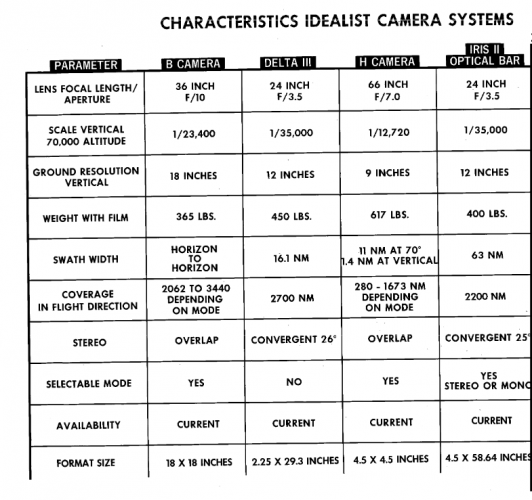
Attached: a quick recap of U-2 cameras as they stood by September 1967.

1-By this point the old 'A cameras' A1, A2, A3 - had been retired, and so had the 'C camera' we discussed up thread.

2-The Delta III was a lightened variant of the Delta II, itself derived from a CORONA spy satellite camera.

3-The IRIS II had just been "borrowed" from the COMPASS ARROW semi-stealth drone [and it would fin its way into NASA Apollo in 1971 and the SR-71 in 1972].

Capture d'écran 2026-10-04 145541.png
 

Attachments

  • CIA-RDP33-02416A000300040001-4.pdf
    687.7 KB · Views: 1
Last edited:
I think NRO's satellites shot stills rather than movies, but perhaps a version of Kodak's declassified technical improvements could now carry over to new, improved cinema film stock. Then Tarantino, or Nolan, or another with deep pockets, instead of using cameras and film from before he was born, could shoot with truly 21st-century film, with results on screen as much above Ben-Hur and Space Odyssey as those were above 1940s black & white movies.
Film stock designed for aerial reconnaissance does not usually aim for neutral "true-to-life" representation, so may not be the best for motion pictures. There have been some but not many cases of new motion picture stocks being developed in recent years (e.g. Kodak's Verita 200d used on Euphoria), but i'm not sure if they used tech from military programs. That being said, you can buy military-spec film stock for stills photgraphy today, e.g. Aerochrome is a false color infrared film that exaggerates greens (if you can find it), and various black and white panchromatic stocks with super fine grain are available to different degrees, e.g. Exeter Pan XX (repackaged Agfa aerial surveillance stock), and I think Rollei might have something similar. But re: Nolan, the 70mm IMAX frame is so much larger than 35mm physically that even with ultra low grain stock (think 50 asa), 35mm doesn't come even close to the equivalent resolution of 70mm. But in the end, it's an artistic decision; Verita 200d was developed and chosen because it looked like an Old Hollywood film stock, not despite it.
 
I think NRO's satellites shot stills rather than movies, but perhaps a version of Kodak's declassified technical improvements could now carry over to new, improved cinema film stock.
It's not movies, but I do know that the guy doing the Gigapixel photo shoots is using a former U-2 camera and film, then scanning the resulting negatives. Scanning because no camera chips exist at that resolution.
 

Similar threads

Back
Top Bottom