
The missiles are easy to track. The nose of a long range SAM exceeds 500 degrees due to aerodynamic heating. The radar seeker in the missile is also transmitting. I can't see the large SAMs getting their own countermeasures.
Missiles when their engines are working - yes. After that - not anymore, at least not on COTS sensors. It's just small.
This means the enemy is firing multiple $3 million SAMs per aircraft. This is getting expensive. The hit-to-kill decoys will continue to become smarter. If there is multiple incoming missiles the decoys can then each select a target.
If your aircraft gets shot down via unreliable countermeasure - no one will use it.
I am not against active interceptors - quite the opposite. But you have to give system what it takes to work. Which is sensor feed, and enough dV for LoAL intercept in direction where you intend to intercept attacks. How to get range - it can be triangulation via more sensors, it can be LTF, it can be radar. But something should be there.
The F-35 has a towed decoy in addition to 60 2x1x8 inch decoys. The hit-to-kill decoys would drop out of the normal 218 dispenser. The new expendable radar transmitter decoys drop out of the 218 dispenser. It then replaces a few of the flares and the towed decoy can still be used.
That's even smaller. Not only you try to achieve hit with partial sensor feed, you're trying htk it in a munition the size of automatic gun shell.
Not even with ten thousand interceptors you can do it, It's folly.
 
Missiles when their engines are working - yes. After that - not anymore, at least not on COTS sensors. It's just small.
The SM-3 hit-to-kill has only an IR seeker and hits incoming missiles with their engines not working.

Which is sensor feed, and enough dV for LoAL intercept in direction where you intend to intercept attacks. How to get range - it can be triangulation via more sensors, it can be LTF, it can be radar. But something should be there.
Sidewinder and ASRAAM is simply told what direction to fly and the seeker then starts looking. The direction is provided by the helmet mounted cueing system allow high off boresite shots.

Passive radar homing is another obvious seeker solution. SEAD missiles such as the AGM-88 would just fly towards the enemy radar transmitter. It does not need range data. Every long range SAM and air-to-air missile has an active radar seeker.

That's even smaller. Not only you try to achieve hit with partial sensor feed, you're trying htk it in a munition the size of automatic gun shell.
Not even with ten thousand interceptors you can do it, It's folly.

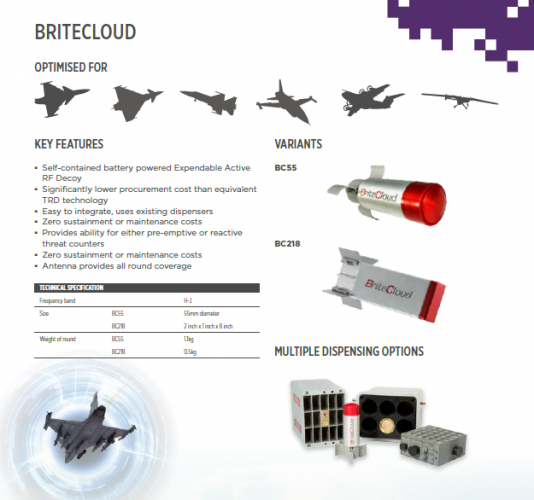
Britecloud is already operational and it has most of the technology needed. Decades ago no one would have imagined this much technology could fit in the size of a 218 flare. A dispenser box can be created where the hit-to-kill decoy takes up the position of multiple 218 flares.

The F-35 dclecoy loadout might then be:
1x towed decoy
4x hit-to-kill munitions
8x britecloud jammers
16x 218 IR flares

brite-cloud.png

The BC55 is 1kg the BC218 is 0.5kg.
Look at the Pike munition. It is 0.75kg and it includes a laser seeker, rocket motor and fins to guide it. It flew 7 years ago. If you removed the rocket motor from the pike you are already at the required size. Electronics has become even smaller in the last 7 years.

The F-35 will definitely have a hit-to-kill decoy that drops from the rear dispenser in 10 years time. I actually think we will see one tested before 2030.
 
Last edited:
https://aviationweek.com/defense/mu...plans-three-part-approach-usaf-tanker-program
Northrop Grumman is presenting a three-pronged approach to the U.S. Air Force if the service progresses with its current “family of systems” framework for future refuelers—from a large blended-wing body down to a small, uncrewed tanker, according to industry sources familiar with the plans.

The prime’s strategy includes both an in-house design of the smaller, low-observable aircraft along with partnerships with other companies to offer the range of options for the Next-Generation Air Refueling System (NGAS) umbrella program.
 
260219_embraer_northrop_RENDER-scaled-e1771538529110-1024x575.jpg


Northrop and Embraer have a long road ahead, with significant development work needed to incorporate a boom that executives are aiming to be optional for buyers and retrofittable on existing aircraft while retaining multi-mission capability like moving cargo.

https://breakingdefense.com/2026/02/northrop-brazils-embraer-partner-on-kc-390-to-pitch-us-others/
 
Last edited:
1) why is that KC390 carrying a Sniper pod? Or the Dragon Eye IRST pod, whichever.

2) The hard part is going to be keeping the tail boom out of the way of the underside of the rear ramp.
 
Last edited by a moderator:
1) why is that KC390 carrying a Sniper pod? Or the Dragon Eye IRST pod, whichever.
Perhaps an early illustration of using the SNIPER NTP and allowing the aircraft to function as a comms node?
2) The hard part is going to be keeping the tail boom out of the way of the underside of the rear ramp.
I doubt the rear ramp would usable at all in that configuration and the cargo bay would likely be equipped with the roll on auxiliary fuel tanks.

The big issue for me is finding someone willing to pay for the modification. NG will put a few dollars into some concept studies but cannot see this going anywhere without a launch customer and I highly doubt the USAF is that customer.
 
I doubt the rear ramp would usable at all in that configuration and the cargo bay would likely be equipped with the roll on auxiliary fuel tanks.
This line:
Northrop and Embraer have a long road ahead, with significant development work needed to incorporate a boom that executives are aiming to be optional for buyers and retrofittable on existing aircraft while retaining multi-mission capability like moving cargo.
Suggests that the point is to have the boom not interfere with cargo operations.

It's like having the Buddy tanker pods on a C-130 full time. (which IIRC is actually on point for the MC-130Js).

But the boom makes it more complicated. You'd need to massively overbuild the joint where the boom pivots to tuck under the door and make the entire shape through there the same as the angle the door meets the tarmac.


The big issue for me is finding someone willing to pay for the modification. NG will put a few dollars into some concept studies but cannot see this going anywhere without a launch customer and I highly doubt the USAF is that customer.
Agreed that USAF is likely not the launch customer. That ship sailed when the Herc-J beat the C390 to the market and beat it in the C-130 replacement contract.

NATO might be an option, if multiple countries agreed to a common standard and all bought in to a shared pool. (see the NATO E-3s for an example)
 
This line:

Suggests that the point is to have the boom not interfere with cargo operations.

It's like having the Buddy tanker pods on a C-130 full time. (which IIRC is actually on point for the MC-130Js).

But the boom makes it more complicated. You'd need to massively overbuild the joint where the boom pivots to tuck under the door and make the entire shape through there the same as the angle the door meets the tarmac.
I read the same thing but it reads to me that the capability is not permanent and implies that the airframe would be configured for AAR, ie the boom pod in the graphic is attached to the airframe along the rear ramp, and then removed when normal cargo operations are planned.
 
But the boom makes it more complicated. You'd need to massively overbuild the joint where the boom pivots to tuck under the door and make the entire shape through there the same as the angle the door meets the tarmac.
I thought the same thing. It is a ridiculous proposal and the engineering involved is extremely complex.

The most likely solution would be to completely unbolt and remove the cargo ramp. The modular boom unit can be mounted to the floor of the cargo bay with a clear path to the rear clamshell doors. The clamshell doors can then be open by a foot or 2 in flight. The boom unit would have a fascia creating a seal between the clamshell doors. This is not something that can be removed quickly.

I am sure if a country purchased a fleet of KC-390 and a portion of the fleet received boom refueling systems then they will never be converted back to cargo. There will then be commonality with maintenance and pilot training.

For Europe this boom system would only be for the F-35A operators. I think it would be easier and cheaper to just fit Navy refueling probes to the European F-35A. I'm actually surprised that F-35A customers didn't have the option of probe and drogue.
 
Last edited:
Do not discard the fact that this is only an artist rendering. The interesting points here are only the mere presence of a boom and pods (including IRST/COM).

Personally, I would have attached the boom joint to the rear landing gear fairing with a stowed position up along the rear fuselage. That way, the boom can extend slanted from the aircraft symmetry plan with all the benefits in slipstream for the refueled aircraft. You would also position the operator in the side rear door area (a custom door panel, removable) with a perfect view, seated, to monitor the operations. The boom could also retract in an actuated fairing bulging along the side fuselage for better aero and RCS.
 
Last edited:
So NG is working with both Jet Zero (blended wing/body) and Embraer (KC-390) interesting. I am wondering if NG is helping Embraer as far as helping to secure non-USAF customers as well including the autonomous boom system?

At the 2025 ARSAG event, I spoke with a couple of USAF LTCol's and a Colonel pilot types regarding NGAS and I was asked what I thought an NGAS configuration should be and I answered the following (this is pertaining to an LO or some-LO platform):

1. No cargo hauling capability.
2. No hauling of personnel.
3. Only be a gas hauler, carry as much off-loadable fuel as possible.

Us four seemed to be in agreement regarding my comments above.

The USAF already has cargo aircraft and tankers which can also carry cargo and personnel. NGAS should probably have a good amount of LO since more than likely it's going to be fueling LO-type jets majority of the time, depending on theater of course.

ARSAG 2026 should be interesting this year.
 
The USAF does not have Cargo aircraft. The USAF has a cargo credit.
Soon the number of mission capable aircraft will start to dwindle while allied pressure on that capacity will, in parallel, increase. That of adversary will pace at higher footing. There are no doubts that a cargo compatible tanker could be a thing to look upon, especially when mission profile push to the convergence of those two types (tactical, nape of the earth flight), at least closer to the threat.

Northrop did see exactly that and combine existing elements into an offer. I am not really sure I personally share all their choices, but the understanding of the tactical picture seems very well in line with what has been discussed on the subject so far.
 
Last edited:
The B-2 and the KC-135 have about the same difference between MTOW and empty weight (90 - 100 tons), so a B-2 sized flying wing LO tanker could have the same capacity. If they build something like that, using the airframe for a heavy bomber (compared to the B-21 as a medium bomber) could be interesting. I would imagine the LO NGAS having a lower requirement for stealth than the B-21, so a bomber variant might not be the same kind of penetrator as the B-21 but more of a replacement for the B-52 as a cruise missile carrier.

Current KC-390s have Cobham refueling pods for probe-and-drogue aircraft, which works for the Brazilians and Hungarians (plus Austrians, Czechs, and Swedes in the future). My idea of the maximally multi-role boom-equipped version of the C-390 would have a detachable boom that can be easily removed from the cargo door and stowed (either on the ground or on the aircraft). The big fairing on the rear of the door would probably prevent it from going down to the ground, but it might still allow the door to go level to use cargo trams. You would still be able to move cargo from airport to airport, but not to unimproved strips. The old L3/Embraer concept had the boom attached to the upward-folding part of the rear door, so it might not have interfered with the load ramp at all. Given the fact that the Dutch, South Korean, and NATO A330 MRTTs have booms that they can use to refuel F-35s, I don't see a significant market unless this is something that the US Air Force is already using.

My preference for KC-Y before an LO KC-Z would be for converted 777-300ER tankers. That would give a fuel capacity of nearly 200 tons, compared to 110 tons for the A330 MRTT and 160 tons for the KC-10. If the Air Force bought a large number of airframes, that would also put price pressure on the -300ER used market and could encourage additional commercial orders for the 777X family.
 
Embraer reached out to us a couple of years ago regarding a ramp mounted hose and drogue system for the KC-390, we provided concepts but it never went any farther than that. We had to derive and create the requirements, they had no idea what to define at the time and their engineers seemed to struggle as well, I found that very surprising. We provided a similar concept for the KHI C-2 and again, their engineers also struggled with requirements.
 
My preference for KC-Y before an LO KC-Z would be for converted 777-300ER tankers. That would give a fuel capacity of nearly 200 tons, compared to 110 tons for the A330 MRTT and 160 tons for the KC-10. If the Air Force bought a large number of airframes, that would also put price pressure on the -300ER used market and could encourage additional commercial orders for the 777X family.
Cobham electric pods do not work well, marginal response performance. Lockheed tried for 5 years to certify for the KC-130, didn't work out and Lockheed went back to the traditional hydromechanical FR-300-type pods.
 
Last edited by a moderator:
My preference for KC-Y before an LO KC-Z would be for converted 777-300ER tankers. That would give a fuel capacity of nearly 200 tons, compared to 110 tons for the A330 MRTT and 160 tons for the KC-10. If the Air Force bought a large number of airframes, that would also put price pressure on the -300ER used market and could encourage additional commercial orders for the 777X family.

Why not just buy more KC-46?
 
Why not just buy more KC-46?
I think a reasonable worst-case scenario for the Pacific war could see most airports in the western Pacific either closed by Chinese missiles or diplomatically inaccessible. The distances are already huge, and I could easily see tankers having to fly from Alaska, Hawaii, or Australia to refuel planes around Japan and the Philippine Sea. The KC-46 can offload 75 tons of fuel at 500 miles, but a 777-based tanker could do that at 3,000 miles. Big bomber missions like Midnight Hammer also require a huge number of tankers, so the need for more offload capacity of any kind is clear.
 
Seems NGAS is still alive.
Yes surprised me but perhaps the potential for a 1.5T defense budget allows the USAF to float this again. It is an interesting argument, pairing the B-21 with a tanker the same way the B-52 and KC-135 were, but I suspect the answer isn't as easy as it was 70 years ago. AAR became the norm across the whole fleet and not just a USSTRATCOM thing as it was then.
 
https://www.airandspaceforces.com/air-force-industry-active-defenses-tanker-fleet

The Air Force Life Cycle Management Center’s Future Tankers office awarded more than $6 million in contracts to Anduril Industries, BAE Systems, Lockheed Martin Corporation, and Sierra Nevada Corporation between Feb. 12 and March 17, according to Sam.gov and USASpending.gov.

  • Anduril Industries—Feb. 12 award for $664,630
  • BAE Systems—Feb. 12 award for $1.3 million
  • Lockheed Martin—Feb. 18 award for $1.6 million
  • Sierra Nevada Corporation—March 17 award for $2.7 million
Aviation Week first reported the firms were tasked to present options for an “air-launched self-defense weapon” as part of the “Tanker Platform Agnostic Kinetic Self Defense Study.”

Anduril, BAE, and Lockheed were scheduled to complete their studies in June, but Sierra Nevada has until July 8, according to USASpending.gov.
 
Aviation Week first reported the firms were tasked to present options for an “air-launched self-defense weapon” as part of the “Tanker Platform Agnostic Kinetic Self Defense Study.”
Anduril: "Install pylons for AIM-9X under the wings, with triple racks per pylon"
BAE: "Install pylons for ASRAAM"
LockMart: "Install pylons for Mini Hit to Kill or Cuda"
Sierra Nevada: "Install pylons for AIM-9X, but add blast deflectors so we can hang missiles in tandem, 6+ per pylon"
 
I don't understand, didn't they just unload 200M$ on a startup claiming they build a stealth optimized large tanker?
 
I don't understand, didn't they just unload 200M$ on a startup claiming they build a stealth optimized large tanker?
They arent - unless i missed something from the article.

They want active defenses for non stealthy tankers
 

Similar threads

Back
Top Bottom