Ainen
I really should change my personal text
- Joined
- 25 August 2011
- Messages
- 2,830
- Reaction score
- 4,937
Missiles when their engines are working - yes. After that - not anymore, at least not on COTS sensors. It's just small.The missiles are easy to track. The nose of a long range SAM exceeds 500 degrees due to aerodynamic heating. The radar seeker in the missile is also transmitting. I can't see the large SAMs getting their own countermeasures.
If your aircraft gets shot down via unreliable countermeasure - no one will use it.This means the enemy is firing multiple $3 million SAMs per aircraft. This is getting expensive. The hit-to-kill decoys will continue to become smarter. If there is multiple incoming missiles the decoys can then each select a target.
I am not against active interceptors - quite the opposite. But you have to give system what it takes to work. Which is sensor feed, and enough dV for LoAL intercept in direction where you intend to intercept attacks. How to get range - it can be triangulation via more sensors, it can be LTF, it can be radar. But something should be there.
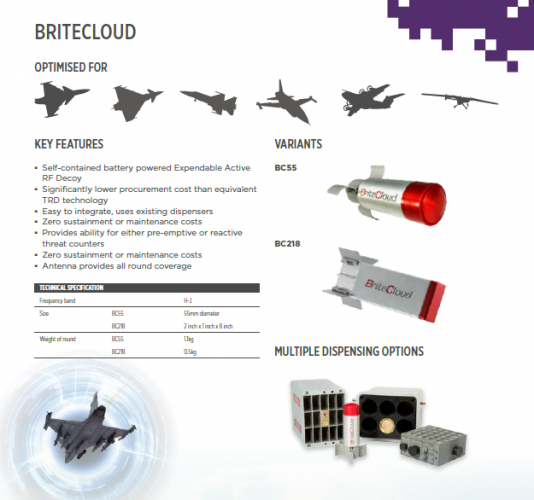
That's even smaller. Not only you try to achieve hit with partial sensor feed, you're trying htk it in a munition the size of automatic gun shell.The F-35 has a towed decoy in addition to 60 2x1x8 inch decoys. The hit-to-kill decoys would drop out of the normal 218 dispenser. The new expendable radar transmitter decoys drop out of the 218 dispenser. It then replaces a few of the flares and the towed decoy can still be used.
Not even with ten thousand interceptors you can do it,