Jump Jet: The Secret History of the Harrier

Where does the " sp.107" designation come from ? It is outside the usual Hawker numbering system. Special projects ? Asking this, wondering about hypothetical Sp.106 or Sp.108...
Study Project.

They were things Ron Williams thought would make a good 'project after next.' He had been seconded into the Advanced Projects Group at Kingston, with other staff from the wider HSA, and thought the 'Hawker' team could try a bit harder, when he went back to work with them on the P.1154RN.

When the P.1127 and P.1154 were active, and later when the Kestrel became the P.1127(RAF), most of the team were busy with real planes, so there were fewer P. numbered projects for the 'next' aircraft, giving Ron his chance to push for longer-term projects. They ended around 1968 due to a design reorganisation. One of the last SP designs fed into the Hawk.
 
I dug out a few SP numbers:

SP.104 - faster (hotter PCB), joint service version of P.1154RN, 1964

SP.105 - STOL version of Kestrel,1964

SP.115 - Harrier with two nozzle Pegasus and 1x RB189 lift jet, became P.1175, 1967

SP.117 - Straight wing trainer, became P.1182 Hawk, 1968
 
Last edited:
Some more:

SP.113 - Supersonic land/ship V/STOL aircraft. Like a P.1154/Harrier hybrid but with long span, high aspect ratio wings and u/c units in wing pods. 1965

SP.115 - Subsonic V/STOL. Harrier-like, with all the problems ironed out (e.g. raised cockpit, lowered engine nozzles). 1966

SP.114 - low cost strike aircraft. Subsonic, like an AMX but with Hunter intakes, 1965

SP.119 - VTOL subsonic ground attack, like a Hawk/Hunter mix (low-mounted wing) with various wing sizes to reduce T/O run. Late 1968
 
Last edited:
I am launching Jump Jet in London at Imperial College on Thursday 22nd October at 2pm.

The event is in-person and online. All welcome to register.

There will be a discussion about the book and a Q&A.

For those physically attending, the plan is to go and look at the first Hawker P.1127 and Alan Turing's computer in the Science Museum after. Both play a big part in the book.

Further details and registration are on this Imperial College page:

https://www.imperial.ac.uk/events/211613/jump-jet/
 
Amazon US actually has physical copies of the book in stock. Considering how indescribably bad they usually are at getting UK-published books in stock within a year of their official release date, I'm tempted to see if there's been any recent planetary alignments I may have missed.
 
Amazon US actually has physical copies of the book in stock. Considering how indescribably bad they usually are at getting UK-published books in stock within a year of their official release date, I'm tempted to see if there's been any recent planetary alignments I may have missed.
Publishing is eternally mysterious but I am glad to hear US buyers can now get the hardback direct.

The book has quite a lot of directly US-relevant content. See https://www.twz.com/air/the-hidden-history-of-americas-harrier-jump-jets
 
Amazon US actually has physical copies of the book in stock. Considering how indescribably bad they usually are at getting UK-published books in stock within a year of their official release date, I'm tempted to see if there's been any recent planetary alignments I may have missed.
Right?
 
Those who've read my book will have seen the 'stealthy' P.1216-53.

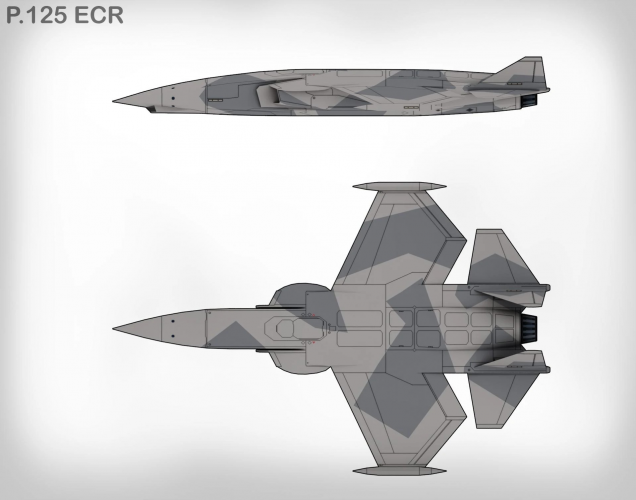
In today's terms it is barely stealthy at all, but one of the striking things I found in the research for the book was just how different UK doctrine was from the USAF. No idea of fighting your way into an IADS like an ATF/F-22. Instead, the belief was even a super stealthy design (which the UK had started to look at) would be seen over central Europe, with its mass of enemy radars, so low flying was still essential. Even the seemingly much stealthier BAe P.125 had external weapons under the fuselage, assuming radars would not be looking up from 200 feet below.

To cope with the radar density at low level the SRARM missile project was hoped to muster a weapon that could go toe-to-toe with an SA-15 system and take out the vehicle, and possibly the missile too. The same with bigger SA-10/SA-11 missiles coming in from on high. It would also be able to take out MiG-29s before they could launch a semi-active missile, or during the engagement, killing the illuminator.

Once the threat changed, and perhaps once the F-117 was flown by exchange pilots, the view of the future changed, and doctrine with it. This 'hybrid' stealth approach fell away.

The reason for my rambling is I find this other view of stealth fascinating and may write it up more fully in an article, to add to what's already in the book (ASTOVL/CABE/NCA etc.). Is there any interest in such a thing from folks here before I start digging out the archive files?
 
Last edited:
Sounds fascinating. I imagine there must be numerous things like this through the history of military flight.
 
Even the seemingly much stealthier BAe P.125 had external weapons under the fuselage, assuming radars would not be looking up from 200 feet below.
I've just looked up the p.125. Surely those wings can't be genuinely beneficial? The edges don't even line up.
Also I wonder why the buried cockpit hasn't been explored further. It might just be pilot preference but I can't think what functions of modern warfare are still better served looking out of the window than condensed onto screens and helmet HUD, especially with AR/VR. There are roles where that might not be the case but if we are fighting with CCAs it follows that a pilot's eye view is not fully necessary.
1790972536144.png

I would love an article on early stealth development BTW!
 
Back
Top Bottom