Jump Jet: The Secret History of the Harrier

Kindle version is out in the US tomorrow. I very rarely buy eBooks anymore but I'm running out of shelf space and don't have room for another bookshelf!
Same problem. Will get the kindle version.
 
What a great read. I received my copy last week and am trying to make the read last but there are so many interesting stories that go towards the main subject. It is interesting that you mention that the women were better in doing the maths and 'crunching through all the possible results ' as NASA found out later.

Robert
 
What a great read. I received my copy last week and am trying to make the read last but there are so many interesting stories that go towards the main subject. It is interesting that you mention that the women were better in doing the maths and 'crunching through all the possible results ' as NASA found out later.

Robert
Thank you! I wanted it to be a book to read on the train if that makes sense. There is a lot packed in but hopefully it all flows. I am glad you are enjoying it.

The job of 'computer' fell to women as it was seen almost like typing back then - a very gendered thing. The contrast with our 'tech bro' world is pretty stark.
 
Mine arrived yesterday all the way in the former colonies. Just flipped through it so far but it looks excellent.

Nice large font -- the publishers certainly know their audience. ;)
Great to hear. Is that Canada?
 
Reading this book is making me glad it was the Harrier and not the Balzac that won the early 60s V/STOL fighter competition. Because being the mature person I that I am, I can't help but snicker whenever I read the name or imagine the kind of unprintable nose art enlisted Marines would have bestowed upon them within five minutes of the type entering squadron service with the USMC.
 
Suggestion for the next edition: include an index, or even better, two, one for names and one for subjects.
 
I received my autographed copy this week and have enjoyed the read-through.

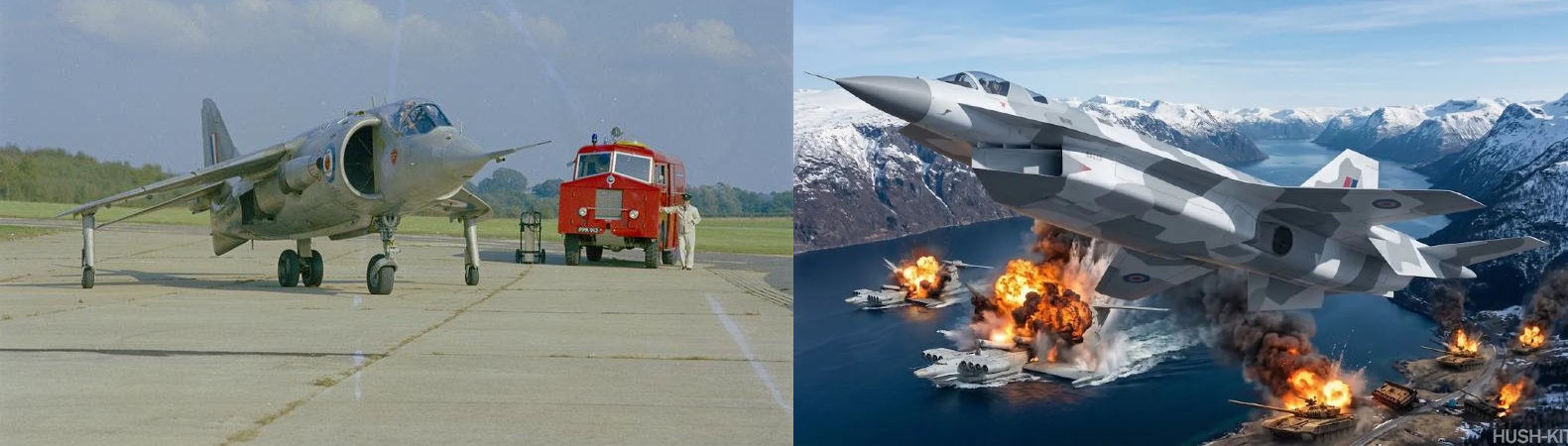
With reference to the book's photo section, I'll take this opportunity to submit my entry for the "What was Mrs. Thatcher sitting in this week?" contest. Enjoy.

1788568090818.jpeg
 
Last edited:
The Harrier emerged from the wreckage of the 'higher, faster' era. It was not optimized (though the VAK 191 was - enough said!), but the shock to designers of having to reign in their ambition was really clear when researching my book.

Certainly at Hawker Ron Williams wanted something like the SP.107 to still be on the horizon. Having started on the Sea Fury at 14, he had grown up during the 'golden jet age'. It was hard to believe it was over.

I guess the XB-70 saw a similar experience. If you had told its designers about the B-52's longevity they would probably never have believed you.

I do wonder how the 'gear change' affected recruitment into aerospace, especially after Apollo ended.
 

Attachments

  • download (2).png
    download (2).png
    1.2 MB · Views: 145
Last edited by a moderator:
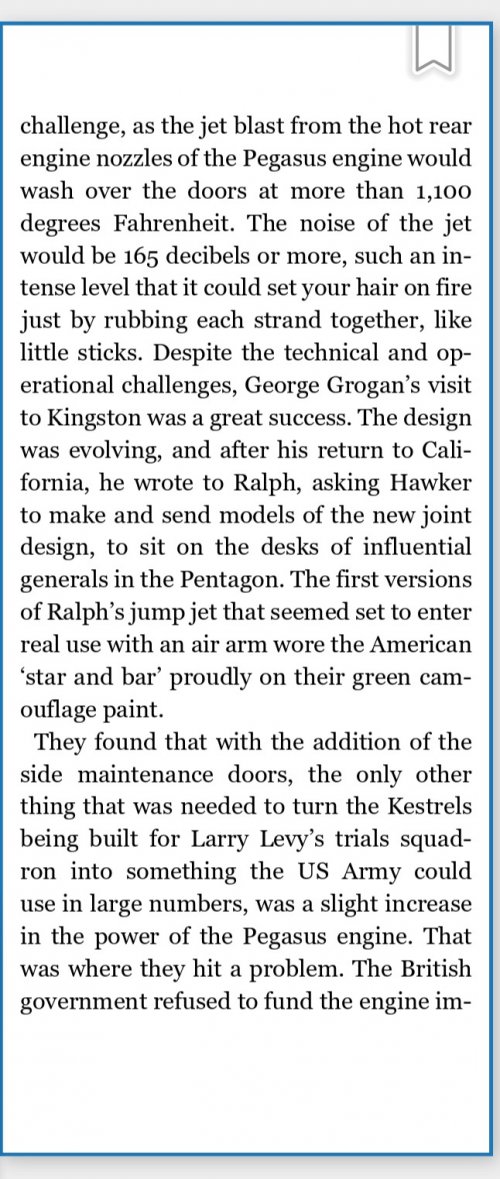
So, I'm genuinely enjoying this book, but this little segment from page 183 is making my head hurt a little bit. I can understand 1,100 degree jet blast setting someone's hair on fire, and 165 decibel jet noise causing extreme physical discomfort, but I'm not sure how either one on their own could rub the strands of one's hair together so intensely they'd ignite like little sticks.

Is this something that's really physically possible, or did the editor get two different concepts combined somehow?
 

Attachments

  • Screenshot_20260904-002535.Moto App Launcher~2.jpg
    Screenshot_20260904-002535.Moto App Launcher~2.jpg
    233.5 KB · Views: 38
So, I'm genuinely enjoying this book, but this little segment from page 183 is making my head hurt a little bit. I can understand 1,100 degree jet blast setting someone's hair on fire, and 165 decibel jet noise causing extreme physical discomfort, but I'm not sure how either one on their own could rub the strands of one's hair together so intensely they'd ignite like little sticks.

Is this something that's really physically possible, or did the editor get two different concepts combined somehow?
The 165 decibels came from an old technical report and it was talking about what that meant with Ralph that came up with the hair and sticks analogy, which someone else had written down he said. Basically, the noise-induced vibration on the strands could do that, if such a situation were practically possible.

Of course, it's 165 decibels at source, so sticking your head into the exhaust flow of the rear nozzle would cause you other problems. While both the temperature and noise might set things alight, the jet blast would likely extinguish any flame. Not that you would know any of this by that point, as you would probably have also been extinguished.

The underlying issue is that most people don't understand that decibels are a log scale etc, but that the hot noisy exhaust contains more energy than most can imagine.
 
The 165 decibels came from an old technical report and it was talking about what that meant with Ralph that came up with the hair and sticks analogy, which someone else had written down he said. Basically, the noise-induced vibration on the strands could do that, if such a situation were practically possible.

Of course, it's 165 decibels at source, so sticking your head into the exhaust flow of the rear nozzle would cause you other problems. While both the temperature and noise might set things alight, the jet blast would likely extinguish any flame. Not that you would know any of this by that point, as your life would probably have also been extinguished by such an action.

The underlying issue is that most people don't understand that decibels are a log scale etc, but that the hot noisy exhaust contains more energy than most can imagine. This was an attempt to say in a line what the few paragraphs here have. It's my attempt to please an editor with a shorthand explanation rather than their imposition on me.

EDIT: It gets examined more later in the book using more technical terms so this was just planting a seed for the general reader. Won't say more now as I shouldn't give spoilers - I am glad you are enjoying it!
 
Last edited:
I bought the kindle that afternoon. Couldn't stop reading ! Good work Mr Pryce, really. It's a treasure trove of information.
 
I just finished listening to the audio version. It's a superb book and a great read / listen!

I got a chuckle every time the word "maths" was said (maybe about 20 times) -- which, like "aircrafts," is not a word in American English. But the narrator's pronouncing "ASTOVL" like "Astro Fall" was though. And word spelling out model numbers like "P-one-one-two-seven' instead of "P-eleven-twenty-seven" made the book about five minutes longer than it should have been. Lol

I learned a lot and had a lot of eye opening insights throughout the book. Everyone on Secret Projects should buy this book -- in print, audio or eBook! You'll definitely enjoy it, or my name's not "VSTOL"!

Can't wait to get it in print! (Amazon says it's available in the US on September 29.)
 
I just finished listening to the audio version. It's a superb book and a great read / listen!

I got a chuckle every time the word "maths" was said (maybe about 20 times) -- which, like "aircrafts," is not a word in American English. But the narrator's pronouncing "ASTOVL" like "Astro Fall" was though. And word spelling out model numbers like "P-one-one-two-seven' instead of "P-eleven-twenty-seven" made the book about five minutes longer than it should have been. Lol

I learned a lot and had a lot of eye opening insights throughout the book. Everyone on Secret Projects should buy this book -- in print, audio or eBook! You'll definitely enjoy it, or my name's not "VSTOL"!

Can't wait to get it in print! (Amazon says it's available in the US on September 29.)
Thank you vstol. With a handle like that I am very glad to hear you like it.

Reading the project numbers that way is at the discretion of the chap who recorded it I think. A small thing to get Finlay, who also recorded Paul Tremelling's Harrier book. I only heard it after it was done.

One math sounds odd to British ears, but aircrafts is not in my vocabulary!
 
I bought the kindle that afternoon. Couldn't stop reading ! Good work Mr Pryce, really. It's a treasure trove of information.
Thanks Archibald. Learning how to make a book largely about men at drawing boards a nice read ('like a thriller' to quote Joe Coles) was a steep learning curve.
 
One math sounds odd to British ears

The oldest citation for maths is only 1911, so its pretty recent. Before that people took the time to write mathematics.

Mathematics matches Physics and Economics. Abbreviating it to Maths isn't especially logical to add an s to an abbreviation. If you abbreviated Economics to Econs 101 for a course name rather than Econ 101 that would be odd, right?

It sounds correct as math or maths only because you've heard it that way all your life.
 
Thank you vstol. With a handle like that I am very glad to hear you like it.

Reading the project numbers that way is at the discretion of the chap who recorded it I think. A small thing to get Finlay, who also recorded Paul Tremelling's Harrier book. I only heard it after it was done.

One math sounds odd to British ears, but aircrafts is not in my vocabulary!
"Mathematics" is like "Physics" in America. It's like a field, not a calculation here. You say, "the math just doesn't add up" or "I'm working out the math."
 
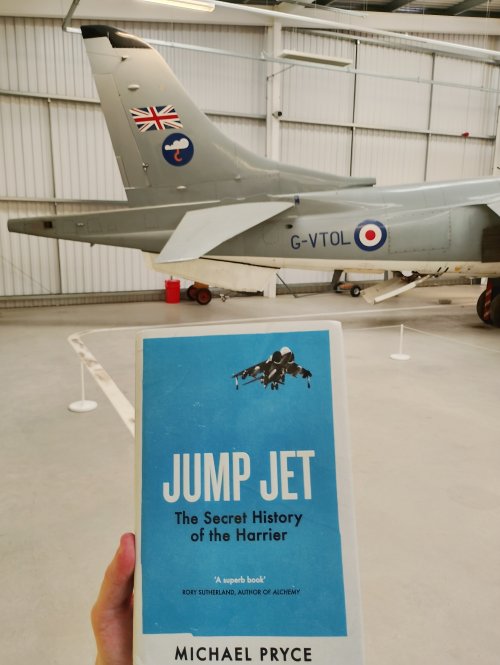
Great book Mike!

As a fan of the Harrier I own a lot of books on anything jump jet or V/STOL related and it’s rare to find out something genuinely new in them.
Jump Jet: The Secret History of the Harrier delivers fresh insights into the world and people that created the Harrier. Then fascinates you with the story of the hopes to replace it with a British designed supersonic jump jet. A definite page turner!
 
Great book Mike!

As a fan of the Harrier I own a lot of books on anything jump jet or V/STOL related and it’s rare to find out something genuinely new in them.
Jump Jet: The Secret History of the Harrier delivers fresh insights into the world and people that created the Harrier. Then fascinates you with the story of the hopes to replace it with a British designed supersonic jump jet. A definite page turner!
Thanks Steve!
 
I'm thoroughly enjoying reading this book, though I admit I'm doing a lot of that while waiting on medical treatment for my wife or getting medical treatment myself (infusions are a slow process). I have to admit that the description of Eglin in chapter 2 matchs what I've heard from the team that did V-22 testing there as well as what little I've seen driving through the area on Interstate 10.
Oh, Col Tom Miller was a grauate of my alma mater and his son was a student there at least some of the years I attended. I did manage to make a talk he gave in the early Seventies on gettign the Harrier for the USMC.
 
Last edited by a moderator:
I'm thoroughly enjoying reading this book, though I admit I'm doing a lot of that while waiting on medical treatment for my wife or getting medical treatment myself (infusions are a slow process). I have to admit that the description of Eglin in chapter 2 matchs what I've heard from the team that did V-22 testing there as well as what little I've seen driving through the area on Interstate 10.
Oh, Col Tom Miller was a grauate of my alma mater and his son was a student there at least some of the years I attended. I did manage to make a talk he gave in the early Seventies on gettign the Harrier for the USMC.
I am glad to hear you are enjoying it and hope it is of some small help at this time. I wish you and your wife all the best with your treatments.

It's very nice of you to say that the Eglin details ring true, and it is incredible to know you heard Tom Miller talk about some of the things in the book. I did visit Norfolk, Virginia for research, but the Eglin stories came from others, plus lots of looking at maps and photos etc.
 
I love how the 1984 P.1216 brochure just says in a matter-of-fact way that "account will be taken of the possibility of Artificial Intelligence (AI)."

Sure, probably a Lisp machine, but it is just nice and low-key.

The subsequent story of the Mission Management Aid is not in the book but follows the usual trajectory. Hype, hope, despair. We are still waiting for true data fusion, the first stage of the hoped-for MMA.

View: https://x.com/MichaelJPryce/status/2099393620872753307?s=20
 
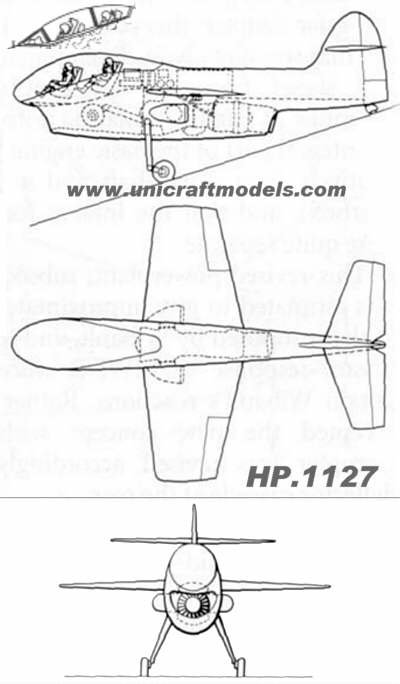
Really enjoying the book so far, but a little niggle that gets in the way so often is that while a huge variety of concepts are described in writing only a few can be shown in the photo sections and on photo pages. When some of the aircraft described are really quite odd this gets in the way of imagining them; a good example would be Hooper's early High Speed Helicopter design for which I cannot find any images online and is quite unlike any aircraft built.
I understand that photo space might increase the price of the book significantly, but a workaround I've seen some authors in other areas use is to include a link or QR code to a public online archive of many more of the referenced images. Might this work in this case, or are the source images not available for use in that way?
 
I am glad you are enjoying it.

Unfortunately, there was a limit on the number of dedicated image pages and lots of possible pictures, so a lot had to be left out. One way around was the pictures at the start of each chapter but ideally I'd have a fully illustrated version as a 'coffee table' book.

The High Speed Helicopter is shown here though: https://fantastic-plastic.com/HawkerHS1127CatalogPage.htm

Also, since Covid, getting access to, and permission from, archives and their images has been harder. The images in the book took many months to get copyright for. So my ideal book would take a lot longer. Still, perhaps one day!
 

Attachments

  • hp1127-dr.jpg
    hp1127-dr.jpg
    24.3 KB · Views: 23
Just finished, and all I can say is Mr Pryce take a bow. I thoroughly enjoyed every page.

What will your next book be about?....
Thank you for that. I am glad you enjoyed it - that was the main aim.

I have a few thoughts re a next book, but will see how this one does before deciding.
 
That was a second bite, but much slower. The designer, Ron Williams, loved the layout so tried it again in the 1970s, avoiding the triple shock intake and the internal weapons bays for AIM-47 missiles. The SP.107 came in delta and VG versions too.

Where does the " sp.107" designation come from ? It is outside the usual Hawker numbering system. Special projects ? Asking this, wondering about hypothetical Sp.106 or Sp.108...
 

Similar threads

Back
Top Bottom