And so one must first ask does India need a full 6th generation FoS + manned 6th gen fighter? Against Pakistan, it's both an offensive and defensive fight. Against China, unless India wants to lose and lose hard, it's going to be a defensive fight. Posing sufficient deterrence against China's weaker flank can be doable without an expensive 6th gen manned platform. The same can be said against penetrating Pakistani air defense. In addition - any 6th gen fighter, be it F-47s and GCAPs or F/A-XXs and FCAS (if either sees the light of day) isn't going to avoid what happened in 2025 if it flies without the FoS supporting it.
Can it? Doesn't quite match recent experience, and Pakistan does invest significant money into AD network.
 
Can it? Doesn't quite match recent experience, and Pakistan does invest significant money into AD network.
Whether it can or cannot - having a 6th gen fighter most certainly isn't the determining factor. If it can, it's spent enough on the rest of the FoS. If it can't, it hasn't spent enough developing the rest of the FoS. If anything, recent experience has shown the shortfalls of indias "other" assets that spelled disaster for frontline units - and not that you need a super 6th gen fighter to do the work. You aren't going to make a dent days against a peer - strategically - with just a manned fighter alone.
 
Whether it can or cannot - having a 6th gen fighter most certainly isn't the determining factor. If it can, it's spent enough on the rest of the FoS. If it can't, it hasn't spent enough developing the rest of the FoS. You aren't going to make a dent days against a peer - strategically - with just a manned fighter alone.
India can afford to outspend Pakistan - arguably, it's the best thing it can do really.
Both will be building full systems of systems - and in Indian case, argument for a proper node component is quite strong.

The problem of building around AMCA is it's unclear where it'll fit anymore. It isn't hi by design, it's a Rafale counterpart. Yes, AMCA won't be ready until end of Rafale run, but even first batch of Rafales won't approach a need for replacement at that point.

In fact, India has now whole 2 flagship programs (AMCA, TEDBA) which at their declared capability point don't really make sense anymore. Both did as Make-in-India, america-tilted export ramp offs.
 
Last edited:
In Indian case, argument for a proper node component is quite strong.
That is true, but again - having a node isn't useful when you are still haven't figured out how and what is required to fight last decade's war.

I don't know how cash strapped or unwilling India is with regards to defense spending, but realistically speaking - do you think India has the money and expertise to field a 6th gen fighter with all its bells and whistles? and just how much time/money/effort is required to build such a node? Given the current state of Indian engine and aerospace tech, it's highly doubtful that India can field such a node on a sufficient timeline. 5.5 gen fighters are still nodes - just not as powerful. That may or may not be made up for by simply buying/producing more of them.

The distributed EW, network resiliency and drones buys much more capability, are much more quickly fielded, and allows India to begin developing their tactics while having something operational - all of which are more useful than waiting and waiting some more for a full 6th gen fighter. India also continues to have issues with having an integrated and networked force - as 2025 showed and it's problems like these that are far more disabling / enabling than what tech they can put on AMCA.
 
Last edited:
It really is only up to the Indian politicians and the military to see if they really nead 6th gen fighters instead of 5th gen like the AMCA since that won't be around any time soon and since China already have two 6th gen fighters currently in prototype form India would be wise to cancle the AMCA and divert the available money into research and have their own 6th gen program instead.
 
That is true, but again - having a node isn't useful when you are still haven't figured out how and what is required to fight last decade's war.

I don't know how cash strapped or unwilling India is with regards to defense spending, but realistically speaking - do you think India has the money and expertise to field a 6th gen fighter with all its bells and whistles? and just how much time/money/effort is required to build such a node? Given the current state of Indian engine and aerospace tech, it's highly doubtful that India can field such a node on a sufficient timeline. 5.5 gen fighters are still nodes - just not as powerful. That may or may not be made up for by simply buying/producing more of them.

The distributed EW, network resiliency and drones buys much more capability, are much more quickly fielded, and allows India to begin developing their tactics while having something operational - all of which are more useful than waiting and waiting some more for a full 6th gen fighter. India also continues to have issues with having an integrated and networked force - as 2025 showed and it's problems like these that are far more disabling / enabling than what tech they can put on AMCA.
Money - they do; this is world's 3rd economy at this point. Expertise...well, "old world" new gen fighters (UK, EU, Russia) are 100% for sale, these manufacturers are too poor to sustain manufacturing domestically. In this sense, i don't think we should treat 6th gen differently. It's just that fighters are more and more to be treated like some sort of frigates(in terms of pricepoints and introduction times), rather than...something smaller.
As for the rest - i am sure it isn't an exclusive relationship. You aim for both.

Indian requirement, as you pointed out, ultimately can be formulated as "maintaing sphere of influence from Malacca to Gulf, being able to hold off China, being stronger than Pakistan".
At their current level, they're only really good with first one. Note, when IAF was clearly stronger than PAF - for almost two decades, nothing really major happened v Pakistan(after Kargil). Now, defending in China even over Himalayas is frankly out of question (only nuclear deterrence), and we already saw twice that Pakistan can win border skirmishes; second time was more visible than the other.
First time, IAF wanted to operate over Pakistan, but Pakistan shown that it can draw blood.
Second time, IAF ops over Pakistan were denied outright - even in form of stand off(glide/rocket assisted bombs); India managed to keep face by lobbing (unintented amounts of) stand off munitions, but this was only doable for a few days as it wasn't the plan.

TLDR: i think requirement is here, and it's the only way for IAF to regain their much desired capability to appear over Pakistan proper.
 
It really is only up to the Indian politicians and the military to see if they really nead 6th gen fighters instead of 5th gen like the AMCA since that won't be around any time soon and since China already have two 6th gen fighters currently in prototype form India would be wise to cancle the AMCA and divert the available money into research and have their own 6th gen program instead.
There is nothing wise in canceling AMCA, the Indian aviation program must work in steps to achieve indigenization. Canceling the program now, will push the Indian Stealth fighter timeline to 2045 at this rate.The point isn't to have better specs on paper, it's to have the fighter in hand. India is facing record low squadron strength, canceling currently in progress projects will only make the pace of modernization far slower.

The plan was always to for from Tejas Mk1 -> Tejas Mk1A -> Tejas Mk2 -> AMCA mk1 -> AMCA mk2 -> ...

Each step of the process is a milestone in paving the way to the next one, canceling any fighter within this line, will doom the successes of fighters proceeding after it.

Tejas Mk2 has been delayed to the point where service entry of the 4.5 gen fighter isn't likely until 2030. Does this mean it's a good reason to cancel it, in order to direct more resources to AMCA? No. Without Tejas Mk2 there is no AMCA. If India had always cancelled fighters it deemed to be entering too late in the game, there won't be any Indian fighters for the foreseeable future.
 
Last edited:
As for the AMCA, it may be a beautiful and excellent aircraft, but its first flight was originally planned for 2017(!)
"Going by forums, Indian government began seriously pursuing the AMCA after 2018, when India left the Su-57 effort with Russia in ~2018.
Before that, the AMCA was just a concept that Indian domestic defence agencies showcased in exhibitions, hoping to get government approval."
 
It really is only up to the Indian politicians and the military to see if they really nead 6th gen fighters instead of 5th gen like the AMCA since that won't be around any time soon and since China already have two 6th gen fighters currently in prototype form India would be wise to cancle the AMCA and divert the available money into research and have their own 6th gen program instead.

We come back to the same question: what is 6th gen?
Are they large ones like the J-36, which will have relatively very high power and cooling capacity? Or are they relatively small ones like the recent SCAF requirements, which will be a more refined step up from upgraded 5th gens?

In the case of AMCA, if India is able to develop technologies rivaling SCAF (let's assume it can develop those technologies, given your notion that India should develop a 6th-gen fighter), then it can use these techs and develop an AMCA Mk2/AMCA-S with those technologies after the base AMCA is developed and certified. AMCA S/mk2( eg. J20 and J20A, su57 and Su57M) being somewhat smaller in size than SCAF, will then be able to semi-match SCAF's capabilities, except for being mainly less stealth-optimized compared to SCAF.
The question then will be: should India abandon AMCA and its subsequent future varients to develop a step up like SCAF for some benefit as a node in the whole system?
Does it make sense to put all this effort and start from beginning in all this beaurocratic hurdle into developing just a "step-up" node? Or should it be a large, high-end node like the J-36 or F-47—but can India afford it? Plus you still need supporting upgraded 5th gen fighters to compliment them.
 
I mean best to the Indians that they develop their own, domestic and fully controlled option in AMCA, but AFAIK has there been anything for show beyond a dozen of trade show props and models? IMO they nailed down the foundation work but there's still alot to progress from that, and it's doubtful with their upper layer grifting culture. If there's any self critical Indian jingoism out there it's slanders on their defense managing politicians, no offense to any Indian out there but stuff's going down bad if your people start inventing derogatory names to rope your reputation around.

Tbh I think if there's a radical change is upper management then we can start seeing progress pressing on the turbo, I read alot on their tech progress sofar and it's apparent that they only need a good leader to tie their efforts together.
 
There is nothing wise in canceling AMCA, the Indian aviation program must work in steps to achieve indigenization. Canceling the program now, will push the Indian Stealth fighter timeline to 2045 at this rate.The point isn't to have better specs on paper, it's to have the fighter in hand. India is facing record low squadron strength, canceling currently in progress projects will only make the pace of modernization far slower.
Ugh, with all due respect, 2045 is realistic - if somewhat optimistic, - timeline for AMCA.
 
2045 Ainen? That is a long time away for India to put the AMCA in service, one can only guess at this point on how many 6th gen fighters will be operational by then and also AMCA may well be obsolete at that time too.
 
2045 Ainen? That is a long time away for India to put the AMCA in service, one can only guess at this point on how many 6th gen fighters will be operational by then and also AMCA may well be obsolete at that time too.
Some rough estimates:

Tejas mk.2: first flight II.2026, main flight testing campaign 2027- (probably at least several years), then introduction/ioc. Without delays it's early 2030s, realistically (and assuming India made significant progress over its past self), actual in service date is 2035.

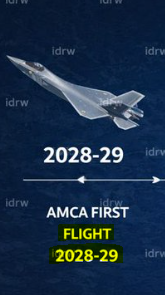
AMCA won't fly until 2029 per current plans, starting main test campaign in 2030. It's a 100% new airframe of new generation, unlike Tejas mk.2. Decade from that point, per international experience, is a rather safe bet, +introduction/IOC. I.e. 2045.

Note, that both are rather optimistic, because it doesn't really correspond with the way Indian developments tend to go; it's more of UK/French/Swedish/Russian timetable, i.e. people are underfunded, but know what they're doing.
 
I really do not think this is true at all. In order to come to this conclusion, you had to have been only considering the manned component, which even then still doesnt hold true.

6th gen air superiority isn't a single platform anymore. Its a family of systems that span air and space and possibly surface assets, held together by a strong comms network, and it's the entire package that enables air superiority. It includes manned elements whose processing power and cooling exceed what 5th gen platforms could achieve even upgraded, and you can definitively point to this requirement whether that be in a 3rd engine and/or adaptive cycling engines. It also calls for manned aircraft as well as supporting systems that can penetrate and remain within enemy joint engagement zones. Its clear that these requirements are increasingly unattainable by existing 5th gen fighters - even if they can control drones, do battle management and process information as well.

Having said all that, most nations really don't need an entire 6th gen FoS + a high end manned platform beyond a 5th gen baseline - even if they can afford one. If you don't need or can't build/procure the whole package, it makes no sense to build a similarly complex fighter. If you aren't looking to penetrate IADS/area denial network that is fielded by a first rate world power, then you likely also don't need it either. Building a manned 6th gen fighter without the FoS isn't going to get you air superiority either even if it is a new generation of aircraft from 5th gen fighters. Whether it's F-47s and GCAPs or F/A-XXs and FCAS (if either sees the light of day), you aren't going to avoid what happened in 2025 if it flies without the FoS supporting it.

And so one must first ask does India need a full 6th generation FoS + manned 6th gen fighter? Against Pakistan, it's both an offensive and defensive fight. Against China, unless India wants to lose and lose hard, it's going to be a defensive fight. Posing sufficient deterrence against China's weaker flank can be doable without an expensive 6th gen manned platform. Incidentally, the same holds true for fighting Pakistan. In both instances, India needs the other part of the 6th gen platform more than the manned component in order to credibly achieve what they want to achieve.

So rather than a super 6th gen fighter, that money would be much better used building out the rest of the 6th gen FoS - AI, drones, resilient comms, expendable systems, distributed jamming and electronic warfare. It's these parts of a 6th gen platform that enable your manned components (either 5th or 6th gen) to act as well as protect them from getting shot down. As these components get fleshed out, one would also hope that India also fixes its tech and procurement problems - however unlikely that may be. Having this FoS will at least ensure any serious Chinese push to be met with strong resistence and attrition while being a sufficient counter to Pakistani IADS.

AMCA, if executed well, will be a medium fighter fielding similar technologies to a J-20S or whatever new Su-57 variant is being produced. In most respects, it probably won't have the technologies, power or cooling that exceeds an upgraded 5th gen fighter. Beyond a sizeable suite of sensors, it'll have AI BMS and drone controlling capabilites, and that's about it. Supported by the entire package, this should be enough to conduct strikes into pakistan while posing a sufficient deterrent on the Chinese border too.
This AMCA will never happen.. India spent 40 years developing the the simple Tejas fighter and so far its been a big failure.. now you think they will succeed with developing a relevant 5gen fighter? Please just stop this.. India talks/dreams alot but delivers $hiet in the end. Nothing pointing in the direction that this will change in the future.
 
Last edited:
Same here IRT, I could easily see the AMCA going the same way as the Tejas. They will eventually have to go the way of buying the Su-57.
 
If India ever had a realistic chance to obtain its OWN 5th generation fighter, the largest window of opportunity opened in the 2005–2006 period.
At that time, defence minister Pranab Mukherjee was reportedly inclined towards RSK MiG’s E-721 project offer. The cooperation would not have been burdened with the same restrictions as in the case of the competing Type 79L project. That was a modified T-50, which, however, was subject to numerous limitations imposed by the Russian Ministry of Defence, so a full transfer of technology simply was not possible.
The Sukhoi lobby eventually won, but mainly for the above reason the subsequent negotiations reached a deadlock.
Mikoyan then slowly continued develop its E-721, tested partial technologies (among other things on the MiG-35), and offered its application elsewhere – for example in the UAE.
According to some indications, work on the project still continues using UAC’s limited internal resources and it is quite possible (only my assumption!) that it will be offered to India again in some form, perhaps as a much more sophisticated alternative for a future naval fighter (in the dimensions and weight class of the J-35) instead of the archaic TEDBF design.
 
Some rough estimates:

Tejas mk.2: first flight II.2026, main flight testing campaign 2027- (probably at least several years), then introduction/ioc. Without delays it's early 2030s, realistically (and assuming India made significant progress over its past self), actual in service date is 2035.

AMCA won't fly until 2029 per current plans, starting main test campaign in 2030. It's a 100% new airframe of new generation, unlike Tejas mk.2. Decade from that point, per international experience, is a rather safe bet, +introduction/IOC. I.e. 2045.

Note, that both are rather optimistic, because it doesn't really correspond with the way Indian developments tend to go; it's more of UK/French/Swedish/Rus

Same here IRT, I could easily see the AMCA going the same way as the Tejas. They will eventually have to go the way of buying the Su-57.
AMCA will take 10 times the effort of the Tejas to work.. i see nothing in the development of Tejas Mk1A and Mk2 pointing in the direction that the Indians got their $hiet together.. its still delay after delay.. endless fantasies of capabilities that never happen.. Indians will field the AMCA when the rest of the world fields the first 7th gen aircraft. I was 20 when the Indians was spamming the internet with BS about the Tejas being the best thing since sliced bread.. now im 40+ and now the Indian AF dosnt want it. Still no deliveries to talk about and still only talk about capabilities that it "will" get.
 
India's two biggest problems of their many problems, in developing indigenous aircraft is the lack of engine security, and the abysmal bureaucracy.

Funding for the prototype development of the Tejas Mk2 was only actually released by the CCS in 2022, and for the AMCA in 2024. This means that any timeline that talked about Mk2 rollout/FF before this point in time would be complete horseshit, and this also applies to AMCA. Despite the 'delays' Tejas Mk2 rollout and eventual first flight in 2026 wouldn't be completely horrendously off schedule, IF they do manage to pull it off this year. IF India gets their Mk2 out this year, I will give the benefit of the doubt for the AMCA Mk1 schedule, rollout by 2029, first flight by 2030, induction into service by 2037-2038. I would HOPE that by now they've learned the lessons from the Tejas debacle and apply it to the AMCA, but really this is just high optimism.

Their second, equally biggest plague is jet engine security. Tejas Mk1A, Tejas Mk2, and AMCA Mk1 all completely depend on the supply of America F404, and F414 engines. A poor decision in retrospect. India has had the delightful of experience maintaining russian engines on both the Su-30MKI and Mig-29K, both were complete maintenance nightmares, thus for it's indigenous fighter Tejas, India had hoped that warming relations with the US would get them far more reliable American engine technology for their indigenous programs. Thus at this point in time Tejas Mk1A, Tejas Mk2, and AMCA Mk1, are only compatible with American Engines.

From the beginning there was zero confidence in India's own Kaveri program, pretty quickly development of Kaveri and Tejas were delinked, and Tejas moved on to only use F404's. At the time this looked like a sensible move as the Kaveri engine was not being seriously developed, nor was it hitting performance targets. Now this decision has completely bit Tejas in the butt. As of current IIRC HAL has 12 airframes of Tejas Mk1A that are just sitting engineless due to the F404 engine delays. It's honestly sort of pathetic, every month on X I see Indians cheering the delivery of 2 F404's to HAL, as it is like a grand accomplishment. This is how badly starved of engines India is at this point in time.

Now it's on the Tejas Mk2, CCS approval took so long because the bureaucracy wanted to ensure that India could sign a deal for F414's for both Tejas Mk2 and AMCA, poor decisions have made both programs 100% reliant on American engines with zero alternatives AGAIN. In terms of development, everything could go perfectly in India, and AMCA and Tejas Mk2 would still be in delayed purgatory, as long as both programs are 100% reliant on American engines that is.

For any other nation, prototype development should only take 3-4 years, expecting the same from India is a fools errand but I remain hopeful. Success of AMCA to me, depends on how closely timelines are stuck for Tejas Mk2.

Down below I'll list FF to IOC dates for 5th gen aircraft. If AMCA FF is 2030, and service entry 2045, even with India's record, that seems far too pessimistic. But personally I also do think 2035 is a bit dubious, that sort of timeline would be beating out the J-20, and be just ahead of the J-35.

F-22: 1997-2005 7 years
F-35: 2006-2015 9 years
Su-57: 2010-2020 10 years
J-20: 2011-2017 6 years
J-35: 2021-2025 4 years
-------------------------------------------------------------------------
AMCA: 2030-2038 8 years

I think everyone here was also surprised China managed to service the J-20 in just 6 years, and im sure India also has the potential to surprise people as well, maybe for the worse or for the better.

 
India's two biggest problems of their many problems, in developing indigenous aircraft is the lack of engine security, and the abysmal bureaucracy.

Funding for the prototype development of the Tejas Mk2 was only actually released by the CCS in 2022, and for the AMCA in 2024. This means that any timeline that talked about Mk2 rollout/FF before this point in time would be complete horseshit, and this also applies to AMCA. Despite the 'delays' Tejas Mk2 rollout and eventual first flight in 2026 wouldn't be completely horrendously off schedule, IF they do manage to pull it off this year. IF India gets their Mk2 out this year, I will give the benefit of the doubt for the AMCA Mk1 schedule, rollout by 2029, first flight by 2030, induction into service by 2037-2038. I would HOPE that by now they've learned the lessons from the Tejas debacle and apply it to the AMCA, but really this is just high optimism.

Their second, equally biggest plague is jet engine security. Tejas Mk1A, Tejas Mk2, and AMCA Mk1 all completely depend on the supply of America F404, and F414 engines. A poor decision in retrospect. India has had the delightful of experience maintaining russian engines on both the Su-30MKI and Mig-29K, both were complete maintenance nightmares, thus for it's indigenous fighter Tejas, India had hoped that warming relations with the US would get them far more reliable American engine technology for their indigenous programs. Thus at this point in time Tejas Mk1A, Tejas Mk2, and AMCA Mk1, are only compatible with American Engines.

From the beginning there was zero confidence in India's own Kaveri program, pretty quickly development of Kaveri and Tejas were delinked, and Tejas moved on to only use F404's. At the time this looked like a sensible move as the Kaveri engine was not being seriously developed, nor was it hitting performance targets. Now this decision has completely bit Tejas in the butt. As of current IIRC HAL has 12 airframes of Tejas Mk1A that are just sitting engineless due to the F404 engine delays. It's honestly sort of pathetic, every month on X I see Indians cheering the delivery of 2 F404's to HAL, as it is like a grand accomplishment. This is how badly starved of engines India is at this point in time.

Now it's on the Tejas Mk2, CCS approval took so long because the bureaucracy wanted to ensure that India could sign a deal for F414's for both Tejas Mk2 and AMCA, poor decisions have made both programs 100% reliant on American engines with zero alternatives AGAIN. In terms of development, everything could go perfectly in India, and AMCA and Tejas Mk2 would still be in delayed purgatory, as long as both programs are 100% reliant on American engines that is.

For any other nation, prototype development should only take 3-4 years, expecting the same from India is a fools errand but I remain hopeful. Success of AMCA to me, depends on how closely timelines are stuck for Tejas Mk2.

Down below I'll list FF to IOC dates for 5th gen aircraft. If AMCA FF is 2030, and service entry 2045, even with India's record, that seems far too pessimistic. But personally I also do think 2035 is a bit dubious, that sort of timeline would be beating out the J-20, and be just ahead of the J-35.

F-22: 1997-2005 7 years
F-35: 2006-2015 9 years
Su-57: 2010-2020 10 years
J-20: 2011-2017 6 years
J-35: 2021-2025 4 years
-------------------------------------------------------------------------
AMCA: 2030-2038 8 years

I think everyone here was also surprised China managed to service the J-20 in just 6 years, and im sure India also has the potential to surprise people as well, maybe for the worse or for the better.
India got no (zero) potential.. Tejas took 40 years and still not finished. Now that its here its old tech.. 25-30 years to late.. South Korea got potential with the Kf21.. even the turks are way ahead with ther Kaan.. even tho that is still a long shot. India got no skill in making airplanes and that is a fact. This AMCA wont fly before 2040.. and when it does its already to old.
 
If India doesn't get AMCA before 2040 they are completely f*ed, more f*ed than they are currently, and the IAF is in a terrible state as of now.

Apparently even their CCA and MUM-T programs haven't even had their fundings cleared yet either. They are on track to do literally nothing for the next half century I suppose.

It's quite expected at this point though honestly, their defense industry is always slacking and looking for the easiest way out. J-20 never even worried their now retired air marshal even the slightest, because they underestimated it so bad they thought it was to be worse than 4th gen "At best 3.5 gen", and that rafale was going to be enough. With this line of thinking, India really has no peer enemies to even worry about.. Living in a bubble with zero urgency.
 
Last edited:
If India doesn't get AMCA before 2040 they are completely f*ed, more f*ed than they are currently, and the IAF is in a terrible state as of now.
I honestly think it's almost a given that it will be after 2040. And this is part of the reason they went Rafale - as if there's a choice.

LCA - Rafale 4/5 - SuperMKI+Su-57E ... + S-400/Barak-8/Spyder is a reasonable lineup, at least for the decade to come. India won't realistically be able to match China in a2a in foreseeble future, regardless of how they will build their force. This leaves them with defensive engagement over GBAD, which potentially can succeed.
It's quite expected at this point though honestly, their defense industry is always slacking and looking for the easiest way out. J-20 never even worried their now retired air marshal even the slightest, because they underestimated it so bad they thought it was to be worse than 4th gen "At best 3.5 gen", and that rafale was going to be enough. With this line of thinking, India really has no peer enemies to even worry about.. Living in a bubble with zero urgency.
India is a young democracy, and it isn't about its age (its several times older than baltic etnocraties, former communist party guys from where come to India teach democracy).
It's about huge, young patriotic and literate(but not very well educated) population. Public speakers, air marshals included, have to think carefully what they say.
This is very different from Pakistan, which is still highly elitist.

When you meet with people from both nations on conferences/etc, you quickly spot the pattern.
 
Last edited:

> It seems the construction of 1st prototype is already going on, which takes say 4 years.
> No country broadcasts their military projects precisely so that adversaries can adjust their plans.
> International incidents & politics affect supply chain ecosystem. For example the wars & tarrif game going on currently.
> National budget, technological changes can also impact a project. For example the Indian Navy has indicated 5gen TEDBF, so the earlier 4gen one may be scrapped. AMCA design may also need modifications.
> Sometimes domestic ecosystem is not in order.
- HAL (Hindustan Aeronautics Limited) is making all types of aircrafts, helicopters, etc, so it is overwhelmed. Other problems in PSUs can be difficult to decipher. It is possible that GoI/MoD/PMO would keep HAL out of AMCA project or in limited role. There seem to be many consortiums bidding.
- New product needs new tools, procedures, technologies, facilities, etc. LCA has been easy to make, but AMCA would need better everything, which are being arranged.
 
> It seems the construction of 1st prototype is already going on, which takes say 4 years.
> No country broadcasts their military projects precisely so that adversaries can adjust their plans.
> International incidents & politics affect supply chain ecosystem. For example the wars & tarrif game going on currently.
> National budget, technological changes can also impact a project. For example the Indian Navy has indicated 5gen TEDBF, so the earlier 4gen one may be scrapped. AMCA design may also need modifications.
> Sometimes domestic ecosystem is not in order.
- HAL (Hindustan Aeronautics Limited) is making all types of aircrafts, helicopters, etc, so it is overwhelmed. Other problems in PSUs can be difficult to decipher. It is possible that GoI/MoD/PMO would keep HAL out of AMCA project or in limited role. There seem to be many consortiums bidding.
- New product needs new tools, procedures, technologies, facilities, etc. LCA has been easy to make, but AMCA would need better everything, which are being arranged.
I have never heard the word "ecosystem" from the Chinese in connection with the development of combat aircraft, but I do see mass production of two types of Chinese 5th generation fighters and several flying prototypes of two types of 6th generation fighters.
 
I have never heard the word "ecosystem" from the Chinese in connection with the development of combat aircraft, but I do see mass production of two types of Chinese 5th generation fighters and several flying prototypes of two types of 6th generation fighters.
China has a far more opaque "ecosystem." But India relies on various small companies to produce individual parts like Radar, Hydraulics, flight control, IRST and then these parts are sent to a larger integrator like HAL for example to produce the Tejas. In order to build a next generation fighter, the entire ecosystem has to grow per say, and this ecosystem is far more vulnerable to supply chain shocks as it a lot of smaller components and sometimes large systems like engines have to be imported from abroad.

This is less prevalent in China as China relies more on state owned corporations and institutions to provide these components, with all suppliers based in China. Complete vertical integration. Thus global supply chain and trade disruptions won't affect China's aerospace progress. Ecosystem just refers to the broader 'indigenous' defense apparatus of a given country. In India especially in aerospace, it isn't very mature and there aren't many options.
 
HAL is out

That looks stupid to me.


China has a far more opaque "ecosystem." But India relies on various small companies to produce individual parts like Radar, Hydraulics, flight control, IRST and then these parts are sent to a larger integrator like HAL for example to produce the Tejas. In order to build a next generation fighter, the entire ecosystem has to grow per say, and this ecosystem is far more vulnerable to supply chain shocks as it a lot of smaller components and sometimes large systems like engines have to be imported from abroad.

This is less prevalent in China as China relies more on state owned corporations and institutions to provide these components, with all suppliers based in China. Complete vertical integration. Thus global supply chain and trade disruptions won't affect China's aerospace progress. Ecosystem just refers to the broader 'indigenous' defense apparatus of a given country. In India especially in aerospace, it isn't very mature and there aren't many options.
The Chinese "ecosystem" is enshrined in the country's constitution, and Indians often rejoice that they don't have it. It's their business.
 
Seems like the IAF may end up with a custom Su-57 before any AMCA prototype even flies. Russians are being pushy with Su-35 but India said absolutely not. I fail to see how even a custom Su-57 gives them any advantages over China or Pakistan. Its not like Russia has even exported a single Su-57 and the deal involves production. Sounds like a drain on resources that should instead be aimed at AMCA.

I wonder if HAL will do the Su-57 contract instead.
 
I have never heard the word "ecosystem" from the Chinese in connection with the development of combat aircraft, but I do see mass production of two types of Chinese 5th generation fighters and several flying prototypes of two types of 6th generation fighters.
How would you describe MIC (Military Industrial Complex)?

The Chinese "ecosystem" is enshrined in the country's constitution, and Indians often rejoice that they don't have it. It's their business.
"enshrined", "constitution", ...
Please elaborate this line.
 
How would you describe MIC (Military Industrial Complex)?


"enshrined", "constitution", ...
Please elaborate this line.
Sure, the basis of the entire Chinese "ecosystem" are Article 6 and Article 7 of the current version of the Constitution:
Btw this thread will celebrate its 17th birthday in a few days. It started with the beautiful AMCA model for aerodynamic measurements...
Yes, seventeenth.
 
Seems like the IAF may end up with a custom Su-57 before any AMCA prototype even flies. Russians are being pushy with Su-35 but India said absolutely not. I fail to see how even a custom Su-57 gives them any advantages over China or Pakistan. Its not like Russia has even exported a single Su-57 and the deal involves production. Sounds like a drain on resources that should instead be aimed at AMCA.

I wonder if HAL will do the Su-57 contract instead.
India has to do something on falling squadron numbers. The GoI/MoD has cleared that AMCA project has sufficient funds & won't get impacted by other deals bcoz making new design Vs existing design are separate things.
Hence the IAF is going for many more Rafales. If Su-57 is purchased then it'll be in few numbers, not to get advantage OVER China (J-20), J-35), but to improve situation relatively better than 4gen jets in IAF (Su-30 MKI, Rafale, MiG-29, Mirage-2000, LCA, etc), till AMCA arrives.

Drain of resources have already occured since decades by import culture, not doing self R&D, delaying LCA, MWF, TEDBF, AMCA, HFA/AHCA, etc, but what is happening now is damage control, a work-around, not a solution.
 
Sure, the basis of the entire Chinese "ecosystem" are Article 6 and Article 7 of the current version of the Constitution:
Every country justifies its economic system mentioned in its constitution, but international trade & commerce cannot be neglected.
For example, Western nations leading most technologies would justify capitalism.
But as 5 fingers are different everywhere, so success, failure, delays, cost-overruns, etc in different domains are seen everywhere, irrespective of communism, socialism, capitalism, etc.
That's why India is also Socialist mixed economy, neither fully capitalist, nor fully communist, & added to the Indian constitution's Preamble by the 42nd Amendment (1976), socialist principles exist in Directive Principles (Articles 38, 39) aiming to reduce inequality. It is a "democratic socialism" where public/private sectors coexist, with state regulation ensuring equitable resource distribution.

Btw this thread will celebrate its 17th birthday in a few days. It started with the beautiful AMCA model for aerodynamic measurements...
Yes, seventeenth.
It'll celebrate 25th b'day silver jubilee also but in different way bcoz Indian citizens & present GoI/MoD are frustrated & they won't let ADA/HAL or anybody dominate anymore, hence PPP (Public Private Partnership) happening now at domestic & international levels.
So far international trade deals helped China & the world saw "made in China" goods, now it'll help India domestically after giving global CEOs. Earlier India used international trade to import, now it'll use it for domestic capabilities.
 
Sure, the basis of the entire Chinese "ecosystem" are Article 6 and Article 7 of the current version of the Constitution:
Btw this thread will celebrate its 17th birthday in a few days. It started with the beautiful AMCA model for aerodynamic measurements...
Yes, seventeenth.
Although the following content may be unrelated to the topic:
Why do you interpret it as China doing this because of the Constitution, rather than the CPC having done this for decades and then enacting laws to legitimize the behavior?
 
This is interesting. Does it have a source?
Indeed it is interesting bcoz in emerging era of 6gen a new 4gen design is non-sense & equivalent to sabotage & suicide. The older ones can continue till there are 4gen jets on both sides of border.
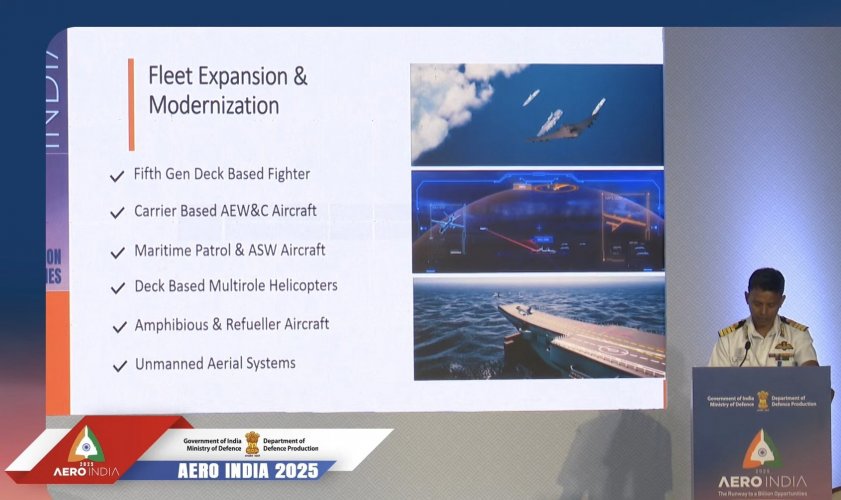
At Aero-India 2025 a presentation cited "Fifth Gen Deck Based Fighter". There's a possibility that AMCA could be navalised like F-35, J-35, rather than clean-sheet design needing more time, money. Or may be that 4gen TEDBF might get modified with IWBs & 2 rudders.

1770210595694.jpeg


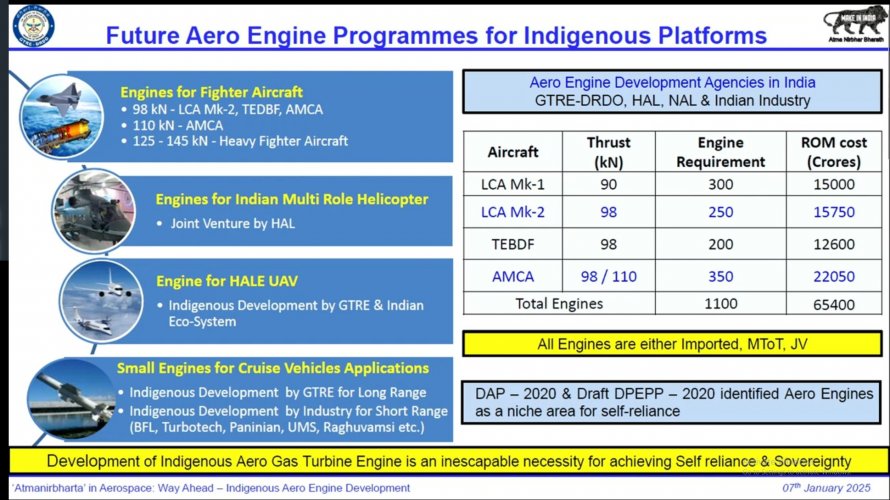
There is also inidcation of HFA (Heavy Fighter Aircraft) via 125-145 KN engine, apparently 5.5-6gen to be better than AMCA & replace Su-30MKI.
So Su-57 cannot be bought in bulk to save resources for this project.

1770211196483.jpeg
 
Indeed it is interesting bcoz in emerging era of 6gen a new 4gen design is non-sense & equivalent to sabotage & suicide. The older ones can continue till there are 4gen jets on both sides of border.
At Aero-India 2025 a presentation cited "Fifth Gen Deck Based Fighter". There's a possibility that AMCA could be navalised like F-35, J-35, rather than clean-sheet design needing more time, money. Or may be that 4gen TEDBF might get modified with IWBs & 2 rudders.

View attachment 800906


There is also inidcation of HFA (Heavy Fighter Aircraft) via 125-145 KN engine, apparently 5.5-6gen to be better than AMCA & replace Su-30MKI.
So Su-57 cannot be bought in bulk to save resources for this project.

View attachment 800907
Okay, thank you.
And one more personal note:
I really wish Indians their own super fighter. They have what it takes, they are intelligent and skilled people.
 
Okay, thank you.
And one more personal note:
I really wish Indians their own super fighter. They have what it takes, they are intelligent and skilled people.
The way they go about it, it honestly becomes less realistic.
Granted, there's no immediate security need, but this really a 5th generation(of employed engineers) project at this point.
 
What is the benefit of the non swept part of the tailerons? Is it more effective? Is it more draggy?
 
Honestly, it's enough... HAL and the whole Indian aviation industry is almost like Stavatti! Fancy models, bolt claims but otherwise NOTHING!!

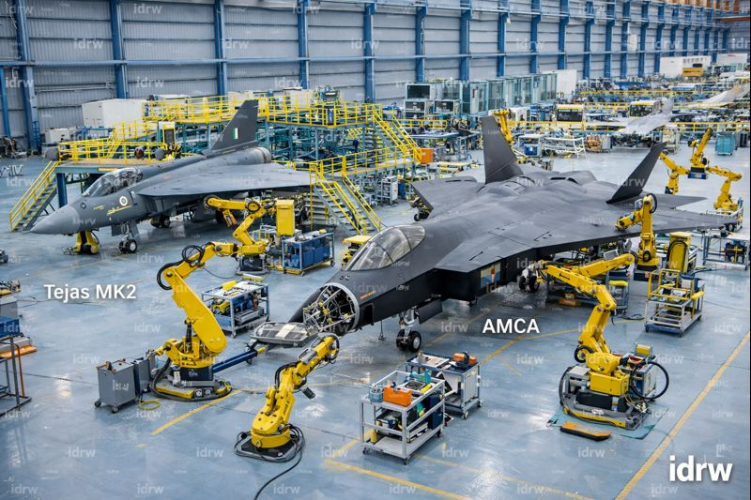
I know Indians especially won't like to hear this—they're currently in the midst of their celebrations—but what's the point? Teja's Mk. 1A is long overdue, and the Mk. 2 hasn't even had its rollout yet! AMCA's design isn't finalized (even according to IDRW they are still diligently working on the geometry), and none of the three mentioned suppliers have any experience in the complete implementation of such a project. They've all certainly developed and built things here and there, and perhaps even manufactured some as suppliers for HAL, but how is a project that isn't even fully thought in CAD supposed to be ready for its maiden flight by 2028/29 made by a team that has never done such a task??

Additionally IDRW is a tabloid that lately seems to be putting more effort into generating nonsensical images with AI than into accurate reporting!

I would almost bet that AMCA 203x is nothing more than a collection of funny AI pictures, models and lots of promises in the vein of "Jai Hind"!

1770218522884.png
 
Back
Top Bottom