Exactly my point but from China almost ANY product immediately gets bashed as a copy or clone or at least being based on stolen stuff!
Let me say in general -
- If a person from certain country gets caught for espionage then it becomes hot global matter.
- The least we can do is not initiate or add to politics, taunts, etc, maintain tech PoV only & preserve our peace of mind. Otherwise global tech discussions can't remain global & technical.
 
Exactly my point but from China almost ANY product immediately gets bashed as a copy or clone or at least being based on stolen stuff!
So why continue the cycle? It's sort of hypocritical to complain about Chinese aircraft always being called copies, only to do it yourself and complain another country is copying Chinese aircraft. I think all of the copy talk is sort of Childish at this point, I didn't expect you to go on twitter and stoke the flames, just to troll hyper nationalist Indians.
 
Yes the curved IRST is concerning even if RAM applied. In Kaan, it is like EOTS. May be KF-21 next block will implement it too.

The space of IWB/SWB is created by basically humping & squeezing the airframe & giving aerodynamic cover.
When we see 4gen jets like EF-2000, F-15, F-18, etc with tight sticking AAMs, so a redesign with aerodynamic cover can be imagined.
The MLG if retracted laterally like in F-22 would create more space for SWB.
Su-57 has wing root mounted SWB.

The current IWB is 4.2m X 2.2m X 0.75m, so 2x3=6 shorter fins version of Astr AAMs can be carried. And with folding fins 2x4=8 AAMs can be carried.
I'm also going to assume that India hasn't been given the Okay to Modify the F414 Nozzles. Leaving the Mk1 with a higher IR signature versus aircraft with serrated nozzles. This is quite underwhelming for an aircraft meant to enter service in the mid 2030's honestly, this is not accounting for delays given India's track record here. Of course the Mk1 is just a stepping stone for the Mk2. The Mk2 will likely solve all of these issues and then some. Are there any official timelines for the Mk2?

I've been hearing some commentators call the AMCA a 5.5gen aircraft, would that be for the Mk2 only? The Mk1 here seems to barely meet 5th gen requirements. And is looking to be quite watered down to meet timelines.

The most recent J-20 and F-35 upgrades seem to be already within the realm of the so called 5.5 gen. If and when Mk2 comes into fruition it would appear India is again investing in the past.
 
I'm also going to assume that India hasn't been given the Okay to Modify the F414 Nozzles. Leaving the Mk1 with a higher IR signature versus aircraft with serrated nozzles. This is quite underwhelming for an aircraft meant to enter service in the mid 2030's honestly, this is not accounting for delays given India's track record here. Of course the Mk1 is just a stepping stone for the Mk2. The Mk2 will likely solve all of these issues and then some. Are there any official timelines for the Mk2?

I've been hearing some commentators call the AMCA a 5.5gen aircraft, would that be for the Mk2 only? The Mk1 here seems to barely meet 5th gen requirements. And is looking to be quite watered down to meet timelines.

The most recent J-20 and F-35 upgrades seem to be already within the realm of the so called 5.5 gen. If and when Mk2 comes into fruition it would appear India is again investing in the past.

On every social site Indian citizens themselves can be noticed to be confused & frustrated by the delays.
The AMCA program director said that it'll have everything the F-35 or basically a proper 5gen jet has, but in MK1 or Mk2 not specified formally.
The jouranlists also just appease the DoD & not ask precise questions at Aero India or other visits & interviews.

3 decades after IT boom & other industrial domains also improved, today millions of Indian tech professionals + students, asking questions like -
- Why 5gen 1990s features still challenge in 2020s for India?
- AMCA said to be initiated in 2010, so what happened in last 15 years?
- YF-22 was re-designed in 1987 in just 3 months. India doesn't have 1980s tech & tools also?
- Why top tycoons like Tata, Ambani, Adani, etc not getting into R&D?
- Why basic features & improvements in AMCA Mk2 in 2040+ timeline when 6gen will be flying, that's 50 years after 5gen born?o_O:D

But India certainly has RAM, RAS, supercomputing, automations, robotics, AI/ML, VR, AR, etc, just not getting utilised properly it seems.
Certain facilities like wind tunnels, fabrication, forging, higher ton press, etc have to be arranged or improved.

After watching this latest 3D CAD i would expect some adjustments in Mk1 itself -
> Ladder & canopy arc rail should be removed to reduce RCS.
> IFRP replaced by spine receptacle. We can get mixed tankers (boom + chute).
> The IWB widened little bit more.
> SWB should be implemented. MLG can be retracted laterally like in F-22.
> Round IRST with stealthy cover.
> Engines big concern & perhaps modified M-88 or EJ-200 with stealthy nozzle can be considered if no arm-twisting, interference. Kaveri R&D & JV(Joint Venture) should continue.
> Custom bombs, ARMs, CrMs, AShMs can be made to be carried internally.
> EOTS can be made retractable. P-8 has retractable turret ball. Su-34 has Platan EOTS. MiG-31 has retractable IRST on chin.

 
On every social site Indian citizens themselves can be noticed to be confused & frustrated by the delays.
The AMCA program director said that it'll have everything the F-35 or basically a proper 5gen jet has, but in MK1 or Mk2 not specified formally.
The jouranlists also just appease the DoD & not ask precise questions at Aero India or other visits & interviews.

3 decades after IT boom & other industrial domains also improved, today millions of Indian tech professionals + students, asking questions like -
- Why 5gen 1990s features still challenge in 2020s for India?
- AMCA said to be initiated in 2010, so what happened in last 15 years?
- YF-22 was re-designed in 1987 in just 3 months. India doesn't have 1980s tech & tools also?
- Why top tycoons like Tata, Ambani, Adani, etc not getting into R&D?
- Why basic features & improvements in AMCA Mk2 in 2040+ timeline when 6gen will be flying, that's 50 years after 5gen born?o_O:D

But India certainly has RAM, RAS, supercomputing, automations, robotics, AI/ML, VR, AR, etc, just not getting utilised properly it seems.
Certain facilities like wind tunnels, fabrication, forging, higher ton press, etc have to be arranged or improved.

After watching this latest 3D CAD i would expect some adjustments in Mk1 itself -
> Ladder & canopy arc rail should be removed to reduce RCS.
> IFRP replaced by spine receptacle. We can get mixed tankers (boom + chute).
> The IWB widened little bit more.
> SWB should be implemented. MLG can be retracted laterally like in F-22.
> Round IRST with stealthy cover.
> Engines big concern & perhaps modified M-88 or EJ-200 with stealthy nozzle can be considered if no arm-twisting, interference. Kaveri R&D & JV(Joint Venture) should continue.
> Custom bombs, ARMs, CrMs, AShMs can be made to be carried internally.
> EOTS can be made retractable. P-8 has retractable turret ball. Su-34 has Platan EOTS. MiG-31 has retractable IRST on chin.
Hi, your assessments seem adequate, but I would add a few notes(please don’t start heated argument about stealth below this, I’m just a humble UAC worker with an opinion, not a radiowave scientist!)

1) ladder(if needed) should be stored in a quick access hatch like on JSF
2) both round rotating IRST(which require more maintenance than angular) and retractable(!!!!) EOTS(still maintenance heavy and more surface irregularity) is a bad decision. Go for JSF style EOTS or, if you care about image quality without distortion, go for rotating round EOTS on the underside of plane’s nose. You can integrate other MAWS/DIRCM apertures in same housing.
3) secondary weapons bay is a no-no. Back in the days, when your country declined offer for transferring some of PAKFA research(mainly the 3Д variant) after you left from PMI, you guys were pretty insistent on having a small airframe on small engines. Additional bays take away fuel, take away structural integrity, in a sense. You have a free space? Put signal intelligence/side looking apertures/jammers, whatever. You are not going to use R-74 class missiles in 99% of modern engagements.
 
Is there a manufacturer of such technologies like integrated EOTS in India?
 
Hi, your assessments seem adequate, but I would add a few notes(please don’t start heated argument about stealth below this, I’m just a humble UAC worker with an opinion, not a radiowave scientist!)
Hello, hope you're doing good. We all can keep our views. There's nothing to argue in heat bcoz we're citizens & 5 fingers different everywhere. What different govt. do could be different from what certain % of citizens feel. Internet simply brought people closer to talk on various things.

1) ladder(if needed) should be stored in a quick access hatch like on JSF
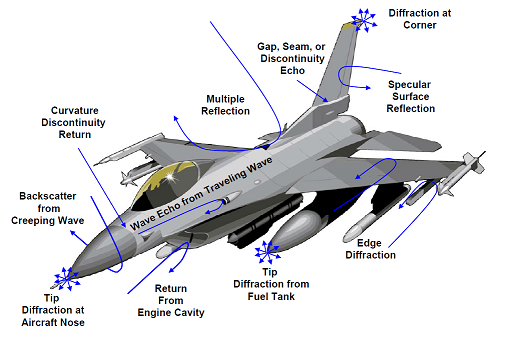
I put my expectations from AMCA after comparing F-22 & F-35. Many people with diagrams show RF scattering, round surface, surface discontinuities, bumps, etc contributing to RCS.
1755086447966.png

F-22 RCS is quoted 0.00015 sqm & F-35 RCS as 10x more 0.0015 sqm.
Why would a nation offer export jet with same low RCS of domestic one with export ban.
RAM, RAS, EW also matter.
So a common techie would think that extra surfaces & discontinuities in F-35 compared to F-22 would contribute to 10x RCS.

2) both round rotating IRST(which require more maintenance than angular) and retractable(!!!!) EOTS(still maintenance heavy and more surface irregularity) is a bad decision. Go for JSF style EOTS or, if you care about image quality without distortion, go for rotating round EOTS on the underside of plane’s nose. You can integrate other MAWS/DIRCM apertures in same housing.
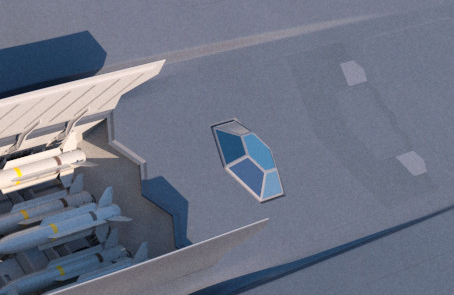
IDK the RCS return of RAM Vs coating on transparent windows like InSbO, etc. @Rodrigo Avella has a 'Manitou' 6gen concept where belly hexagonal DEW aperture is retractable.

1755086216753.png

So after seeing retractable optical apertures already in some 4gen jets + new concepts, i thought perhaps EOTS can also be retracted.
The DAS sensors are MAWS + fixed IRST, but DIRCM is moving on gymbal.

3) secondary weapons bay is a no-no. Back in the days, when your country declined offer for transferring some of PAKFA research(mainly the 3Д variant) after you left from PMI, you guys were pretty insistent on having a small airframe on small engines.
I'm not journalist, nor i track politics, so exactly IDK what Russia & India did with FGFA/PAKFA except India disagreed in terms of work share, ToT, cost, etc.
Being a techie i foucs on tech part only & even sometimes naturally may differ with govt. & manufacturers.
IMO, India should have negotiated for Al-31/41 or F-100/110 category engines for a stealth jet bigger than AMCA, an AHCA what i refer.

Additional bays take away fuel, take away structural integrity, in a sense. You have a free space? Put signal intelligence/side looking apertures/jammers, whatever. You are not going to use R-74 class missiles in 99% of modern engagements.
The challenge of stealth jet is to mix weapons, fuel, sensors internally with structural integrity.
At multiple places i read that 5gen airframe compromises aerodynamics, performance, range, endurance, etc for internal weapons compared to 4gen airframe with freely hanging weapons.
Beast mode load can't be compared to stealth load obviously.
Now what should i think?
If some new features like stealth is needed then i guess some compromise or adjustments have to be made.
Some country demonstrate feasible tech 1st & then others start following.

Imagine a little smaller F-22, Su-57, that doesn't restrict putting SWB. Its all upto coordination in team of all types of engineers.
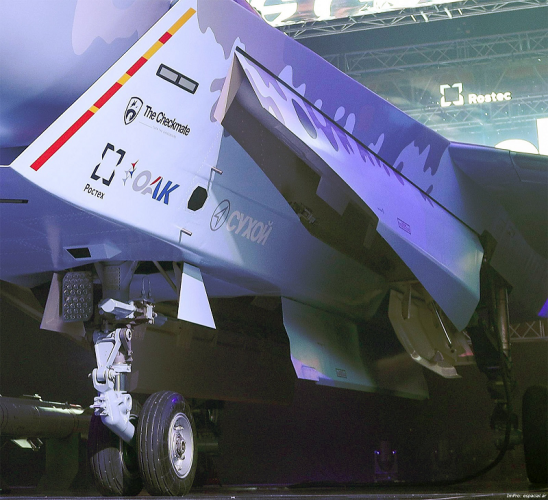
Su-75 with just 1 engine showcases SWB, then why not a 2 engine jet?

1755087176946.png

Moreover, good situational awareness by sensor fusion & networking, then countermeasures & tactics can make missiles miss target, so more shots would be needed.
 
Su-75 with just 1 engine showcases SWB, then why not a 2 engine jet?
su75 has quite narrow central bay.


Su75's mtow is quoted to ~26tons.
AMCA's mtow is quoted to be ~27 tons.

Su75 is not designed with supercruise in mind, its TWR is supposed to be similar to f35A.
 

Attachments

  • images (14) (3).jpeg
    images (14) (3).jpeg
    18 KB · Views: 59
su75 has quite narrow central bay.


Su75's mtow is quoted to ~26tons.
AMCA's mtow is quoted to be ~27 tons.

Su75 is not designed with supercruise in mind, its TWR is supposed to be similar to f35A.
All 3 statements are wrong.
 
su75 has quite narrow central bay.

Su75's mtow is quoted to ~26tons.
AMCA's mtow is quoted to be ~27 tons.

Su75 is not designed with supercruise in mind, its TWR is supposed to be similar to f35A.

Yes, 1 engine so narrow IWB, 2 engines then wider IWB.
Supercruise depends on many things including TWR but also LWR (Lift to Weight Ratio), types of drags due to airframe shape which needs computers to determine. I don't intend to get into those Cd, Cl formulas & equations. Common people refer to wing loading = wings area / loaded A/c weight.

AMCA's IWB is 4.2m x 2.2m so 2x3=6 AAMs (4x BVR + 2 CCMs) can be accomodated. That way i'm fine w/o SWB in MK1. But i think we should at least try to fly a prototype with SWB to get more data on performance.
 
Yes, 1 engine so narrow IWB, 2 engines then wider IWB.
Both are in similar weight classes, and both have similar iwb space.

Having single engine, twin engine is less relevant than overall size and weight of jets.


Supercruise depends on many things including TWR but also LWR (Lift to Weight Ratio), types of drags due to airframe shape which needs computers to determine. I don't intend to get into those Cd, Cl formulas & equations. Common people refer to wing loading = wings area / loaded A/c weight.
But you only need lack of few or one of these things to act as a "limiting factor", And twr is the most looked at factor.

in case of f35, su75 the thrust is a limiting factor to achieve "relevant/consistent" supercruise performance to be called supercruise capable.

I said it with respect to thrust "requirement" put forward for amca, as i assumed you thought su75 to be a smaller airframe than AMCA due to it being single engine with lower thrust requirements.
 
Both are in similar weight classes, and both have similar iwb space.

Having single engine, twin engine is less relevant than overall size and weight of jets.


But you only need lack of few or one of these things to act as a "limiting factor", And twr is the most looked at factor.

in case of f35, su75 the thrust is a limiting factor to achieve "relevant/consistent" supercruise performance to be called supercruise capable.

I said it with respect to thrust "requirement" put forward for amca, as i assumed you thought su75 to be a smaller airframe than AMCA due to it being single engine with lower thrust requirements.

I try to consider all aspects at their place as ultimate o/p is combination of all factors - thrust, lift, design, altitude (air density), load, etc.

Agreed that overall A/c TWR looked at more but 2 engines take more horizontal space, so more AAMs can be laid out in IWB.
Su-75 seems to have longer but narrow IWB hence compensates it by SWB.

If we take F-22 as reference, then its dry thrust/STOW (Stealth Take Off Weight) = 2x116 KN / 9.8 / (19.7 empty + 8.2 fuel + 1.1 AAMs) tons = 0.82
Wet thrust/STOW = 2x156 KN / 9.8 / (19.7 + 8.2 + 1.1) = 1.1
F119 engine's dry/wet ratio = 116/156 = 0.74
Wing loading = STOW 29 tons / 78 sqm = 371.8 Kg/m2

For F-35-A with 4x 152 Kg AMRAAMs, dry thrust/STOW = 1x128 KN / 9.8 / {13.3 empty + 8.3 fuel + (4x0.152)} = 0.58
Wet thrust/STOW = 1x191 KN /9.8 / (13.3 + 8.3 + 0.608) = 0.87
F135 engine's dry/wet ratio = 128/191 = 0.67
Wing loading = STOW 22.2 tons / 43 sqm = 516.46 Kg/m2.

For AMCA with 6x 154 Kg short-fin version Astr-2 AAM, dry thrust/STOW = 2x58 KN / 9.8 / {12 + 6.5 + (6x0.154)} = /19.424= 0.6
Wet thrust/STOW = 2x98 KN / 9.8 / (12 + 6.5 + 0.924) = 1.03
F414 engine's dry/wet ratio = 58/98 = 0.59
Wing loading = STOW 19.42 tons / 55 sqm = 353.16 Kg/m2

So obviously F-22 has advantage bcoz F119 engine pushes dry thrust more.
F-35 has very high wing loading, still takes off runway with afterburner in 10sec.
AMCA has TWR little over F-35 & wing loading little lower than F-22.

So in my low IQ o_O , i don't think having SWB for 2 IR-CCMs is problematic.

Exact official front/top/bottom/side views by GoI/ADA not available.
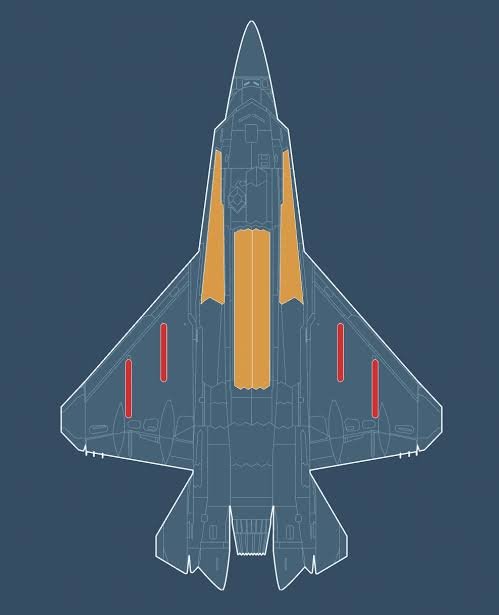
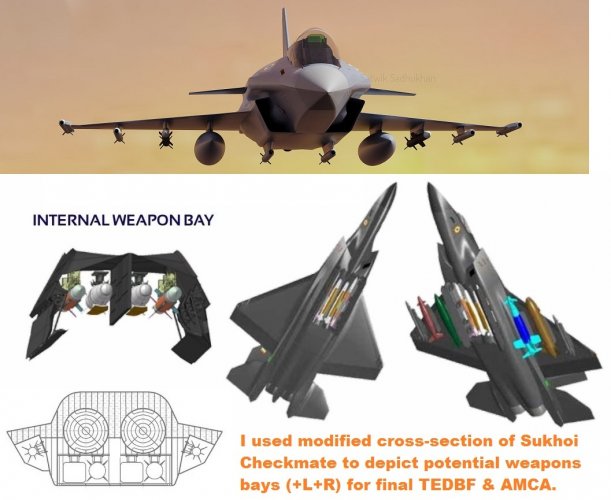
For an old post elsewhere i used Su-75 cross section to compare SWB for AMCA -

1755101680503.jpeg


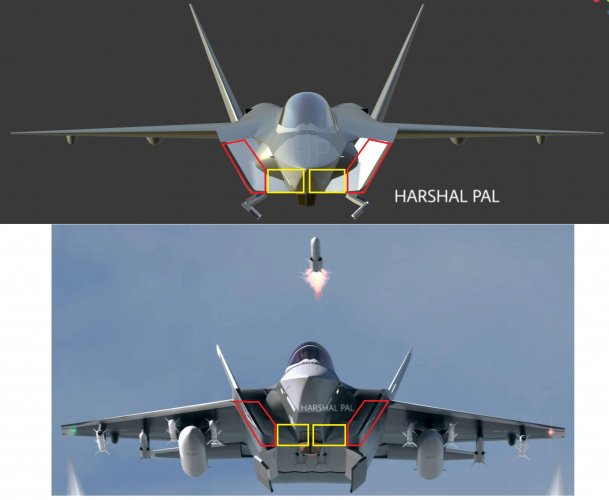
And the following is simple NOTIONAL highlighting on an artist's CAD of potential SWB space -

1755102108402.jpeg
 
First prototype rollout by 2027 end and FF in 2028 is highly optimistic.

Wasn't Tejas mk2 funds sanctioned in 2022, rollout is supposed to be by end of 2025 with FF by Q1 2026. That's 3 years from sanctioned funds to rollout for a fighter jet that is far less complex than AMCA.

If AMCA had the requisite funds sanctioned in 2024, based on India's track record, prototype roll out by 2027 and FF by 2028 is not realistic. AMCA is nearly 2x larger than tejas mk2, uses two engines instead of one. Has far more complex systems and requires far more advanced parts from many vendors compared to tejas mk2.

If it takes 3 years for Tejas mk2, I suspect AMCA prototype will take 5 years to manufacture. This will be very easily testable. If tejas mk2 is not seen by Q4 2025. I will suspect that AMCA timeline is not realistic at all.

I am already reminded that the original Tejas mk2 timeline has slightly slipped before the revised timeline for FF by Q1 2026. So most likely AMCA will have delays too.

Again only time will tell.

Quoting myself here, I suspect AMCA timeline is not realistic, I've been proven semi-right. Officials have now moved Tejas mk2 rollout from Q4 2025, and Q1 2026 FF to Q2 2026 rollout and Q4 2026 FF. This is another 6 month delay to the schedule. Time and time again, India has shown it cannot follow the planned schedule for any of their developments.

How can AMCA realistically appear by 2027, when Tejas mk2 rollout is at minimum in 2026? Who knows if they'll end up delaying the mk2 again to 2027.
 
Quoting myself here, I suspect AMCA timeline is not realistic, I've been proven semi-right. Officials have now moved Tejas mk2 rollout from Q4 2025, and Q1 2026 FF to Q2 2026 rollout and Q4 2026 FF. This is another 6 month delay to the schedule. Time and time again, India has shown it cannot follow the planned schedule for any of their developments.

How can AMCA realistically appear by 2027, when Tejas mk2 rollout is at minimum in 2026? Who knows if they'll end up delaying the mk2 again to 2027.

IMO, bcoz the future belongs to stealth & China has J-20 + J-35 + J-36 + J-50 + 3rd spotted jet:oops:o_O, hence a brand new non-stealthy design will simply get squashed like mosquito, or it'll have to do brooming & mopping of battlefield hitting targets which can't fire up at jets.

IAF would have AMCA & Indian Navy also wants 5gen TEDBF. So Tejas Mk2 (MWF) would carry value only if it evolves like Su-75.

AMCA can be navalised like F-35-C or the delta-canard TEDBF has to be made stealthy.
I imagine a heavy stealth jet AHCA made 1st from Naval PoV & then adapted to AF also, but that needs a thread of its own.

So perhaps DoD got scolded by MoD to prioritise stealth jets.
Time will tell.
 
The radar to be used on Su-30MKI UPG is an upscaled variant of Uttam.

It's called Virupaksha.

It has 2500 TRM modules. GaN HEMT. Vivaldi antenna elements. UWB.

According to stealth flanker calculations, it's the most powerful and longest ranging aesa mmr for a fighter ac in existence today.
can i have the range? i cant seem to be able to find it anywhere
 
I try to consider all aspects at their place as ultimate o/p is combination of all factors - thrust, lift, design, altitude (air density), load, etc.

Agreed that overall A/c TWR looked at more but 2 engines take more horizontal space, so more AAMs can be laid out in IWB.
Su-75 seems to have longer but narrow IWB hence compensates it by SWB.
You're using static thrust (on stand at that). The one you need is dynamic, i.e. at speed. Overall, not the right factors, this whole affair(supercruise) just works differently. Case example: Concorde, with rather pitiful TWR, yet way faster and far more sustainable supercruise than F-22.
In Su-75, main IWB appears to be exactly same as su-57(width and depth); it's standard. Side bays are indeed MRAAM-sized.
 
You're using static thrust (on stand at that). The one you need is dynamic, i.e. at speed. Overall, not the right factors, this whole affair(supercruise) just works differently. Case example: Concorde, with rather pitiful TWR, yet way faster and far more sustainable supercruise than F-22.
In Su-75, main IWB appears to be exactly same as su-57(width and depth); it's standard. Side bays are indeed MRAAM-sized.

Indeed this supercruise thing is a puzzle.
Concorde supercruise is quoted at Mach-2 & 55-60,000 ft.
Another closest visual military jet i can mention quickly is XB-70 Valkyrie whose cruise is quoted at Mach-3 at 70,000 ft.

AFAIK, somewhere around 35-45,000 ft. might be a sweet spot b/w sufficient air density levels & drag, for supercruise.
So F-22 supercruise at Mach 1.8 would be b/w 35-50,000 ft.

On NGAD F-47 thread i tried a discussion on "dynamic thrust", but i discontinued it bcoz it needs dedicated thread on engine to discuss & understand shock waves at inlet, change in airflow direction & speed, shaping the inlet accordingly, the convergent-divergent duct, pressure recovery, "velocity triangle" related to fan blades, the various formulas of P2/P0, T2/T0, etc.
Still, if anybody can 'fill in the blanks' straight that for F-22, if 116 KN is dry static thrust at sea level on a bell intake ramp, then say at 40,000 ft at mil power what would be the theoretical full dry dynamic thrust, with formula, then it would be very helpful. :cool:

Concorde & XB-70 Vs F-22, the visual difference we see is a thin fuselage, 4x big engines & huge delta wing with high sweep & lift. But AGILE jet fighter can't be designed like them.

Anyways, what i replied was on SWB which IMO is not a problem, And it can be made modular like in F-15 to be EFT or SWB.
 
My bad on MTLW, it's indeed 26(for some reason was sure it's 28).
Other - standard 4.2x~0.8 useful, full depth.
And it's a super cruising configuration.
Analysis of t-75 from Chengdu, J-20 design firm, said the math isn't mathing as advertised. Obviously several erroneous points but the point about empty weight/take off weight, size and combat range not checking out is interesting. Also emphasis on advertisement of "continuous supersonic cruise" rather than "supercruise," similar to desperate language from lockheed's f-35 or eurofighter at times.

 
I see a lot of news nowadays about their engine making a lot of progress. Anyone know anything more?
 
My bad on MTLW, it's indeed 26(for some reason was sure it's 28).
Other - standard 4.2x~0.8 useful, full depth.
And it's a super cruising configuration.
The F-22, J-20, J-35, KF-21 Blk3, and AMCA have two belly weapons bays placed side by side to create a single large roughly 2m wide central bay.

While the Su-57 and KAAN have 2 narrow roughly 0.8-1m wide bays down the centerline that are placed in tandem.

The Su-75 uses a single Su-57 weapons bay on the belly, and to make up for the lack of weapons bay volume, it uses two full length side weapons bays that can carry full length BVRAAMs unlike the ones found on the F-22 and J-20, which are made for SRAAMs.

If the Su-75 did not have full side bays, it would only be able to carry a pitiful 2 BVRAAMs. Which is not ideal.

The AMCA does not have enough fuselage length like the Su-75 does to have full length side bays. Therefore it's quite obvious to see why they were not added as the tradeoff of volume for them is becoming less worth it. Fights are trending towards longer ranges, with fuel and electronics taking priority.
 
Last edited:
Suggests Safran might not be as locked in for the engine partner as was reported a few months back when they were reported to be finalising the MOU after being selected as the preferred partner.


Rolls Royce CEO says they are planning a major investment in Indian production to make it their third foreign home market after Germany and the US. They are finalising the MOU to supply engines for Arjun tanks (presumably the Mk2) as well as another land combat vehicle program, they are in talks to produce the engine for the AMCA and a marine derivative of the turbine for the Indian Navy's ships.
 
Suggests Safran might not be as locked in for the engine partner as was reported a few months back when they were reported to be finalising the MOU after being selected as the preferred partner.


Rolls Royce CEO says they are planning a major investment in Indian production to make it their third foreign home market after Germany and the US. They are finalising the MOU to supply engines for Arjun tanks (presumably the Mk2) as well as another land combat vehicle program, they are in talks to produce the engine for the AMCA and a marine derivative of the turbine for the Indian Navy's ships.


As I said already so often! A deal is official, when the Western contractor confirms it and not when any random Indian fan-site or X-account claims again whatever the hell!
 
After a long time I looked up the latest information about AMCA.
First flight in 2029...
Or never?
 
That is a long time away Geo 2029 for the AMCA? Certainly an other possibility is that they could cancel it completely and jump a generation and go sixth gen since that is what the rest of the world is currently doing.
 
That is a long time away Geo 2029 for the AMCA? Certainly an other possibility is that they could cancel it completely and jump a generation and go sixth gen since that is what the rest of the world is currently doing.
I'm assuming you're talking about airframe design change.

As more and more changes in generations of fighters are about internals of airframe, which can be updated especially during the development period, leaving the airframe constraint that limit the aircraft from becoming 6th gen.

Though what is 6th gen? What distinction it has compared to lets say future upgraded 5th gen airframes? Large size fighter jet without vertical stabs( though tempest will have them) and powerful avionics( 1000kva or more electric power and cooling)?
Not having those large 6th gen one could be considered a capability gap, instead of a generational one, as France proposes its SCAF to be ~30 ton mtow *6th gen jet* more of a Heavy-ish medium weight fighter.
 
Last edited:
Nobody really knows much about what makes a sixth gen fighter sixth gen mokahete, it was the same with fifth gen back in the day when they were starting to talk about the requirements to make a fifth gen fighter, I was still at school when the YF-22/F-22 was announced as the winner of the ATF competition.
 
Nobody really knows much about what makes a sixth gen fighter sixth gen mokahete, it was the same with fifth gen back in the day when they were starting to talk about the requirements to make a fifth gen fighter, I was still at school when the YF-22/F-22 was announced as the winner of the ATF competition.
So we were in the same situation. However, when I saw first time the YF-23 and YF-22 on the cover of the magazine, I was shocked and it was immediately clear what the fifth generation was.
 
Nobody really knows much about what makes a sixth gen fighter sixth gen mokahete, it was the same with fifth gen back in the day when they were starting to talk about the requirements to make a fifth gen fighter, I was still at school when the YF-22/F-22 was announced as the winner of the ATF competition.
In 5th gen, the most standout feature is stealth, a majorly airframe based feature.

When talking about 6th gen, lockeed says F35's airframe can incorporate 80% of F47's capabilities.


Now, im not saying new 6th gen airframes are not needed, but the current writing on the wall that my eyes see are certain exotic capabilities like better airframe materials but mostly power generation related for relatively few top end aerial combatants( an airforce equivalent of flagship or cruiser in modern naval terminology)
 
Last edited:
So we were in the same situation. However, when I saw first time the YF-23 and YF-22 on the cover of the magazine, I was shocked and it was immediately clear what the fifth generation was.
On the other hand.
When i initially saw tempest/GCAP drawings i thought a larger 5th gen design with larger wing and removal of horizontal stabs.

When i saw J36 , then it was shocking, but still saw familiar design choices, a 3 engine( 2 can't provide enough thrust?) supersonic bomber/strike aircraft were one of my initial queries.
 
After a long time I looked up the latest information about AMCA.
First flight in 2029...
Or never?
Less chances it will happen before 2030, going by the history of Indian defence, their industry have picked pace compared their sorry state before but still below expectations.
 
One can agree with that, and China and the USA clearly demonstrate that they are counting on parallel production of so-called 5th and 6th generation aircraft in the future, since the number of the latter will be very limited.
In any case, it's clear that only a few countries in the world will be able to afford "6th generation" aircraft, and for European countries, it's a major mistake that they don't have the option of a 5th generation aircraft besides the F-35.The development of FCAS in Europe and the UK is dominated by quite egoistic great power ambitions, while Denmark, Slovakia, Portugal, and most countries in Europe don't need a monster for the "Pacific battlefield."
A certain alternative to the F-35 could be the new light manned fighter from Swedish Saab, but in that case, development needs to be accelerated as much as possible (which could happen in connection with Greenland).
As for the AMCA, it may be a beautiful and excellent aircraft, but its first flight was originally planned for 2017(!), then 2024, then 2026, and so on.
I wish the Indians that they finally achieve their dreamed-of independence ("Make in India" has nothing to do with technological independence; it's just political marketing), but the development seems endless.
 
One can agree with that, and China and the USA clearly demonstrate that they are counting on parallel production of so-called 5th and 6th generation aircraft in the future, since the number of the latter will be very limited.
We don't know that. And i personally would be very careful making this conclusion, esp. for smaller, J-20 sized J-XDS. Same scale, same elements; why should it be different?
I.e. Indian problems are Indian problems; world won't wait. Frankly speaking, it now looks quite likely it won't be even amca, it will be Rafale.
Whatever will be in production in China in parallel with Amca, we'll probably see next decade. Optimistically.
while Denmark, Slovakia, Portugal, and most countries in Europe don't need a monster for the "Pacific battlefield."
Frankly speaking, they don't *need* long range strike fighter which they don't really even control either, yet here we are.
NATO as a whole, as dirercted by US, does.
A certain alternative to the F-35 could be the new light manned fighter from Swedish Saab, but in that case, development needs to be accelerated as much as possible (which could happen in connection with Greenland).
SAAB juuuust about finished their current fighter development program.
 
"Frankly speaking, they don't *need* long range strike fighter which they don't really even control either, yet here we are.
NATO as a whole, as dirercted by US, does"

Clear position.
 
Nobody really knows much about what makes a sixth gen fighter sixth gen mokahete, it was the same with fifth gen back in the day when they were starting to talk about the requirements to make a fifth gen fighter, I was still at school when the YF-22/F-22 was announced as the winner of the ATF competition.
I really do not think this is true at all. In order to come to this conclusion, you had to have been only considering the manned component, which even then still doesnt hold true.

6th gen air superiority isn't a single platform anymore. Its a family of systems that span air and space and possibly surface assets, held together by a strong comms network, and it's the entire package that enables air superiority. It includes manned elements whose processing power and cooling exceed what 5th gen platforms could achieve even upgraded, and you can definitively point to this requirement whether that be in a 3rd engine and/or adaptive cycling engines. It also calls for manned aircraft as well as supporting systems that can penetrate and remain within enemy joint engagement zones. Its clear that these requirements are increasingly unattainable by existing 5th gen fighters - even if they can control drones, do battle management and process information as well.

Having said all that, most nations really don't need an entire 6th gen FoS + a high end manned platform beyond a 5th gen baseline - even if they can afford one. If you don't need or can't build/procure the whole package, it makes no sense to build a similarly complex fighter. If you aren't looking to penetrate IADS/area denial network that is fielded by a first rate world power, then you likely also don't need it either. Building a manned 6th gen fighter without the FoS isn't going to get you air superiority either even if it is a new generation of aircraft from 5th gen fighters. Whether it's F-47s and GCAPs or F/A-XXs and FCAS (if either sees the light of day), you aren't going to avoid what happened in 2025 if it flies without the FoS supporting it.

And so one must first ask does India need a full 6th generation FoS + manned 6th gen fighter? Against Pakistan, it's both an offensive and defensive fight. Against China, unless India wants to lose and lose hard, it's going to be a defensive fight. Posing sufficient deterrence against China's weaker flank can be doable without an expensive 6th gen manned platform. Incidentally, the same holds true for fighting Pakistan. In both instances, India needs the other part of the 6th gen platform more than the manned component in order to credibly achieve what they want to achieve.

So rather than a super 6th gen fighter, that money would be much better used building out the rest of the 6th gen FoS - AI, drones, resilient comms, expendable systems, distributed jamming and electronic warfare. It's these parts of a 6th gen platform that enable your manned components (either 5th or 6th gen) to act as well as protect them from getting shot down. As these components get fleshed out, one would also hope that India also fixes its tech and procurement problems - however unlikely that may be. Having this FoS will at least ensure any serious Chinese push to be met with strong resistence and attrition while being a sufficient counter to Pakistani IADS.

AMCA, if executed well, will be a medium fighter fielding similar technologies to a J-20S or whatever new Su-57 variant is being produced. In most respects, it probably won't have the technologies, power or cooling that exceeds an upgraded 5th gen fighter. Beyond a sizeable suite of sensors, it'll have AI BMS and drone controlling capabilites, and that's about it. Supported by the entire package, this should be enough to conduct strikes into pakistan while posing a sufficient deterrent on the Chinese border too.
 
Last edited:
Back
Top Bottom