Thanks for the schematic, now I understand. Basically using the helium as the working fluid for a heat pump system moving heat from the inlet to the LH2 fuel, which is the ultimate heat sink with the waste heat going out the exhaust. I still don’t really see how this decouples the system from the LH2 fuel flow, since a lower LH2 flow rate means less heat rejection, raising the inlet temperature, etc.
It means less heat rejection from the He in the LH2 pump heat exchanger, but it also means less heat sink into the He in the post-pre-burner heat exchanger. :)

The other issue I see is using the same nozzle for the rocket combustion chamber and the air breathing combustor. Rockets chamber pressure tends to be way higher than an air breathing combustor, even with the ram recovery and air compression system. Using both is likely to have the rocket exhaust very under expanded (inefficient) to prevent operating the air breathing system with an over expanded nozzle condition (separated unstable flow, poor efficiency)

Hopefully the SABRE group knows more than I do!
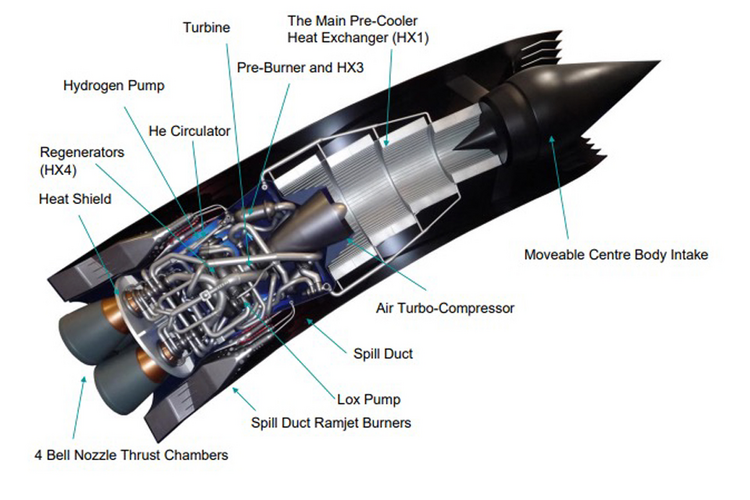
The combustors aren't shown in great detail in that diagram. There are two ways out, ramjet burners and LOx-supplied rocket burners at higher speeds, with presumably some partial flow through each in the transition phase.

1716283272573.png
 
Just thought about something... if they use MIPCC, they will fly to Mach 5. Is that hypersonics ?
 
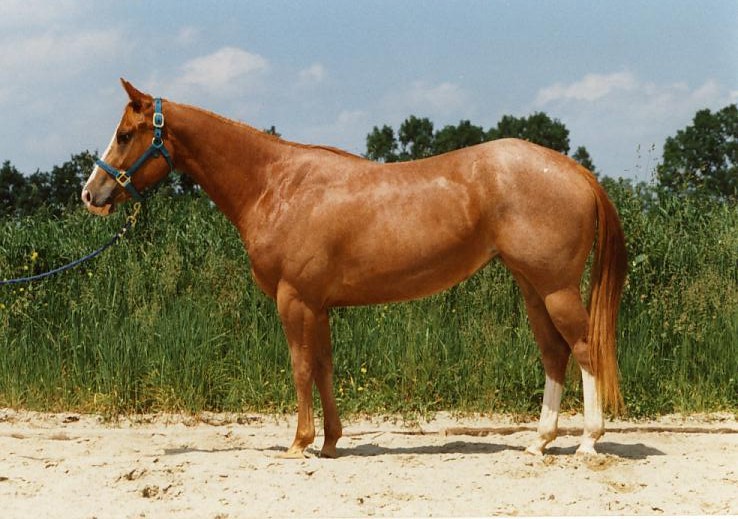
A quarter horse ? does it only have one leg ?

...

(runs for cover).
Heh.

The American Quarter Horse, or Quarter Horse, is an American breed of horse that excels at sprinting short distances. Its name is derived from its ability to outrun other horse breeds in races of 1⁄4 mi (0.40 km) or less;

I'd assume that if they get to something closer to a full-sized aircraft they might call it a Thoroughbred.
 
Pre-coolers are great, reducing the inlet temperature of a jet engine can greatly increase the available performance.

The problem is always - where does the waste heat from the pre-cooler go? LH2 is always a go to heat sink, but it has storage and handling problems. You can move the heat and try to shed it to the free stream, but that is hot also. Trying to use a heat pump to move the heat is a complicated….

Sometimes I wonder if old fashioned inlet water injection would be just as effective and simpler…..
 
But why would they do otherwise? Their pre-cooling needs are only transitional. If they lighten the vehicle enough, with that F-100, the time to get from Mach2,5 to Mach3+ to switch to the ramjet might be very short. Spraying should be enough.
 
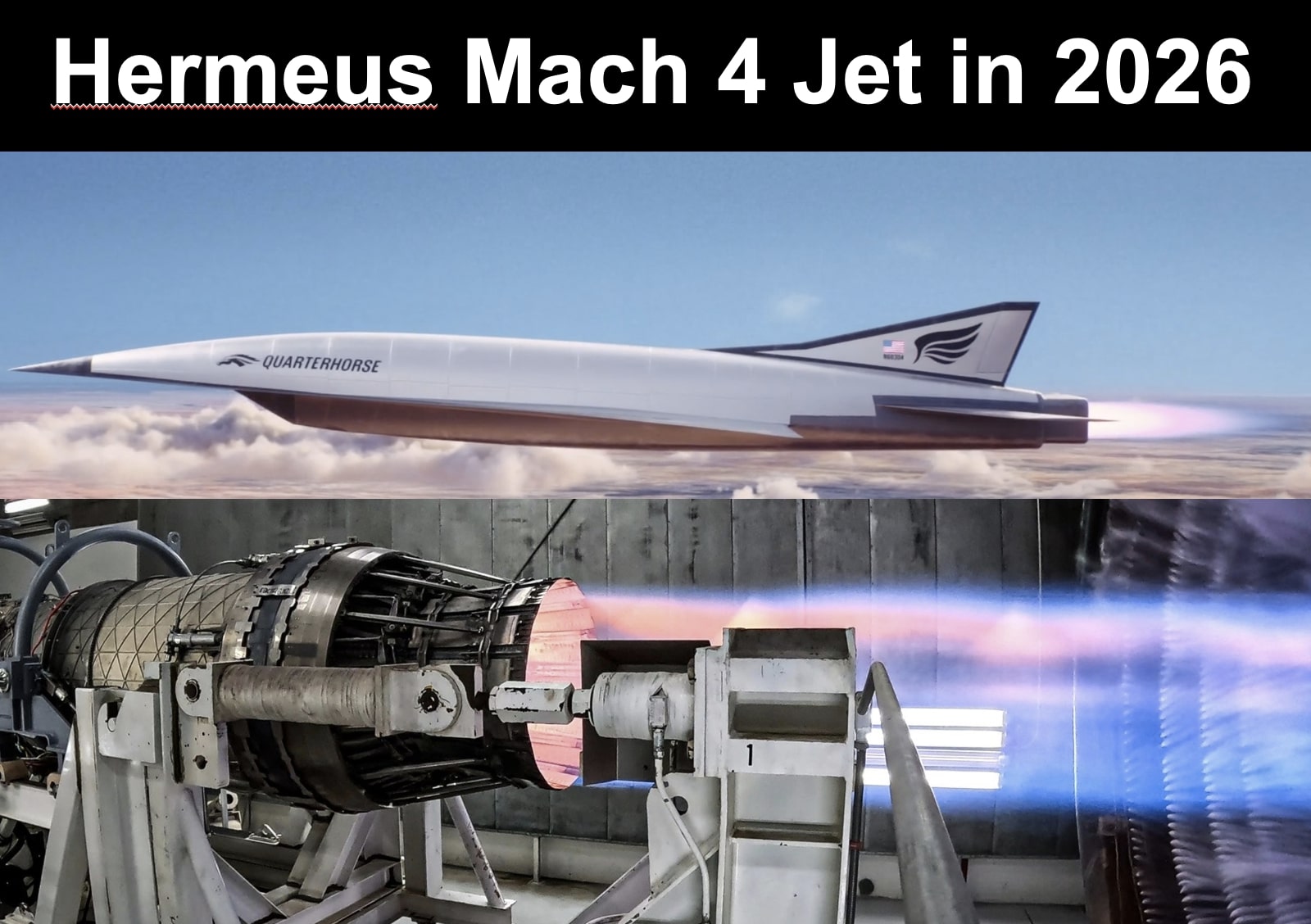
Hermeus has selected Cecil Airport in Jacksonville, Florida for its hypersonic engine test facility. Named HEAT (High Enthalpy Air-Breathing Test Facility), this facility will be Hermeus’ largest and most technologically advanced test site to date and become a national asset for hypersonic testing. The site will also be the initial base for Hermeus’ high-Mach flight test capabilities starting in 2026, expanding cadence and affordability of the nation’s flight test infrastructure.

We announced our plans for the new facility at a groundbreaking ceremony at Cecil Airport in Jacksonville. Hermeus executives and employees were joined by U.S. Congressman Aaron Bean (FL- 04), U.S. Congressman John Rutherford (FL-05), State Sen. Clay Yarborough (R-Jacksonville), Mayor Donna Deegan, Florida Department of Commerce officials, JAXUSA officials, and other community leaders.

The HEAT facility will provide continuous high flow rate, high enthalpy and low-pressure conditions required for high-supersonic and low-hypersonic flight modeling. This capability will make the facility an important asset to more effectively test and field various hypersonic technologies – not only for Hermeus but also for the Department of Defense and its commercial partners.

Hermeus will test a variety of engines and propulsion subsystems at HEAT – from the Pratt & Whitney F100 engine to Hermeus’ proprietary hypersonic Chimera engine. The facility will be built in phases with initial sea-level static engine tests starting before the end of 2024. Future phases of the facility will introduce continuous high-Mach vitiated air flow to simulate more flight-like high-Mach testing conditions on the ground.
View: https://www.youtube.com/watch?v=0rGZoFqqi-k
 
From P&W:

1726585501918


  • maiden flight mostly described as a "Hop"
  • Vr was "above 150 kt, maximum altitude "around 100 ft", less than a minute flown
  • originally planned several test flights with mk1, though delays caused by flight clearance and wet lakebed conditions at Edwards AFB runway 15/33 led to months long delay fo maiden flight.
  • focus now on getting mk2 airborne, and most tests will be carried out using mk2. will go supersonic later this year
  • mk2 wind tunnel tests were carried out for wind speeds in range from M 0.6 to M 3
 
Last edited:
If they bet on MIPCC technology, then they are technically sound.
Also economically sound: off the shelf turbofan, chemically cooled. No new engine, no complicated precooler metallurgy. Also no LH2 and no helium: just plain old kerosene.
For a startup starting from scratch and with limited funding, that's a lot of key advantages. Easier and cheaper than (for example) the late REL pre-cooler and SABRE.
That's the beauty of MIPCC - just ask @Hydroman .
 
Last edited:
MIPCC met its propulsion (ATK-GASL) performance goals for the DARPA RASCAL program (I can't believe its been 21 years since I worked RASCAL). However, the RASCAL mothership had to carry enough water for the initial high-mach climb event to 150Kft then zoom to apogee of 200Kft for payload deployment. Plus you need a robust spray bar/water delivery system for proper water atomization to create the inlet sea-level environment to get maximum F100 engine performance at altitude. We had re-created the F-14 variable inlet ramp system to control airflow in which I designed the actuation system.
If they bet on MIPCC technology, then they are technically sound.
Also economically sound: off the shelf turbofan, chemically cooled. No new engine, no complicated precooler metallurgy. Also no LH2 and no helium: just plain old kerosene.
For a startup starting from scratch and with limited funding, that's a lot of key advantages. Easier and cheaper than (for example) the late REL pre-cooler and SABRE.
That's the beauty of MIPCC - just ask @Hydroman
[/QUOTE]
 
View: https://twitter.com/hermeuscorp/status/2008932507895595096


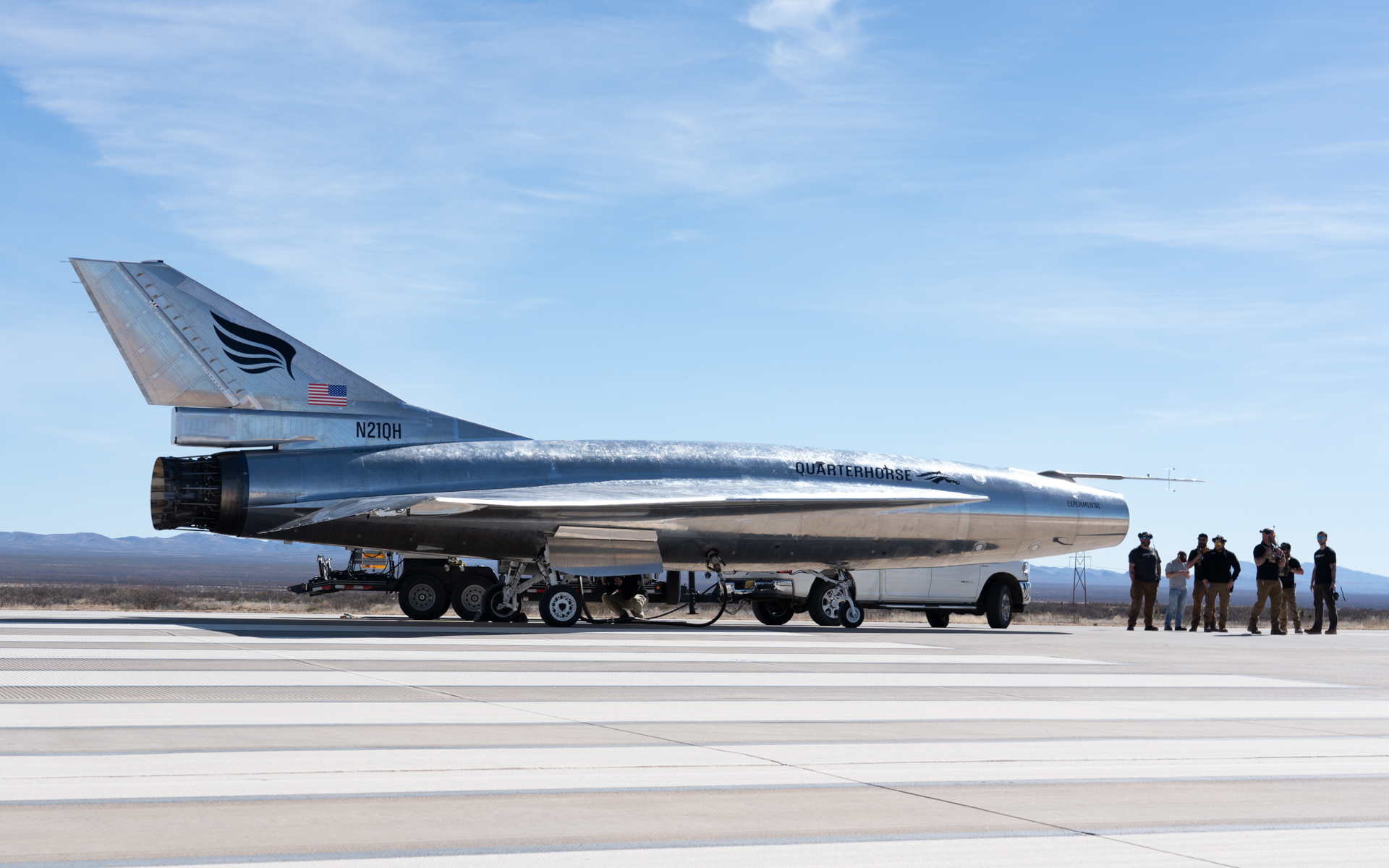
After being shipped from Atlanta, Quarterhorse Mk 2.1 has arrived at Spaceport America — our new home for the next chapter. The journey to first flight starts now.

What comes next:

✅ Reintegration of tail and wings
✅ Ground operations and systems checkouts
✅ Engine ground runs
✅ Progressive taxi testing
✅ Preparation for first flight

All in service of delivering flight-ready capability for national security.

View: https://twitter.com/hermeuscorp/status/2014369012247904637


We're not just building the planes fast, we're building the infrastructure fast.

Our team has stood up deployed operations at @Spaceport_NM, transforming a blank slate into a disciplined flight-test complex, including a 6,000-square-foot custom hangar for Quarterhorse Mk 2.1 that was built in less than a week.
 
Updates since April. Quarterhorse Mk 1 had its first flight and they made significant progress on assembly of Quarterhorse Mk 2.

View: https://twitter.com/hermeuscorp/status/1927355527740191131
[May 27]

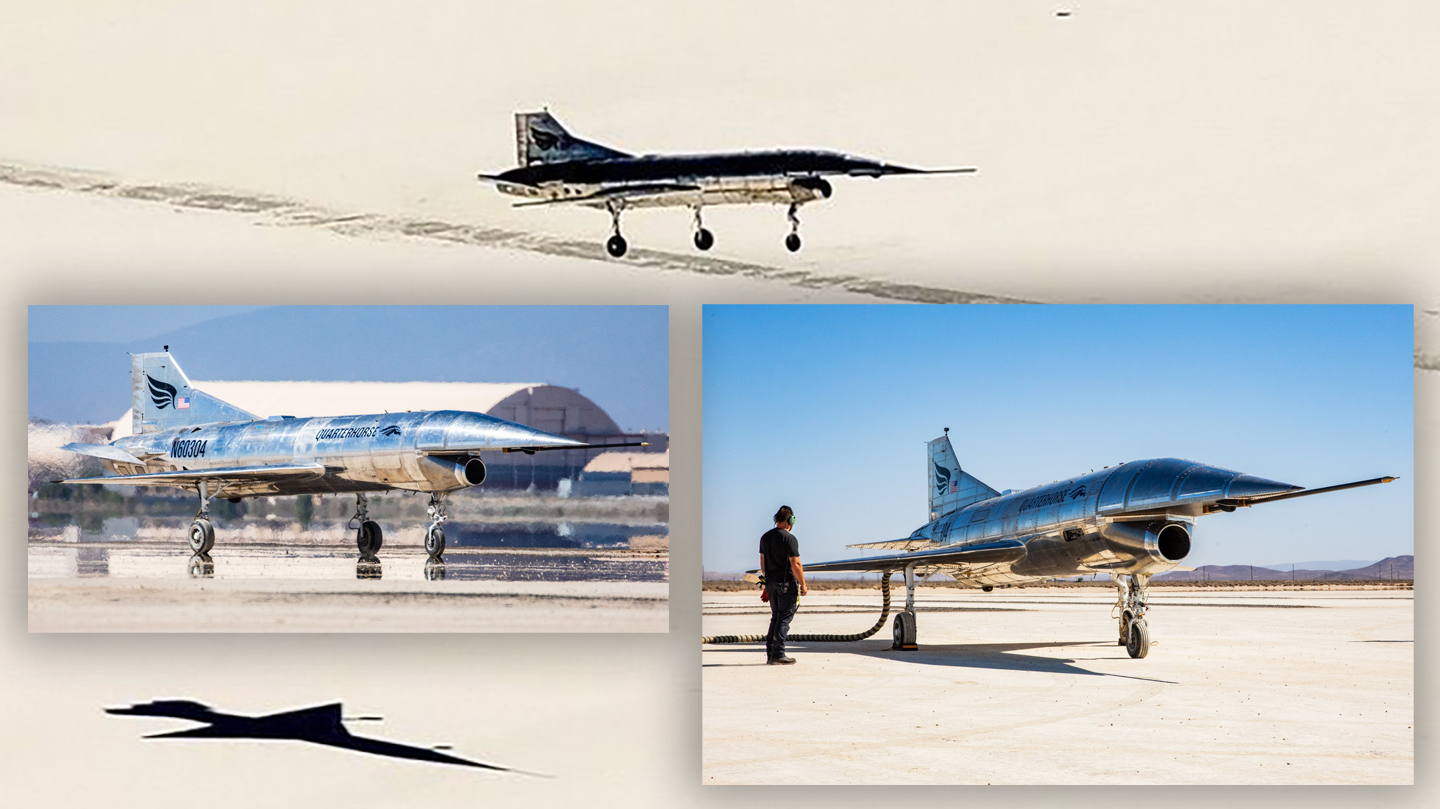
Airborne! Last week, Quarterhorse Mk 1 took off from Edwards AFB, achieved stable flight and landed smoothly. Mk 1's flight validated our rapid, iterative approach to airplane development and advanced our mission to radically accelerate aviation.

Hermeus Flies Quarterhorse Mk 1 at Edwards Air Force Base [May 27]

Hermeus, a venture capital-backed aerospace and defense technology company specializing in high-speed aircraft, announced today the flight of its Quarterhorse Mk 1 aircraft. This milestone is a significant step in Hermeus’ development of high-Mach and hypersonic aircraft. With this flight, Hermeus demonstrated a rapid development pace, advancing Hermeus’ mission to operationalize hypersonic technologies.

Quarterhorse Mk 1 is the first in a series of uncrewed aircraft on Hermeus’ iterative development roadmap. The company’s approach emphasizes “hardware richness” – building multiple prototypes in quick succession, allowing the team to take well-managed technical risk. While driving technical progress towards high-speed flight, this approach simultaneously enables Hermeus to rapidly develop its team and talent. The “one aircraft per year” development cadence drives Hermeus’ engineers and technicians through multiple crucibles of full life-cycle aircraft development in a very short time period. As a result, the company is progressively building a team capable of solving the hardest engineering challenges of aviation to operationalize hypersonic aircraft.

The team is actively reviewing data and integrating lessons learned into Hermeus’ next iteration, Quarterhorse Mk 2, currently being manufactured at Hermeus’ headquarters in Atlanta. The scale of an F-16, Quarterhorse Mk 2 is a high-Mach aircraft designed to de-risk uncrewed supersonic flight. It is on-track to fly late this year. This vehicle will enable both high-cadence hypersonic flight test and novel operational defense capabilities.

View: https://twitter.com/hermeuscorp/status/1937497452585562275
[June 24]

You're looking at the "Iron Bird," Hermeus' facility housing the insides of Quarterhorse Mk 2, including the inflight power generators, control surfaces, and landing gear. This set up enables us to rapidly test and iterate on all subsystems in parallel — outside the vehicle — before they're integrated into the final frames.

Watch the full Forbes feature on Hermeus' Youtube.

View: https://twitter.com/hermeuscorp/status/1965774780956557542
[Sep. 10]

Hermeus is building fast airplanes - fast. Less than four months after Quarterhorse Mk 1's first flight, Mk 2 is weight on wheels - the first time the aircraft bears its own weight. Turns out an F-16 class drone is quite large. This is what iterative development looks like. Next up: F-100 engine integration.

View: https://twitter.com/hermeuscorp/status/1968379205499961461
[Sep. 17]

Less than a week after Quarterhorse Mk 2 achieved weight on wheels we completed integration of the iconic Pratt & Whitney F100 engine. This is what it means to build fast. Next Up: Integrated systems testing.
 

It flew its first second aircraft in February at Spaceport America over White Sands Missile Range airspace in New Mexico. The Quarterhorse Mk 2.1 plane is three times larger than the initial prototype and about the size of an F-16. The goal is to reach supersonic speeds.

Not much past the usual puff puff of a startup marketing dept.


Not much past the usual puff puff of a startup marketing dept.
With the polished metal, goal of reaching, "supersonic speeds" and the nose inlet. . .I feel like I'm reading something from the 50s.
 

Similar threads

Back
Top Bottom