Forest Green
ACCESS: USAP
- Joined
- 11 June 2019
- Messages
- 14,630
- Reaction score
- 31,766
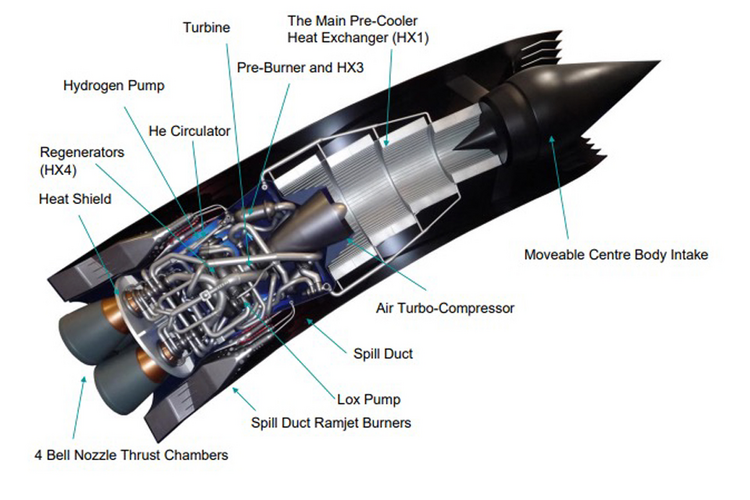
It means less heat rejection from the He in the LH2 pump heat exchanger, but it also means less heat sink into the He in the post-pre-burner heat exchanger.Thanks for the schematic, now I understand. Basically using the helium as the working fluid for a heat pump system moving heat from the inlet to the LH2 fuel, which is the ultimate heat sink with the waste heat going out the exhaust. I still don’t really see how this decouples the system from the LH2 fuel flow, since a lower LH2 flow rate means less heat rejection, raising the inlet temperature, etc.

The combustors aren't shown in great detail in that diagram. There are two ways out, ramjet burners and LOx-supplied rocket burners at higher speeds, with presumably some partial flow through each in the transition phase.The other issue I see is using the same nozzle for the rocket combustion chamber and the air breathing combustor. Rockets chamber pressure tends to be way higher than an air breathing combustor, even with the ram recovery and air compression system. Using both is likely to have the rocket exhaust very under expanded (inefficient) to prevent operating the air breathing system with an over expanded nozzle condition (separated unstable flow, poor efficiency)
Hopefully the SABRE group knows more than I do!




 Reintegration of tail and wings