Are, the NATO members' governments, actually stopping buying American military wares of any kind in any considerable degree or capacity? Because so far it seems nobody actually translated their words into actions.
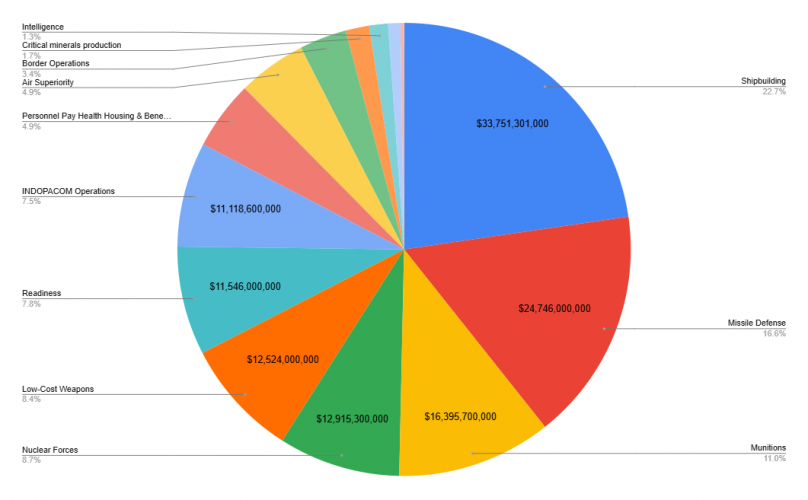
Shipbuilding has the largest bucket at $33B, with many line items for general industrial development, as well as additional ships in a few classes: 3x John Lewis, 1x Virginia, 2x Burke, 1x America, and 1x San Antonio. $2B is also included for Landing Ship Medium, which recently had been paused and adjusted in scope.
Missile defense is next at $24B, with a few notably large line items: $5.6B for space-based and boost phase intercept capabilities, $7.2B for space-based sensors, and $2.2B for hypersonic defense (glide phase interceptor?)
"Munitions" and "Low-cost weapons," while separate sections, total $29.9B. This includes $65M for integration of an Army missile interceptor onto Navy ships, presumably this is PAC-3. Drones and the drone industrial base are included here as well.
$3.1B for F-15 EX, $400M for F-47, $500M for F/A-XX.
$1.5B for Sentinal, $4.5B for B-21, $2B for SLCM-N
$4B for classified space superiority programs for INDOPACOM
$1.6B total for infrastructure and airfields in INDOPACOM, although "hardened aircraft shelters" is conspicuously absent as a direct mention.
$5B for border operations.
Remember, this is all in addition to the current funding from last year under the continuing resolution.
For what I know of the German population (I visited from Meckleburg to Freiburg) this will not translate automatically into combat readiness or will to join the Bundeswehr. And I do not wish a "Germany awaken" moment. Matter of fact, the less they spend or think about seriously rearming the better.
Excluding the UK and demanding trade concessions, freedom of movement and fishery rights is a certain path to turn the UK away from collective collaboration.
This has got to be driven by France in order to scoop up that money. Not going to play well with the likes of Poland or Sweden.
If Starmer gives in, his days will be numbered and I wouldn't bank any such treaty considering the major political swings coming. Lot's of choppy waters ahead.
Are, the NATO members' governments, actually stopping buying American military wares of any kind in any considerable degree or capacity? Because so far it seems nobody actually translated their words into actions.
That's like asking 'Are we there yet?' before the car has left the garage. It'll take months if not years, or years if not decades to see if there's a significant effect, because that's the timescale of defence procurement.
The need to replace the 757s has been on the cards for the last 10yrs at least as they were already second hand when they got them
The SH-2Gs are also a very small fleet and indeed there aren't many around the world still in use. Moreover NZ really only went with them because Australia was too but then Australia got out. I am surprised they have kept them as long as they have.
Many European countries are strengthening their armed forces, with billions of euros flowing into the military and defense. Europe wants, indeed needs, to stand more on its own two feet. But how quickly can the continent become ready to defend itself? Does the public support the drive towards remilitarization? DW News traveled across Europe and met civilians, soldiers and security experts to find out.
Israel will invest $110 billion over 10 years in improving its defense industrial independence.
In 2024 GDP figures this means an annual defense spending increase of 2% of GDP for the next decade.
This site uses cookies to help personalise content, tailor your experience and to keep you logged in if you register.
By continuing to use this site, you are consenting to our use of cookies.