
You are using an out of date browser. It may not display this or other websites correctly.
You should upgrade or use an alternative browser.
You should upgrade or use an alternative browser.
German Special Air-Air Anti-Bomber Weapons
- Thread starter moin1900
- Start date

Atomic Coyote
I really should change my personal text
- Joined
- 31 March 2015
- Messages
- 73
- Reaction score
- 150
https://www.secretprojects.co.uk/threads/kramer-x-4-air-to-air-missile.6097/
The (MCLOS guidance) X-4 was planned to use an acoustic proximity fuse.
The (MCLOS guidance) X-4 was planned to use an acoustic proximity fuse.
Rheinmetall-Borsig Unterlüss -
Technical reports on automatic weapons in aircraft
June 20 – July 6, 1945
This post-war report mentions various aircraft armament systems, such as the "Oberon" radar sighting system, semi-rigid firing methods (with and without stabilization), rocket weapons (e.g., RZ65, R4M, Panzerblitz I–IV, R100BS, Natternase) and automatic gun-laying turrets.
Semi-rigid firing (with and without stabilization)
A tactical prerequisite for employing the semi-rigid firing method against heavy four-engine bomber formations would be ensuring protection against escort fighters.
The semi-rigid firing method without stabilization was tested during the war. A Messerschmitt 110 armed with a 3cm MK 101 served as the testbed. In addition, the installation of an L 103Z in a Messerschmitt 410 was planned. The remote-controlled FLA 103Z was planned as a further development of the L 103Z.
In the semi-rigid firing method with stabilization, the gunner and the aiming gear are replaced by a gyroscope. The report shows a drawing of a remote-controlled FLA 103Z with gyroscopic stabilization.
The semi-rigid installation of upward-firing weapons such as the L 108Z—seen here installed in a Junkers 388—was also considered. This weapon was designed to be mounted at an upward angle of 70° and featured a traverse range of ±10° in elevation and ±15° in azimuth.
Source: Bundesarchiv
Signatur: RH 8/3529
Direct Link:
https://invenio.bundesarchiv.de/invenio/direktlink/8f898a39-4bea-4079-9370-2e5be9821bf7/
Technical reports on automatic weapons in aircraft
June 20 – July 6, 1945
This post-war report mentions various aircraft armament systems, such as the "Oberon" radar sighting system, semi-rigid firing methods (with and without stabilization), rocket weapons (e.g., RZ65, R4M, Panzerblitz I–IV, R100BS, Natternase) and automatic gun-laying turrets.
Semi-rigid firing (with and without stabilization)
A tactical prerequisite for employing the semi-rigid firing method against heavy four-engine bomber formations would be ensuring protection against escort fighters.
The semi-rigid firing method without stabilization was tested during the war. A Messerschmitt 110 armed with a 3cm MK 101 served as the testbed. In addition, the installation of an L 103Z in a Messerschmitt 410 was planned. The remote-controlled FLA 103Z was planned as a further development of the L 103Z.
In the semi-rigid firing method with stabilization, the gunner and the aiming gear are replaced by a gyroscope. The report shows a drawing of a remote-controlled FLA 103Z with gyroscopic stabilization.
The semi-rigid installation of upward-firing weapons such as the L 108Z—seen here installed in a Junkers 388—was also considered. This weapon was designed to be mounted at an upward angle of 70° and featured a traverse range of ±10° in elevation and ±15° in azimuth.
Source: Bundesarchiv
Signatur: RH 8/3529
Direct Link:
https://invenio.bundesarchiv.de/invenio/direktlink/8f898a39-4bea-4079-9370-2e5be9821bf7/
MK 108 - Performance Enhancement
MK 108 Info
https://www.secretprojects.co.uk/threads/me-262-projects-pre-projects-and-variants.6994/post-323427
[1] January 24, 1945
The Führer demands a significant increase in the combat engagement range for fighter aircraft deployed against bombers, in order to reduce their vulnerability to defensive fire.
To this end, regarding aircraft armament—and in addition to the already implemented increase in the rate of fire—priority must be given to increasing the muzzle velocity and increasing the caliber.
[3] February 15, 1945
Performance enhancement of the MK 108
Muzzle velocity: 505 m/s
Explosive charge weight: 88 g
Previous rate of fire: 600 rounds/min
Rate of fire increased to 850 rounds/min through the use of a breech mechanism reduced in weight. To date, 1,000 rounds have been fired during trials at Rheinmetall-Borsig. The belt lift required for aircraft installation has not yet been taken into account.
[2] February 26, 1945 - March 4, 1945
Increase in the rate of fire of the MK 108 from 600 rpm to 850 rpm achieved with an experimental weapon by the developer, Rheinmetall-Borsig.
[4] March 13, 1945
No new test results received.
[5] July - August 1945
Investigations into a possible increase in the rate of fire of the MK 108 from 600 to 1,200 rounds per minute.
An increase in the rate of fire has already been achieved. By reducing the weapon's breech weight from 11.6 kg to 7.8 kg, it was possible to increase the rate of fire from 600 to 950 rounds per minute.
Source:
Bundesarchiv
[1] Signatur: R 3/1511; Page: 13-14
Direct Link:
https://invenio.bundesarchiv.de/invenio/direktlink/e24042df-11e8-4865-9b87-4ff8170444d6/
[2] Signatur: RL 3/2567; Page: 241
Direct Link:
https://invenio.bundesarchiv.de/invenio/direktlink/ff268edd-8129-450a-b0e4-6a35d48fc287/
[3]&[4] Signatur: RL 3/2583; Page: 38, 56
Direct Link:
https://invenio.bundesarchiv.de/invenio/direktlink/760e51f9-0854-4241-93e5-8831c9163bc9/
[5] Signatur: RH 8/3528; Page: 4 - 121
Direct Link:
https://invenio.bundesarchiv.de/invenio/direktlink/cc962b9e-67f0-4b6b-8c32-55c1bb62fd20/
Sidenote:
This document also contains drawings of various aircraft armament systems, e.g.:
- He 162 with 2x MK 108
- He 162 with 2x Rohrblocktrommel & 2x Rohrblock SG118
- He 162 with R4M "Waben"
- Heinkel with SG119 & 2x MK 108
- STL 108Z "Natter"
- MK 112
October 1943
MK 108 – Weapon Manual
Source: Bundesarchiv
Signatur: RL 3/7206
Direct Link:
https://invenio.bundesarchiv.de/invenio/direktlink/4d088114-cdd2-41db-ab57-9a9ccf16d285/
MK 108 Info
https://www.secretprojects.co.uk/threads/me-262-projects-pre-projects-and-variants.6994/post-323427
[1] January 24, 1945
The Führer demands a significant increase in the combat engagement range for fighter aircraft deployed against bombers, in order to reduce their vulnerability to defensive fire.
To this end, regarding aircraft armament—and in addition to the already implemented increase in the rate of fire—priority must be given to increasing the muzzle velocity and increasing the caliber.
[3] February 15, 1945
Performance enhancement of the MK 108
Muzzle velocity: 505 m/s
Explosive charge weight: 88 g
Previous rate of fire: 600 rounds/min
Rate of fire increased to 850 rounds/min through the use of a breech mechanism reduced in weight. To date, 1,000 rounds have been fired during trials at Rheinmetall-Borsig. The belt lift required for aircraft installation has not yet been taken into account.
[2] February 26, 1945 - March 4, 1945
Increase in the rate of fire of the MK 108 from 600 rpm to 850 rpm achieved with an experimental weapon by the developer, Rheinmetall-Borsig.
[4] March 13, 1945
No new test results received.
[5] July - August 1945
Investigations into a possible increase in the rate of fire of the MK 108 from 600 to 1,200 rounds per minute.
An increase in the rate of fire has already been achieved. By reducing the weapon's breech weight from 11.6 kg to 7.8 kg, it was possible to increase the rate of fire from 600 to 950 rounds per minute.
Source:
Bundesarchiv
[1] Signatur: R 3/1511; Page: 13-14
Direct Link:
https://invenio.bundesarchiv.de/invenio/direktlink/e24042df-11e8-4865-9b87-4ff8170444d6/
[2] Signatur: RL 3/2567; Page: 241
Direct Link:
https://invenio.bundesarchiv.de/invenio/direktlink/ff268edd-8129-450a-b0e4-6a35d48fc287/
[3]&[4] Signatur: RL 3/2583; Page: 38, 56
Direct Link:
https://invenio.bundesarchiv.de/invenio/direktlink/760e51f9-0854-4241-93e5-8831c9163bc9/
[5] Signatur: RH 8/3528; Page: 4 - 121
Direct Link:
https://invenio.bundesarchiv.de/invenio/direktlink/cc962b9e-67f0-4b6b-8c32-55c1bb62fd20/
Sidenote:
This document also contains drawings of various aircraft armament systems, e.g.:
- He 162 with 2x MK 108
- He 162 with 2x Rohrblocktrommel & 2x Rohrblock SG118
- He 162 with R4M "Waben"
- Heinkel with SG119 & 2x MK 108
- STL 108Z "Natter"
- MK 112
October 1943
MK 108 – Weapon Manual
Source: Bundesarchiv
Signatur: RL 3/7206
Direct Link:
https://invenio.bundesarchiv.de/invenio/direktlink/4d088114-cdd2-41db-ab57-9a9ccf16d285/
Last edited:
Adjustable, upward-firing MK 108s
April 9, 1945
Proposal No. 3 of the Reich Marshal’s Special Representative for Countering Four-Engine Combat Formations
(Vorschlag Nr.3 des Sonderbeauftragten des Reichsmarschalls für die Abwehr von viermotorigen Kampfverbänden)
Upward-firing armament against bombers during daylight interception:
The proposal aimed to increase the firing range of the Mk 108 from 500 m to 1,000 m.
Jet fighters (Messerschmitt 262) equipped with inflight-adjustable MK 108 cannons that can be used either in the standard position (linked to the EZ 42 gyro gunsight) or as upward-firing armament (15⁰ - linked to the EZ 42 sight and a fixed auxiliary sight).
This firing method is unsuitable for aerial combat against fighter aircraft; therefore, the viability of this method hinges on the development of a weapon adjustment mechanism.
Source: Bundesarchiv
Signatur: RL 2II/1393
Direct Link:
https://invenio.bundesarchiv.de/invenio/direktlink/51df8730-ffbb-4ec6-ba05-ab2608056992/
Blohm & Voss P.215 - (Geradbahnschuss)
https://www.secretprojects.co.uk/threads/various-blohm-und-voss-projects.18712/post-204800
April 9, 1945
Proposal No. 3 of the Reich Marshal’s Special Representative for Countering Four-Engine Combat Formations
(Vorschlag Nr.3 des Sonderbeauftragten des Reichsmarschalls für die Abwehr von viermotorigen Kampfverbänden)
Upward-firing armament against bombers during daylight interception:
The proposal aimed to increase the firing range of the Mk 108 from 500 m to 1,000 m.
Jet fighters (Messerschmitt 262) equipped with inflight-adjustable MK 108 cannons that can be used either in the standard position (linked to the EZ 42 gyro gunsight) or as upward-firing armament (15⁰ - linked to the EZ 42 sight and a fixed auxiliary sight).
This firing method is unsuitable for aerial combat against fighter aircraft; therefore, the viability of this method hinges on the development of a weapon adjustment mechanism.
Source: Bundesarchiv
Signatur: RL 2II/1393
Direct Link:
https://invenio.bundesarchiv.de/invenio/direktlink/51df8730-ffbb-4ec6-ba05-ab2608056992/
Blohm & Voss P.215 - (Geradbahnschuss)
https://www.secretprojects.co.uk/threads/various-blohm-und-voss-projects.18712/post-204800
1943 Rheinmetall-Borsig - Flying Flak
Firing from an aircraft based on artillery principles:
In 1943, Rheinmetall-Borsig submitted a 26-page memorandum titled "Die fliegende Flak" (The Flying Flak).
The exact content of the memorandum is not evident from the documents listed below, though some details are mentioned. The memorandum evidently addressed the installation of heavy anti-aircraft guns in aircraft to enable engagement of aerial targets in the manner of flak artillery and the division of tasks between pilot and gunner. In addition to semi-rigid and rigid weapon mountings, a fully rotatable mount was also envisaged. However, it turned out that completely new types of aircraft had to be developed for this armament. Discussions regarding the memorandum further revealed that a 360-degree traverse for a 5,5 cm weapon was not feasible, as this would have required an aircraft on the scale of the Junkers 390.
Source: Bundesarchiv
Signatur: RL 3/41; Page: 633 - 651
Signatur: R 26-III/52; Page: 44 - 48
Signatur: RL 3/57; Page: 161, 131
Direct Link:
RL 3/41 & RL 3/57
https://invenio.bundesarchiv.de/invenio/direktlink/451dac1d-5d4d-4772-9d24-45ba2507d22c/
R 26-III/52
https://invenio.bundesarchiv.de/invenio/direktlink/63ed1c57-c855-4c5d-b005-8c7a0793f2d2/
Firing from an aircraft based on artillery principles:
In 1943, Rheinmetall-Borsig submitted a 26-page memorandum titled "Die fliegende Flak" (The Flying Flak).
The exact content of the memorandum is not evident from the documents listed below, though some details are mentioned. The memorandum evidently addressed the installation of heavy anti-aircraft guns in aircraft to enable engagement of aerial targets in the manner of flak artillery and the division of tasks between pilot and gunner. In addition to semi-rigid and rigid weapon mountings, a fully rotatable mount was also envisaged. However, it turned out that completely new types of aircraft had to be developed for this armament. Discussions regarding the memorandum further revealed that a 360-degree traverse for a 5,5 cm weapon was not feasible, as this would have required an aircraft on the scale of the Junkers 390.
Source: Bundesarchiv
Signatur: RL 3/41; Page: 633 - 651
Signatur: R 26-III/52; Page: 44 - 48
Signatur: RL 3/57; Page: 161, 131
Direct Link:
RL 3/41 & RL 3/57
https://invenio.bundesarchiv.de/invenio/direktlink/451dac1d-5d4d-4772-9d24-45ba2507d22c/
R 26-III/52
https://invenio.bundesarchiv.de/invenio/direktlink/63ed1c57-c855-4c5d-b005-8c7a0793f2d2/
Flying Flak
(Luftkreuzer, Grosszerstörer, Schwerzerstörer, Breitseitenflugzeug, Fliegende Flakbatterie, Flakkreuzer)
[1] October 8, 1943
The Reichsmarschall, Schmid, and Galland discussed the concept of air cruisers - large and heavy destroyers that were essentially high-performance, heavily armored gunships intended to be equipped with long range large-caliber weapons (5,5 cm, 8 cm, 10 cm, or larger). These air cruisers were designed for broadside combat (Bordseitengefecht) or for attacking enemy bomber formations from below. Galland proposed using Heinkel 177s modified for this purpose.
[2] October 29, 1943
Galland requested three Junkers 88 S aircraft for "Erprobungskommando 25" and mentioned the possibility of installing 30 "Nebelwerfer" rockets as upward-firing armament in a He 177, as well as mounting 15 or fewer reloadable tubes in the Dornier 217.
[3] November 12, 1943
Hauptmann Schöner commanded a unit equipped with upward-firing armament. The men were enthusiastic about this weaponry; they desired large aircraft—specifically the Heinkel 177—fitted with 12 upward-firing cannons.
[4] December 6, 1943
Generalfeldmarschall Milch mentioned the experimental installation of 3,7 cm, 5 cm, 7,5 cm, and 8,8 cm weapons, as well as a Heinkel 177 equipped with 30 upward-firing weapons. Rheinmetall’s memorandum "Die fliegende Flak" is also mentioned.
[5] July 20, 1944 – October 20, 1944
"Grosszerstörer" - Proposals by Jagdgruppe 10
Deployment of the "Kerze" device against enemy four-engine bomber formations.
He 177 with 33 rocket tubes & Ju 88 G-1 with 10 rocket tubes.
Source:
Bundesarchiv
[1] Signatur: RL 3/61; Page: 1267–1271
[2] Signatur: RL 3/39; Page: 687–691
[3] Signatur: RL 3/39; Page: 292
[4] Signatur: RL 3/41; Page: 635
[5] https://www.secretprojects.co.uk/threads/german-special-air-air-anti-bomber-weapons.6945/post-828351
Direct Link:
https://invenio.bundesarchiv.de/invenio/direktlink/451dac1d-5d4d-4772-9d24-45ba2507d22c/
(Luftkreuzer, Grosszerstörer, Schwerzerstörer, Breitseitenflugzeug, Fliegende Flakbatterie, Flakkreuzer)
[1] October 8, 1943
The Reichsmarschall, Schmid, and Galland discussed the concept of air cruisers - large and heavy destroyers that were essentially high-performance, heavily armored gunships intended to be equipped with long range large-caliber weapons (5,5 cm, 8 cm, 10 cm, or larger). These air cruisers were designed for broadside combat (Bordseitengefecht) or for attacking enemy bomber formations from below. Galland proposed using Heinkel 177s modified for this purpose.
[2] October 29, 1943
Galland requested three Junkers 88 S aircraft for "Erprobungskommando 25" and mentioned the possibility of installing 30 "Nebelwerfer" rockets as upward-firing armament in a He 177, as well as mounting 15 or fewer reloadable tubes in the Dornier 217.
[3] November 12, 1943
Hauptmann Schöner commanded a unit equipped with upward-firing armament. The men were enthusiastic about this weaponry; they desired large aircraft—specifically the Heinkel 177—fitted with 12 upward-firing cannons.
[4] December 6, 1943
Generalfeldmarschall Milch mentioned the experimental installation of 3,7 cm, 5 cm, 7,5 cm, and 8,8 cm weapons, as well as a Heinkel 177 equipped with 30 upward-firing weapons. Rheinmetall’s memorandum "Die fliegende Flak" is also mentioned.
[5] July 20, 1944 – October 20, 1944
"Grosszerstörer" - Proposals by Jagdgruppe 10
Deployment of the "Kerze" device against enemy four-engine bomber formations.
He 177 with 33 rocket tubes & Ju 88 G-1 with 10 rocket tubes.
Source:
Bundesarchiv
[1] Signatur: RL 3/61; Page: 1267–1271
[2] Signatur: RL 3/39; Page: 687–691
[3] Signatur: RL 3/39; Page: 292
[4] Signatur: RL 3/41; Page: 635
[5] https://www.secretprojects.co.uk/threads/german-special-air-air-anti-bomber-weapons.6945/post-828351
Direct Link:
https://invenio.bundesarchiv.de/invenio/direktlink/451dac1d-5d4d-4772-9d24-45ba2507d22c/

JEngO-23
ACCESS: Restricted
- Joined
- 14 February 2026
- Messages
- 37
- Reaction score
- 70
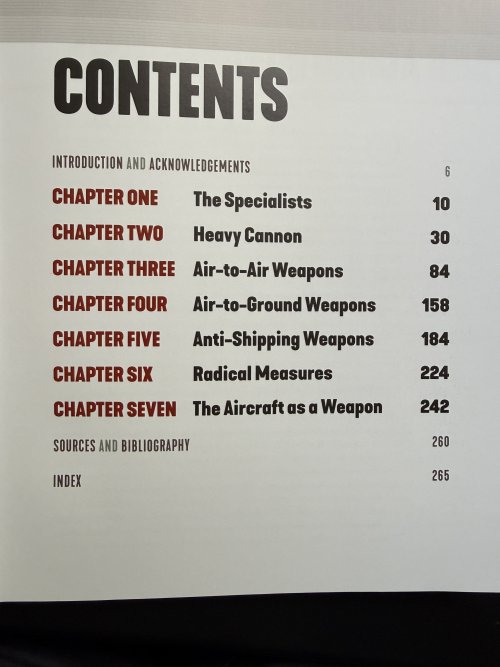
There is a massive amount of primary source material on this thread, but a very readable secondary source is Robert Forsyth's "Luftwaffe Special Weapons 1942-45", published by Osprey in 2021. Chapter 2 on "Heavy Cannon", Chapter 3 on "Air-to-Air Weapons" and Chapter 6 on "Radical Measures" are fairly extensive, and there is a useful "Sources and Bibliography" section at the end listing Primary Sources. I expect that the experts in this forum will already know most if not all of its contents, but for a newcomer to the topic it could be a useful introduction. I have attached a photo of the contents list.

Last edited:
Ju 88 and Ju 388 – 5cm Weapons
[1] September 26, 1944
Development of the Junkers 388 equipped with a 5cm weapon for daytime operations is to be continued for the time being; a precise assessment is required regarding aiming accuracy, stabilization issues, and the potential installation of Jumo 222 engines.
[10] October 27, 1944
MK 214A
Oberstingenieur Mix reports that, in accordance with a TLR decision, 50 guns are to be manufactured for aircraft installation, though a decision regarding their actual installation has not yet been reached. Flight tests using the Ju 88 are due to commence shortly.
[2] January 3, 1945 – January 5, 1945
In addition to the installation of the 5cm MK 214 in the Junkers Ju 88 and Ju 388, the feasibility of installing it in the Arado 234—using either a single or a twin-barrel configuration—must be immediately evaluated from a design standpoint and subjected to testing. The same investigations must be carried out for the Dornier Do 335* and the Messerschmitt Me 262.
[3] January 6, 1945
Increasing the performance of armament—whether by using a lengthened 3cm barrel or by switching to a 5cm caliber to engage heavily armed enemy aircraft from greater distances—does not appear promising when compared to new engagement methods.
[9] January 11, 1945
High-performance aircraft:
Prioritizing the installation of 5cm weapons and the stabilization sight.
[4] January 24, 1945
Installation of the MK 214 A in a Ju 88 for the purpose of weapon testing.
[5] February 9, 1945
Accelerated installation of MK 214 A in Ju 88 – March 10, 1945 deadline unfeasible.
[6] February 15, 1945
First MK 214 A weapon installed in a Junkers Ju 88 for testing on 10 March 1945
[7] February 26, 1945
Comparison of the prospects for success of various methods to break the air terror
Bordkanonen:
The requirement laid down by the Führer for a 5 cm aircraft cannon with an effective combat range of over 1,500 meters—and thus high muzzle energy—can only be realized technically, given the current state of aircraft cannon technology, with a weapon weight of approximately 750 kg; this means that an entirely new aircraft would have to be developed for this cannon—a process that, experience shows, takes at least three years. Consequently, it is not to be expected that the air terror can be broken through the use of conventional aircraft cannons.
[8] March 13, 1945
Installation of MK 214 A in Junkers Ju 88:
Completion of weapon installation delayed until 14 March 1945 due to operational interruptions (power outage, air raid alert). Static firing tests commencing 14 March 1945.
Source:
Bundesarchiv Files
[1] R 3/1760; Page: 199
[2] R 3/1511; Page: 3
[2] RL 3/2690; Page: 72
[2] RL 3/2690; Page: 58
[3] RL 3/2690; Page: 42
[4] R 3/1511; Page: 13
[5] RL 3/2691; Page:52
[6] RL 3/2583; Page: 53
[7] R 26-III/52; Page: 434 - 436
[8] RL 3/2583; Page: 38
[9] RL 3/2690; Page: 92
[10] RL 36/257; Page: 8 - 10
*Dornier 335 with 5cm Weapon
It was determined as early as October 18, 1944, that installing the 5 cm weapon in the Dornier 335—whether as a central fuselage-mounted gun or in the wings—was neither technically feasible nor viable.
Source: Bundesarchiv
Signatur: RL 3/2570; Page: 316
Signatur: RL 3/2690; Page: 58
Signatur: RL 3/12; Page: 608
[1] September 26, 1944
Development of the Junkers 388 equipped with a 5cm weapon for daytime operations is to be continued for the time being; a precise assessment is required regarding aiming accuracy, stabilization issues, and the potential installation of Jumo 222 engines.
[10] October 27, 1944
MK 214A
Oberstingenieur Mix reports that, in accordance with a TLR decision, 50 guns are to be manufactured for aircraft installation, though a decision regarding their actual installation has not yet been reached. Flight tests using the Ju 88 are due to commence shortly.
[2] January 3, 1945 – January 5, 1945
In addition to the installation of the 5cm MK 214 in the Junkers Ju 88 and Ju 388, the feasibility of installing it in the Arado 234—using either a single or a twin-barrel configuration—must be immediately evaluated from a design standpoint and subjected to testing. The same investigations must be carried out for the Dornier Do 335* and the Messerschmitt Me 262.
[3] January 6, 1945
Increasing the performance of armament—whether by using a lengthened 3cm barrel or by switching to a 5cm caliber to engage heavily armed enemy aircraft from greater distances—does not appear promising when compared to new engagement methods.
[9] January 11, 1945
High-performance aircraft:
Prioritizing the installation of 5cm weapons and the stabilization sight.
[4] January 24, 1945
Installation of the MK 214 A in a Ju 88 for the purpose of weapon testing.
[5] February 9, 1945
Accelerated installation of MK 214 A in Ju 88 – March 10, 1945 deadline unfeasible.
[6] February 15, 1945
First MK 214 A weapon installed in a Junkers Ju 88 for testing on 10 March 1945
[7] February 26, 1945
Comparison of the prospects for success of various methods to break the air terror
Bordkanonen:
The requirement laid down by the Führer for a 5 cm aircraft cannon with an effective combat range of over 1,500 meters—and thus high muzzle energy—can only be realized technically, given the current state of aircraft cannon technology, with a weapon weight of approximately 750 kg; this means that an entirely new aircraft would have to be developed for this cannon—a process that, experience shows, takes at least three years. Consequently, it is not to be expected that the air terror can be broken through the use of conventional aircraft cannons.
[8] March 13, 1945
Installation of MK 214 A in Junkers Ju 88:
Completion of weapon installation delayed until 14 March 1945 due to operational interruptions (power outage, air raid alert). Static firing tests commencing 14 March 1945.
Source:
Bundesarchiv Files
[1] R 3/1760; Page: 199
[2] R 3/1511; Page: 3
[2] RL 3/2690; Page: 72
[2] RL 3/2690; Page: 58
[3] RL 3/2690; Page: 42
[4] R 3/1511; Page: 13
[5] RL 3/2691; Page:52
[6] RL 3/2583; Page: 53
[7] R 26-III/52; Page: 434 - 436
[8] RL 3/2583; Page: 38
[9] RL 3/2690; Page: 92
[10] RL 36/257; Page: 8 - 10
*Dornier 335 with 5cm Weapon
It was determined as early as October 18, 1944, that installing the 5 cm weapon in the Dornier 335—whether as a central fuselage-mounted gun or in the wings—was neither technically feasible nor viable.
Source: Bundesarchiv
Signatur: RL 3/2570; Page: 316
Signatur: RL 3/2690; Page: 58
Signatur: RL 3/12; Page: 608
Fächerschusskanone
March 13, 1945 – March 20, 1945
The "Fächerschusskanone" was an alternative proposal by Dr. Beyerle to Osenberg’s "Planet" missile system, utilizing existing technology.
One problem with the "Planet" missile system designed by Osenberg would have been generating the spiral flight path of the sub-projectiles at high speeds. This would have required the use of control surfaces or thrust from nozzles mounted on the sides of the projectiles. It was unclear whether such a rocket could have been successfully developed in such a short time.
Fächerschuss-Lafette
The cluster of fifty 20mm tubes was to be housed in a mount featuring a 35° traverse and elevation range in all directions. Weapon stabilization was to be achieved either via the aircraft's automatic control system or by stabilizing the mount itself. Additionally, the weapon was designed to be reloadable in flight. The drawing in the document shows a mount installed in the nose of a twin-engine aircraft.
Source: Bundesarchiv
Signatur: R 26-III/52; Page: 292 - 326
Direct Link:
https://invenio.bundesarchiv.de/invenio/direktlink/63ed1c57-c855-4c5d-b005-8c7a0793f2d2/
March 13, 1945 – March 20, 1945
The "Fächerschusskanone" was an alternative proposal by Dr. Beyerle to Osenberg’s "Planet" missile system, utilizing existing technology.
One problem with the "Planet" missile system designed by Osenberg would have been generating the spiral flight path of the sub-projectiles at high speeds. This would have required the use of control surfaces or thrust from nozzles mounted on the sides of the projectiles. It was unclear whether such a rocket could have been successfully developed in such a short time.
Fächerschuss-Lafette
The cluster of fifty 20mm tubes was to be housed in a mount featuring a 35° traverse and elevation range in all directions. Weapon stabilization was to be achieved either via the aircraft's automatic control system or by stabilizing the mount itself. Additionally, the weapon was designed to be reloadable in flight. The drawing in the document shows a mount installed in the nose of a twin-engine aircraft.
Source: Bundesarchiv
Signatur: R 26-III/52; Page: 292 - 326
Direct Link:
https://invenio.bundesarchiv.de/invenio/direktlink/63ed1c57-c855-4c5d-b005-8c7a0793f2d2/
Similar threads
-
New book - Sonderwaffen - Experimental guns, rockets and missiles used by the Luftwaffe during World War Two.
- Started by Justo Miranda
- Replies: 36
-
 Italian Fotobomba (AH, 1945)
- Started by Dilandu
- Replies: 15
-
Article Related to Some of Russian Air Launched Missile Programme
- Started by ocay
- Replies: 4
-
 Development of Airborne Armament 1910-1961
- Started by RyanC
- Replies: 3
-