German Light Aircraft Prototypes & Projects

hesham

ACCESS: USAP
Senior Member
Joined
26 May 2006
Messages
37,575
Reaction score
19,620
Hi,

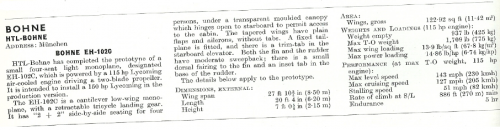
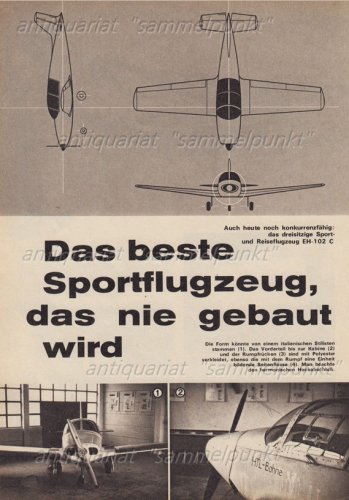
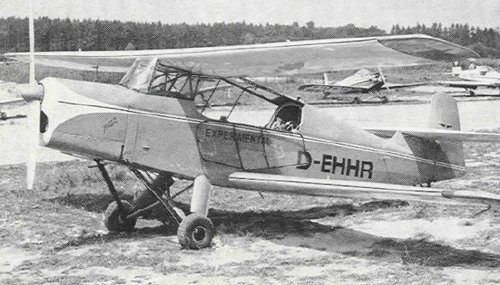
here is a little known German light aircraft,called Bohne EH.102C,it was a four-seat low-wing monoplane of 1969,has anyone a drawing or picture to it ?.
 

Attachments

  • 1.png
    1.png
    255.3 KB · Views: 449
Last edited:
Quick search at Google and at EBay.
Link: http://r.ebay.com/Eke6vL
 
Thank you my dear Rolf.
 

Attachments

  • 1.jpg
    1.jpg
    10.1 KB · Views: 408
Bigger image.
 

Attachments

  • EH-102C.jpg
    EH-102C.jpg
    152.7 KB · Views: 400
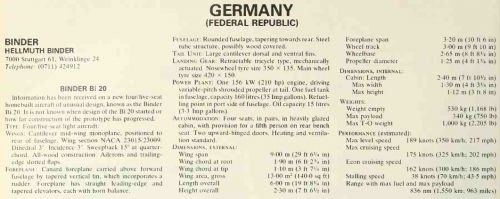
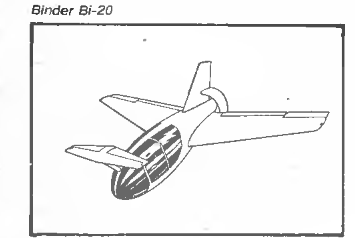
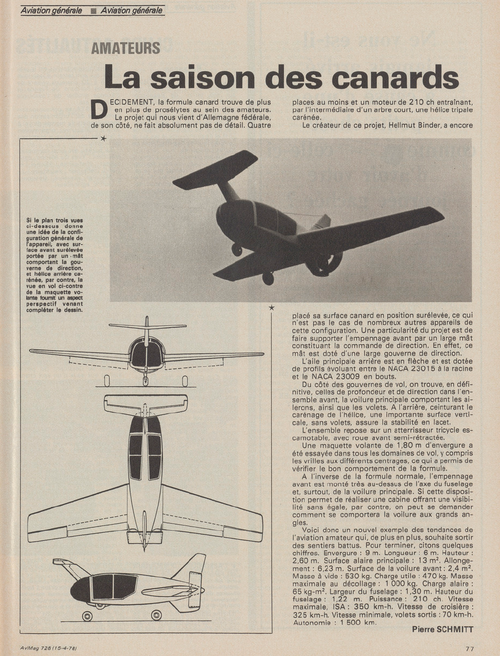
From JAWA 1973,

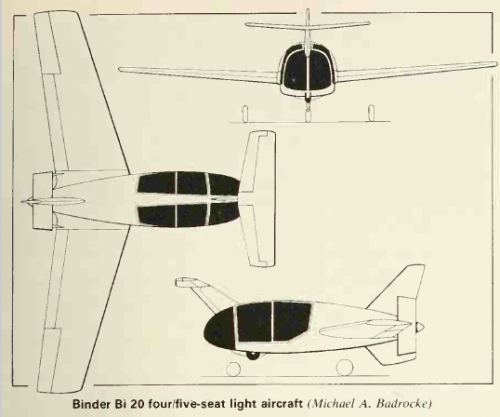
here is Binder Bi 20,it was unusual 4/5 seat low-mid-wing light airplane Project,with
canard shape and powered by a pusher engine.
 

Attachments

  • 33.png
    33.png
    82.1 KB · Views: 239
  • 34.png
    34.png
    240.9 KB · Views: 229
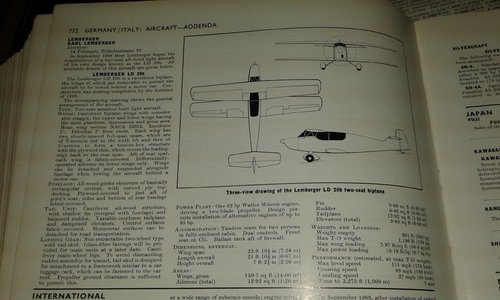
From JAWA 1969,

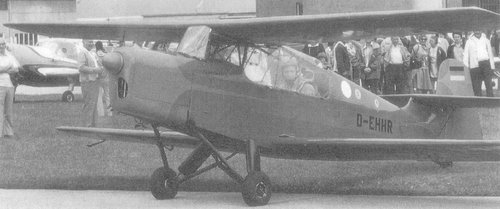
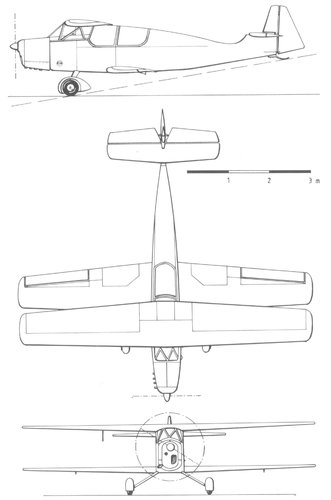
here is a Lemberger LD 20b two seat amateur-built light aircraft.
 

Attachments

  • ٢٠١٩١١٢٠_١٧١٦٤٩.jpg
    ٢٠١٩١١٢٠_١٧١٦٤٩.jpg
    1.5 MB · Views: 120
Anybody knows something about the Binder B.24?

Bruno Lange: Typenhandbuch der Deutschen Luftfahrttechnik:
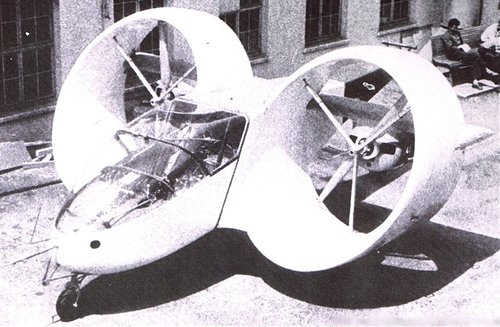
B-24A, double ring wing STOL aircraft, with 2 66kW (90PS) Continental C90. The prototype was under construction at Schempp-Hirth, the development was canceled.
 
Last edited:
This is the only pohoto of the Binder B-24 I ever saw.
The details I have:
4-seat sport
two 90hp Continental C90 piston engines
DETAILS: In 1958 Binder Aviatik KG started development of the 4-seat B-24 sport aircraft and a prototype was completed in September 1959. The forward fuselage and the wings were constructed by Schempp-Hirth Flugzeugbau KG and the aircraft underwent ground trials, but the project was terminated in 1960. The B-24 had a very unusual configuration with two large propellers turning in prominent shrouds and the aircraft was powered by two 90hp Continental C90 engines. Instead Binder Aviatik acquired a licence for the much more conventional Piel CP-30 Émeraude and then built an own variant as the CP-301S Smaragd (qv).
Production: 1 (unflown)
 

Attachments

  • Binder B-24.jpg
    Binder B-24.jpg
    137.4 KB · Views: 113
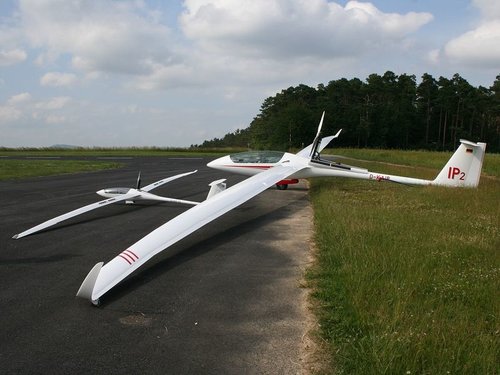
Binder actually build two sailplanes in series, the EB.28 and EB.29.
 

Attachments

  • Binder EB-28.jpg
    Binder EB-28.jpg
    80.2 KB · Views: 98
  • Binder EB-29.jpg
    Binder EB-29.jpg
    146.2 KB · Views: 97
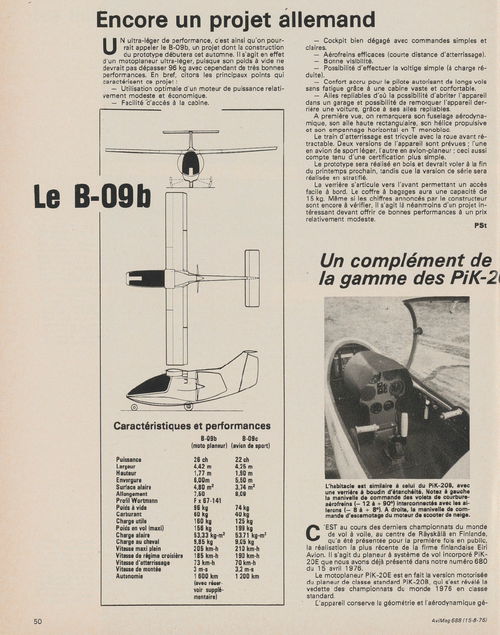
From Aviation magazine 1976,

what was this B-09 ?.
 

Attachments

  • 11.png
    11.png
    1.8 MB · Views: 56
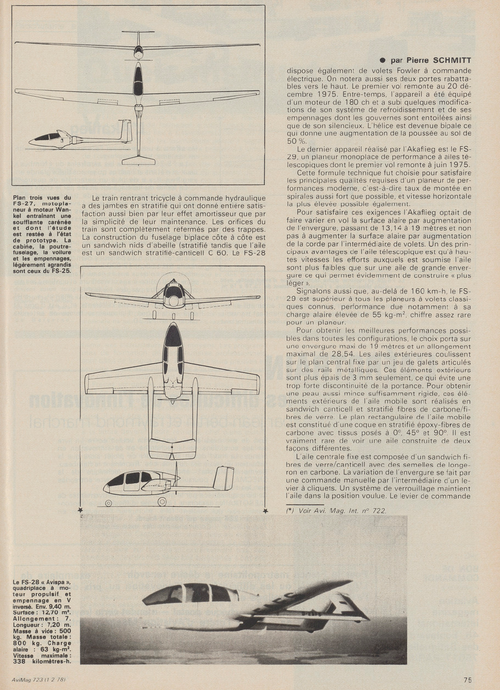
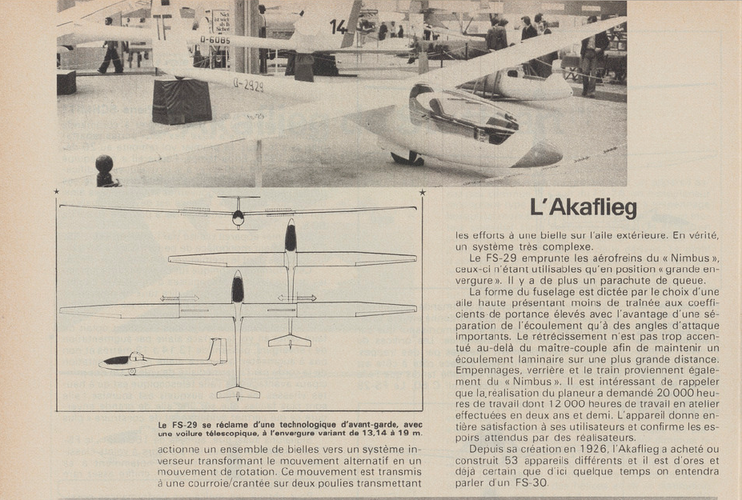
From Aviation magazine 1978.
 

Attachments

  • 4.png
    4.png
    1.8 MB · Views: 44
  • 5.png
    5.png
    1 MB · Views: 50
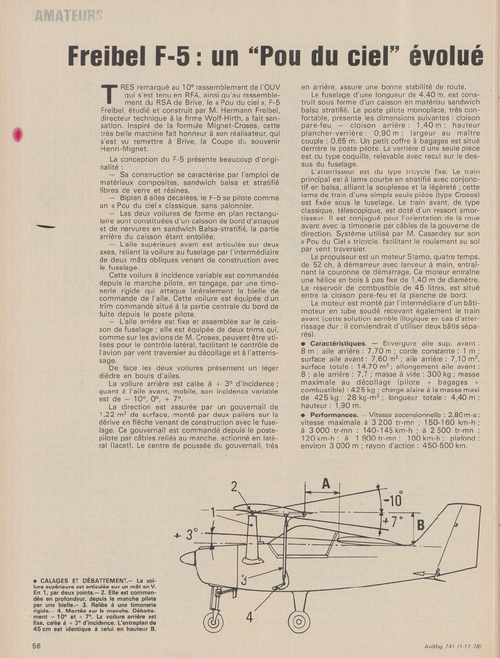
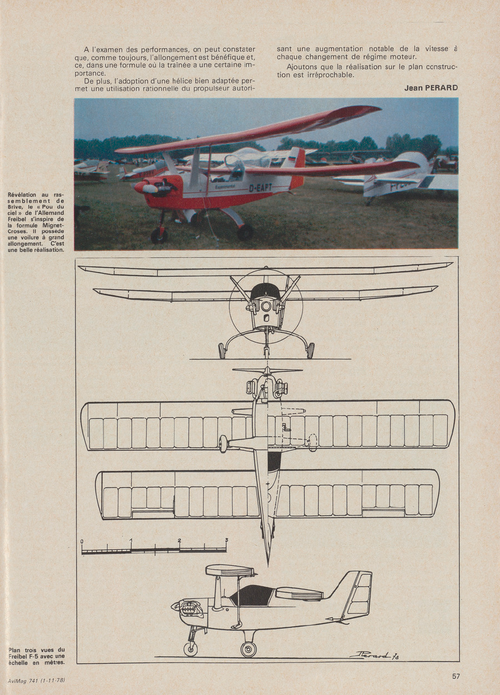
From Aviation magazine 1978,

the Frebel F-5.
 

Attachments

  • 4.png
    4.png
    1.8 MB · Views: 42
  • 5.png
    5.png
    2 MB · Views: 53
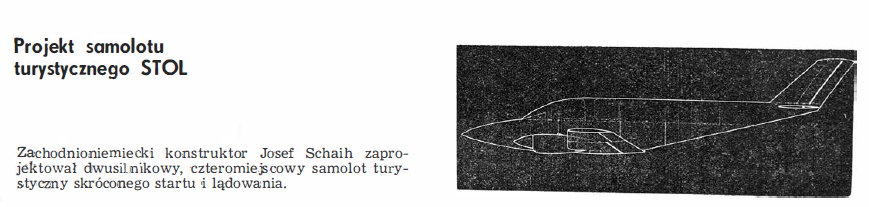
From Technika Lotnicza 1971,

West German designer Josef Schaih designed a twin-engine, four-seat touring aircraft with short takeoff and landing capabilities.

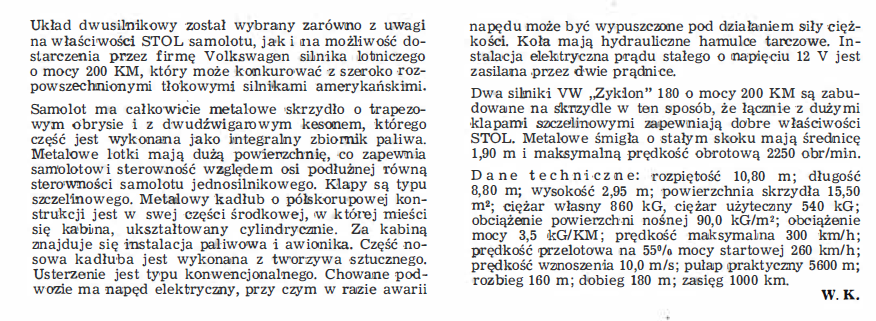
The twin-engine configuration was chosen both because of the aircraft's STOL capabilities and because Volkswagen could supply a 200 hp aircraft engine, which could compete with the widely used American piston engines.

The aircraft has an all-metal wing with a trapezoidal outline and a two-spar box, part of which serves as an integral fuel tank.

The metal ailerons have a large surface area, providing the aircraft with controllability about the longitudinal axis equivalent to that of a single-engine aircraft. The flaps are slotted. The metal fuselage, with a semi-shell construction, is cylindrical in its central section, which houses the cabin. Behind the cabin are the fuel system and avionics. The nose section of the fuselage is made of plastic.
The tailplane is of a conventional type. The retractable landing gear is electric, but in the event of a drive failure, it can be extended by gravity.
The wheels have hydraulic disc brakes. The 12V DC electrical system is powered by two generators.
Two 200 hp VW "Zyklon" 180 engines are mounted on the wing so that, together with large slit flaps, they provide good STOL capabilities. The metal fixed-pitch propellers have a diameter of 1.90 m and a maximum rotational speed of 2,250 rpm.
Technical data: wingspan 10.80 m; length 8.80 m; Height 2.95 m; wing area 15.50 m²; empty weight 860 kg, useful load 540 kg; wing loading 90.0 kg/m²; power load 3.5 kg/hp; maximum speed 300 km/h; cruise speed at 55% takeoff power 260 km/h; rate of climb 10.0 m/s; practical ceiling 5600 m; takeoff run 160 m; ground run 180 m; range 1000 km.
 

Attachments

  • 2.png
    2.png
    116.1 KB · Views: 14
  • 3.png
    3.png
    261.4 KB · Views: 14
Back
Top Bottom