You'd have to relocate the cockpit to an An-124-like position. The A380 standard cockpit position is in front of the main deck.Just to illustrate what a strategic A380M might look like.

You are using an out of date browser. It may not display this or other websites correctly.
You should upgrade or use an alternative browser.
You should upgrade or use an alternative browser.
Future European Strategic Transport
- Thread starter apparition13
- Start date

- Joined
- 3 June 2006
- Messages
- 3,543
- Reaction score
- 6,229
Well, find those drawings of the Nord 600 again and call it in our times, the 'Airbus A600M'. 
See thread 'SNCAN (Nord) 6000':
https://www.secretprojects.co.uk/threads/sncan-nord-6000.7494/post-177746
See thread 'SNCAN (Nord) 6000':
https://www.secretprojects.co.uk/threads/sncan-nord-6000.7494/post-177746

- Joined
- 25 July 2007
- Messages
- 4,916
- Reaction score
- 5,537
If they're stupid enough to want to fight in their own country I don't know what to tell you.
My question could have been better phrased. I meant: Did Europeans still see flying MBTs to other continents as a strategic priority for them?

EmoBirb
ACCESS: Top Secret
- Joined
- 18 January 2025
- Messages
- 2,714
- Reaction score
- 6,959
Debatable. Currently European (as in the European portion of NATO) strategic outlook is firmly concerned with Eurasia first and foremost. With the MENA region to a lesser degree, but in these cases transport via ship across the Mediterranean Sea seems more economical, effective and reasonable. But, as far as I am aware, nobody in Europe is planning to deploy Leopards and Leclercs in inner Mongolia, the Andes, Alaska or Australia anytime soon.My question could have been better phrased. I meant: Did Europeans still see flying MBTs to other continents as a strategic priority for them?
So, as @H_K pointed out, the main incentive for a "strategic airlift" type aircraft, which could only be supplied by Airbus, is to also capitalize on the commercial market regarding super heavy or oversized payloads which have been previously handled by the An-124 and An-225. An-124 is aging and Il-100 is still in development, so right now would be the time for Airbus to capitalize on that opportunity before a Russian or possibly even Chinese design comes around and takes up significant potential market share. Ultimately the military benefits are a nice extra, but not something that Europe in the current environment desperately needs. If anything something above the A400M that is more akin to the C-17 would seem more in line with current European interests, and something that could find further export customers, while the market for extremely large aircraft like the An-124 or C-5 is ultimately more limited.
Scott Kenny
ACCESS: USAP
- Joined
- 15 May 2023
- Messages
- 19,656
- Reaction score
- 28,136
100% agreed. I mean, there's all of ~60x An-124s and ~130x C-5s.while the market for extremely large aircraft like the An-124 or C-5 is ultimately more limited.
So at best a total market of about 200 airframes.
EmoBirb
ACCESS: Top Secret
- Joined
- 18 January 2025
- Messages
- 2,714
- Reaction score
- 6,959
Realistically the market is even smaller. The C-5 is exclusively in military use and the USAF won't replace it with a foreign design. The An-124 operated by the VKS will also be replaced by an Ilyushin design. This leaves around a dozen aircraft in the hands of civilian operators which will need eventual replacement. Maybe Airbus can leverage their standing and find new market opportunities, but I doubt you'd be able to sell more than 30 of such An-124 equivalents to civilian operators around the globe. While a C-17 equivalent is of less interest to the civilian sector, it has far higher potential on the military export market.100% agreed. I mean, there's all of ~60x An-124s and ~130x C-5s.
So at best a total market of about 200 airframes.
Which is why I said that from a military POV a C-17/Il-76 style aircraft is what European militaries would need more, and what the market would desire as well. While a C-5/An-124 equivalent would capitalize on a unique market niche which it could possibly expand upon but which would ultimately still remain a niche and the overall fleet of military and civilian machines would probably not exceed 50 aircraft at best.

FighterJock
ACCESS: Above Top Secret
- Joined
- 29 October 2007
- Messages
- 7,256
- Reaction score
- 8,570
Hell freazing over springs to mind sadly in regards to a future foreign large strategic transport purchase by the USAF, I would think that the USAF would rather go on it's own in terms of a replacement for the C-5 Galaxy.
Scott Kenny
ACCESS: USAP
- Joined
- 15 May 2023
- Messages
- 19,656
- Reaction score
- 28,136
I dunno, they did very nearly buy the Airbus tanker the second time around.Hell freazing over springs to mind sadly in regards to a future foreign large strategic transport purchase by the USAF, I would think that the USAF would rather go on it's own in terms of a replacement for the C-5 Galaxy.
Having a C-5/An-124 sized aircraft in production when the USAF looks to replace their C-5s would give you a very strong leg up. Though I'd want a very different set of flight-control laws in place, laws where the plane will allow the pilot to exceed the safe flying envelope if necessary.
FighterJock
ACCESS: Above Top Secret
- Joined
- 29 October 2007
- Messages
- 7,256
- Reaction score
- 8,570
Thanks for mentioning the Airbus tanker Scott Kenny, but they went with the KC-46 and what happened there?
Scott Kenny
ACCESS: USAP
- Joined
- 15 May 2023
- Messages
- 19,656
- Reaction score
- 28,136
Boeing protested and won the recompete. (And honestly, it was always intended to be some corporate welfare for Boeing to keep the 767 line open a little longer)Thanks for mentioning the Airbus tanker Scott Kenny, but they went with the KC-46 and what happened there?
But having a transport currently running off the assembly lines is a very different offer than "we can build the assembly line for these in 2 years and start having planes come off that line in 4".
So I think that Airbus should build their big-transport plane with An-124 cargo dimensions because at least that way the Oil Industry will buy a couple dozen, and possibly make it in two lengths like the C-141A vs C-141B.
FighterJock
ACCESS: Above Top Secret
- Joined
- 29 October 2007
- Messages
- 7,256
- Reaction score
- 8,570
Same thoughts here, I would really like to see a big strategic aircraft built by Airbus but whether they have the necessary funding to do such a thing remains to be seen.

Owens Z
quaerimus scientiam
- Joined
- 6 October 2023
- Messages
- 553
- Reaction score
- 820
"Strategic" and "outsize" brings to mind something that can carry an MBT intercontinental... Can any of the large Airbus aircraft be redesigned to carry Challenger/Abrams/Leapard 2, assuming a similar kind of design as ATOCA?
"Using a gradual approach" implies to me something other than a clean sheet design, hence my question about modifying an Airbus...
If they looked at an A380 freighter, then the obvious solution is to buy and convert a number of A380s that are being retired due to economic reasons. It would be faster and cheaper than building from scratch. Heck, buy the lot, convert a few, and keep the rest for spares. If the airlines are planning on scrapping them anyway it may be possible to get a lot of them cheap...
Same thoughts here, I would really like to see a big strategic aircraft built by Airbus but whether they have the necessary funding to do such a thing remains to be seen.
I like seeing a new aircraft as much as anyone, FighterJock. But...
Europe can buy lightly used A380 airliner engines cheaply, because those engines aren't operated by any other plane and thus have only scrap value. The UK-made A380 airliner wings had been designed to accommodate A380F heft. Yet because the fuselage is inherently unsuitable (a design flaw recognized only later), the effort of converting retired A380 airliners, however cheaply obtained, into A380F freighters would cost more than building new A380Fs from scratch. To reopen the complicated A380 production lines in France and Germany now would be possible, with political will. Those lines had lost a tremendous amount of taxpayer money building 251 airliners. To reopen those lines just to build two or three dozen A380Fs for Europe's armed forces, with judicious strengthening of the hold's floor to allow carry of armored fighting vehicles in addition to air freight containers, and then sell another dozen or so to big oil companies (maybe)—I think it safe to say this won't happen. And while I like H_K's art, the major redesign needed to shoehorn front and/or rear loading ramps in to the existing A380F design for Ro/Ro would make such a revived program even more expensive. No.
Europe might as well begin with a clean-sheet-of-paper design, and find some foreign partners with a similar requirement and deep pockets.
FighterJock
ACCESS: Above Top Secret
- Joined
- 29 October 2007
- Messages
- 7,256
- Reaction score
- 8,570
Agreed Owens Z, we need a clean-sheet design for the strategic transport and look towards Australia and Canada for a start of point for foreign partners to help fund the project.
Owens Z
quaerimus scientiam
- Joined
- 6 October 2023
- Messages
- 553
- Reaction score
- 820
An idea from the French magazine RAIDS Aviation, illustrated by Nikaus. I quote the artist:
Interesting, TomTom; thank you. I had not heard of this prospective Airbus A600M transport, an enhanced A400M made straightforwardly (and perhaps relatively inexpensively?) by lengthening the existing wing and fuselage and adding a fifth and sixth engine; perhaps inspired by how the Antonov An-124 became the An-225. I know that ATR 42 and bigger ATR 72 airliners use the same assembly line, as the line had been designed to accommodate: perhaps the A600M could likewise be built alongside A400Ms.
A load of 50,000kg still doesn't get this A600M to the capacity of a C-17 or Xi'an Y-20 or a late-model Ilyushin Il-76, but the increase could be useful.

Err... but if your country is attacked or invaded, you have no choice but to fight in your own country on your own territory; that doesn’t make you stupid.If you fight in your own country, you're going to wreck your own country.
If you can fight in the other guy's country, you're going to wreck his country.
Which of those two options is better for your country?
The Baltics? Should have all their tank units on a hair trigger to go charging into the depths of Russia, like the US forces in Germany in the 1980s/90s.
Take Ukraine at the moment, for example.
Not every country is lucky enough to have almost an entire continent to itself and borders only with two countries that are far weaker militarily.
Scott Kenny
ACCESS: USAP
- Joined
- 15 May 2023
- Messages
- 19,656
- Reaction score
- 28,136
Would it be possible to reuse A380 engines and wings but with a clean sheet fuselage?I like seeing a new aircraft as much as anyone, FighterJock. But...
Europe can buy lightly used A380 airliner engines cheaply, because those engines aren't operated by any other plane and thus have only scrap value. The UK-made A380 airliner wings had been designed to accommodate A380F heft. Yet because the fuselage is inherently unsuitable (a design flaw recognized only later), the effort of converting retired A380 airliners, however cheaply obtained, into A380F freighters would cost more than building new A380Fs from scratch. To reopen the complicated A380 production lines in France and Germany now would be possible, with political will. Those lines had lost a tremendous amount of taxpayer money building 251 airliners. To reopen those lines just to build two or three dozen A380Fs for Europe's armed forces, with judicious strengthening of the hold's floor to allow carry of armored fighting vehicles in addition to air freight containers, and then sell another dozen or so to big oil companies (maybe)—I think it safe to say this won't happen. And while I like H_K's art, the major redesign needed to shoehorn front and/or rear loading ramps in to the existing A380F design for Ro/Ro would make such a revived program even more expensive. No.
Europe might as well begin with a clean-sheet-of-paper design, and find some foreign partners with a similar requirement and deep pockets.
Are the wings adaptable to high wing/anhedral installation?
Preemptive self defense has been an established concept for at least 20 years now.Err... but if your country is attacked or invaded, you have no choice but to fight in your own country on your own territory; that doesn’t make you stupid.
Take Ukraine at the moment, for example.
Not every country is lucky enough to have almost an entire continent to itself and borders only with two countries that are far weaker militarily.
And what if you don't have the means to do use "Preemptive self defense" against a much more powerful aggressive neighbour? Does that makes you a stupid country ?Preemptive self defense has been an established concept for at least 20 years now.
Last edited:
Owens Z
quaerimus scientiam
- Joined
- 6 October 2023
- Messages
- 553
- Reaction score
- 820
On 16 nov 2021, the European Council has adopted a new wave of joint projects within the Permanent Structured Cooperation (PESCO) framework. One of these is for a new strategic transport...
An-380 isn't a good starting point for an outsize-loads transport: the upper deck floor gets in the way. You can't easily remove it either as it holds the fuselage in shape. This severely limits the height of the loads you can carry (no more than 2.5m height over the main deck, compared to 4.5m for the An-124). Its payload is enormous (150t), but it's more suited for LD3 containers than outsize loads.
Sorry you're getting an answer so late. Yes, the French did have plans and conceptual designs for a very large, high-wing airlifter in the 60s- the SNCAN(Nord) 6000. It would've absolutely dwarfed the C-5/An-124 or even the An-225, with far greater payload capacity (about 450 tonnes). However I have doubts on its rough-field capability as well as the number of paved airfields that could sustainably operate an aircraft of this size, especially in Metropolitan France...
European military requirements for such aircraft in terms of numbers? How many states outside of France and the UK even want to deploy extra-Europa? Australian needs? Indian?
In the OP, mentioned RO/RO for MBTs and an intercontinental range. I am wondering if, today, anyone still sees flying European tanks to other continents as a strategic priority?...
Well, find those drawings of the Nord 600 again and call it in our times, the 'Airbus A600M'...
My question could have been better phrased. I meant: Did Europeans still see flying MBTs to other continents as a strategic priority for them?
Agreed Owens Z, we need a clean-sheet design for the strategic transport and look towards Australia and Canada for a start of point for foreign partners to help fund the project.
It's true that the USAF's worldwide range is unique. Still, for more likely requirements, to fly tanks or other 150-ton loads intracontinental would remain impressive for a new-design transport of A380F/An-124 size. Say, UK to Cyprus, or France to Finland, or Australia's SE to NW. A full-load range of 1800 nautical miles would allow any of those flights. (For comparison, the An-124 can do about 2000 nm.) Nova Scotia to Vancouver (2400 nm) would need a bit more.
The subcontinent is another large-dimension nation facing threats, therefore a possible partner. Indonesia might buy one or two for disaster relief. Japan, for reinforcement of its Sakishima Islands in case an emergency arises. And further sales to the civilian An-124 and Beluga customers of the past thirty years. And maybe for what follows the Ariane 6 rocket, ArianeGroup will prefer to air-ship the vehicle to French Guiana for launch, rather than continue the slow water route.
Enough prospective sales to start some preliminary plans in Europe?
Scott Kenny
ACCESS: USAP
- Joined
- 15 May 2023
- Messages
- 19,656
- Reaction score
- 28,136
200 birds? maybe.Enough prospective sales to start some preliminary plans in Europe?
How much did it cost to develop the A380 again? ~25bn in 2005 Euros?
So we'd be looking at ~40bn in 2026 Euros, divided across 200 birds, means 200mil in development costs per bird plus materials costs. A320neo costs about 1.65mil per ton, A380 MTOW is 575tons, so expected cost for "Airbus-124" is 950mil-1.15bn per plane.
Can you convince the Powers That Be that a billion dollars a plane is reasonable or affordable?
Would it be possible to reuse A380 engines and wings but with a clean sheet fuselage?
Are the wings adaptable to high wing/anhedral installation?
New fuselage should be doable, see the Beluga/SP conversions. Using the same wing in a high wing configuration might be a lot harder to do.

- Joined
- 26 May 2011
- Messages
- 2,630
- Reaction score
- 4,651
BAe Woodford examined a number of these designs based on the A300 series. See On Atlas' Shoulders.New fuselage should be doable, see the Beluga/SP conversions. Using the same wing in a high wing configuration might be a lot harder to do.
Chris

From my understanding, and I should have thought about this in my initial post, this perspective is not from AIRBUS but from the magazine authors.Interesting, TomTom; thank you. I had not heard of this prospective Airbus A600M transport, an enhanced A400M made straightforwardly (and perhaps relatively inexpensively?) by lengthening the existing wing and fuselage and adding a fifth and sixth engine; perhaps inspired by how the Antonov An-124 became the An-225. I know that ATR 42 and bigger ATR 72 airliners use the same assembly line, as the line had been designed to accommodate: perhaps the A600M could likewise be built alongside A400Ms.
A load of 50,000kg still doesn't get this A600M to the capacity of a C-17 or Xi'an Y-20 or a late-model Ilyushin Il-76, but the increase could be useful.
The development of such machines would make sense within the framework of a European QRF, standardized in terms of equipment and organization. This would ensure that—regardless of whether it were a Spanish, Greek, or Polishbattalion—it would be clear exactly what could be deployed and where: from Ceuta to Riga or Rhodes.
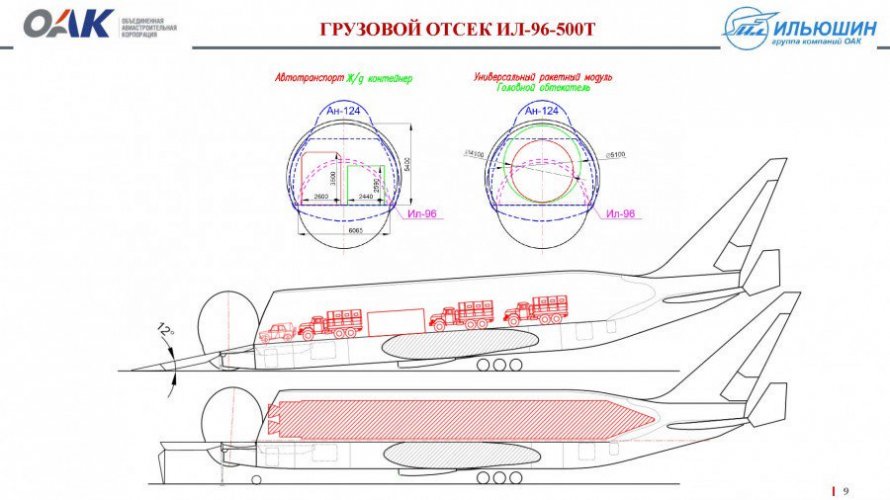
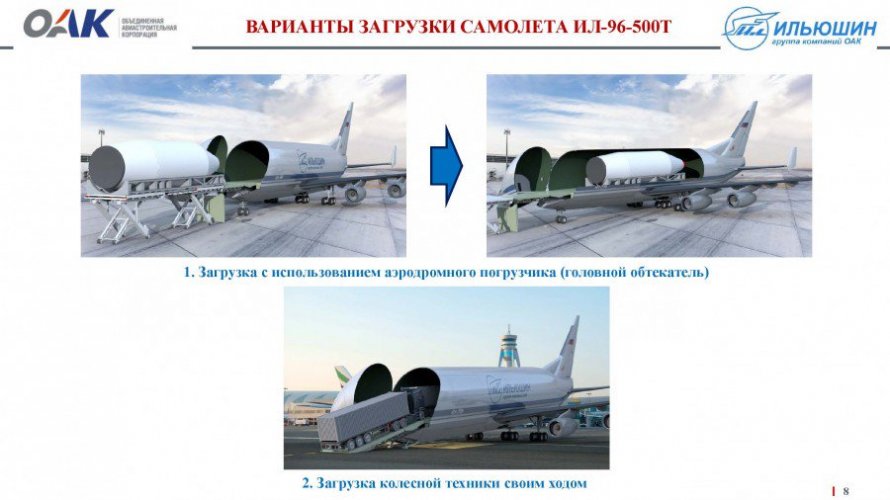
I just discovered that Ilyushin had a similar project, the IL-96-500T.
https://www.secretprojects.co.uk/threads/ilyushin-il-96-projects.10695/post-350889
What's interesting is:
https://www.secretprojects.co.uk/threads/ilyushin-il-96-projects.10695/post-350889
What's interesting is:
a) The mix of military and civilian missions (strategic airlift, AN124-style civilian cargo charters, space support)
b) The high reuse of IL-96 components (wing, engines, bottom fuselage)
c) Similar modifications to those I was envisioning (new swivel nose, unpressurized main cargo hold, kneeling landing gear)
d) Most of all, the small production run - only 16-aircraft!
So overall it would seem viable to leverage an existing design to reduce development costs and enable small scale production. The benefit of starting with an A380 platform is that you could reuse wings and engines from stored aircraft, perhaps also other parts of the fuselage (tail section?) and internal systems, with a much higher payload than the Il-96 (2x the Il-96's max take off weight).Attachments
Last edited:
Scott Kenny
ACCESS: USAP
- Joined
- 15 May 2023
- Messages
- 19,656
- Reaction score
- 28,136
It'd be more-or-less affordable to Beluga/Super Guppy/Dreamlifter convert an existing airframe design.I just discovered that Ilyushin had a similar project, the IL-96-500T.
https://www.secretprojects.co.uk/threads/ilyushin-il-96-projects.10695/post-350889
What's interesting is:
a) The mix of military and civilian missions (strategic airlift, AN124-style civilian cargo charters, space support)b) The high reuse of IL-96 components (wing, engines, bottom fuselage)c) Similar modifications to those I was envisioning (new swivel nose, unpressurized main cargo hold, kneeling landing gear)d) Most of all, the small production run - only 16-aircraft!So overall it would seem viable to leverage an existing design to lower development costs and enable small scale production. The benefit of starting with an A380 platform is that you could reuse wings and engines from stored aircraft, perhaps also other parts of the fuselage (tail section?) and internal systems, with a much higher payload than the Il-96 (2x the Il-96's max take off weight).
My concern is all the staging you'd need to have for those at the loading and destination airports, versus a through-deck low deck high wing cargo plane like the C-5 or An-124.
And, again, you do need to be able to land the aircraft doing loads for the oil industry on some sketchy runways that could even be gravel(!). Yes, the oil industry could likely afford to pave the runways and leave the staging for such aircraft.
But for military use, you'd need to fly an A400/A600 in with the staging, then your Super Beluga, then another A400/600 to recover the staging at the end of the job.

- Joined
- 13 August 2007
- Messages
- 10,423
- Reaction score
- 18,114
What defined a Future European Strategic Transport ?
what is needed to be transported ?
Military equipment, troops, Rescue equipment, aid supplies, refugees.
do it serve also as commercial cargo-plane ?
Has to land on Take-off and landing runway only or unpaved fields ?
Is STOL needed ?
If all answers are yes
You need something like C-17
if only Take-off and landing runway
you need a four engine Airbus Beluga (with longer fuselage)
what is needed to be transported ?
Military equipment, troops, Rescue equipment, aid supplies, refugees.
do it serve also as commercial cargo-plane ?
Has to land on Take-off and landing runway only or unpaved fields ?
Is STOL needed ?
If all answers are yes
You need something like C-17
if only Take-off and landing runway
you need a four engine Airbus Beluga (with longer fuselage)
I was once firmly on the side of "nah, airliners can't be turned into B-52s (bombers) or C-5 Galaxy (military cargo planes). I have to say however that the modified 747s and Beluga XLs changed my opinion.
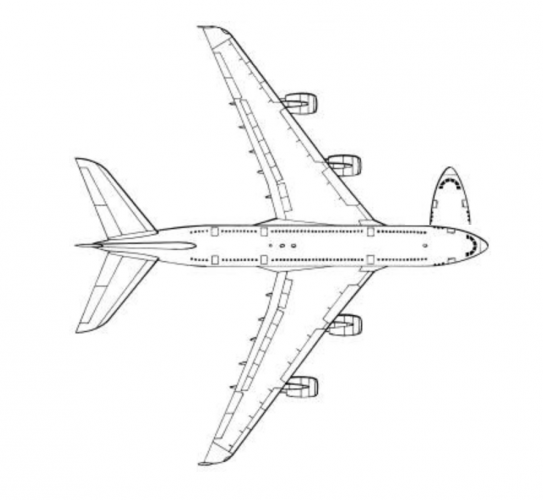
About the A380, the classic "nose hinged upwards" can't work since the cockpit is on the way. But how about cutting and pivoting the cockpit laterally, as done by Conroy on the Guppies ? then with kneeling of the nosewheel and a limited ramp, one can load big payloads as practically as on a C-5 Galaxy.
How hard would it be, compared to Beluga modifications to A300 and A330 airframes ?
(please excuse that pathetic jury-rigged picture)

About the A380, the classic "nose hinged upwards" can't work since the cockpit is on the way. But how about cutting and pivoting the cockpit laterally, as done by Conroy on the Guppies ? then with kneeling of the nosewheel and a limited ramp, one can load big payloads as practically as on a C-5 Galaxy.
How hard would it be, compared to Beluga modifications to A300 and A330 airframes ?
(please excuse that pathetic jury-rigged picture)
Last edited:
I'm not following. You won't need any special unloading equipment if the aircraft can kneel and use its own ramp for roll-on/roll-off.My concern is all the staging you'd need to have for those at the loading and destination airports, versus a through-deck low deck high wing cargo plane like the C-5 or An-124.
And, again, you do need to be able to land the aircraft doing loads for the oil industry on some sketchy runways that could even be gravel(!). Yes, the oil industry could likely afford to pave the runways and leave the staging for such aircraft.
But for military use, you'd need to fly an A400/A600 in with the staging, then your Super Beluga, then another A400/600 to recover the staging at the end of the job.
Also do you have any examples of "sketchy" runways used by the AN-124? I can't find a single photo of the AN-124 landing on gravel or dirt (despite the fact that it has the capability on paper). I also reviewed hundreds of Antonov Airlines charter flights and 99% of them are between airports with 3,000m+ runways designed for heavy take-offs by widebody aircraft. The other 1% of flights are to/from smaller airports with 2,500-2,700m runways... still fine for a large jet carrying oversize loads on shorter legs with less than full fuel load.
Oil & gas missions follow the same pattern... destinations such as Calgary, Mobile, New Orleans, or even Baku all have big runways.
So all in all it doesn't seem like runway limitations are a major constraint for typical civilian and military charters. For everything else, there's C-17s and A400Ms.
I'm not following. You won't need any special unloading equipment if the aircraft can kneel and use its own ramp for roll-on/roll-off.
Also do you have any examples of "sketchy" runways used by the AN-124? I can't find a single photo of the AN-124 landing on gravel or dirt (despite the fact that it has the capability on paper). I also reviewed hundreds of Antonov Airlines charter flights and 99% of them are between airports with 3,000m+ runways designed for heavy take-offs by widebody aircraft. The other 1% of flights are to/from smaller airports with 2,500-2,700m runways... still fine for a large jet carrying oversize loads on shorter legs with less than full fuel load.
Oil & gas missions follow the same pattern... destinations such as Calgary, Mobile, New Orleans, or even Baku all have big runways.
So all in all it doesn't seem like runway limitations are a major constraint for typical civilian and military charters. For everything else, there's C-17s and A400Ms.
The A380 main deck is higher off the ground than that of the An-124: first estimate is about 3 m vs. 1 m for the An-124. The An-124 kneeling function puts the front edge of the deck even closer to the ground. IDK if the A380 main wheel trucks can support kneeling without modification.
At 3 meters, you need a big, sturdy ramp to load a hundred tons. You don't want to lose 20t and 1/4 of your cargo volume by carrying a massive ramp.
The A380 main deck is higher off the ground than that of the An-124: first estimate is about 3 m vs. 1 m for the An-124. The An-124 kneeling function puts the front edge of the deck even closer to the ground. IDK if the A380 main wheel trucks can support kneeling without modification.
At 3 meters, you need a big, sturdy ramp to load a hundred tons. You don't want to lose 20t and 1/4 of your cargo volume by carrying a massive ramp.
Dang. There goes my kneeling idea. Even after moving the entire cockpit / forward fuselage to the side, there is still that problem. Readily agree that ramps can get very heavy very quickly.
We need an A380 cutaway. https://www.reddit.com/media?url=https://i.redd.it/1jhw8gugt7yx.jpg
A good view of an A380 cargo hatch and how it is loaded. Clearly that cargo deck is perched very high, just look at the guy standing in the door treshold. If he is 1.80 m tall, then the height relative to the ground is twice more.
https://www.reddit.com/media?url=https://preview.redd.it/could-you-mod-the-a380-to-be-a-versatile-cargo-aircraft-v0-rydmjv5dzi891.jpg?width=1080&crop=smart&auto=webp&s=d9fe8727faf3709128897c327d08eb3d598afe6f
Last edited:
The A380 main deck is higher off the ground than that of the An-124: first estimate is about 3 m vs. 1 m for the An-124. The An-124 kneeling function puts the front edge of the deck even closer to the ground. IDK if the A380 main wheel trucks can support kneeling without modification.
At 3 meters, you need a big, sturdy ramp to load a hundred tons.
However it's interesting that Ilyushin thought they could pull it off with their Il-96-500T (door sill height: 4.5m), by adding a 12 degree ramp and kneeling landing gear. The A380 would be in a similar boat, but with the advantage of more payload margin to carry a longer/heavier ramp if needed.
Not denying that loading will create constraints and require a some big design changes, but certainly much less than designing an all-new aircraft. So the question becomes can it be made to work and come close to the AN-124's ease of operation?
Not James Stockdale
ACCESS: Secret
- Joined
- 29 August 2025
- Messages
- 255
- Reaction score
- 477
Boeing's entry into the C-5 program was a design that was based on the 747 and looked almost exactly like an An-124. If we knew how much that design actually had in common with the 747, that could tell us how much if the A380 might be usable in an airlifter.
You know, I wonder whether four GE90s could compensate for the mass of the ramp. Boom, job done.However it's interesting that Ilyushin thought they could pull it off with their Il-96-500T (door sill height: 4.5m), by adding a 12 degree ramp and kneeling landing gear. The A380 would be in a similar boat, but with the advantage of more payload margin to carry a longer/heavier ramp if needed.
Not denying that loading will create constraints and require a some big design changes, but certainly much less than designing an all-new aircraft. So the question becomes can it be made to work and come close to the AN-124's ease of operation?
By the way, payload of the never-built A380-800F was to be 158 metric tons, a bit more than an An-124 (150 mt) and much more than a 747-200F (113 mt) and a C-5A (120 mt ?)
A quick internet search told me the 747-8F can carry 139 mt and the C-5M, 127 mt.
Not James Stockdale
ACCESS: Secret
- Joined
- 29 August 2025
- Messages
- 255
- Reaction score
- 477
I know it's probably beyond Embraer's capability to handle by themselves, but an enlarged version of the C-390 would be practically identical to the Y-20 in capability and appearance. With 4 x 31k lbf engines, I would expect a payload of 60-70 tons. I don't know if there is anyone left in Europe outside of Airbus who could be a partner on a project like that.
An A380 has the same amount of thrust as the An-225, but it lacks 30 ft if wingspan and 50 m^2 of wing area compared to the An-225. Based on the TWRs and wing areas of military transports like the An-124 and C-5, I would expect a payload around 180 - 200 tons. Overall dimensions would probably be about the same as an A380, with a length of 240 ft and wingspan of 260 ft compared to the An-124's length of 226 ft and wingspan of 240 ft.
An A380 has the same amount of thrust as the An-225, but it lacks 30 ft if wingspan and 50 m^2 of wing area compared to the An-225. Based on the TWRs and wing areas of military transports like the An-124 and C-5, I would expect a payload around 180 - 200 tons. Overall dimensions would probably be about the same as an A380, with a length of 240 ft and wingspan of 260 ft compared to the An-124's length of 226 ft and wingspan of 240 ft.
Last edited:
EmoBirb
ACCESS: Top Secret
- Joined
- 18 January 2025
- Messages
- 2,714
- Reaction score
- 6,959
For everything else, there's C-17s and A400Ms.
Except that there are less than 15 C-17s in european hands, an aircraft that's not in production anymore and of american origin. Thus a military oriented european airlift should seek to replace that capability within Europe. Be it an evolution of the Atlas or a clean sheet design.
Scott Kenny
ACCESS: USAP
- Joined
- 15 May 2023
- Messages
- 19,656
- Reaction score
- 28,136
100% agree here.Thus a military oriented european airlift should seek to replace that capability within Europe. Be it an evolution of the Atlas or a clean sheet design.
Europe should actively be working on developing a large airlifter. Possibly one with two different lengths, but cargo box should be An-124 width and height. The shorter version would make a decent C-17 replacement, the longer one would serve in C-5/An-124 missions.
It is absolutely possible to lean on the oil industry to help fund the replacement for the Airlifter that their entire industry is built around.

shin_getter
ACCESS: Top Secret
- Joined
- 1 June 2019
- Messages
- 1,491
- Reaction score
- 2,192
I get the feeling that Europe should instead figure out how to disassemble every important piece of kit into small payloads.
It seems like even transport submarines make more sense in a world where even very weak powers can just TBM expensive airplanes with help from 3rd party targeting.
It seems like even transport submarines make more sense in a world where even very weak powers can just TBM expensive airplanes with help from 3rd party targeting.
Scott Kenny
ACCESS: USAP
- Joined
- 15 May 2023
- Messages
- 19,656
- Reaction score
- 28,136
Then you have to reassemble everything at the destination. Which takes a lot of time.I get the feeling that Europe should instead figure out how to disassemble every important piece of kit into small payloads.
It seems like even transport submarines make more sense in a world where even very weak powers can just TBM expensive airplanes with help from 3rd party targeting.
Crud, it takes about 72hrs to fully re-load and re-equip a Stryker unit moved by air, let alone anything heavier.
Similar threads
-

-
 Lockheed Martin C-5M Super Galaxy replacement
- Started by Triton
- Replies: 46
-

-
-