Future European Strategic Transport

apparition13

I really should change my personal text
Joined
27 January 2017
Messages
728
Reaction score
1,343
"Strategic" and "outsize" brings to mind something that can carry an MBT intercontinental. C-17 is the small end of that scale. An-124 and C-5 are the large. Well, An-225 is the large, but that's a one off so far. I suppose something like the ATOCA KC-33 proposal from Boeing in the competition the KC-10 won could also work. That involved raising the cockpit to create a single diameter space, adding a kneeling capability to the front wheels, and a fold up nose and ramp to allow for roll-on and roll-off, resulting in 105 tonnes of capacity including an Abrams. Can any of the large Airbus aircraft be redesigned to carry Challenger/Abrams/Leapard 2, assuming a similar kind of design as ATOCA?
 
Can any of the large Airbus aircraft be redesigned to carry Challenger/Abrams/Leapard 2, assuming a similar kind of design as ATOCA?
In principle I would think so, considering the scope of the changes made to create the Beluga and its XL version.


Capacity is 47 tonnes for the regular and 50 for the XL and they obviously need specialised loading facilities. They're designed for outsize, not heavyweight cargo.

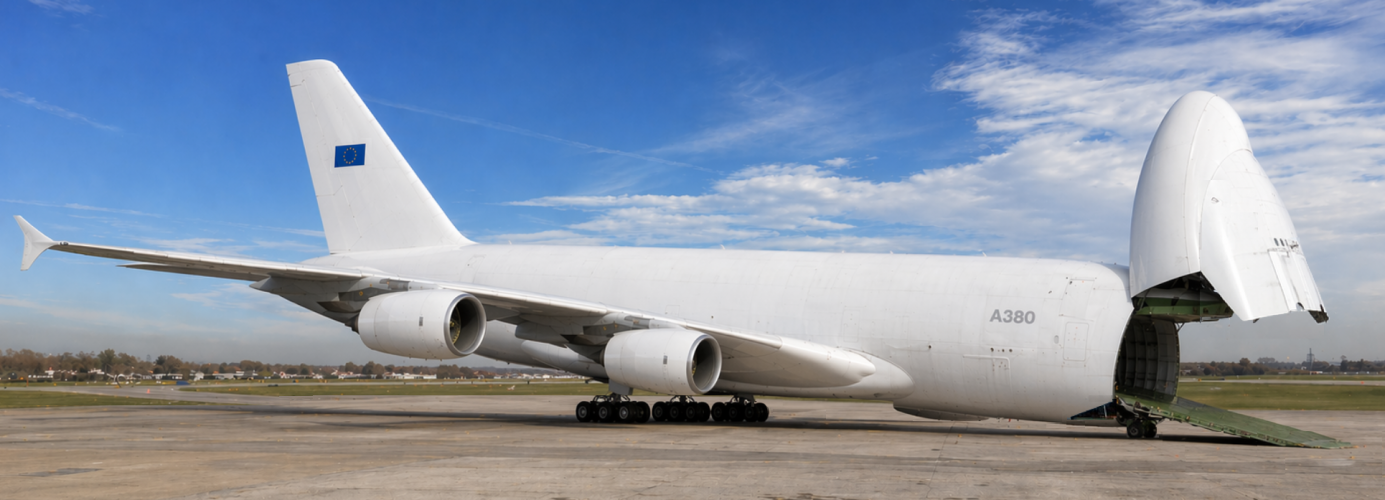
A cargo version of the A380 was proposed but not built. 150 tonnes in this case.


Production of the A380 ends with the delivery of the final aircraft to Emirates in December. I presume the tooling will be scrapped.

I suppose that in principle some second-hand A380s could be Belugized. That seems unnecessarily complicated though. Moreover the airframes and landing gear of civil aircraft would be hard to adapt to military requirements.

Antonov has floated the idea of resuming An-124 production:

In August 2014, it was reported that plans to resume joint production of the Antonov An-124 had been shelved due to the ongoing political tensions between Russia and Ukraine.

https://en.wikipedia.org/wiki/Antonov_An-124_Ruslan


Maybe that might be a route, if a need were identified, with a joint venture not with Russia but with NATO/EU or individual states. It could be called the An-124MF ('MF" for 'Middle Finger' - to Putin).
 
Last edited:
Back in 1999 Airbus made a (desperate) Beluga bid to Great Britain against C-17s. Did not worked too well... Belugas are not build for "rough" fields and military missions (Kandahar airfield !)
 
So much horror at some of these suggestions! The beluga's are purpose designed to carry wings, with that 47 tons spread out throughout the length of the fuselage, not built to take a Stripped down Challenger tank, no matter how carefully driven. Also the Beluga's use purpose built loading and unloading buildings, they dont have cranes, ramps etc.

Hacking an A380 with a large jigsaw, again, built for 500 wee people, not for tanks.

Either update or copy the C17 or refresh the AN124 with western engines and new avionics.

And given the torture and cost to Airbus of the A400 I cant see them volunteering to lead this, for the glory of total sales of 24 airframes, over 20 years......
 
So much horror at some of these suggestions! The beluga's are purpose designed to carry wings, with that 47 tons spread out throughout the length of the fuselage, not built to take a Stripped down Challenger tank, no matter how carefully driven. Also the Beluga's use purpose built loading and unloading buildings, they dont have cranes, ramps etc.

Hacking an A380 with a large jigsaw, again, built for 500 wee people, not for tanks.

Either update or copy the C17 or refresh the AN124 with western engines and new avionics.

And given the torture and cost to Airbus of the A400 I cant see them volunteering to lead this, for the glory of total sales of 24 airframes, over 20 years......
"Using a gradual approach" implies to me something other than a clean sheet design, hence my question about modifying an Airbus.

I agree with you on both the An-124 and C-17. I have my doubts about Antonov since Ukraine doesn't seem to have the capacity to build much of anything in any quantity right now. I suspect getting those lines running again would be almost as big an investment as restarting C-5 production, but buying Antonovs (An70 is also a promising design) would also be a way to support Ukraine against Putin.

Shutting the C-17 production line falls into the "worst decisions in aviation history" category for me. It was the only strategic transport being produced; shutting production of the only anything being produced is idiotic. If you're concerned with airfields, the C-17B proposal with rough field capability could have addressed that. Personally I like the C-17FE design as well, and think with its rough field capability it would have made a good replacement for the C-135 airframe in the KC, AWACS, ELINT, etc. roles. A fine way to untether all those large support aircraft from long runways.

If you're really in the mood to replace the C-130 the Embraer 390 and Kawasaki C-2 (a bit bigger, but longer ranged and airliner fast) are both in production. I don't know if they would need to be modified for rough field operations or not, but it should be quicker than a new design. Or help Antonov get the An-70 up and running. Any of those options would be better than waiting 20 years for a new design to mature.
 
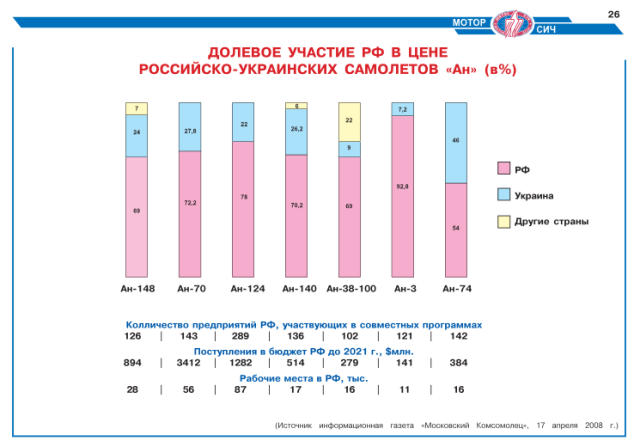
I would say antonov large transports are out of questions. due to how dependent they are to Russia. That includes AN-70 whose 70% of its components are Made in Russia. and AN-124 also accounts for considerable amount of Russian parts.

174902_900.png
 
Sensible but unlikely option: license the An-124 design, update design with Airbus avionics and Western engines, build in Airbus factories.
Certainly wouldn’t be the first time it’s been mused; four Trents on a An-124 derivative would be handsome.
 
Thread has gotten a bit muddled by splitting it off.

On 16 nov 2021, the European Council has adopted a new wave of joint projects within the Permanent Structured Cooperation (PESCO) framework.

One of these is for a new strategic transport:
  • Strategic Air Transport for Outsized Cargo
    The 5-nation project Strategic Air Transport for Outsized Cargo (SATOC) aims to fill the critical shortfall for strategic transport for outsized and heavy cargo, a crucial enabler for military missions and operations. SATOC involves a gradual 3-step approach, firstly by identifying a sufficient number of project members – with possible third state participation, harmonising requirements and finally identifying and agreeing on a common European solution for the transport of outsized cargo.

    The five participating nations are: Germany, Czechia, France, Netherlands, Slovenia. An initial project timeline for the collection and harmonisation of requirements will run until 2023 with a possible agreement on a European solution and a follow-on project foreseen in 2026.

More details:

In 2018, it was estimated that two-thirds of the needs of the French forces in terms of strategic airlift to foreign theaters of operations depended on the charter of “oversized” civilian planes, i.e. under the SALIS contract. [Solution intérimaire pour le transport aérien stratégique] awarded by NATO to a private company [Antonov Logistics Salis, en l’occurrence], or via a so-called “order form” procedure, which gave rise to the opening of an investigation by the National Financial Prosecutor’s Office because of hiring deemed “excessively expensive” of wide-body aircraft by the Ministry of the Armed Forces.

But in either case, this strategic airlift capability relies essentially on the AN-124-100 aircraft, capable of carrying a load of 120 tonnes in a single flap, and incidentally. [sous réserve des disponibilités] on type AN-22 and IL-76 devices.
So France initiated this.
If it had not been canceled in 2007, the Airbus A380-800F cargo project, with its capacity to carry up to 150 tonnes of cargo, could have been the ideal candidate for the SATOC program… Also, will it probably be necessary to develop a new aircraft, as suggested in November 2018 by General Philippe Lavigne, then Chief of Staff of the Air & Space Army? [CEMAAE]. Defending the idea of a “European runway in the field of very heavy and very large volume air transport”, he had indeed declared: “There is certainly a place for a large European heavy transport aircraft. […] We have a great aeronautics industry to face this challenge ”.
 
The most amazing thing there might be that nobody unleash on them an onslaught of insults for writing down the result of their analysis when those that similarly did the same a decade ago were systematically subject to such.

Amazing.
 
Last edited:
From the Pesco Project Proposals Assessment Report:

The RC sets the necessary number and
the PC identifies a lack of large “C17 – type” aircrafts contributing to achieve the EU
CSDP military LoA. The lifecycle for the remaining AN-124 fleet (the mainstay for the
strategic transport of over- and outsized cargo) is coming to an end and no
replacement is envisioned. From this perspective, the proposal mainly focuses on
consulting the main companies and see if they are able to transform existing planes
and provide Strategic transport as a service. The project mainly aims at providing a
feasibility study in the short term, but capabilities are unlikely to be provided in order
to support the EU military LoA in the short term (2026). In its current form, the project
does not seem to address any Operational Collaborative Opportunity.
RC=Requirements Catalogue
Currently, the project is a consultation of
existing industries to conduct a feasibility study, it will not bring new capabilities.
At this stage, it is understood that the project
may not provide capabilities committed to the Force Catalogue but Strategic Air
Transport as a service by contracting an industrial. Nonetheless, given the existing and
planned fleets of A 400M, this would greatly mitigate the related shortfall for loads
which are above A400M capabilities. Nonetheless, it appears that this program may
not be available to CSDP missions and operations in the medium term.
 
If they looked at an A380 freighter, then the obvious solution is to buy and convert a number of A380s that are being retired due to economic reasons. It would be faster and cheaper than building from scratch. Heck, buy the lot, convert a few, and keep the rest for spares. If the airlines are planning on scrapping them anyway it may be possible to get a lot of them cheap.

If the An-124 (and An-22) have been providing the service in the meantime, there may also be an opportunity to work with Ukraine to build new ones, but probably not in the Ukraine since I'm getting the impression the workforce doesn't exist for new build aircraft. A co-production agreement with Airbus might make sense.

Either way, the C-17 shutdown decision keeps looking worse and worse to me.
 
An-380 isn't a good starting point for an outsize-loads transport: the upper deck floor gets in the way. You can't easily remove it either as it holds the fuselage in shape. This severely limits the height of the loads you can carry (no more than 2.5m height over the main deck, compared to 4.5m for the An-124). Its payload is enormous (150t), but it's more suited for LD3 containers than outsize loads.
 
A380's wing might be a good start to do it quickly. But then CFRP would do even better.
Forget about the fuselage. But most systems might do as well.
 
Sorry for the necroposting, and also because I may post in the wrong place.
Were there any French or European projects/concepts during the Cold War for a C-17 or C-5 type strategic airlifter?
 
Sorry for the necroposting, and also because I may post in the wrong place.
Were there any French or European projects/concepts during the Cold War for a C-17 or C-5 type strategic airlifter?
Sorry you're getting an answer so late.
Yes, the French did have plans and conceptual designs for a very large, high-wing airlifter in the 60s- the SNCAN(Nord) 6000. It would've absolutely dwarfed the C-5/An-124 or even the An-225, with far greater payload capacity (about 450 tonnes). However I have doubts on its rough-field capability as well as the number of paved airfields that could sustainably operate an aircraft of this size, especially in Metropolitan France.
PFA the thread on this: https://www.secretprojects.co.uk/threads/sncan-nord-6000.7494/
 
Last edited:
If the An-124 (and An-22) have been providing the service in the meantime, there may also be an opportunity to work with Ukraine to build new ones, but probably not in the Ukraine since I'm getting the impression the workforce doesn't exist for new build aircraft. A co-production agreement with Airbus might make sense.
The petroleum industry has built up most of the civilian demand for An124s, roughly half the entire production run. Eventually those will break down and need to be replaced.

And whatever gets built to replace them will end up with a cargo bay very close to the size of that of the An124. If anything, the bay will be a little bigger than the An124. Because all the Oil Patch loads are built into chunks that can fit into an An124.

Problem is, the Oil Patch demand is only enough for ~30 aircraft.
 
European military requirements for such aircraft in terms of numbers?

How many states outside of France and the UK even want to deploy extra-Europa?

Australian needs?

Indian?
 
European military requirements for such aircraft in terms of numbers?

How many states outside of France and the UK even want to deploy extra-Europa?
I think we can add Italy to that, troops into Africa.


Australian needs?

Indian?
Oz will probably buy whatever the US does.

India will want to build it in house.
 
An-380 isn't a good starting point for an outsize-loads transport: the upper deck floor gets in the way. You can't easily remove it either as it holds the fuselage in shape. This severely limits the height of the loads you can carry (no more than 2.5m height over the main deck, compared to 4.5m for the An-124). Its payload is enormous (150t), but it's more suited for LD3 containers than outsize loads.
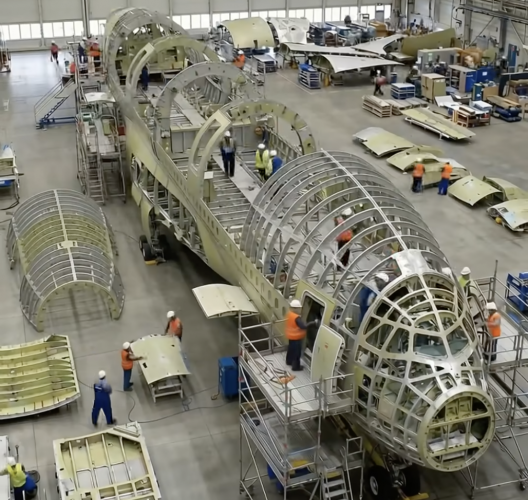
How about taking some stored A380s, stripping them down to the structural bulkheads like in this pic (prototype MSN001), and adding reinforcing bulkheads that allow you to fly semi-pressurized without that upper deck floor?

Keep the expensive bits - wings, tail section, engines, and lower platform including underfloor cargo compartment. Then replace the nose section entirely with a visor style arrangement, elevated cockpit, kneeling landing gear etc.

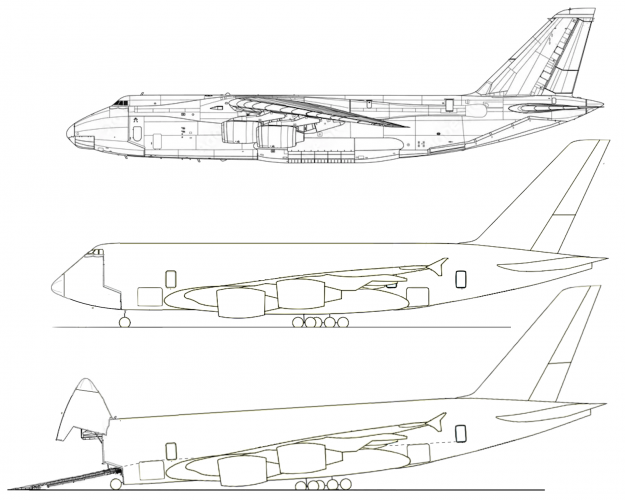
The result might look a little like below... slightly bigger than an AN-124, with the equivalent capacity of roughly ~5x A400Ms. If Beluga could work, perhaps so could this?? A380 vs AN-124 20px=1m v3.png
 

Attachments

  • A380 frames.png
    A380 frames.png
    1.7 MB · Views: 113
Last edited:
How about taking some stored A380s, stripping them down to the structural bulkheads like in this pic (prototype MSN001), and adding reinforcing bulkheads that allow you to fly semi-pressurized without that upper deck floor?

Keep the expensive bits - wings, tail section, engines, and lower platform including underfloor cargo compartment. Then replace the nose section entirely with a visor style arrangement, elevated cockpit, kneeling landing gear etc.

View attachment 809861
I'm pretty sure that the upper floor is structural for pressurization. Double-bubble design, remember?
 
I'm pretty sure that the upper floor is structural for pressurization. Double-bubble design, remember?
That's why if you're flying unpressurized (like the Beluga) or partially pressurized (like the AN-124) the structural loads become much easier to deal with. Which might help with removing the upper floor.
 
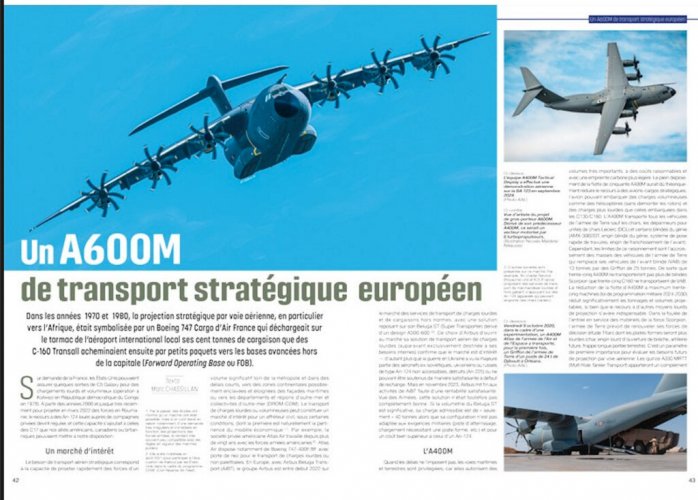
An idea from the French magazine RAIDS Aviation, illustrated by Nikaus.
nikaus10.jpg
I quote the artist:
A very interesting work I did last month for a prospective article in Raids Aviation magazine (Issue n°78) for the Bourget Air Show about the A600M, a strategic transport aircraft based on the A400M but with six TP400 turboprop engines, an enlarged fuselage and a payload capability of 50 tons !
You can find his work here.
 
Distinctly sub-optimal for a military transport.
Why? The AN-124's cargo hold isn't pressurized yet that doesn't stop it from hauling armor, helicopters, and containers.

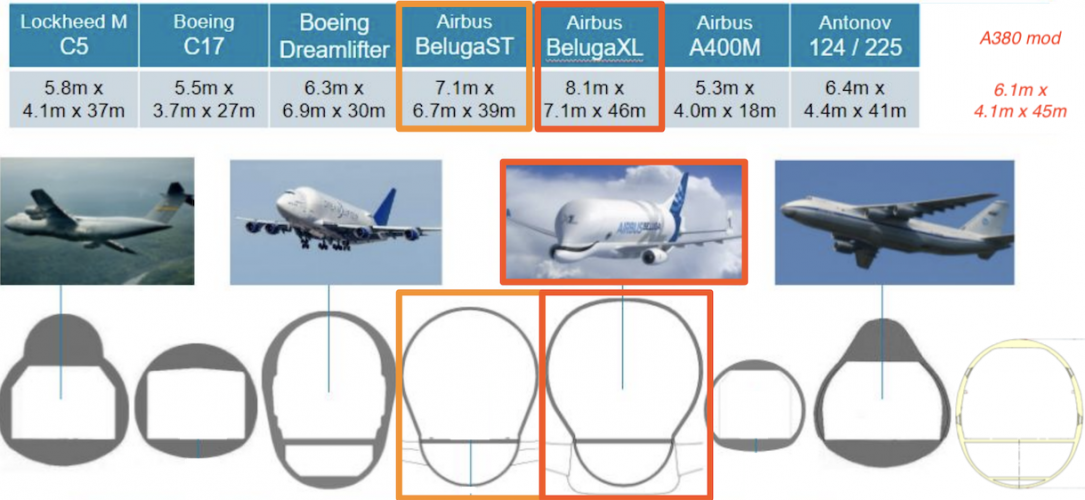
For what it's worth, here is the A380 cross-section if you remove the upper deck floor. It's somewhat larger than the C-5 and is only slightly smaller than the AN-124. The high ceiling is a little wasteful as there's ~1m of unusable height that is higher than the cargo door dimensions in the nose.

The floor would of course have to be strengthened for heavy armor... hopefully that wouldn't impact the underfloor pallet stowage which is quite useful (10x 463L pallets)... basically you could simultaneously haul 10-20% more than a C-5 Galaxy in the main cargo hold, and a full A400M pallet load under floor!

Cargo cross sections A380 mod 20px=1m.png
 
Last edited:
How about taking some stored A380s, stripping them down to the structural bulkheads like in this pic (prototype MSN001)
This is damn AI, can't you see it?
 
This is damn AI, can't you see it?
?? Not sure if you're being tongue in cheek.

It's a screen grab from an Airbus video of the first static test A380 airframe in Toulouse... over 2 decades ago!
 
This is damn AI, can't you see it?
Sorry looks like I got conned! The first 10 seconds of the A380 assembly video looked so real with them sliding the upper fuselage panels into place… I knew this is different from the typical manufacturing process but assumed this was because this showed a 1st prototype and the A380 for the first time used a mix of materials for different sections of the fuselage skin.
 
Why? The AN-124's cargo hold isn't pressurized yet that doesn't stop it from hauling armor, helicopters, and containers.
Because it does stop you from carrying passengers.


For what it's worth, here is the A380 cross-section if you remove the upper deck floor. It's somewhat larger than the C-5 and is only slightly smaller than the AN-124. The high ceiling is a little wasteful as there's ~1m of unusable height that is higher than the cargo door dimensions in the nose.

The floor would of course have to be strengthened for heavy armor... hopefully that wouldn't impact the underfloor pallet stowage which is quite useful (10x 463L pallets)... basically you could simultaneously haul 10-20% more than a C-5 Galaxy in the main cargo hold, and a full A400M pallet load under floor!

View attachment 809942
Also, in practice the Oil industry has standardized their transportable loads around An124 bay dimensions. So any new transport should be built with that as the same minimum size, as that will allow you to sell a couple dozen on the civilian market as An124s age out.

And a new cargo plane needs every single sale it can get.
 
How about taking some stored A380s, stripping them down to the structural bulkheads like in this pic (prototype MSN001), and adding reinforcing bulkheads that allow you to fly semi-pressurized without that upper deck floor?

Keep the expensive bits - wings, tail section, engines, and lower platform including underfloor cargo compartment. Then replace the nose section entirely with a visor style arrangement, elevated cockpit, kneeling landing gear etc.

The result might look a little like below... slightly bigger than an AN-124, with the equivalent capacity of roughly ~5x A400Ms. If Beluga could work, perhaps so could this??View attachment 809878
Just to illustrate what a strategic A380M might look like.

(Hopefully this use of AI image generation is OK... actually required quite a lot of manual edits to make it look right!)

A380M.png

What's most important IMHO is to avoid over-specifying requirements. The fundamental requirement is to replace the An-124, period. Adding any other capabilities such as pressurization for passenger transport and sensitive cargo, or military capabilities (e.g. dirt runways, self-protection) would only serve to introduce unnecessary complexity and drive up costs. In fact most AN-124 users have plenty of aircraft that can meet those other needs (C-17s, A400M, A330 MRTTs). The only real gap is efficient high volume logistic transport into a 10,000ft+ runway, whether measured by weight or volume... armored vehicles, 20ft containers, oversized cargo, helicopters etc.
 
Last edited:
Just to illustrate what a strategic A380M might look like.

(Hopefully this use of AI image generation is OK... actually required quite a lot of manual edits to make it look right!)

View attachment 810164
Okay, I see what you're thinking. (Also, I think this is very valid use of AI!)


What's most important IMHO is to avoid over-specifying requirements.
100% agree here.


The fundamental requirement is to replace the An-124, period. Adding any other capabilities such as pressurization for passenger transport and sensitive cargo, or military capabilities (e.g. dirt runways, self-protection) would only serve to introduce unnecessary complexity and drive up costs. In fact most AN-124 users have plenty of aircraft that can meet those other needs (C-17s, A400M, A330 MRTTs). The only real gap is efficient high volume logistic transport into a 10,000ft+ runway, whether measured by weight or volume... armored vehicles, 20ft containers, oversized cargo, helicopters etc.
There are 2 things that come to mind here.
1) It may prove very useful to have a rear access ramp as well as the front ramp, but that gets into weight&balance fun while loading (insert pictures of UPS planes sitting on their tail)
2) An124 replacement may involve "crappy-airfield" landings for the Oil Industry (the primary civilian-size users of An124s)
 
Why? The AN-124's cargo hold isn't pressurized yet that doesn't stop it from hauling armor, helicopters, and containers.
Because it does stop you from carrying passengers...

I think you have that wrong, H_K. In the Antonov An-124, the big cargo hold is indeed lightly pressurized, while the flight deck is fully pressurized. See for example page 61 of Yefim Gordon's book Antonov's Heavy Transports (Red Star Vol 18): the An-124's "air conditioning system ensures a pressure differential of 0.55 kg/cc (7.82 psi) in the two upper cabins, 0.25 kg/cc (3.57 psi) in the cargo hold, as well as the necessary temperature and air changes per hour in the cabins for people and a positive temperature in the cargo hold (in case of need)..." Thus troops or evacuees could be accommodated in the heated hold at 8000' conditions at a flight altitude of 18,000 feet.

As touched on above, the blueprint of the Airbus A380 airliner makes it inherently impossible (at an economical price) to convert it into a freighter, unlike the design of the Boeing 747. Retired A380s must be scrapped rather than repurposed, a design flaw which contributed to the disappointing sales that ended the program. (The never-built A380F freighter had a different design.)
 
In the OP, @apparition13 mentioned RO/RO for MBTs and an intercontinental range. I am wondering if, today, anyone still sees flying European tanks to other continents as a strategic priority?

If not, I'm thinking that the petroleum industry has no options but Dreamlifter style Guppy conversions.
 
I think you have that wrong, H_K. In the Antonov An-124, the big cargo hold is indeed lightly pressurized, while the flight deck is fully pressurized. See for example page 61 of Yefim Gordon's book Antonov's Heavy Transports (Red Star Vol 18): the An-124's "air conditioning system ensures a pressure differential of 0.55 kg/cc (7.82 psi) in the two upper cabins, 0.25 kg/cc (3.57 psi) in the cargo hold, as well as the necessary temperature and air changes per hour in the cabins for people and a positive temperature in the cargo hold (in case of need)..." Thus troops or evacuees could be accommodated in the heated hold at 8000' conditions at a flight altitude of 18,000 feet.

Thanks. I’d heard of the partial pressurization capability in the AN-124’s main cargo hold, but also read that in normal logistical operations the hold is unpressurized and the crew move through the hold with an oxygen bottle, and only if required. That may also be to reduce fatigue cycles and extend service life.

Which is what leads me to say that the partial pressurization is a nice to have, not a “must have”. Other holds such as the Beluga are not pressurized at all either.
 
In the OP, @apparition13 mentioned RO/RO for MBTs and an intercontinental range. I am wondering if, today, anyone still sees flying European tanks to other continents as a strategic priority?
If they're stupid enough to want to fight in their own country I don't know what to tell you.


If not, I'm thinking that the petroleum industry has no options but Dreamlifter style Guppy conversions.
That's not viable for most of the airfields the petroleum industry uses at destination.
 
If they're stupid enough to want to fight in their own country I don't know what to tell you.
A blanket statement.
In the, granted extreme, cases of the Baltic nations and Ukraine, sending their tanks somewhere far away defeats the purpose of their acquisition - given the current state of affairs.
Different priorities for different nations.
 
Last edited:
A blanket statement.
In the, granted extreme, cases of the Baltic nations and Ukraine, sending their tanks somewhere far away defeats the purpose of their acquisition - given the current state of affairs.
Different priorities for different nations.
If you fight in your own country, you're going to wreck your own country.

If you can fight in the other guy's country, you're going to wreck his country.

Which of those two options is better for your country?

The Baltics? Should have all their tank units on a hair trigger to go charging into the depths of Russia, like the US forces in Germany in the 1980s/90s.
 

Similar threads

Back
Top Bottom