Phoenix_jz

ACCESS: Confidential
Joined
1 April 2020
Messages
130
Reaction score
543
Since there aren't any large threads for FREMM already, I figured I would create one specifically to discuss the background and development of the FREMM-EVO, a pair of interim frigates ordered for the Marina Militare Italiana.


Background:

Before we talk about the FREMM-EVO, we should talk about the earlier FREMM variants. The FREMM was jointly developed by France and Italy to meet requirements for a future ASW frigates. The Italian half of the program was for ten frigates - four in an Anti-Submarine Warfare (ASW) Configuration, and six in a General-Purpose (GP) configuration. The primary difference between these variants is that while the former have a towed VDS (CAPTAS-4) and two 76/62 naval guns, the GP variant lacked the towed VDS in favor of a rapid launch and recovery ramp for large RHIBs, and had a 127/64LW forward in place of a 76/62. This focus on GP ships over ASW was part of a general shift of the 1990s-2000s that placed more emphasis on peacekeeping and patrol operations than serious warfighting, given the reduced submarine presence with the end of the Cold War. By the 2010s, however, this was recognized as an error. Not only did Russian activity become resurgent, but procurement of submarines by non-NATO nations in the Mediterranean increased considerably. Only procuring four dedicated ASW frigates would be stretching these assets too thinly.

In 2020, Fincantieri sold the final pair of FREMM-IT-GP to Egypt while they were still under their ownership, under agreement with the Italian government. Fincantieri was contractually obligated to still deliver the final pair of FREMM-IT-GP to the Marina Militare and would cut steel on two new ships in 2021. The Marina Militare took the opportunity to order a modified configuration, alternatively called the 'Enhanced' or 'Hybrid' variant (originally rendered as GPe), which effectively adopted the sensors and countermeasures of the ASW configuration while retaining the 127/64LW forward. These frigates were 'hybrid' in other senses and contained other enhancements over the first eight FREMM-IT. The platform management system was replaced by a new, more comprehensive 'Ship Management System' by Fincantieri NexTech, and the electronic warfare suite was replaced by the new generation system - Zeus/Virgilius fielded on the units of the 2014 naval program (Trieste & the PPA).

FREMM-EVO

Public information about the FREMM-EVO goes back to about February 2023, though the project almost certainly started earlier. As part of a series of hearings of the Italian Senate Defense Commission by the service heads (Chiefs of Staff) of the Italian armed forces, CSMM Adm. Credendino laid down an operational requirement for an additional 3-6 ASW Frigates on top of the existing force of ten FREMM (4x GP, 4x ASW, 2x 'Hybrid') planned up to that date. Based on interviews with RID (03/23) around the same time, Credendino's drive for procurement was more modest, in the region of 2-4 additional ASW frigates.

Two different FREMM designs appear to have been in development at this time. The first was a long-term solution variably called either 'FREMM 2.0' or 'FREMM-NG' ('Next Generation'), which would be a larger successor to the existing FREMM design, incorporating new technologies and greater growth margin versus the existing hull. This was a long-term solution.

News quickly emerged about a short-term design, studies for which were to be funded under the DPP 2023-25. In June of 2023, RID reported that these two new frigates (no.13 and 14 of the overall Italian build program, but 11th and 12th for Italian service) would be adopting the fixed-face Kronos Quad (GaN AESA, C-band) in place of the rotating Kronos Grand Naval (MFRA, also a C-band AESA), but not the full Kronos Dual Band Radar (incorporating the X-band Kronos Starfire) due to the more extensive re-design that would require. This would not fit in line with the navy's timescale.

Evidentially something changed in that regard in the next few months, and in October 2023 RID reported that the design - now being called FREMM-EVO - would in fact incorporate the full Krono Dual Band Radar (C & X-band), and would utilize the Aster 30 Block 1NT interceptor out of their 16 VLS cells. This indicated the adoption of the SADOC 4 CMS and SAAM-ESD++ air warfare system used by the PPA Full. In February 2024, the draft decree for the FREMM-EVO program was sent to Parliament for approval, with the entire program coming in at €2bn.

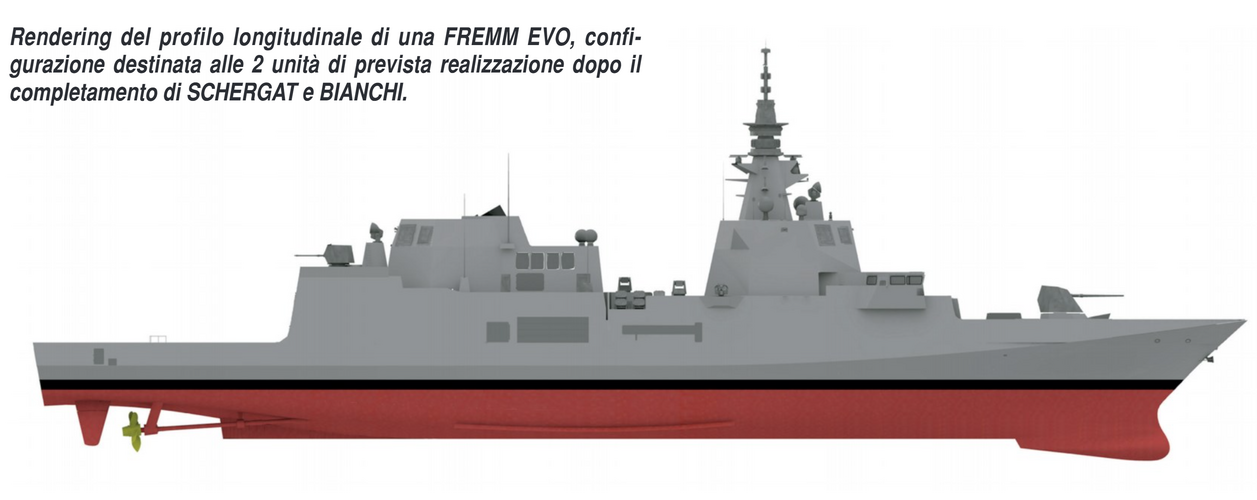
As part of an article on Marina Militare programs in RID 01/24, RID published an early render of the design:

z2nmpm01juac1.png

In March 2024, RID reported that as part of studies for FREMM-EVO, the integration of CAMM-ER was being considered.

On 31 July 2024, the contract for the construction of the FREMM-EVO was signed with OSN (a joint venture between Fincantieri and Leonardo) for the procurement of the vessels, with a value of €1.5bn (€750M per ship). On top of previously described features, the FREMM-EVO would be equipped with two 76/62 Strales systems rather than a 127/64LW + 76/62 Strales, as first indicated. They would also replace the previously ubiquitous 25mm KBA weapon systems with the Lionfish 30 as part of a new integrated anti-drone system. A drone management system would also be integrated into their CMS for use with UAVs, USVs, and UUV's, and they would also adopt the new-generation IFF and datalink systems. The missile armament remained the same in number as the prior FREMM, but with enhanced capabilities - eight Teseo Mk.2 EVO in place of the Mk.2/A, and Aster 30 Block 1NT from the 2x8 Sylver A50 VLS. The ships would remain FFBNW two modules (2x8) for strike-length cells.

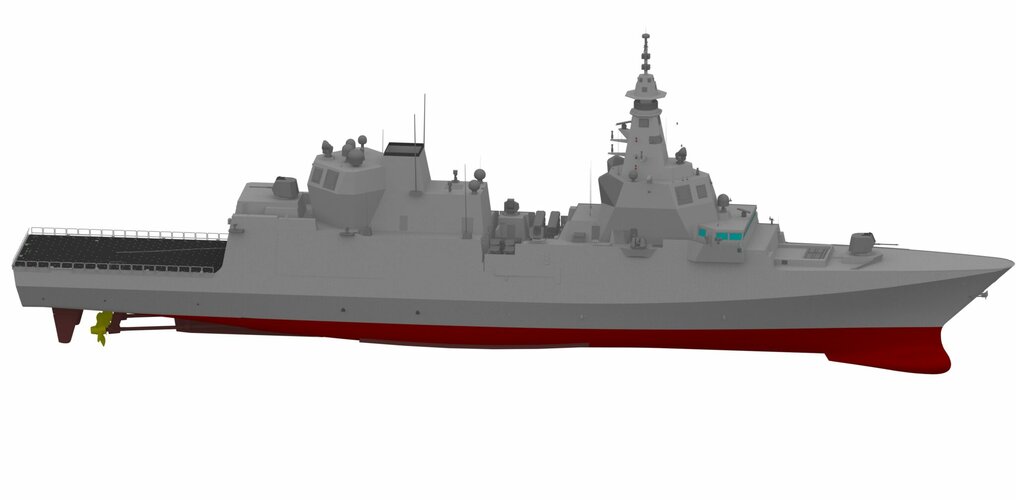
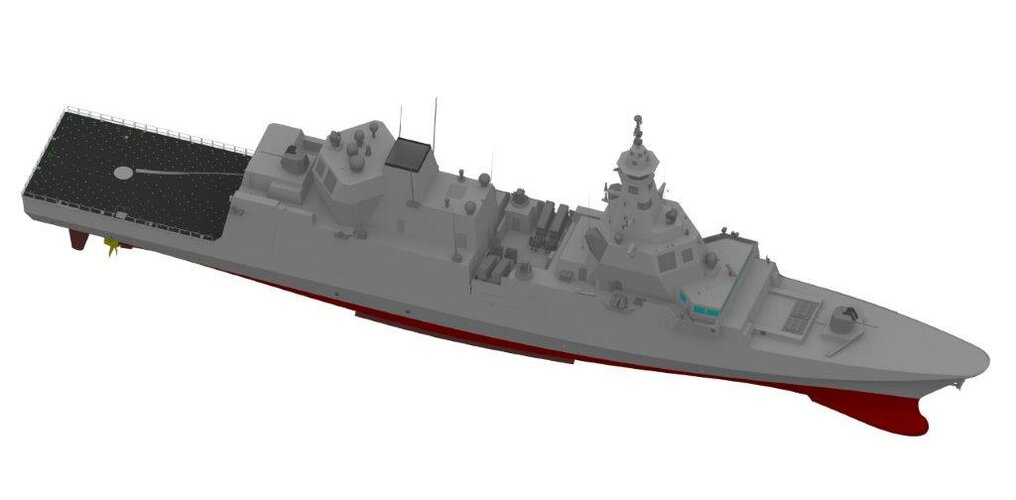
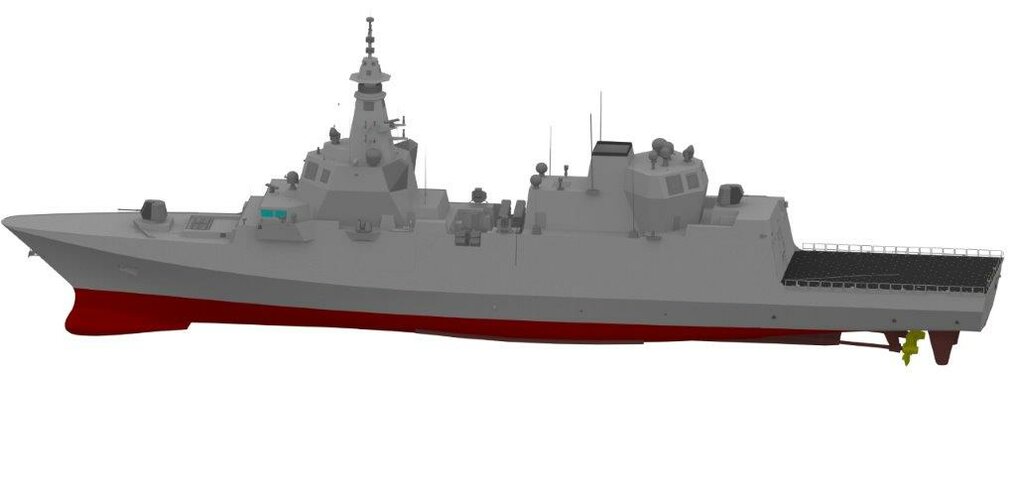
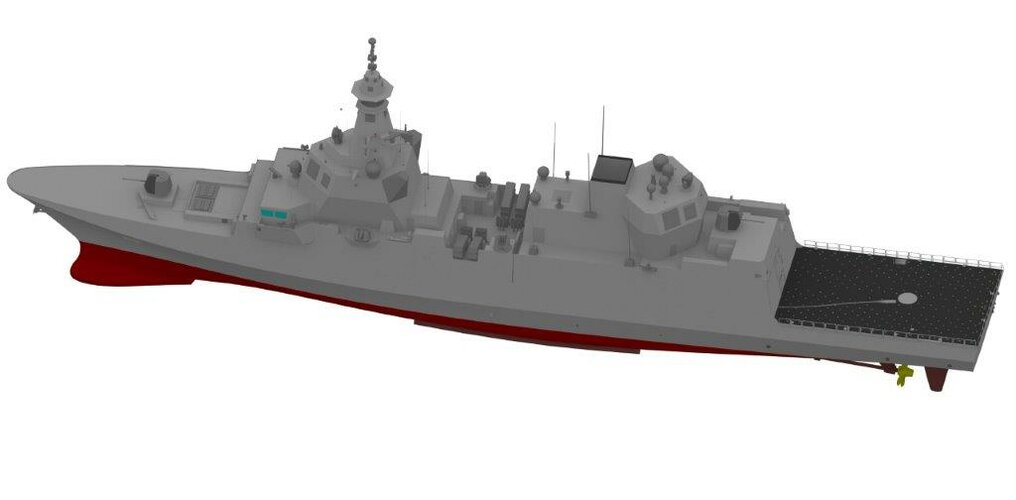
With the contract, new official renders were released;

Fremm-EVO-iso-3.jpeg-scaled.jpg


More recently, in October 2024 RID reported that unlike the first ten FREMM - which have accommodations modules installed in the location of the strike-length cells - the FREMM-EVO will keep that space reserved only for additional VLS (thus reducing total accommodations). Studies are ongoing as to whether or not the ships will keep the space open for future VLS, fit 2x8 A70 VLS for the MdCN land attack cruise missile as an interim solution, or the fitting of soft launch tubes for CAMM-ER (12 at a minimum). Additionally, RID reported on details of the new 'ADRIAN' anti-drone system that would be integrated into ship. ADRIAN is designed to tackle sub-100 kg drones, and will function fully integrated into the ship’s electronic warfare system while also taking tracks from the Kronos DBR and the DSS-IRST. Despite this, it will also have a separate dedicated X-band radar, either the OMEGA 360 by Fincantieri NexTech or the TMMR (Tactical Multi-Mission Radar) by Leonardo. There will also be a separate dedicated jammer for attacking drones and potentially hijacking them, though the system can also destroy the drone with the ship’s weapons.

In an interview with CSMM Admiral Credendino released by RID today (28 October 2024), RID asked;

And on the FREMM EVO, will there be missiles in the spaces previously occupied on the FREMM by additional dressing rooms?

To which Credendino responded;

Absolutely. We are studying various options, including the long-range missile, and we are asking the industry to develop a universal multi-missile launcher, which would give us greater flexibility and operational versatility.

Note that the comment about 'the long range missile' is referring to longer-ranged missiles in general, versus the CAMM-ER, which had been mentioned in the prior question. The mention of a 'universal multi-missile launcher' is particularly noteworthy as it is known now that the Marina Militare is pushing for the development of what is generally known as the 'Sylver A70 NG' - an evolution of the existing A70, able to fire multiple ammunition types (MdCN, Aster, FC/ASW, Aquila) compared to the current Sylver A70 that only launches the MdCN land attack cruise missile.
 
Last edited:
You can really feel the pain from having single-purpose VLS. Relying on just 16 ASTER-30 for air defense is uncomfortable in the post-Red Sea missile shoot era, but having to give up on the A70 launchers to have room for CAMM-ER silos is bad too. If MBDA had ever come through on the idea of quad-packing CAMM in Sylver, this whole problem would get much better (12 ASTER and 16 CAMM-ER would be at least somewhat satisfactory) but that seems to be vaporware.
 
You can really feel the pain from having single-purpose VLS. Relying on just 16 ASTER-30 for air defense is uncomfortable in the post-Red Sea missile shoot era, but having to give up on the A70 launchers to have room for CAMM-ER silos is bad too. If MBDA had ever come through on the idea of quad-packing CAMM in Sylver, this whole problem would get much better (12 ASTER and 16 CAMM-ER would be at least somewhat satisfactory) but that seems to be vaporware.

FWIW, I suspect you could get 24 Albatros NG cells for CAMM-ER in the space reserved for 16x A70, just looking at other ships (ex, think of the Type 45's), and 24x CAMM-ER + 16x Aster 30 B1NT is not terrible.

But, yeah, the lack of an actual universal VLS has been dogging the Marina Militare for ages. They weren't going to buy A70 cells for the FREMM and Horizon's without getting the go-ahead for deep strike missiles, because those cells couldn't launch Aster. And they weren't going to buy A50 VLS just to have to pull it out again later (particularly not with where the budget was when the FREMM were procured).

With the end result being that all the FREMM-IT were procured with only half their VLS, and those VLS were the tactical-length A50 (which are mounted in a space that is actually sized for strike-length).

With that said, if A70-NG is a larger diameter cell (to better accommodate Aquila or other future payloads), CAMM-ER quadpacks may be possible. We do know that multi-packs in A50 cells was studied for the MMI in the mid-2010s, indicating that a dual-pack would be possible. But if A70-NG is larger diameter - say, Mk.41-sized (63.8 x 63.8 cm, versus the 56 x 56 cm of Sylver A43/50/70), I wouldn't rule out that studies are restarted for quad-packs.
 
With that said, if A70-NG is a larger diameter cell (to better accommodate Aquila or other future payloads), CAMM-ER quadpacks may be possible. We do know that multi-packs in A50 cells was studied for the MMI in the mid-2010s, indicating that a dual-pack would be possible. But if A70-NG is larger diameter - say, Mk.41-sized (63.8 x 63.8 cm, versus the 56 x 56 cm of Sylver A43/50/70), I wouldn't rule out that studies are restarted for quad-packs.
But a larger A70-NG could mean that less cells fit into the existing space
 
But a larger A70-NG could mean that less cells fit into the existing space

Yeah, that is a concern. At least in terms of module dimensions, Sylver is somewhat 'fatter' than Mk.41 (227cm vs 207.65cm), but also shorter (259cm versus 316.56cm). That 57.56cm difference in length is not small, if, say, A70NG were to become as 'long' as a Mk.41 module in order to have the same cell size.

But to be honest, even if you get less cells overall, the ability to quad-pack SAMs into them and remove the need for full-sized cells to accommodate a single short-range SAM does get you back quite a number of cells. Ex, if you take a 32-cell FREMM that might normally accommodate 16x Aster 15 and 16x Aster 30, and replace the Aster 15's with quad-packed CAMM-ER, then suddenly I can load 32x CAMM-ER into a single Sylver module and carry those plus 24x Aster 30. If my frigate can only accommodate 24x cells, then I can still take 32x CAMM-ER + 16x Aster 30, or 16x CAMM-ER + 24x Aster 30, or replace some of the Aster's in this example with Aquila for defense against HGV's, or potentially strike missiles, etc.
 
Yeah, that is a concern. At least in terms of module dimensions, Sylver is somewhat 'fatter' than Mk.41 (227cm vs 207.65cm), but also shorter (259cm versus 316.56cm). That 57.56cm difference in length is not small, if, say, A70NG were to become as 'long' as a Mk.41 module in order to have the same cell size.
Well mk.41 has square canister where Sylver uses more rectangles tought the actual canister is round so changing that alone to a more rectangle design could allow more internal volume.
Also a70 is supposed to be able to use 7m long missiles where the strike lentgh MK.41 can only go to 6.7m so its already able to use longer but "thinner" missiles.
But to be honest, even if you get less cells overall, the ability to quad-pack SAMs into them and remove the need for full-sized cells to accommodate a single short-range SAM does get you back quite a number of cells. Ex, if you take a 32-cell FREMM that might normally accommodate 16x Aster 15 and 16x Aster 30, and replace the Aster 15's with quad-packed CAMM-ER, then suddenly I can load 32x CAMM-ER into a single Sylver module and carry those plus 24x Aster 30. If my frigate can only accommodate 24x cells, then I can still take 32x CAMM-ER + 16x Aster 30, or 16x CAMM-ER + 24x Aster 30, or replace some of the Aster's in this example with Aquila for defense against HGV's, or potentially strike missiles, etc.
In the end ITS a question of trade offs but IS the A70-NG development even finnished? Or the design Frozen? If not then building any ship without knowing the size could create quite some problems if they aren't acounted before.
 
Last edited:
Well mk.41 has square canister where Sylver uses more rectangles tought the actual canister is round so changing that alone to a more rectangle design could allow more internal volume.
Also a70 is supposed to be able to use 7m long missiles where the strike lentgh MK.41 can only go to 6.7m so its already able to use longer but "thinner" missiles.

Depends on the version. A43 and A50 cells are square, matching Aster canisters, while A70's shape is allegedly not. But as TomS just said, Sylver itself could probably be built to be denser than it is. But I suspect larger cell diameter overall is going to be important going forward, to fit more powerful boosters for higher-tier SAMs.

In the end ITS a question of trade offs but IS the A70-NG development even finnished? Or the design Frozen? If not then building any ship without knowing the size could create quite some problems if they aren't acounted before.

Definitely not finished. We heard rumors about it as early as 2021 but it's something we now know the Marina Militare has requested the development of from industry, and studies are actively underway.

But at the same time, much as was done with JSF -> F-35 for Cavour, you can design around a future payload if you know how large and massive it will be, possibly by simply mandating the general dimensions in the first place. It's entirely possible they already have a size in mind and are designing the silos for VLS modules on the FREMM-EVO and DDX accordingly (especially in the context of the latter, which is where the NG VLS was first referenced and for whom incorporating future interceptors is extremely important).
 
But to be honest, even if you get less cells overall, the ability to quad-pack SAMs into them and remove the need for full-sized cells to accommodate a single short-range SAM does get you back quite a number of cells. Ex, if you take a 32-cell FREMM that might normally accommodate 16x Aster 15 and 16x Aster 30, and replace the Aster 15's with quad-packed CAMM-ER, then suddenly I can load 32x CAMM-ER into a single Sylver module and carry those plus 24x Aster 30. If my frigate can only accommodate 24x cells, then I can still take 32x CAMM-ER + 16x Aster 30, or 16x CAMM-ER + 24x Aster 30, or replace some of the Aster's in this example with Aquila for defense against HGV's, or potentially strike missiles, etc.
See also the Constellation-class FFG where 32 cells means 6x VL-ASROCs, 12x ESSM, and 23x SM2s/SM6s. And honestly I'd rather have 24x ESSM and 20x Standards, given the Red Sea Turkey Shoot.
 
Depends on the version. A43 and A50 cells are square, matching Aster canisters, while A70's shape is allegedly not.
Probaly as A70 was made for MDCN which didn't need it.
But as TomS just said, Sylver itself could probably be built to be denser than it is. But I suspect larger cell diameter overall is going to be important going forward, to fit more powerful boosters for higher-tier SAMs.
I mean FC/ASW may need it but the rest can be done in the existing volume given that Aster 30 only uses 5 of the 7 m.
 
On the other hand, Sylver is not as densely packed as it could be; lots of room around the margins of each module. Judicious repackaging could make a larger A70-NG fit in nearly the same space.
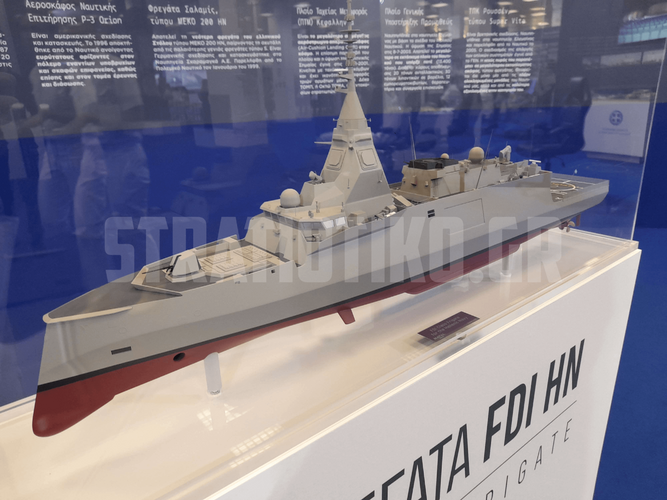
While yes there packed like shit (just look at the greek FDI's) 1000050398.png
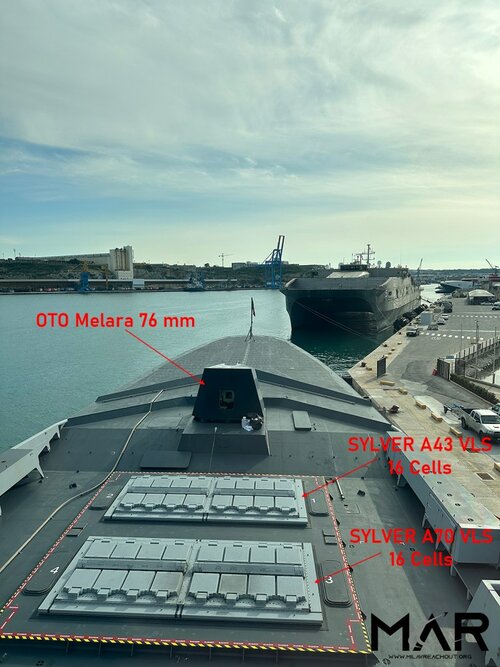
You wont get that mutch space out of it with FREMM which (looking at the french counterpart) doesnt offer mutch. 1000050399.jpg
 
RE: Sylver packing; due to some detail design of things like the access for maintenance inside, manual closing of the doors etc. it can't be fitted with the long sides flush with one another, although some ships have a very small gap (small crew members maybe? :) )
 
RE: Sylver packing; due to some detail design of things like the access for maintenance inside, manual closing of the doors etc. it can't be fitted with the long sides flush with one another, although some ships have a very small gap (small crew members maybe? :) )
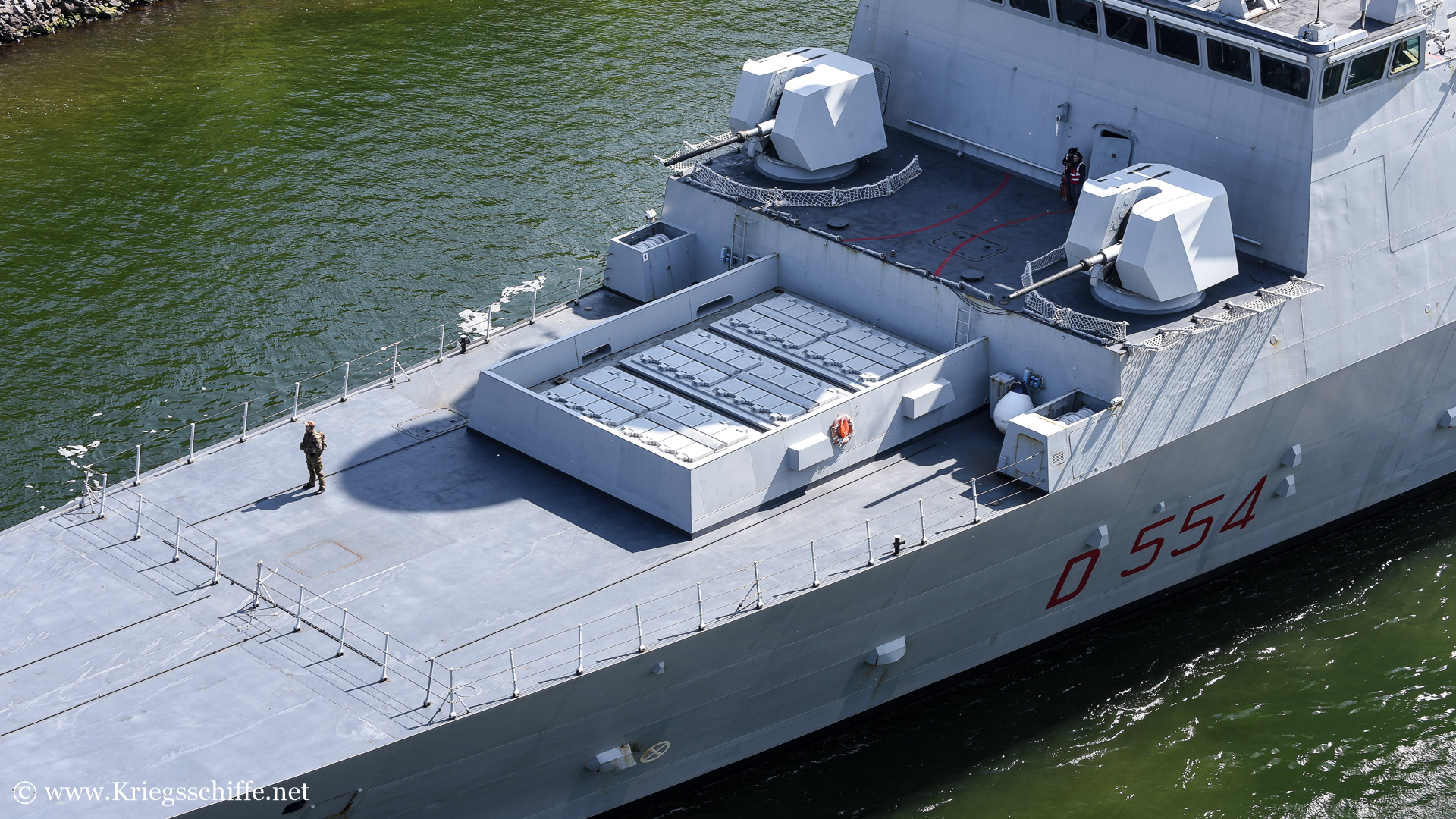
Yes the Sylver modules seem to be much more tightly packed on the Horizon DDGs (pic below).

I believe one reason driving the wider spacing aboard FREMM FRs and FDIs, mentioned in industry sources, is strict safety rules when carrying cruise missiles (including heavy fire proof bulkheads to contain internal explosions).

The USN doesn't seem to have the same concerns with its massive Tomahawk missile farms, but I'm pretty sure there are good reasons why some spacing may be desirable.

DSC_3987.jpg
 
Yes the Sylver modules seem to be much more tightly packed on the Horizon DDGs (pic below).

I believe one reason driving the wider spacing aboard FREMM FRs and FDIs, mentioned in industry sources, is strict safety rules when carrying cruise missiles (including heavy fire proof bulkheads to contain internal explosions).

The USN doesn't seem to have the same concerns with its massive Tomahawk missile farms, but I'm pretty sure there are good reasons why some spacing may be desirable.

DSC_3987.jpg
I just read that FDI is supposed to be able to take another 16 vls cells tought even then this Arrangement doesn't really make sense to me. Afterall they only have 1 A70 system
 
I mean FC/ASW may need it but the rest can be done in the existing volume given that Aster 30 only uses 5 of the 7 m.

Aster isn't the concern so much as something like Aquila. Which will need the length of A70 at the very least - though I don't have a good measure of the missile's diameter at present.
 
Aster isn't the concern so much as something like Aquila. Which will need the length of A70 at the very least - though I don't have a good measure of the missile's diameter at present.
But the internal volume is in the end not that mutch smaller so its more than possible to build something like Aquila fitting in it.
 
So, lost the RHIB bay under the flight deck in exchange for a VDS...

I'm not totally sure that is a good trade, but volume where a VDS can be placed is limited.

I would say it is a excellent change, for the position the Marina Militare is in. The primary difference between the capabilities of the FREMM-IT-ASW and FREMM-IT-GP is that the GP types have a fast launch and recovery ramp in the stern where the ASW types have their towed arrays.

The original divide in types the MMI procured were split six GP, four ASW, which in the long run was going to be a substantial reduction in surface ASW capacity versus the Cold War fleet. When the last pair of GP types were sold to Egypt before delivery in 2020, the Marina Militare took the opportunity to pay the difference and have them procured as a 'hybrid' type, combining the ASuW capabilities of the GP types with the ASW capability of the ASW type, and reversing the prior balance of FREMM to four GP, six ASW. The FREMM-EVO bring the number of ASW FREMM up to eight.

The RHIB capacity is somewhat made up for with this modified variant and the EVO. The FREMM-IT of both variants have two above-deck RHIB bays - a long bay on the portside for an 11-meter RHIB and a shorter one on the starboard side for a 7-meter. The FREMM-GP's aft ramp actually adds a third RHIB, which can be launched or recovered rapidly in more adverse sea conditions than the traditional bays. Based on the wording of this article, it appears both bays are now longer types meant to accommodate 11-meter RHIBs. This is the first I've actually heard of this, which is rather interesting - I know that will be a feature on the FREMM-EVO (can will also be used to host and launch USVs), but I had not previously heard it would apply to these hybrid FREMM.
 
FWIW, I suspect you could get 24 Albatros NG cells for CAMM-ER in the space reserved for 16x A70, just looking at other ships (ex, think of the Type 45's), and 24x CAMM-ER + 16x Aster 30 B1NT is not terrible.

But, yeah, the lack of an actual universal VLS has been dogging the Marina Militare for ages. They weren't going to buy A70 cells for the FREMM and Horizon's without getting the go-ahead for deep strike missiles, because those cells couldn't launch Aster. And they weren't going to buy A50 VLS just to have to pull it out again later (particularly not with where the budget was when the FREMM were procured).

With the end result being that all the FREMM-IT were procured with only half their VLS, and those VLS were the tactical-length A50 (which are mounted in a space that is actually sized for strike-length).

With that said, if A70-NG is a larger diameter cell (to better accommodate Aquila or other future payloads), CAMM-ER quadpacks may be possible. We do know that multi-packs in A50 cells was studied for the MMI in the mid-2010s, indicating that a dual-pack would be possible. But if A70-NG is larger diameter - say, Mk.41-sized (63.8 x 63.8 cm, versus the 56 x 56 cm of Sylver A43/50/70), I wouldn't rule out that studies are restarted for quad-packs.
Poland is getting 12 CAMM-ER cells (quad pack) to replace the planned 16 cell MK-41. Wonder if thats just because of the different footprint, but they could also have loaded that system into the original MK-41.
 
Poland is getting 12 CAMM-ER cells (quad pack) to replace the planned 16 cell MK-41. Wonder if thats just because of the different footprint, but they could also have loaded that system into the original MK-41.
Could you elaborate on this? What ship do you mean here?
We do know that multi-packs in A50 cells was studied for the MMI in the mid-2010s, indicating that a dual-pack would be possible.
OK, I'm curious about one thing here - I've seen claims that the CAMM can be quad-packed into the Sylver VLS and CAMM-ER can be dual-packed. How is that possible since the external dimensions of both of these missiles' launch containers are the same apart from length, at 275 × 275 mm? And if that is the case, the CAMM being quadpackable would mean CAMM-ER has to be as well.
 
Could you elaborate on this? What ship do you mean here?

OK, I'm curious about one thing here - I've seen claims that the CAMM can be quad-packed into the Sylver VLS and CAMM-ER can be dual-packed. How is that possible since the external dimensions of both of these missiles' launch containers are the same apart from length, at 275 × 275 mm? And if that is the case, the CAMM being quadpackable would mean CAMM-ER has to be as well.
Both CAMM and CAMM-ER are quad-packed, CAMM-MR is double-packed.
 
Both CAMM and CAMM-ER are quad-packed, CAMM-MR is double-packed.
Into the Mk41, yes. I mean the Sylver specifically - I've seen many people, including on this forum, claim that the ER can only be dual-packed (despite both being dimensionally able to be quad-packed), so I wonder what is the official rationale behind it, if there even is any. Or, if it's a myth, then I wonder where it comes from.
 
I guess to dual pack CAMM-MR it would need 3 fins instead of 4. The polish project was using "Albatros", which seems to use ExLS or similar for the VLS.
 
"Extended Range" sounds like it should be more than "Medium Range", until you realise CAMM and CAMM-ER are short range. Thats probably why its confusing.
 
I guess to dual pack CAMM-MR it would need 3 fins instead of 4. The polish project was using "Albatros", which seems to use ExLS or similar for the VLS.
Poland never intended to use the mushroom farm VLS in any of its variants (so no Albatross NG either), the Wicher-class frigates (the ones built under the Miecznik program) were meant to use the Mk41 for the very beginning, so the CAMM-MR will be designed for the Mk41 too. Unless I misunderstood you even more than I thought, which I feel might be the case:)
 
Mbda website (i think) said Albatros NG uses a quad packed Mk-41 compatible vls, which suprised me because i also thought they had come up with longer CAMM-ER mushrooms. However, Mk-41 usually comes in 8-cell modules but the Miecznik program has 12 cells. ExLS is based on 3 Mk-41 cells with cold launch so without the exhaust management and presumably no deluge fire suppression. Four 3-cell ExLS modules would explain the Miecznik configuration. Its not a mushroom farm.
 
Haven't seen any claims of the Albatross NG using such a VLS, and the only VLS this system currently uses are indeed the mushrooms, though a bit different than those for the CAMM missiles, as seen on the Babur-class corvettes: 1000029438.png
Not to mention that a "quad packed Mk41 compatible VLS" would indicate the Standalone ExLS which is too short for the CAMM-ER in its current form (though could be easily stretched I suppose).

As for the Wicher-class, each ship is to be fitted with 4 Mk41 Strike modules, so 32 cells per ship. I suspect the number 12 came from the fact that the VLS were bought for all 3 ships of the class, so there were 12 launchers in total, but that refers to the number of whole modules, not just cells.
 
So i cant find the MBDA link that said 12 cells for the Albatros NG. However NavalNews had an old article saying its installed in strike length Mk-41 amidships (sounds like the hosted ExLS version), but no numbers. MBDA specify that Poland plans to use existing CAMM stocks but that Albatros NG is designed for quad packed CAMM-ER.

Dont think this is the latest update so plans may have changed. I vaguely remember seeing that the 16-cell Mk-41 had been changed to a 12-cell Albatros-NG system based on Mk-41.
 
"Poland plans to use existing CAMM stocks" might mean a couple of things here though, one of them is that the missile stocks are to be shared between the frigates and GBAD, as Poland is basing both on the CAMM family of missiles, and they are to be shared to make procurement and logistics easier.

Dont think this is the latest update so plans may have changed. I vaguely remember seeing that the 16-cell Mk-41 had been changed to a 12-cell Albatros-NG system based on Mk-41.
I don't recall seeing any AH140 renders with just 16 Mk41 cells. I know there are some with 2×6 mushrooms, and I'm pretty sure the Venturer will have that configuration until it's equipped with the Mk41. As for the Wicher-class, these frigates were always meant to be equipped with 32 Mk41 cells each, at least since Babcock was chosen as the partner, which can be seen on official renders: GqL1AjLXoAAQQRA.jpg
 
OK, I'm curious about one thing here - I've seen claims that the CAMM can be quad-packed into the Sylver VLS and CAMM-ER can be dual-packed. How is that possible since the external dimensions of both of these missiles' launch containers are the same apart from length, at 275 × 275 mm? And if that is the case, the CAMM being quadpackable would mean CAMM-ER has to be as well.

It's a good question. I'm not really sure why this is the case.

I know the Marina Militare did have MBDA look into fitting multipacks of CAMM-ER into Sylver A50 circa 2014-16, and dual-packs are what were possible. This is why if you go back to a lot of the early information around the naval units of the legge navale 2014/15 (the PPA and Trieste), you will see comments about having 16x A50 VLS for '16 Aster or 32 CAMM-ER'. The Marina Militare ultimately never went ahead with procuring CAMM-ER and so nothing more happened on this front.

With CAMM and quad-packs into Sylver - I am not familiar with any navy actually asking for such a study, though MBDA did claim on older promotional material that quad-packs of CAMM into Mk.41 and Sylver would be possible.

This is one such example from 2017, which claims:

Sea Ceptor will operate from the SYLVER and Mk41 launchers using a quad-pack configuration, various flexible canister configurations are also available. The Soft Vertical Launch technology reduces system mass and eases installation. The Command & Control System is designed to enable rapid integration with both new and existing naval combat systems.

More recent material has stopped repeating this claim - see this brochure from 2023:

In the maritime environment, CAMM has a number of launcher options. Mk 41 compatible, CAMM can be quadpacked into each cell of either Strike or Tactical length launchers. If space is at a premium or for smaller vessels, CAMM can also be quadpacked into the compact Extensible Launcher System (ExLS), which is part of the Mk 41 family.

Note that ExLS is the means for quad-packing CAMM in Mk.41. There is both the 3-cell ExLS module, which is based on the Mk.41 system and co-developed between Lockheed Martin and MBDA UK, and the Host ExLS inserts that go into tactical and strike-length Mk.41.

---

Truth be told, I suspect that CAMM would require some kind of additional adapter to use CAMM (cold launch) from Sylver (hot launch system), just as is the case with Mk.41. Sylver is however significantly narrower than Mk.41 - 56 x 56cm versus 63.8 x 63.8 cm - and it may simply be unable to fit such a system while still accommodating four CAMM canisters. Quad-packing CAMM into Sylver A50 may simply have never been possible, and MBDA comments about quad-packing CAMM into Sylver may have just been marketing assumptions without any real analysis backing them. This would not be the first time this has happened - MBDA also talked about being able to fire Aster SAMs from the Sylver A70 VLS but that is not possible with the currently fielded A70 VLS.
 
Last edited:
Truth be told, I suspect that CAMM would require some kind of additional adapter to use CAMM (cold launch) from Sylver (hot launch system),

Dimensionally it would need a rack of some kind to hold it, but don't worry about the cold or hot launch. The CAMM canister IS the VLS for the missile. Everything is contained within it, no need for venting...the piston that propels the missile out is captive, any gases forced out go out of the top.
 
Sylver is however significantly narrower than Mk.41 - 56 x 56cm versus 63.8 x 63.8 cm - and it may simply be unable to fit such a system while still accommodating four CAMM canisters.
The launch container for both CAMM and CAMM-ER is 275 × 275 mm, so that would be a veeery tight fit (550 × 550 without any mounting brackets), likely requiring modifications to both the canisters and the VLS cell. So there are two other options - either using the Albatross-NG VLS or asking LM to stretch the ExLS and using these for the ERs, the latter I find very unlikely, though better from the technical standpoint.
 
or asking LM to stretch the ExLS and using these for the ERs, the latter I find very unlikely, though better from the technical standpoint.
Most of the proposed ExLS quadpacks included a spacer as a significant part of the vertical height to bring the overall length of shorter ordnance up to the full length of the cell - Nulka, for instance, being about half the length of CAMM. So ExLS has had variable length launch cells from the word go, and ER would be just a new length to add to the existing range.

OTOH I suspect CAMM and CAMM-MR are likely to cannibalize the CAMM-ER market between them once MR is available.
 
Most of the proposed ExLS quadpacks included a spacer as a significant part of the vertical height to bring the overall length of shorter ordnance up to the full length of the cell - Nulka, for instance, being about half the length of CAMM. So ExLS has had variable length launch cells from the word go, and ER would be just a new length to add to the existing range.
That's the Host ExLS though, and I meant the 3 cell Standalone module which is just long enough to fit the CAMM launch container, but about a meter too short for CAMM-ER:
1757522872221.png
 

Similar threads

Back
Top Bottom