Scott Kenny
ACCESS: USAP
- Joined
- 15 May 2023
- Messages
- 19,802
- Reaction score
- 28,415
Citation needed.The explicit role of FFG(X) was to contribute to the escort of the CSG, this is not up for debate

Citation needed.The explicit role of FFG(X) was to contribute to the escort of the CSG, this is not up for debate

Constellation was going to have an MCM package?
Also have you got any sources to back this up?
An LCS is not a CSG frigate, they are so distinct that they shouldn't even be discussed in the same setting. Come on now
Typhon has already been tested on LCS lol
Ok but why would LCS do the job of a frigate?
So just to get this straight, you envision
that LUSVs will come to the fore in areas which have seen less development and interest before areas in which they have seen more development and interest?
You don't see how increased magazine depth and reducing reliance on single ship platforms at lower cost is useful in the Indo-Pacific?
They are all SSCs but they fill different niches.
FF(X) fills a completely different role to FFG(X). This is so unserious what
The explicit role of FFG(X) was to contribute to the escort of the CSG, this is not up for debate
Uh, the literal FFG(X) RFI?Citation needed.
Come on now, what you're referring to is a third order mission, after contributing to the defense of the CSG and ASW operations.“During Phase 1 (Deter Aggression) and Phase 2 (Seize the Initiative) operations, the FFG(X) will normally aggregate into strike groups and Large Surface Combatant-led surface action groups but also possess the ability to robustly defend itself during conduct of independent operations while connected and contributing to the fleet tactical grid,”
Synopsis: THIS REQUEST FOR INFORMATION (RFI) IS FOR INFORMATIONAL AND PLANNING PURPOSES ONLY AND SHALL NOT BE CONSTRUED AS A REQUEST FOR PROPOSAL, REQUEST FOR QUOTE, OR AS AN OBLIGATION ON THE PART OF THE GOVERNMENT. THERE WILL NOT BE A SOLICITATION, SPECIFICATIONS, OR DRAWINGS AVAILABLE. THIS ANNOUNCEMENT MAY OR MAY NOT TRANSLATE INTO AN ACTUAL PROCUREMENT(S) IN FUTURE YEARS. THERE IS NO FUNDING ASSOCIATED WITH THIS ANNOUNCEMENT.
Background: The Navy desires to award a Detail Design and Construction contract in FY2020 for its next evolution of small surface combatant the future Guided Missile Frigate (FFG(X)). A competition for FFG(X) is envisioned to consider existing parent designs for a Small Surface Combatant that can be modified to accommodate the specific capability requirements prescribed by the US Navy.
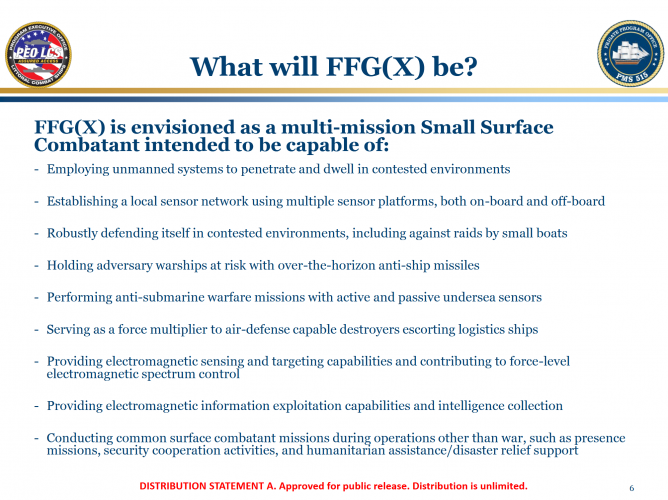
The Navy is interested in the FFG(X) to provide Combatant and Fleet Commanders a uniquely suitable asset to achieve select sea control objectives and perform maritime security operations while facilitating access in all domains in support of strike group and aggregated fleet operations. In terms of the Navy's Distributed Maritime Operations (DMO) Concept, this FFG(X) small surface combatant will expand blue force sensor and weapon influence to provide increased information to the overall fleet tactical picture while challenging adversary ISR&T efforts. The purpose of this type of ship is to (1) fully support Combatant and Fleet Commanders during conflict by supplementing the fleet's undersea and surface warfare capabilities, allow for independent operations in a contested environment, extend the fleet tactical grid, and host and control unmanned systems; and (2) relieve large surface combatants from stressing routine duties during operations other than war.
This platform will employ unmanned systems to penetrate and dwell in contested environments, operating at greater risk to gain sensor and weapons advantages over the adversary. The FFG(X) will be capable of establishing a local sensor network using passive onboard sensors, embarked aircraft and elevated/tethered systems and unmanned vehicles to gather information and then act as a gateway to the fleet tactical grid using resilient communications systems and networks.
During Phase 0 (Shape the Battlespace) operations, FFG(X) will operate independently to develop a Recognized Maritime Picture and Recognized Air Picture, perform presence missions, conduct security cooperation activities, support humanitarian assistance and disaster relief (HA/DR) efforts; and conduct security assistance and security force assistance (SFA). This ship will reduce demand on high end cruisers and destroyers that currently conduct ASW, SUW, and Theater Security Cooperation missions; allowing for an increase of more capable assets to maintain a stabilizing presence in regions where tensions with nations that have highly capable naval forces may exist.
During Phase 1 (Deter Aggression) and Phase 2 (Seize the Initiative) operations, the FFG(X) will normally aggregate into strike groups and Large Surface Combatant led surface action groups but also possess the ability to robustly defend itself during conduct of independent operations while connected and contributing to the fleet tactical grid. FFG(X) will perform its missions in complex electronic warfare and anti-ship missile threat environments, and, therefore, when available from other Navy efforts, will integrate hard-kill with advanced soft-kill systems at the combat systems level to enable the most effective offense and defense management of onboard weapons and decoy inventories. FFG(X) missions during these phases include:
•· Complement the surface warfare (SuW) capabilities of a Carrier Strike Group and Expeditionary Strike Group with capacity in aggregated operations (e.g., as a pack) to deter or defeat aggression by adversary warships with over-the-horizon anti-ship missiles. Concepts of employment for this type of ship will include integrated operations with area air defense capable destroyers and cruisers as well as independent operations while connected and contributing to the fleet tactical grid. Additionally, this platform must defend against raids of small boats
•· Perform anti-submarine warfare (ASW) scout and patrol missions that complement the capabilities of Strike Group and theater operations with enhanced active and passive undersea sensing capabilities.
•· Support transoceanic logistics movements by serving as a force multiplier to area air defense capable destroyers. If equipped with weapons providing the required capability and capacity, the ship will independently escort logistics ships during transit through low and medium threat regions.
•· Provide robust electromagnetic sensing and targeting capabilities and contribute to force level electromagnetic spectrum control
•· Provide electromagnetic information exploitation capabilities and intelligence collection
The FFG(X) aviation capability will include secure and traverse systems for aircraft handling and incorporate the aircraft systems and sensors into an integrated combat system.
To achieve these missions, the Navy desires to use common Navy systems across the radar, combat system, C4ISR systems, and launcher elements. Hull, Mechanical, and Electrical systems commonality with other US Navy platforms is also encouraged.
So you're saying there is 0 relation in role?The MCM is being offboarded to LUSVs. I'm not sure why you need this to be repeated.
Both a Perry and a Knox were SSCs, I guess they filled the same role?They're not. They're both SSCs.
They don't have a production design ready for FF(X) but you're willing to ignore that. Flight I is literally just a cutter painted grey so that politicians can score political pointsThe Navy doesn't have a production ready design
FF(X) is an ASW lilypad and patrol frigate, FFG(X) contributes to the defense of a CSG. If you can't see that's distinct then idk what to tell youIt really doesn't
You haven't even read the RFI, don't try come at me with liesNot really. FFG(X) would have escorted ATF shipping to assault areas and fought in the littorals. Burkes would stay in deep water with the carriers and provide screens for everything. LSCs stay in open ocean while SSCs get close. The FFG-62 is just an SSC that can fight its way to shore rather than needing to wait for it to be cleared.
It has enough resources to fight China or to patrol its empire. It doesn't have enough to do both. FFX is a potentially too-little-too-late attempt to change that by getting a small surface combatant that can be used as a colonial gunboat to free up Burkes in other theaters.
The result will be that instead of FFG(X) escorting ATF shipping, it will be DDG-51s, and there will be enough to still escort the carriers.
FFG(X) escorting ATF shipping
This is sort of practicalities which now mean USN can't escort things through Hormuz. And there is no idea when it will be possible, as it hangs on cleaning away highly dispersed and concealed AD network spread over huge area, possible target after possible target.The LCS became the SSC about a decade ago once all the stupid mission module shit finally died. Sadly LCS is irredeemably tied to being able to swap mission modules, so having it be fixed as either MCM or SSC is not practical, and that's without getting into just how bad they are for the crews.
The irony here now is that Iran seems to be a desparate attempt to free up resources from ME once and for all, skipping failed attempts to have a force that can respond to contingencies there.As it stands right now, the US has enough resources to fight China or to patrol its empire. It doesn't have enough to do both. FFX is a potentially too-little-too-late attempt to change that by getting a small surface combatant that can be used as a colonial gunboat, precisely to free up Burkes in other theaters, to form ATF shipping and UNREP groups for CSG support in INDOPACOM.
It's approaching the escort gap from the other end, by addressing virtual attrition, rather than trying to make an actually viable frontline escort. The result will be that instead of FFG(X) escorting ATF shipping or UNREP groups, it will be DDG-51s, and there will be enough to still escort the carriers.
At least that's the hope.
So you're saying there is 0 relation in role?
Both a Perry and a Knox were SSCs, I guess they filled the same role?
They don't have a production design ready for FF(X) but you're willing to ignore that. Flight I is literally just a cutter painted grey so that politicians can score political points
FF(X) is an ASW lilypad and patrol frigate, FFG(X) contributes to the defense of a CSG. If you can't see that's distinct then idk what to tell you
The irony here now is that Iran seems to be a desparate attempt to free up resources from ME once and for all, skipping failed attempts to have a force that can respond to contingencies there.
What happened instead is US launched the contingency itself, and there is no end in sight. FFX as shown can patrol empire, but even when it will be available years later, it can't by itself counter existing Iranian threat.
SEWIP is being installed on LCS as part of L&S, It has already been fitted to the first ship, LCS-10. FFG(X) design work remains funded, I somewhat wonder if this isn't an attempt to take pressure off the shipyard, get the ship complete to standard, then order a complete production run seeing as no other ships fills the FFG(X) niche. Unlike some people I will highlight that this is speculation based on the facts available to usSEWIP LCS could, but they are gone from the equation.
Genuinely laughable, girl get a grip. They spent 10 years trying to develop the optimal MCM package and suddenly every foreign navy is going the same way with offboard systems, UxVs, and standoff workNo, I'm saying that the navy most famous for pretending mines don't exist will continue to pretend mines don't exist. If LCS were considered most important for its minesweeping capabilities it would been built from a offshore oil rig supply vessel rather than a high speed car ferry.
IronicIt'll be fine. It's twice the displacement of LCS and has a larger crew. It's a good ship.
You're inventing what I said and responding to what you imagined. Do the bare minimum and read the RFI that I kindly provided for you, maybe that will helpFF(X) is fine. It's easily buildable and will provide a hull that has sufficient volume for useful things, unlike LCS, without being a dead on arrival dumpster fire like FFG(X).
Genuinely laughable, girl get a grip. They spent 10 years trying to develop the optimal MCM package and suddenly every foreign navy is going the same way with offboard systems, UxVs, and standoff work
You're inventing what I said and responding to what you imagined. Do the bare minimum and read the RFI that I kindly provided for you, maybe that will help
LCS doesn't escort anything, you have been told this by people more reputable than me. Evidently nothing more needs to be saidescorting ATF shipping, convoys,
LCS doesn't escort anything,
Point of order, the late Cold War carrier escort group was 2x CGs, 2x Burkes, and 2x Spruance. That's it.You can't defend a CVBG completely effectively with anything less than six Burkes and two cruisers similar to DDG(X).
You're still inventing what I said and responding to what you imagined lol, and on top of that you're denying realityYeah it turns out making everything useful into unfunded modules and buying $700 million empty boxes was a bad move. Glad we got away from it with the FF(X) and will finally have a decent colonial gunboat. Maybe if FMM can ever fix the FFG-62's, on their own dime, the USN will look at it again too.
Reason number million why the government betrayed the navy by forcing the Zumwalt program to endand 2x Zumwalts
Isn't current doctrine three to four Aegis escorts with other nearby ships operating more flexibly?Even with the Chinese AShBM threat, I don't think you need 6x Burkes plus 2x DDGX/cruisers.
Point of order, the late Cold War carrier escort group was 2x CGs, 2x Burkes, and 2x Spruance. That's it.
Modern equivalent is 2x DDGX, 2x Burke IIIs, and 2x Burke I/IIs (for ASW and mostly letting their missiles be CEC reloads).
You're still inventing what I said and responding to what you imagined lol, and on top of that you're denying reality
Reason number million why the government betrayed the navy by forcing the Zumwalt program to end
European forces in ME?This is true. It would need a babysitting Burke to provide zone BMD, like the Houthi escort, and all it could really do is conduct SOF raids and cruise missile strikes like Horn of Africa or OEF-P. Not bad for a little boat and it has the volume and potential to accept hull plugs for things like VLS down the road.
But if I were a betting man I would say that there's some policy wonk telling Trump to hit the Iranians, mainly as an excuse to divest US presence in the region outside of Israel, and to force the Europeans to act in protecting their own backyard. It seems to be working in that direction anyway. If the USN were to somehow pull back entirely and become an INDOPAC/NORTH/SOUTHCOM oriented force, it would be sitting pretty in terms of available resources to prosecute a war with China.
European forces in ME?
There's a type 31 GP series which are effectively an ideal FFX-like purpose-built for the Gulf escort; they aren't there yet though, and they're a bit low end to really run convoys through the slot by themselves.
Without US - i.e. Burke (and the whole point is to strip them from here) - there's no much TBM from Europe/UK anytime soon.
What happened instead right now is that Indopacom is stripped ofBurkesnaval power. And all that can only happen later, when the epic show is already there right now.
All of the T31 will be getting the 32 fitted for but not with VLS cells added in. So it will be a more useful ship. Also the T31 even without VLS is vastly better than the FFX with a very quiet hull, top tier ASW equipment, and sea ceptor (much better than RAM).There's a type 31 GP series which are effectively an ideal FFX-like purpose-built for the Gulf escort; they aren't there yet though, and they're a bit low end to really run convoys through the slot by themselves.
I guess we should be building cruise ships then. 20x the displacement and 20-50x the crew, should do just fine. The sailors can blast missiles from the sky with the water guns in the water park.It'll be fine. It's twice the displacement of LCS and has a larger crew. It's a good ship.
That's my thought also. FFG(x) will be ironed out and a ship launched around the time this administration ends. So the next one then cancels FFX and increases the FFG(X) buy. For the price of a few hundred million wasted into the corruption machine.SEWIP is being installed on LCS as part of L&S, It has already been fitted to the first ship, LCS-10. FFG(X) design work remains funded, I somewhat wonder if this isn't an attempt to take pressure off the shipyard, get the ship complete to standard, then order a complete production run seeing as no other ships fills the FFG(X) niche. Unlike some people I will highlight that this is speculation based on the facts available to us
You can't make colonial overlord by marrying her into role(no sexism intended). Especially when overlords are shadows of what they were back in 1956, and are frankly looked down upon. Individual gulf air forces are comparable to largest european ones, and if Iran can keep out USN out of the strait, what can be said about europeans?More like abrogating the Middle East as part of the American Empire, and letting Europe run the show down there, as they did before.
Type 45/Horizonte is a normal air defenseIt would be Type 45s and Horizons. They would drive racetracks on either end of the strait and fire at TBM contacts on radar. If the UK rejoined the EU, and there was a standing naval force between Italy/France/UK, they could be a very muscular regional power.
Close escort wouldn't be practical nor desirable.
My understanding is they did a few individual intercepts of artillery rockets, guided or not(233mm, more or less MLRS).PAAMS ships are fine at BMD tbf. They did a few Red Sea intercepts.
T31 isn't especially quiet as far as i understand, it's also a cheapscrub COTS hull. Which is its largest advantage (they are really cheap, even with additional mk.41 contract).All of the T31 will be getting the 32 fitted for but not with VLS cells added in. So it will be a more useful ship. Also the T31 even without VLS is vastly better than the FFX with a very quiet hull, top tier ASW equipment, and sea ceptor (much better than RAM).
I think it very much depends how FF(X) flight II develops. Despite what Kat has attempted to claim, there is a distinct role for a patrol frigate and ASW lilypad within the USN that is distinct from both the MCM and surface warfare oriented LCS and the CSG frigate Constellation. SSCs of multiple types have their place and in the ideal world they’d all existThat's my thought also. FFG(x) will be ironed out and a ship launched around the time this administration ends. So the next one then cancels FFX and increases the FFG(X) buy. For the price of a few hundred million wasted into the corruption machine
The alternative is buying FFX, and
50% of a Burke for 80% of the cost (FFG-62), or more Burkes? Lol.
Adding to this:
More like abrogating the Middle East as part of the American Empire, and letting Europe run the show down there, as they did before.
It would be Type 45s and Horizons. They would drive racetracks on either end of the strait and fire at TBM contacts on radar. If the UK rejoined the EU, and there was a standing naval force between Italy/France/UK, they could be a very muscular regional power.
Close escort wouldn't be practical nor desirable.
PAAMS ships are fine at BMD tbf. They did a few Red Sea intercepts.
Yeah, I think they were betting on Iran being super flimsy due to the protests (and it might still be) and bombing to be like Kosovo, but that doesn't seem to be happening. Who knows, maybe they're going to take Kharg next and Iran will feel the bite, though.
SoH is literally the front line of this conflict…how is that a job for a 3rd line vessel?Sounds like a 3rd line warship needs to escort tankers through the Strait of Hormuz.
So if a Burke does BMD, you are still defending against various forms of artillery/rockets in a swarm combined with potentially cruise missiles and/or aerial drones and decoys, and likely some kamikaze speedboats. That means layered defence because leakers are guaranteed and not always with much warning. Without layers of pretty efficient anti-drone weapons you are looking at some expensive engagements and could exhaust your RAM launchers pretty quickly.
The MCM module literally requires humans to operate it…so how are you going to reuse it on an unmanned vessel?NSC.
It was a criticism when the ship was being designed. Turns out their high speed isn't actually useful because they aren't zipping between theaters. It was an okay idea that wasn't actually useful in real life.
Which is exactly why LCS is now off the table.
Cool. The modules can be repurposed for LUSV.
An NSC with some TLAMs, a Seahawk hangar and room for VBSS teams, and maybe some ESSMs.
There is no particular reason for the United States to escort shipping out of the Strait of Hormuz.
It's energy independent and, if it needs to, it can simply purchase or bribe ship crews through CIA slush funds to build a ghost fleet to surge energy from Texas to Japan or Taiwan or Europe. Middle Eastern oil is a thing that China most of all, and Europe secondarily, need. The U.S. still needs a presence in CENTCOM to stop the PRC from getting oil, but beyond that, it doesn't really need to do anything about the ships.
If the Europeans want to escort shipping, they can, but it's not the 1980s anymore. Europe certainly has enough ships to do it. As it stands, the Iranians are doing a pretty bad job of closing the strait anyway, so it's not even particularly concerning, and unless oil hits like $250/bbl it won't even be as bad as 2008 before the U.S. can wiggle its way out with Venezuela oil deals or building an East-West Saudi pipeline to a large capacity terminal. Chinese and Iranian flagged tankers are passing through fine every day simply because the Iranians are being very selective in their targets.
The only reason the U.S. is actually going to do it is because I'm pretty sure Hegseth and Trump haven't realized 1986 was 40 years ago, they probably think it was like 15 or 20, so they're just crudely following the playbook of Praying Mantis and ODS.
Even FFGX was not supposed to be escorting carriers. It was intended to escort the carrier supply convoys, the other convoys (like across the Atlantic), and the amphibs.
The explicit role of FFG(X) was to contribute to the escort of the CSG, this is not up for debate
I thought it was meant to do that though? Which is part of the reason there was such a horrible(and unnesessary) mission creep, as if NAVSEA tried to make it Burke equivalent(and fvcked up speed in process, making it pointless).
Uh, the literal FFG(X) RFI?
During Phase 1 (Deter Aggression) and Phase 2 (Seize the Initiative) operations, the FFG(X) will normally aggregate into strike groups and Large Surface Combatant led surface action groups
| Sustained Speed (as defined by the achievable speed at full load displacement, normal trim, and clean bottom) | 28 kts at 80% MCR |
I think “sea state 6” is pretty key to that statement from admiral Downey. It’s almost incomprehensible, at least in my mind, that a 30kn+ design such as FREMM would fall below 28kn in good conditions even with the modifications made.What I'm saying is: with the cancellation of the speed requirement, perhaps the Constellation is now considered unacceptably slow for a CSG.
What country is buying a 7500ton corvette?Its hard to fathom that other countries are buying 'corvettes' in the Constellation weight class with only a 14 day endurance. Even with the cost artificially inflated it seems like Constellation class ships orders should have been expanded, not completely abandoned. I would like to see a better hull chosen as the baseline, but the armament was not an abject failure by any means. Sure, it could have been better, but the armament seemed to progress as the program was protracted out. Not getting hulls completed was the most serious shortcoming in the program.
This is largely due to Congress, more or less. We're going to have to take procurement out of their hands, especially since it's becoming readily apparent that Congress is far more easily captured by enemy agents than anticipated (oh, the joys of memetic warfare on a freedom-maximal-minded democracy).Its hard to fathom that other countries are buying 'corvettes' in the Constellation weight class with only a 14 day endurance. Even with the cost artificially inflated it seems like Constellation class ships orders should have been expanded, not completely abandoned. I would like to see a better hull chosen as the baseline, but the armament was not an abject failure by any means. Sure, it could have been better, but the armament seemed to progress as the program was protracted out. Not getting hulls completed was the most serious shortcoming in the program.
... I wouldn't be surprised that new corvettes are that weight class because the 'floor' has risen that much. The sad reality is that you'll need a mini-Burke for a frigate/corvette these days.What country is buying a 7500ton corvette?
Are we talking surface defence? Useful I think. In the strait you could be ambushed by surface drones even with escorts.If there has been any lessons derived from Operation Epic Fury is the need for drones patrolling the waves around shipping. Both small craft and miniature submarines pose threats to unprotected targets. Unmanned vessels and aircraft for this role need to be put into service yesterday.
Bushmaster 50mm? I doubt Navy would go for Army guns... So far theres 57mm and 30mm. While i think 30mm is a bit insufficient for a ship, it has some capability that might be more useful than Phalanx if it can accurately get enough rounds on target as a CIWS.I would want at lease one Phalanx (or Goalkeeper or DARDO) on each side (or end) of the ship. Perpindicular to the Phalanx could be Mark 110 57mm, OTO Super Rapido, or Bushmaster 50 mm-based C-RAM. And I wouldn't consider DS30M Mark 2 or HEL as a substitute, so some of these should be mounted, too.
So out of the two options USN has standardised on, you want the Mk-45. With its rate of fire, your guided round better gets its first shot. But i still agree that an effective CIWS-like capability against SRBMs would make sense, so those hit-to-kill 57mm MAD-FIRES rounds might happen one day?FFG(X) should imho carry a high angle capable main gun somewhere between 90 mm and the 127 mm. I am fine with neither FF(X) nor FFG(X) carrying the Mark 45 5-inch/54-caliber, but I do not believe the Mark 110 or Super Rapido fulfill the role.
There might be a case for a MCM ship to replace LCS eventually, but its not the FFGX or FFX.The FFx is a useless ship.
And they could fry the nav radar of other commercial shipping and aircraft, or at least cause collisions if a jammer is used recklessly.And there’s no operational non prototype microwave defense, plus those are huge
But 2 mounts per ship. So they are building it for 360° coverage.The Italians see the 76mm guns as CIWS.
Whats the minimum you need against SRBM? Not a full scale BMD system? But would be similar to classice area air defence in that you need a layered missile defence with range to protect other ships. If SPY6 EASR isn't enough to detect an SRBM, all SPY1 burkes might be similar.Aegis is NOT a BMD system. Not when we're talking about 9RMA SPY6 antennas.
I reckon there might be a justification for maximum 6 hulls to free up other assets in noncombat roles, probably far away. Maybe supporting Antarctica...The difference is you think FFX is useful, the majority of us think it's a net negative to buy them.
Even if its wasn't, there would be situations where a commander would like to have a ship with the FFGX capabilities tasked to supplement the CSG's usual AAW escortThe explicit role of FFG(X) was to contribute to the escort of the CSG, this is not up for debate
There's no justifcation for the NSC at the current cost, also the CG didn't like it enough to continue buying more. Would make more sense to get whatever they are doing for their next cutter or just FFGX as it's only marginally more expensive.Whats the minimum you need against SRBM? Not a full scale BMD system? But would be similar to classice area air defence in that you need a layered missile defence with range to protect other ships. If SPY6 EASR isn't enough to detect an SRBM, all SPY1 burkes might be similar.
I reckon there might be a justification for maximum 6 hulls to free up other assets in noncombat roles, probably far away. Maybe supporting Antarctica...
Even for late cold war (the 600-ship Navy), the plan for the convoy defense groups was a Spruance and 9x FF/FFGs (Ideally all FFGs). So 9x FFG(X) and a Burke today would be expected.Second side note: interesting how they are only envisioned as augmenting DDGs in the convoy escort role, not acting as escorts themselves. As I have opined previously, seaborne logistical convoys in the Pacific are either out of the threat area and thus don't need as much protection or are so deep within the threat area that they need some pretty heavy protection. In my opinion this is only more proof that FFG(X) is a proper SAG asset first and an escort second
Correct. 1 gun per hemisphere.But 2 mounts per ship. So they are building it for 360° coverage.
There's a pretty big difference between SPY6v2 EASR (a single, rotating 9xRMA array) and the old SPY1 on the Burkes. The closest comparison to the SPY1 burke is SPY6v4 (4x fixed 24xRMA arrays)Whats the minimum you need against SRBM? Not a full scale BMD system? But would be similar to classice area air defence in that you need a layered missile defence with range to protect other ships. If SPY6 EASR isn't enough to detect an SRBM, all SPY1 burkes might be similar.
I'd honestly expect more like 9x ASROCs, 12x ESSM, and I'm not sure about the SM2/TLAM mix. There's arguments for more than 4x TLAMs, as the US primary method of gunboat diplomacy.You need to consider growth margin too. You can't just size hulls that are to serve for 30-40 years only to current threats. SRBM are just going to get more capable. The only things that define if a specific vessel is capable of full scale BMD is the radar size and interceptors available. You won't be doing BMD at all with FFGX, as anticipated load outs would likely look like 8 ASROC, 16 ESSM, 16 SM2, 4 TLAM or maybe SM6 once more important ships get enough SM6 10 years or more down the line. So you'll have very few shots to do BMD with on top of an insufficiently powerful radar to make great use of SM3 when alone.
The largest OPVs and corvettes with that kind of endurance that I’ve seen are about 2000-2500 tons. That’s a long way from 7500 tonsThis is largely due to Congress, more or less. We're going to have to take procurement out of their hands, especially since it's becoming readily apparent that Congress is far more easily captured by enemy agents than anticipated (oh, the joys of memetic warfare on a freedom-maximal-minded democracy).
Though I'm not holding my breath on Congress getting its just deserts, given that the Congresscritter that blabbed about Japanese depth charges being set too shallow during WW2 never got hanged as proper.
... I wouldn't be surprised that new corvettes are that weight class because the 'floor' has risen that much. The sad reality is that you'll need a mini-Burke for a frigate/corvette these days.
I don't think there's much point in putting TLAM on FFGX for gunboat diplomacy. What are you going to do with 6-8 TLAM, look at the numbers fired at Syria/Iran. You'd need dozens of these there, or just have 2 DDG or a SSBN. It would make more sense to be a SM2 and SM6 mix (in the future) to provide some bare minimum ABM capability if it's positioned correctly on top of a fast ASM.Even for late cold war (the 600-ship Navy), the plan for the convoy defense groups was a Spruance and 9x FF/FFGs (Ideally all FFGs). So 9x FFG(X) and a Burke today would be expected.
Correct. 1 gun per hemisphere.
There's a pretty big difference between SPY6v2 EASR (a single, rotating 9xRMA array) and the old SPY1 on the Burkes. The closest comparison to the SPY1 burke is SPY6v4 (4x fixed 24xRMA arrays)
I'd honestly expect more like 9x ASROCs, 12x ESSM, and I'm not sure about the SM2/TLAM mix. There's arguments for more than 4x TLAMs, as the US primary method of gunboat diplomacy.
Seems like USN sees "escort" as an AAW role, while ASW is a more loosely attached independent effort.My bad, so that would be 4-6 Burkes nowadays. Point being FFGs as a battlegroup escort isn't a real job, it's a metabolic reaction to resource starvation, which would be minimized in war when/where possible.
And yet thats partly the point of a FFG(X) thread...Well, the reality is FFG(X) doesn't exist anymore and FF(X) does, so what FFG(X) hypothetically would have done is irrelevant.
Didn't it start as "60% of the cost" and get debunked several times? Again, comparing the first 2 ships in a class with the latest iteration of a class running for the last 40 years...You keep saying this, but the only source for a Constellation being 80% the cost of a Burke is the Secretary of the Navy, who has zero water-related experience of any kind and who didn't explain his estimate. The same SECNAV who brought you the DDG(X) cancellation and the Battleship.
I was trying to say that "3rd line" is an antiquated concept that doesn't really reflect how a modern navy would task its fleet.SoH is literally the front line of this conflict…how is that a job for a 3rd line vessel?
Both SM-2 and SM-6 aren't exactly great at ABM. They have a shot, but this is not something you want to rely on; furthermore, they're big.I don't think there's much point in putting TLAM on FFGX for gunboat diplomacy. What are you going to do with 6-8 TLAM, look at the numbers fired at Syria/Iran. You'd need dozens of these there, or just have 2 DDG or a SSBN. It would make more sense to be a SM2 and SM6 mix (in the future) to provide some bare minimum ABM capability if it's positioned correctly on top of a fast ASM.
I agree there, however we need to wait for larger VLS to dual pack PAC-3. SM-6 is nice for more terminal things/SRBM and can be used for surface targets, engage airbreathing targets at long range if cued in by other sensors, but has a very limited production rate currently.Both SM-2 and SM-6 aren't exactly great at ABM. They have a shot, but this is not something you want to rely on; furthermore, they're big.
Answer is PAC-3.

Having read the report, something about the paper's written style seems very off - there's a recurring overuse of adjectives and emphasizing words that don't look like what is normally seen from an industry or even think-tank report. Call me crazy but it reads a bit like a undergraduate essay... or something written by AI. Here's a sample from p.15 (italics mine):https://smawins.com/news/constellation-class-frigate-tragedy/
This confirms basically everything we've been saying about FFG(x) cancelation reasons and confirms why everything we've been saying about FF(x) being bad.
First Steel and the Collapse of Optionality
On 31 August 2022, first steel was cut for FFG-62.
Construction began while design work continued in
parallel, collapsing remaining optionality and converting
unresolved design issues into immediate
cost, rework, and schedule pressure on the shop
floor.
Concurrency was not unprecedented, but it
required heightened trust, rapid escalation, and
decisive intervention when assumptions failed. Yet,
those conditions were beginning to erode.
Tragedy becomes fate only when an institution convinces
itself that no alternative remains. The cancellation
of the Constellation-class frigate, the erosion
of trust between Navy and industry, and the visible
fatigue now surrounding the program do not foreclose
a rational path forward. They obscure it. What
has narrowed the decision space is not technical
impossibility, but the accumulation of avoidance.
2x Burke I/IIs (for ASW and mostly letting their missiles be CEC reloads).

From the current point of view, the problem is more about insufficient Congressional control over military, than excessive...Congressional involvement is a necessary evil. Congress has the power of the purse and responsibility for oversight.
The Finns have four 4200 ton corvettes currently being built with a superior 4-fixed panel Sea Giraffe 4A radar and they carry similar armaments. They have fewer Mk41 cells obviously. But endurance is only planned for 14 days.What country is buying a 7500ton corvette?
The Italians like to mount them in a staggered tandem up front..Correct. 1 gun per hemisphere
The point I was making is that we can have multiple types on one ship to ensure against saturation attacks and having the wrong type for the situation. Plus I believe ships should have one large caliber dual-purpose weapon for unloading on targets of opportunity that can hopefully dull the nose on an incoming BM. I don't think ALaMO or VULCANO really meet that goal. And Mark 45 would be great, but it was not typically put on frigates.So out of the two options USN has standardised on, you want the Mk-45. With its rate of fire, your guided round better gets its first shot. But i still agree that an effective CIWS-like capability against SRBMs would make sense, so those hit-to-kill 57mm MAD-FIRES rounds might happen one day?