
FighterJock
ACCESS: Above Top Secret
- Joined
- 29 October 2007
- Messages
- 6,701
- Reaction score
- 7,926
Well done Arianespace, now let's see how many launches it gets per year in this day and age where competition is fierce.

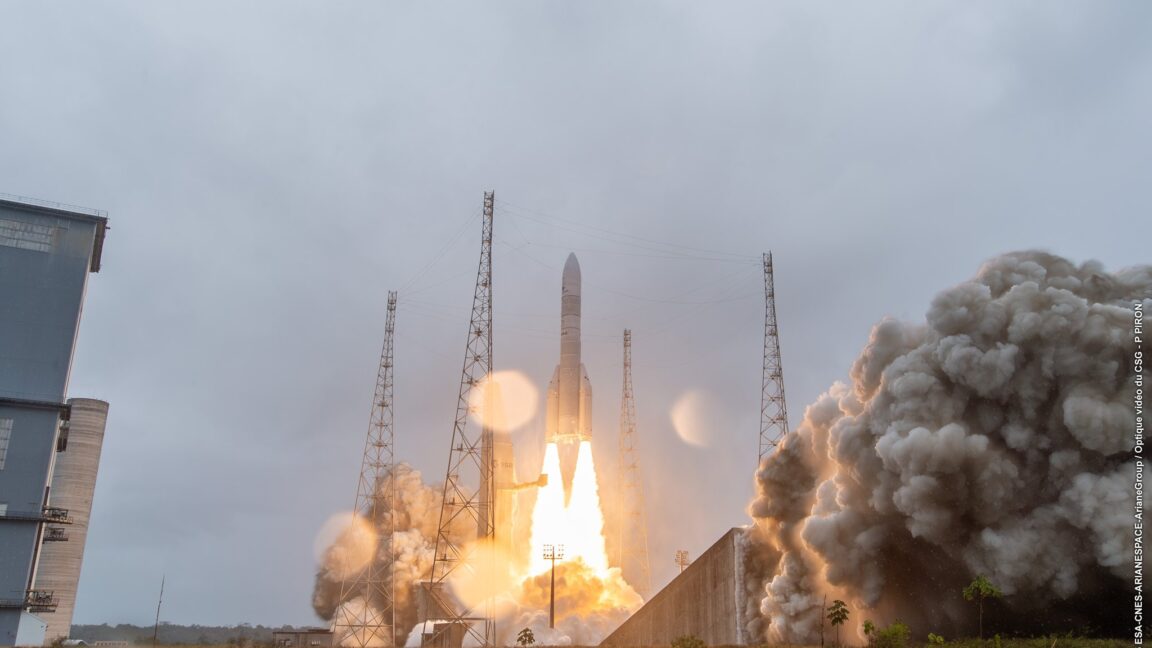
On March 6, 2025 at 1:24 p.m. local time in Kourou, French Guiana (4:24 p.m. UTC, 5:24 p.m. CET), Ariane 6, the new European heavy-lift launcher operated by Arianespace, lifted off from Europe’s Spaceport carrying the CSO-3 satellite on behalf of the French Defense Procurement Agency (DGA) and the French space agency (CNES), for the French Air and Space Force’s Space Command (CDE).
With this first commercial mission, Ariane 6 successfully placed CSO-3 into sun-synchronous orbit (SSO) at an altitude of 800 km. Spacecraft separation occurred 1 hour and 6 minutes after lift-off.
CSO-3 is the third satellite in the MUSIS (MUltinational Space-based Imaging System) program led by the DGA. This Earth observation system of three satellites is designed for defense and security purposes. They are equipped with the latest generation of optical sensors and guarantee the continuity of France’s optical Earth surveillance resources, transmitting very high resolution (VHR) images for France’s armed forces and its European partners. CSO-1 and CSO-2 were both successfully launched by Arianespace, in 2018 and 2020 respectively. Each satellite was developed by Airbus Defence and Space as prime contractor, with Thales Alenia Space prime contractor for the VHR optical instrument.
David Cavaillolès, CEO of Arianespace, said: “The successful launch of CSO-3 is a great day for European space and marks the beginning of the Ariane 6’s commercial operation. With this further success, we are consolidating our independent access to space and helping to guarantee sovereignty on behalf of our citizens. It is an honor for Arianespace to have delivered the entire CSO system to orbit and to have accompanied France and its European partners in this strategic mission. I thank the Ministry for the Armed Forces, Space Command, the French Defense Procurement Agency and CNES for their renewed confidence.”
CNES CEO Lionel Suchet said, “I am delighted at the successful launch of the French defense satellite CSO-3 for CNES and the DGA. This launch success, Ariane 6’s first commercial mission, is excellent news in so many ways and clearly demonstrates European and French excellence in space, to the benefit of our citizens. In orbiting of this third CSO satellite, CNES is providing the armed forces with operational support for the continuation of their space capabilities. I congratulate all the teams who worked to ensure the success of this launch, both in preparing the satellite and carrying out this first Ariane 6 commercial mission.”
“With this success, Ariane confirms the return of autonomous access to space for Europe. It demonstrates the quality of the industrial development of Europe’s new heavy-lift launcher. This success is the result of unique European industrial cooperation. I want to thank the Ministry of Armed Forces for its renewed confidence as well as all employees from ArianeGroup and its partners for their unwavering commitment,” said Martin Sion, CEO of ArianeGroup. « All our efforts are now focused on ramping up the Ariane 6 production ».
For this first commercial mission, the Ariane 6 vehicle was in the two-booster Ariane 62 configuration with a short fairing.
Versatile and competitive, Ariane 6 achieves a major production ramp up in order to meet the requirements of European institutional missions, as well as the growing needs of the commercial market.
Ariane 6 is a program developed within the framework of the European Space Agency (ESA). As prime contractor and design authority for the launcher, ArianeGroup is responsible for development and production alongside its industrial partners. Ariane 6 is marketed and operated by Arianespace as of this first commercial flight.

…Philippe Baptiste, France's minister for research and higher education, says Ariane 6 is "proof of our space sovereignty," as many European officials feel they can no longer rely on the United States. Baptiste, an engineer and former head of the French space agency, mentioned "sovereignty" so many times, turning his statement into a drinking game crossed my mind.
"The return of Donald Trump to the White House, with Elon Musk at his side, already has significant consequences on our research partnerships, on our commercial partnerships," Baptiste said. "Should I mention the uncertainties weighing today on our cooperation with NASA and NOAA, when emblematic programs like the ISS (International Space Station) are being unilaterally questioned by Elon Musk?
"If we want to maintain our independence, ensure our security, and preserve our sovereignty, we must equip ourselves with the means for strategic autonomy, and space is an essential part of this," he continued.
But European officials have freely admitted the commercial market is secondary on their list of Ariane 6 goals.
European satellite operators stopped launching their payloads on Russian rockets after the invasion of Ukraine in 2022. Now, with Elon Musk inserting himself into European politics, there's little appetite among European government officials to launch their satellites on SpaceX's Falcon 9 rocket.
 arstechnica.com

Should be at the very end of the year. Still planned for 2025 but wouldn't be surprised if it gets delayed to 2026. It'll be a Kuiper launch (35 or so), so the payloads also have to be ready for it.I look forward to the first Ariane 64 lift-off.
…During a panel discussion at the Satellite 2025 conference March 10, David Cavaillolès, the new chief executive of Arianespace, said geopolitical tensions since the start of the Trump administration had provided a clear example of the need for Europe to have its own means of accessing space, something it lacked for a time given delays in the introduction of the Ariane 6 and problems with the smaller Vega C rocket.
“Autonomous access to space is one of our missions for decades, so this is not new,” he said. “What is new is that, in the past sometimes, it sounded a bit theoretical and so on. And now, I think, people really understand what it means to have sovereign domestic capabilities to deliver end-to-end missions.”
“We should see an increase an institutional demand,” he added. While ESA and the European Commission have used Ariane for their missions when that vehicle was available, some national governments have turned to SpaceX in particular for launching their satellites rather than use Ariane.
He reiterated Arianespace’s desire to get the Ariane 6 up to full capacity, about 10 launches a year, as soon as possible. That is required to meet the demands of its largest commercial customer, Amazon’s Project Kuiper constellation. However, Cavaillolès said he expects stronger institutional demand to emerge in the years to come.
“Clearly, today we see that the market, especially the institutional market, is growing faster than the supply,” he said. “Our challenge is to ramp up successfully as quick as possible.”
 spacenews.com


And Ariane 6 isn’t planning on stopping there: four more launches are scheduled by the end of 2025 and its order book includes no fewer than 32 missions! These include the MetOp-SG-A1 weather satellite, which is scheduled for launch in August, the Sentinel-1D satellite from Copernicus, the European Earth observation program, and two satellites from the Galileo constellation, the European GPS.
Arianespace@Arianespace
Mission success for flight #VA264!
On August 12, 2025 at 10:41 p.m. Kourou local time (01:41 a.m. UTC, 3:41 a.m. CEST, on August 13), #Ariane6 placed #MetopSGA1 into a sun-synchronous orbit for @Eumetsat, reaffirming Europe's commitment to Earth observation
[July 7]
The launch was the first of five that Arianespace, the operator of the Ariane 6, has planned for 2025. That manifest, though, is backloaded to the second half of the year, with the next launch, of a Eumetsat weather satellite, scheduled for no earlier than August.
David Cavaillolès, who became CEO of Arianespace in January after the departure of longtime CEO Stéphane Israël, reaffirmed those plans in a panel discussion at the Paris Air Show last month, although he did not give a firm schedule of launches and their payloads.
He did not, though, offer a more precise schedule for reaching what he called “cadence ten,” or ten launches a year. “Everybody is extremely motivated, but we want to do it step by step,” he said. “First we have to deliver on ’25 and this is a big challenge, so we focus on that.”
He went so far as to suggest that ramp-up could be relatively gradual. Asked what “as soon as possible” meant in terms of a year, he said only that Arianespace planned more than five Ariane 6 launches in 2026. “In ’29, when we start deploying IRIS², which is a milestone program, we’ll be more than for sure at cadence ten.”
They are currently aiming for 4 flights (2 more)As of June, Arianespace was planning 5 flights in 2025.
[July 7]

Arianespace announces it has been awarded the contract to launch two SATCOMBw Stufe 3 satellites with two Ariane 6 for the German Armed Forces (Bundeswehr).
Arianespace to launch EU's Copernicus Sentinel-1D satellite on November 4, 2025, with Ariane 6
* On November 4, 2025, with Ariane 6, Arianespace will place into orbit Sentinel-1D, a Copernicus satellite for the European Commission within the scope of a contract signed with the European Space Agency (ESA).
* The Sentinel-1D satellite is designed to carry an advanced radar instrument to provide an all-weather day-and-night supply of imagery of Earth's surface.
* The VA265 mission will be the third commercial flight for Ariane 6, Europe's new heavy-lift launcher.
* With this launch, Arianespace supports a major environmental mission while also carrying out its commitment of guaranteeing Europe's autonomous access to space.
On November 4, 2025 at 6:03 p.m. local time (9:03 p.m. UTC, 10:03 p.m. CET), Arianespace will launch the Sentinel-1D satellite with Ariane 6 from Europe's Spaceport in French Guiana.
The mission, designated VA265, will be the third commercial flight for Ariane 6, the new European heavy-lift launcher. The satellite will be placed into Sun-Synchronous Orbit (SSO) at an altitude of approximately 693 km. Spacecraft separation will occur around 34 minutes after lift-off.
The Sentinel-1D satellite is part of Copernicus, the Earth observation component of the European Union's Space Programme. Copernicus is managed and funded by the European Union with a partial contribution of ESA. As the world's most advanced Earth observation system, Copernicus provides continuous, free, and reliable Earth observation data and services to public authorities, companies and citizens around the globe. Sentinel-1D will carry advanced radar technology to provide an all-weather, day-and-night supply of imagery of the Earth's surface, delivering data essential to monitoring sea ice, track icebergs and glaciers, subsidence, and oil spills.
Thales Alenia Space, a joint venture between Thales (67 %) and Leonardo (33 %), is the prime contractor of Sentinel-1D which arrived in French Guiana on September 11th, 2025.
The VA265 mission once again highlights Arianespace's commitment to space for a better life on Earth, as well as ensuring Europe's autonomous access to space.
The VA265 launch at a glance:
* 356th launch by Arianespace
* 4th Ariane 6 launch and 3rd commercial flight
* 10% of the satellites launched by Arianespace are Earth observation satellites
* 7th Sentinel satellite launched by Arianespace
* 53rd mission for the European Space Agency
* 109th spacecraft built by Thales Alenia Space launched by Arianespace
For any request to receive the clean feed of the launch broadcast, please contact: Camille SOHIER - [email protected]


Initial 60-litre demonstrator tanks have already proven CFRP's ability to hold liquid hydrogen without leakage. Building on this milestone, engineers are now constructing a larger 2,600-litre prototype tank measuring two metres in diameter.

A CFRP shouldn't have any particular issue holding LH2. You're basically taking an LH2 tank and wrapping carbon around it. The carbon provides the strength while the liner provides the "airtightness".From the above:
Quite an ambitious scale-up effort and probably a little bit early in their announcement!
I don't think it is a metal tank with a composite overwrap.A CFRP shouldn't have any particular issue holding LH2. You're basically taking an LH2 tank and wrapping carbon around it. The carbon provides the strength while the liner provides the "airtightness".
So not a COPV but all carbon? Interesting.I don't think it is a metal tank with a composite overwrap.

ESA Earth Observation
@ESA_EO
Just over a week to go until launch for @CopernicusEU Sentinel-1D!
Late last week, the satellite was encapsulated in the #Ariane6 rocket fairing.
Liftoff is set for 22:02 CET (21:02 GMT) on 4 November.
The Copernicus Sentinel-1D satellite has joined the Sentinel-1 mission in orbit. Launch took place on 4 November 2025 at 22:03 CET (18:03 local time) on board an Ariane 6 launcher from Europe’s Spaceport in French Guiana.
The Sentinel-1 mission delivers high-resolution radar images of Earth’s surface, performing in all weathers, day-and-night. This service is used by disaster response teams, environmental agencies, maritime authorities and climate scientists, who depend on frequent updates of critical data.
Sentinel-1D will work in tandem with Sentinel-1C, flying in the same orbit but 180° apart, to optimise global coverage and data delivery. Both satellites have a C-band synthetic aperture radar (SAR) instrument on board, which captures high-resolution imagery of Earth’s surface. They are also equipped with Automatic Identification System (AIS) instruments to improve detection and tracking of ships. When Sentinel-1D is fully operational, it will enable more frequent AIS observations, including data on vessel identity, location and direction of passage, enabling precise tracking.
Sentinel-1D was launched on Europe’s heavy-lift rocket Ariane 6 on flight designated VA265.
Credit: ESA/CNES/Arianespace/Arianegroup
Same, but apparently delayed to early 2026.I'm looking forward to the first launch of the Ariane 64.
 la1ere.franceinfo.fr
A CFRP shouldn't have any particular issue holding LH2. You're basically taking an LH2 tank and wrapping carbon around it. The carbon provides the strength while the liner provides the "airtightness".
I do see issues with the resin being cooled down to -253 C.
It would almost certainly have insulation, even if it was just a regular metal tank.I do see issues with the resin being cooled down to -253 C. There might have been an insulation (could be aerogel plus a sealant) on the inside.
The issue is the difference in coefficient of thermal expansion/contraction between the liner and overwrap. And the epoxy thermal properties.A CFRP shouldn't have any particular issue holding LH2. You're basically taking an LH2 tank and wrapping carbon around it. The carbon provides the strength while the liner provides the "airtightness".
The shape makes a difference. Don't know if they did better or not but theirs definitely doesn't look like this:Europe did better with composites than X-33 guys?


