TomcatViP

Hellcat
Joined
12 February 2017
Messages
11,016
Reaction score
16,919
Dassault Aviation expresses willingness to commit to a Space Plane project, meeting AdlAE recent new long term perspectives: (Link in Fr - You might want tuse an auto-translator)

Alors que le thème de la « très haute altitude » [soit la zone comprise entre 20 et 100 km d’altitude] s’est imposé, l’apport d’un « avion spatial » pourrait sans doute être pertinent. Mais, pour le moment, selon M. Trappier, un tel appareil ne suscite pas d’intérêt en France… alors que Dassault Aviation a imaginé le concept VEHRA [Véhicule hypersonique réutilisable aéroporté], qui ne s’est jamais concrétisé, faute de crédits.

« Il n’y a pas d’avion spatial aujourd’hui. J’en ai l’idée. La volonté, je l’ai.
***///-----------------------------------------///***

While the theme of "very high altitude" [i.e., the area between 20 and 100 km above sea level] has emerged, the contribution of a "space plane" could undoubtedly be relevant. But, for the moment, according to Mr. Trappier, such a aircraft is not yet generating any interest in France... even though Dassault Aviation has imagined the VEHRA [Hypersonic Reusable Airborne Vehicle] concept, which never materialized due to lack of funding.

"There is no space plane today. I have the idea. I have the will."


Attachments

  • Gten1mvbYAAJT_9.jpeg
    Gten1mvbYAAJT_9.jpeg
    54.8 KB · Views: 59
Somehow, Hermes returned

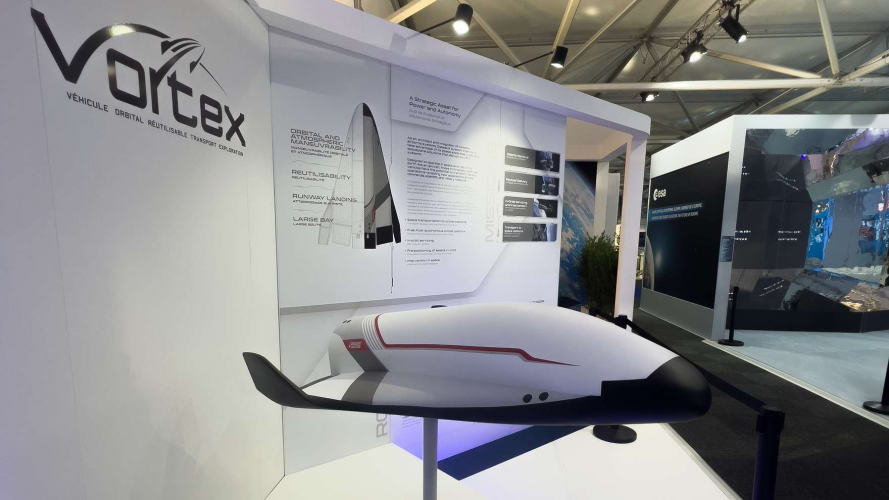
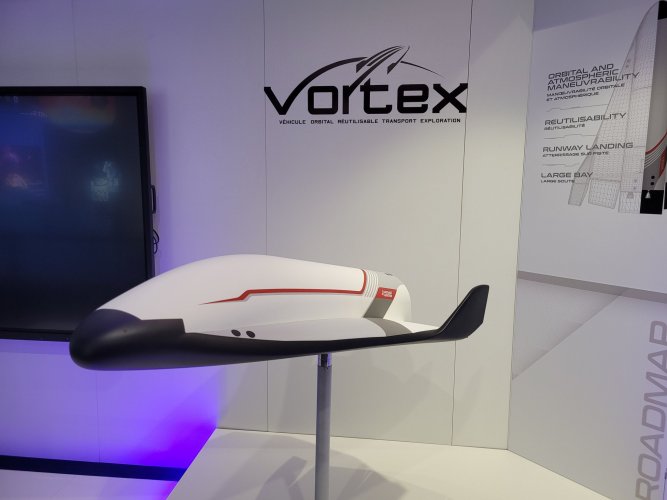
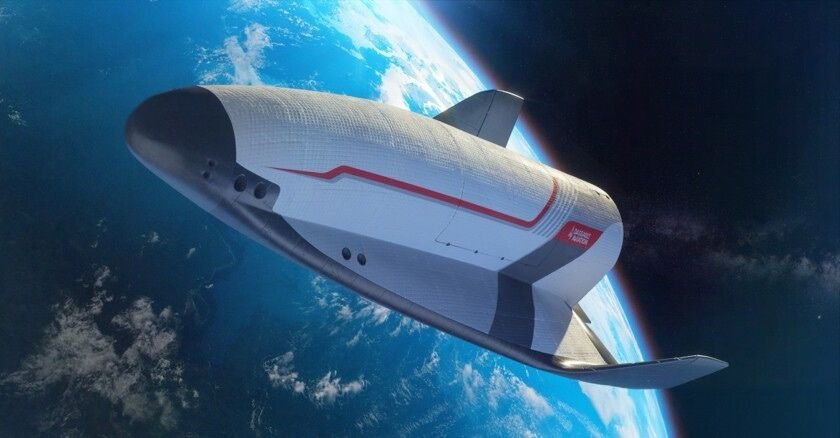
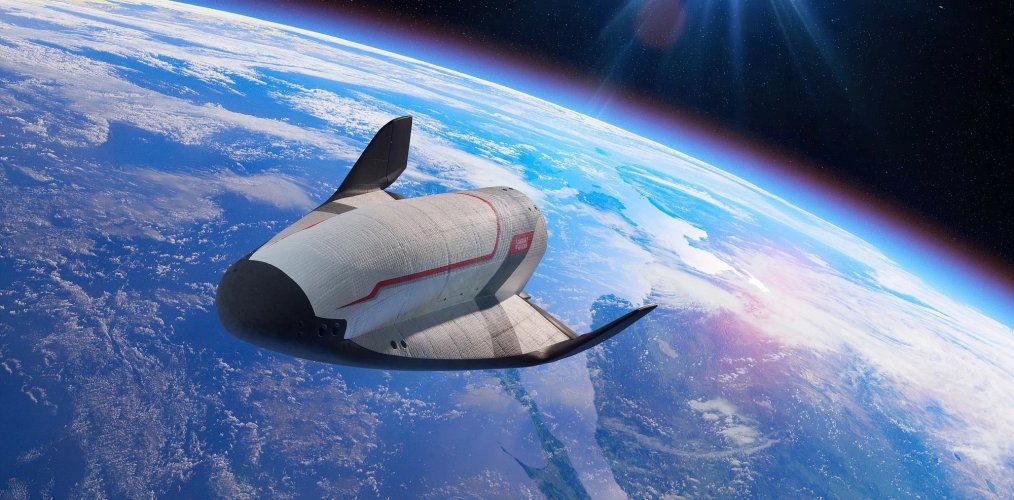
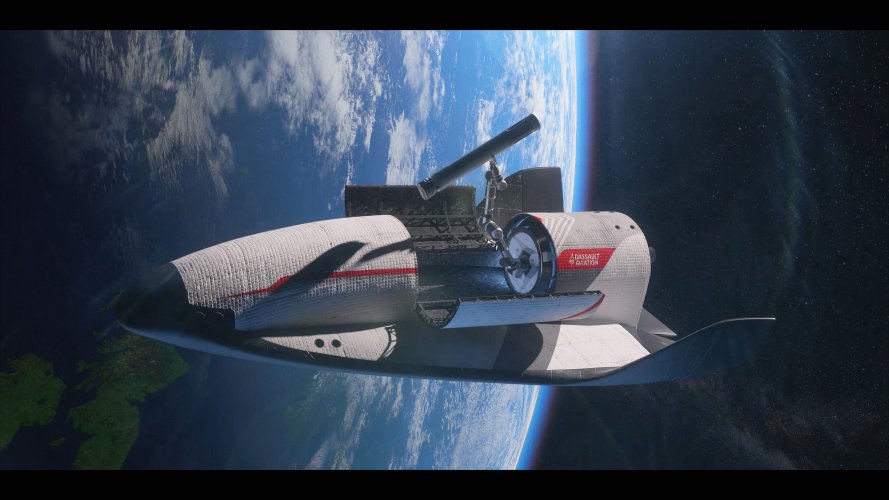
Dassault got tired of proposing the same VEHRA for 20 years and came up with an unmanned distant derivative of Hermes named "Vortex" (Véhicule Orbital Réutilisable de Transport et d'Exploration,
Reusable Orbital Transport and Exploration Vehicle)...


Although the Vortex's precise specifications have not yet been revealed, it is assumed that the vehicle could reach a launch weight of 15 tons, with a length of approximately 12 meters and a payload and return capacity of 4 tons. Its aerodynamic shape, meanwhile, has already been determined. Dassault is reportedly planning a first suborbital demonstration flight for 2028.


The European Space Agency could formalize its commitment to the program tomorrow with details on the form this collaboration will take. In this context, with the ongoing development of its Space Rider, ESA finds itself involved in two space vehicle projects. This situation may be surprising, but it should be put into perspective. On the one hand, the Space Rider, developed by Thales Alenia Space, is a project primarily led by Italy, and on the other hand, the two vehicles are not in competition, but rather complementary. Although the Space Rider is innovative, it has limited operational capabilities compared to the Vortex.
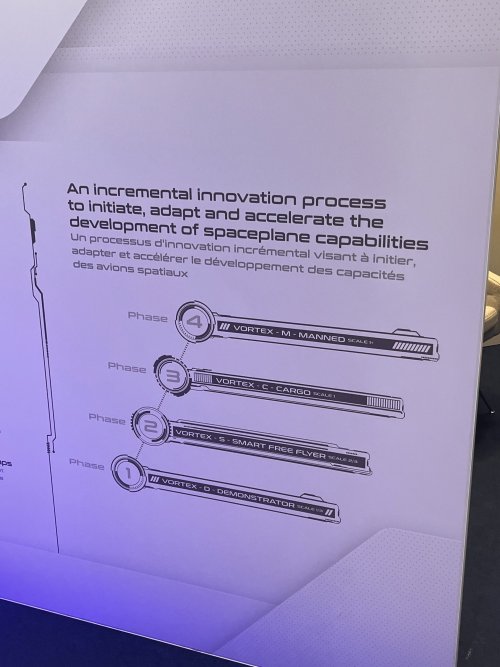
The program is divided into four phases:
Vortex-D will be a 1/3 scale demonstrator,
Vortex-S a 2/3 scale vehicle,
Vortex-C a 1/3 scale cargo ship,and finally,
Vortex-M a manned aircraft.
The first phase aims to address the risks associated with such technology, validate flight control principles, and begin the integration and testing of certain systems, according to Dassault Aviation.

According to the data collected, the 1/3 scale demonstrator should be 4 meters long with a wingspan of 2.5 meters, which would make the Vortex-C and -M approximately 12 meters long with a wingspan of approximately 6 to 7 meters.

A first demonstrator flight is expected for 2028, and an initial operational configuration could be established as early as 2031—an ambitious goal that will require significant funding, according to an industry expert.T

The spaceplane project is already included in the 2024-2030 Military Planning Act and is mentioned in the "innovation" section, for which a total budget of 10 billion euros is planned. The Military Planning Act provides for "technical and operational analyses to refine requirements."
1750472288170.png
1750472298288.jpeg
1750472309404.jpeg

It definitely does look like hermes from some angles...
1750472645460.png
1750472863098.jpeg

And the french armed forces announced a 30M€ participation in the project
The ESA only signed a preliminary agreement

I'll be honest, I think this will quickly fit in this "unbuilt or cancelled project" section.
 
One big new of the Le Bourget show , with the launching by the French Air Force and government of this program , it have more support than the SCAF.
A Space plane for dual use military and civilian.
 
As brought to us by @dark sidius, during Le Bourget 2025 airshow, an agreements was signed with France MoD with the intend to support Dassault´s development of a next generation Space shuttle vehicle prioritizing commercial aspects for space access and affordable persistence for the armed forces similarly to the Boeing X-37B:

Le développement d’un drone spatial, à l’image du X-37 américain ou le CSSHQ chinois permettrait d’accroître les capacités d’intervention en orbite. Un tel projet avait été évoqué par un rapport parlementaire publié en 2020, soit au moment où il était question d’élaborer un plan de relance pour la Base industrielle et technologique de défense [BITD] lors de la pandémie de covid-19.
[...]
« Nous visons le marché de la mobilité dans l’espace, un domaine où la Chine, la Russie et les États-Unis avancent très vite. L’espace devient un terrain de compétition stratégique, économique et scientifique. La France a besoin de cette capacité. Et Dassault a les compétences en aérodynamique, dans les commandes de vol, le guidage et le dialogue homme-machine », a d’abord rappelé M. Trappier.
--------------------------**////-------------------------------

The development of a space drone, similar to the American X-37 or the Chinese CSSHQ, would increase intervention capabilities in orbit. Such a project was mentioned in a parliamentary report published in 2020, at the time when a recovery plan for the Defense Industrial and Technological Base (BITD) was being considered during the COVID-19 pandemic.
[...]
"We are targeting the space mobility market, an area where China, Russia, and the United States are advancing very rapidly. Space is becoming a strategic, economic, and scientific competitive arena. France needs this capability. And Dassault has the expertise in aerodynamics, flight controls, guidance, and human-machine communication," Mr. Trappier began.

https://www.meretmarine.com/fr/defe...onstrateur-d-avion-spatial-vortex-de-dassault '


1750498695259.png
 
Last edited:
According to the update version of opex360 article:
(English translation)
Mr Lecornu later clarified that the Ministry of the Armed Forces would be funding this spaceplane project - ‘a disruptive innovation’, he said - to the tune of €30 million. The maiden flight of Vortex D is scheduled for 2028.
Four stages/versions have been announced: VORTEX D (1/3 scale demonstrator), VORTEX S (2/3 scale Smart Free Flyer), VORTEX C (cargo) and VORTEX M (manned flight).
 
WoW!

Interesting that the heat shield strategy is the same as with Hermes:

(from Hermes page on Wiki)
According to CNES, Hermes would have been subject to more extreme re-entry conditions than the Space Shuttle due to its smaller size exposing the vehicle to higher aerothermal pressures.[14] The baseline thermal protection,[15] was to withstand temperatures of 1,400-1,600 °C for a minimum of 20 minutes and studied by Dassault and SEP, would have consisted of carbon elements with an anti-oxidant coating applied to portions of the nose and leading edges of the wings, while thermal tiles were to have covered the underside of the wing and fuselage.[14] These tiles would have employed thin, reinforced ceramic-carbon honeycomb composite insulating layers separated by thin sheets of metal alloy to reflect the heat; an alternative concept for the tiles would have employed higher metallic portions in place of ceramics. The upper surfaces of the vehicle would have been subject to less heat than the lower surfaces, and used flexible blanket-like low-density, glassfibre-ceramic layers.[14]
 
Last edited:
As brought to us by @dark sidius, during Le Bourget 2025 airshow, an agreements was signed with France MoD with the intend to support Dassault´s development of a next generation Space shuttle vehicle prioritizing commercial aspects for space access and affordable persistence for the armed forces similarly to the Boeing X-37B:


https://www.meretmarine.com/fr/defe...onstrateur-d-avion-spatial-vortex-de-dassault '


View attachment 775342
French government and Dassault director Eric Trappier take seriously the defense and war in the space domain, this time I think more that the Vortex space plane take life sooner than the FCAS , Vortex is leading by France and Dassault.
first flight demonstrator in 2028
The program is divided into four phases:

Vortex-D will be a 1/3 scale demonstrator,
Vortex-S a 2/3 scale machine,
Vortex-C a 1-scale cargo ship
and finally Vortex-M a manned craft.
The first step aims in particular to remove the risks associated with such technology, validate the principles of flight control and start the integration and testing of certain systems, indicates Dassault Aviation.

According to the data collected, the 1/3 scale demonstrator should be 4 meters long with a wingspan of 2.5 meters, which would make Vortex-C and -M machines about 12 meters with a wingspan of about 6 to 7 meters.
 
Last edited:
So the soborbital demonstrator will fly in 2027 Flyaway? I will be keeping my fingers and toes crossed that it succeeds where Hermes failed and the full scale spaceplane will fly in 2030.
 
Well, at least, it would make one credible spacecraft in the entire portfolio of ESA future launcher projects... Sad that Dassault doesn´t go directly for the launcher as well.
 
Some information from the French DGA and Dassault’s CEO shared during senate hearings that I haven’t seen mentioned here :

According to the DGA (French Defence Procurement Agency):
  • 2 years of development for the first demonstrator (Vortex-D, at 1/3 scale, 4m long - 2.5m wingspan)
  • Budget of 70 Million €
  • More than 50% self-financed by Dassault
  • The goal of this demonstrator is to achieve a suborbital flight at Mach 12 by 2027.
It will be launched by a Rocket Lab Electron micro-launcher → https://en.wikipedia.org/wiki/Rocket_Lab_Electron

Objectives of the demonstrator :
  • Test hypersonic guidance
  • Test thermal protection
  • Test terminal maneuverability
The Minister, the DGA, and Dassault genuinely believe in the project, it’s not just for show.
According to E.Trappier (Dassault)
We already have advanced discussions — I won’t reveal them today — with the Germans, the Italians, and other countries, precisely to mobilize a team on this subject, which I consider very strategic.”


Also on thermal shielding from the CEO of The Exploration Company, one of the largest private space startups in Europe (DE/FR), during a french senate hearing.

Could this technology also have applications within the Vortex program ?

Here at 1:06:40 --> View: https://www.youtube.com/live/mzb17onqG94?t=4000s
Another aspect, in terms of return on investment — or why space exploration and human spaceflight are important — is the military dimension.

The technologies we’re developing have dual-use applications.

For example, re-entry technologies: the re-entry materials we’re developing have both civilian and military uses.

As an example, MBDA will be conducting tests in a few months using our thermal protection system, which we produce in Bordeaux, to determine whether this very low-cost protection could be suitable for hypersonic missiles.

So the re-entry technologies we’re working on have direct applications in hypersonics, whether for missiles or hypersonic aircraft.
 
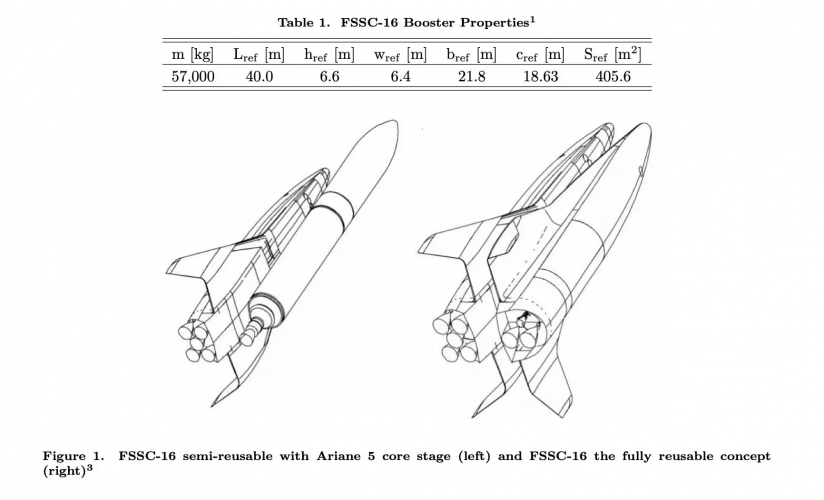
Yes--Martin favors that one. His design. The winged booster (five engines each-depicted on the left in both drawings) is a first stage.

A similarly shaped re-usable second stage is depicted on the right-most image, though it can be swapped out with an expendable second stage as seen in the left-hand drawing...that for higher orbits I would imagine.

VORTEX might be a tad more stubby, just eyeballing things. Still, it is more booster-like than Hermes that was designed from the start to be a pure orbiter only.

Maybe the SPACE LINER guys will get onboard?
 
Last edited:
Best athlete ;)

Dassault partners with the German OHB to develop its space shuttle "Vortex"


The aircraft manufacturer is turning to the German satellite manufacturer OHB to accompany it in its spacecraft program. A partnership based on everyone's best skills, in order to give Europe low-orbit flight capital.

For a long time, many observers wondered why Dassault Aviation did not have more ambitions in space. This time, the manufacturer of Rafale and Falcon business planes decided to slip a big piece into space research.

Some 70 engineers are now working on "Vortex", the reusable orbital transport and exploration vehicle, whose project was first presented at the Salon du Bourget last summer. The goal is to quickly develop a demonstrator of this new space shuttle. Dassault aims for a first flight of a prototype at 1/3 scale around 2027.
 
Last edited:
More tidbits from the article :

To achieve this and move as quickly as possible, Dassault has chosen a German partner. Regardless of the ongoing disputes with Airbus's German military division over leadership of the Future Combat Air System (FCAS), Dassault and the Bremen-based satellite manufacturer OHB have decided to join forces.
Dassault CEO Eric Trappier has reached an agreement with OHB CEO Marco Fuchs on the development of this spaceplane, capable of operating in and out of low Earth orbit. This dual-use spaceplane could transport payloads to space stations, retrieve objects from low Earth orbit, deploy payloads, intercept enemy satellites, and more.
To develop this capability for operations in orbit, Dassault and OHB intend to leverage their complementary expertise. Dassault is responsible for studies on the aircraft and its "reusability," meaning its ability to land and take off again to reach low Earth orbit. For the aircraft manufacturer, this involves validating in flight technologies critical for controlling hypersonic flight and atmospheric reentry, which requires significant work on advanced thermal protection technologies and flight control.
Alongside the expertise of the aircraft manufacturer, which had already worked in the 1980s on space shuttle projects, the satellite manufacturer OHB will bring its knowledge of the exoatmospheric environment, and will make use of its experience in tracking the trajectories of satellite objects, in space telecommunications and in space engineering.


Cooperation
For the time being, Dassault is not very forthcoming about "Vortex" but confirms the partnership with the German family-owned company. Currently, Dassault is largely self-financing the studies on "Vortex," but the aircraft manufacturer is participating in a project supported by the French Ministry of the Armed Forces, the CNES (French National Centre for Space Studies), and the European Space Agency (ESA).
Last year, the ESA selected two space cargo projects to develop a commercial freight transport service by 2030 to the International Space Station or its future private competitors. The ESA signed agreements with The Exploration Company and Thales Alenia Space, providing €25 million in funding for each project.
The European Space Agency (ESA) is set to launch a second tender in 2026 for its low Earth orbit cargo service, and Dassault hopes to include its Vortex spacecraft. Unlike the two selected projects, this involves an aircraft, not a capsule like The Exploration Company's Nyx capsule, which aims for a return to Earth's atmosphere.
France, thanks to a revision of its military spending law, and Germany are expected to join forces to finance the next phase of the ESA's "LEO Cargo Return Service" project. According to one expert, adding Dassault to the two ongoing projects should not pose much of a problem initially, as the amounts to be spent between now and 2027 do not exceed several tens of millions of euros. The key challenge for all projects will be scaling up, but European states will not be ready for this before 2028.
 
Last edited:
Dassault Starts Vortex Spaceplane Parts Production

MERIGNAC, France—Dassault Aviation has started building parts for its Vortex spaceplane demonstrator with the aim of building momentum for a project it wants to see flying as early as 2028.

Some of the components being built now are due for plasma torch testing at the Italian Aerospace Research Center in Capua, Italy, near Naples, says Igor Fain, head of Vortex business development at Dassault. The tests will assess the parts' various heat shield technologies for their properties and to address differences in heat buildup that will occur on the spaceplane.


Dassault and the French government have signaled they are open to other countries and companies joining. Fain noted that Dassault is focusing on its aircraft-making expertise and would be keen to draw in technical know-how from Germany and elsewhere for parts of the program, not unlike the partnership the company led on the Neuron uncrewed combat air vehicle demonstrator on which Saab was a partner. The vehicle is due to be assembled at Dassault's site in Istres, France.

Fain said despite the involvement of the French defense procurement agency DGA, the company views Vortex as a dual-purpose system with application in the growing commercial space economy—for instance, providing ways to bring medicines or other items made in low Earth orbit back to the ground. The operational vehicle would land on a runway and expose the payload to only 1.5 g, making it attractive as a cargo return vehicle, Fain said. It could be used for on-orbit satellite repairs and, in a military sense, rendezvous and proximity operations.

Fain said the company is employing an incremental development approach. The Vortex-D would be followed by Vortex-S smart free-flyer and then the Vortex-C operational cargo vehicle with a system weight of 8-9 metric tons and 2 tons of payload. The company also has long-term plans for a human-rated Vortex-H.

 
Interview about the Vortex program

Step-by-step development approach, with the first big milestone being a tech demonstrator flight planned for Q2 2028.
This demonstrator is about 1/3 scale and will do a suborbital flight to ~100 km at Mach 10, mainly to test the hard parts of hypersonic re-entry (heat loads, thermal protection, flight control, overall behaviour).

After that, the end goal is pretty broad: reusable spaceplanes for in-orbit servicing (refuelling, repairs, upgrades), microgravity “free flyer” missions, and eventually cargo transport, then possibly crewed flights.

Big emphasis is on reusability economics : how often it can fly, how fast it can be turned around, and how heavy the refurbishment is between flights. Thermal protection is really one of the main drivers there.

On the launcher side, nothing fixed yet … they’re still studying different options, especially because the vehicle is meant to be launched in an “out-of-fairing” configuration (don't know if that the right term), which adds integration challenges.

Also it's designed to be fully autonomous fully autonomous during the return and landing phases, building on the neuron experience.


On the launcher side, nothing fixed yet … they’re still studying different options, especially because the vehicle is meant to be launched in an “out-of-fairing” configuration (don't know if that the right term), which adds integration challenges.
SpaceLiner was to be parallel staged....top mount articles were said to impart pitch loads, bending moments, etc. Thus X-37's shroud.

Very wide fairings have been looked at:
 

Similar threads

Back
Top Bottom