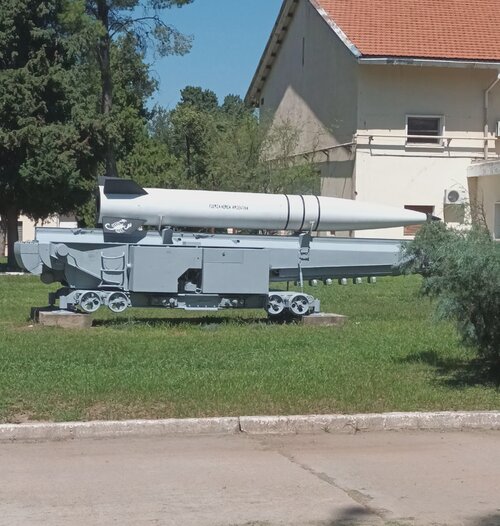
The Myth of Reaction: The True Genesis of the Condor Missile Program
This article previews findings from an ongoing investigation into the origins of the Condor II program. Due to its journalistic format, it does not reproduce here the full apparatus of sources, archives, and interviews — including Brazilian and British intelligence documentation — that underpins each claim; that documentary evidence will be published in full detail in the book that will grow out of this work.
Argentine historiography settled on a linear, narrow account of the development of its missile technology: the Condor II program is said to have been a reactive response, a desperate postwar attempt to restore deterrence after the military defeat in the Falklands in 1982.
Yet the documentary record of intelligence agencies — including declassified British and Brazilian files — traces an autonomous timeline, disconnected from wartime urgency. These files describe a long-range technology-transfer plan in which public discourse and the infrastructure's actual use ran on separate tracks: outwardly, a scientific satellite-injection program; behind closed doors, the redirection of that capability toward a medium-range ballistic missile. The Argentine Air Force (FAA) was not seeking a "turnkey" weapon, but rather sought to place the country among the select club of nations with advanced development capability.
To that end, Argentina built strategic ties with European consortia under engineering oversight controlled from Germany, operating at the margins of Cold War restrictions. Condor II was not born of 1982; it was the outcome of a technology-insertion strategy designed to exploit gaps in the European arms industry. Argentina sought the sovereign capability that made the missile possible, positioning itself as a development node in a heavily regulated market. Far from a survival narrative, the program was a demonstration of ambition: a "surrogate womb" for cutting-edge weaponry whose counterparts remain in service around the world today.
The Foundations: The German Connection and Dual-Use Doctrine
In 1976, the Bohlen industrial family began expanding its arms empire into the developing world with the backing of the West German federal government, deepening a strategic alignment between Germany and Argentina that included programs such as the Navy's naval platforms, the IA-63 "Pampa" trainer aircraft, and the Argentine Medium Tank (TAM). These agreements pursued substantial technology transfer that would let Argentina compete in the international arms market, reviving the autonomist logic associated with Generals Mosconi and Savio. Argentine interest in rocketry dated back to the 1940s and had matured in the 1960s through exchanges with NASA and a visit by Wernher von Braun, which trained the Institute for Aeronautical and Space Research (IIAE) in solid-fuel vectors.
In 1969, Argentina signed an agreement with the West German aerospace agency DFVLR, a framework that institutionalized the later Satellization Plan. Although the public goal was placing satellites into orbit, the underlying scientific competencies were identical in their dual-use nature to military ones. Until then, IIAE's domestic production of sounding rockets relied on immature methods and machinery adapted from the food industry.
1974–1979: The Strategic Turning Point
Two milestones in 1974 reshaped the landscape:
- The regional factor: the IIAE developed the SS-40 artillery rocket, demonstrated to Libya. Its inadequate performance cost Argentina the Libyan contract, which went instead to the Brazilian arms industry — an opportunity Brazil capitalized on to launch its own successful ASTROS family of rocket launchers.
- The global factor: India's nuclear test ("Smiling Buddha") triggered a tightening of export controls by the leading powers, layering nuclear restrictions on top of aerospace ones.
The FAA stayed the course. The 1972 "Tasso report" laid down the first lines for a surface-to-surface vector, consolidated in 1979 in the "Alvarisqueta report." This document outlined the need for a ballistic missile with a 2,000 km range, a tactical missile, and a stand-off guided bomb, in line with NATO's contemporary conventional-weapons doctrines.
Financing this ambition strained Argentina's fragile domestic finances through a complex architecture of credit. Far from resting on straightforward budget allocations or direct operating expenditures of hundreds of millions of dollars, the financial scaffolding was camouflaged under the umbrella of the German export credit insurance scheme known as Hermes — the mechanism called
Hermesbürgschaften, originally tied to the development of the Pampa aircraft alongside Dornier and DFVLR. In this way, the FAA drew on its own credit line worth close to USD 600 million, a hidden liability whose secret decrees would only begin to be declassified decades later, as a condition in the Paris Club negotiations to recognize the outstanding debts of that era.
The Corporate Architecture and the Open Secret
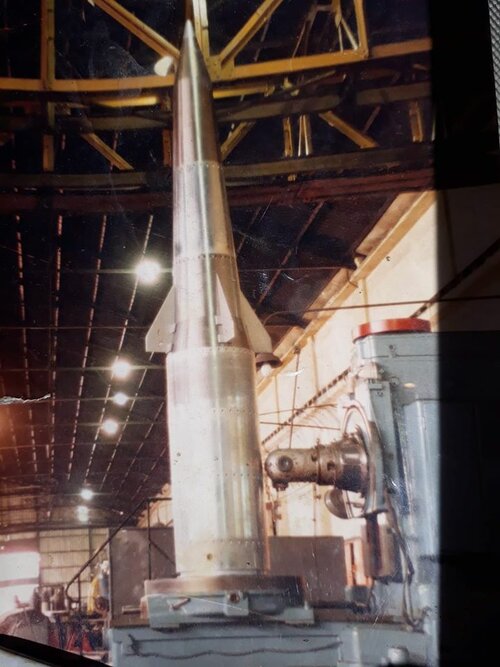
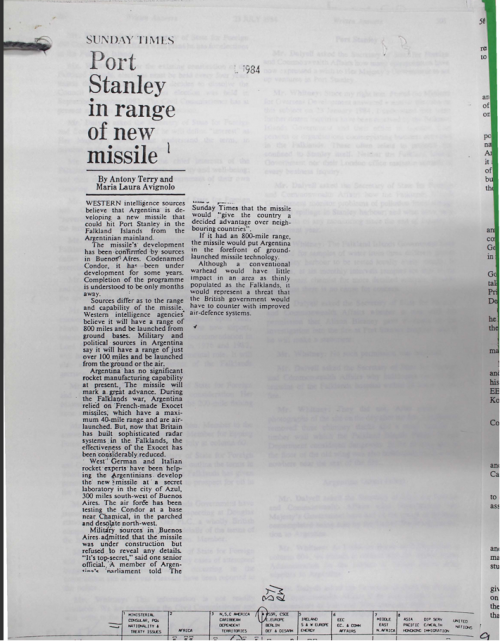
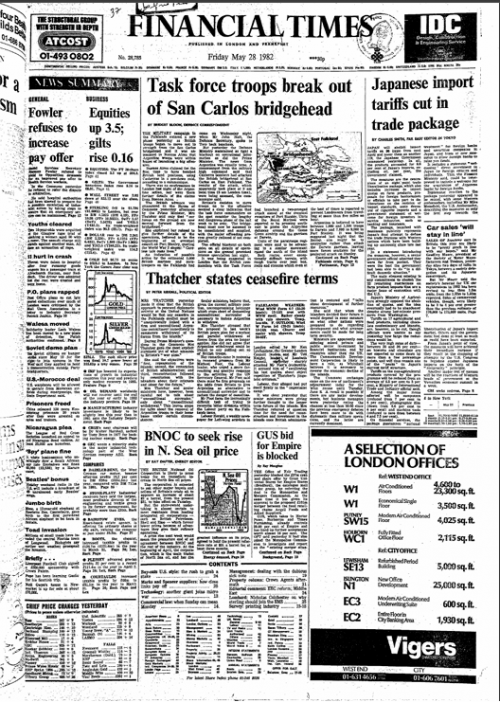
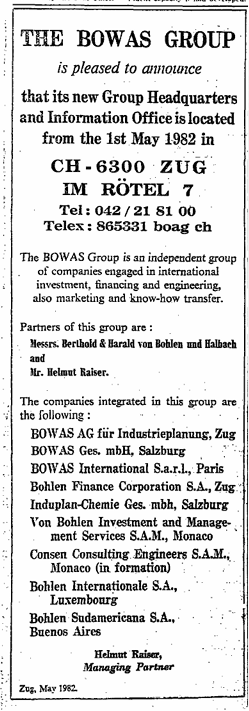
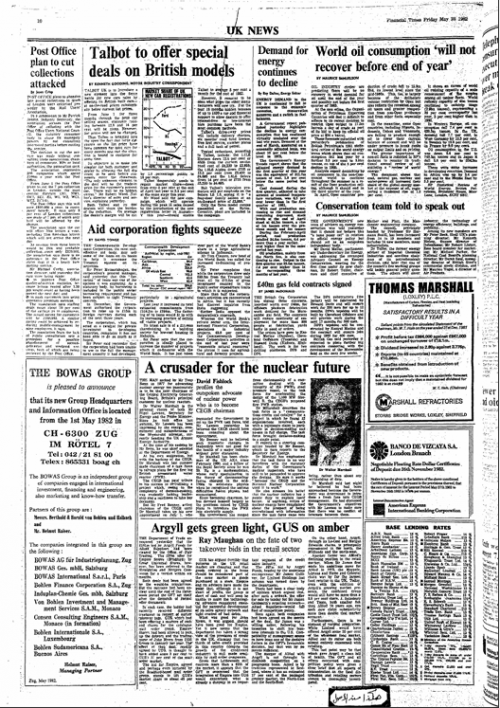
The program's ownership structure reveals a design meant to sidestep controls. The Air Force never allocated an explicit budget line for the purchase of "Condor missiles"; the records show only salaries and operating expenses for infrastructure. The rocket motors produced legally belonged to INTESA, a joint venture created with the aim of exporting the finished weapons systems. In May 1982, in the middle of the war, Bohlen group subsidiaries were already circulating commercial brochures advertising their capabilities tied to the program. This was not a leak; it was explicit corporate advertising that the mainstream press failed to pick up as news until the Sunday Times article of July 1984.
This network brushed up, in a confirmed way, against the nuclear and scientific-technological industry. As for how that link began, only a testimonial account exists so far: a nuclear executive at Pilcaniyeu recalls that a senior FAA officer approached him to request help manufacturing the solid-booster casings, under the none-too-discreet premise of building "a missile for the Arabs" — deliberately omitting dates and names out of a fear that would later extend to Western and Israeli intelligence services after 1987, and presumably also to the social condemnation of the local scientific community, in what I call part of "INVAP's dark history."
But the outcome of that link no longer rests on this anecdote alone: the United States' own intelligence analysis records that INVAP manufactured the program's first booster bodies, and Ing. De León — independently — cites an approximate number of units produced. The convergence between a foreign intelligence source and a local researcher, with no apparent connection between the two, elevates this from an isolated testimony to a corroborated fact. That same equipment — used for rolling and welding the casing sheets — was later transferred to Bertolina/DosTec, suggesting that production capacity did not remain static with a single supplier but migrated as the program matured industrially.
Something with a different kind of verifiable backing is the training link: the résumés of several program engineers list training in computer systems at the Balseiro Institute in 1983. That training role, however, was not tied to trajectory calculations or vector simulation, critical engineering tasks that were carried out centrally at the Falda del Carmen plant. Even with that functional caveat, the picture that emerges between the casing manufacturing and the technical training confirms a real institutional cooperation network with the Bariloche scientific circuit, well before Egypt's formal entry into the consortium in 1985.
The War as an Interruption, Not an Origin
Between 1980 and April 1982, technical commissions were selecting suppliers across Europe, the United States, and Israel for the project's most critical components, sending dozens of engineers abroad for training under the cover of the existing agreements between the IIAE and the DFVLR. In the midst of building the solid-motor production plant at Falda del Cañete — deliberately christened "Falda del Carmen" to throw off foreign intelligence, despite not being near that actual town — April 2, 1982 arrived.
That day, following a nearly bloodless landing, the Argentine flag once again flew over the Falklands: no longer Port Stanley, but Puerto Argentino, for the following 79 days. Direct combat with the United Kingdom ended in military defeat and suspended much — though not all — of the military modernization programs. Shortly before the war, the FAA had begun an extensive upgrade of its IAI Dagger fighter-bombers — acquired in 1978 — with assistance from British firms, and was holding advanced talks to bring in another batch of BAC Canberra light bombers, and even the Avro Vulcan bombers that the UK itself would use during the conflict to strike the airfield's runway and the air-defense systems deployed in the area.
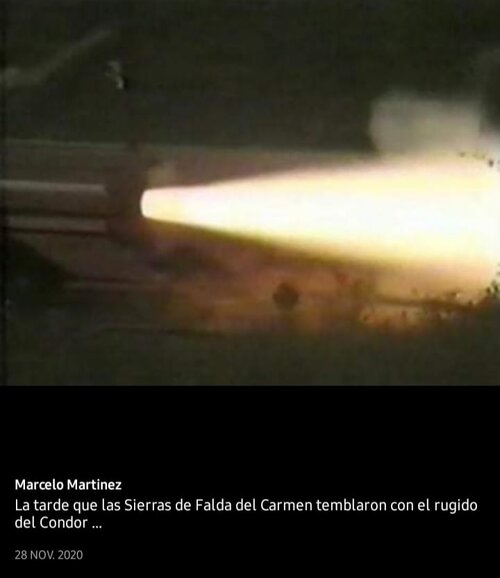
Some time after the surrender, the Air Force General Staff created the planning group "Fuerza Aérea 2000," a think tank meant to chart the institution's future toward the turn of the century, as recorded by De León and Daniel Blinder. It was in that setting that the circle of officers aware of the Condor program widened, and where the idea gained traction of redirecting what had until then been a scientific sounding-rocket and satellite-injection project toward a medium-range ballistic missile capable of reaching the newly announced Mount Pleasant air base, whose construction had already been announced.
Key institutional note: this internal-use hypothesis never translated into the administrative step that would have confirmed operational intent: formally incorporating the vector into the Air Force's Order of Battle (ORBAT).
The project was affected during the armed conflict in several ways: much of its military personnel was reassigned to the war effort, and although the scientific and technical staff based in Germany faced no major setbacks, cooperation with contractors and suppliers was not fully restored until around October 1982. British companies and scientific institutions remained key parts of the machinery, exactly as had been set out nearly three years earlier — which already foreshadows that the war interrupted the program, but neither redirected nor originated it.
The United Kingdom: From Transonic Simulation to Direct Chemical Supply
Under this reading, the Falklands War did not function as a catalyst or an accelerator for the program. Scientific exchanges and the supply of technology through MBB or DFVLR were strictly suspended between April and October 1982, only to fully normalize afterward. This demythologizes the United Kingdom's role as a monolithic enemy of the program; on the contrary, European commercial channels positioned it as an active collaborator and supplier that was involved in the vector's most sensitive components.
On one hand, Argentine and MBB engineers regularly used the transonic wind tunnels at the Royal Aircraft Establishment (RAE) in Farnborough for the aerodynamic analysis of the tactical artillery missile and the hypersonic vector intended for the MRBM (Medium-Range Ballistic Missile).
On the other, British involvement pierced the boundary of military chemistry: it is documented that the United Kingdom sold, through the Italian firm SNIA, the very same industrial mixers for solid propellant that ended up installed at Falda del Carmen, in Egypt, and in Iraq. More critically still, London was directly responsible for transferring — to Argentina alone — the formulation for carboxyl-terminated polybutadiene (CTPB), the propellant originally intended for the Alacrán and Tábano vectors; Egypt, by contrast, developed its own solid propellant through the French firm SNPE, for its own tactical missile that competed with — rather than complemented — the Argentine project on that specific front. According to statements from the program's own engineers, that transfer to Argentina was carried out through corporate secrecy, via an MBB subsidiary based in the island of Jersey, thereby circumventing export directives under the very jurisdiction of the British Crown.
The claim that Condor II was never actually conceived as a weapon of issue for the South Atlantic theater finds additional support in one institutional fact: as far as the available documentation allows one to reconstruct, the Air Force never issued a formal requirement to incorporate the missile into its Order of Battle (ORBAT). This normative absence is consistent with the idea that the vector was neither born nor developed as a weapon for the force's own arsenal, but rather as a technological and industrial development aimed at the export market — though, like any argument from absence, this data point is more a supporting indicator than a self-sufficient proof.
Meanwhile, regional and global intelligence services already had the project fully mapped out:
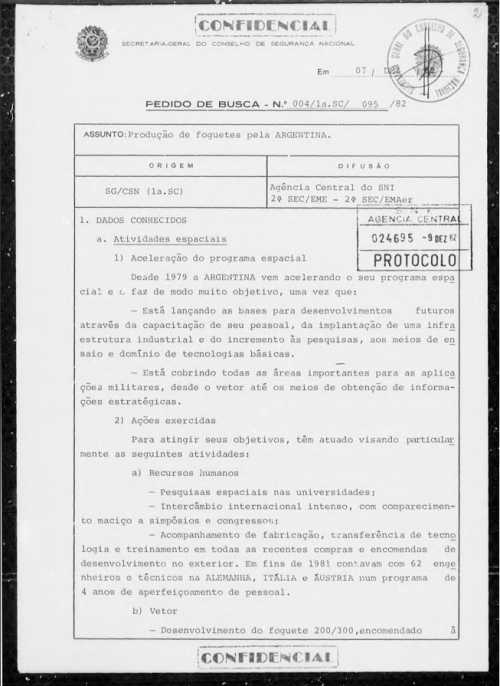
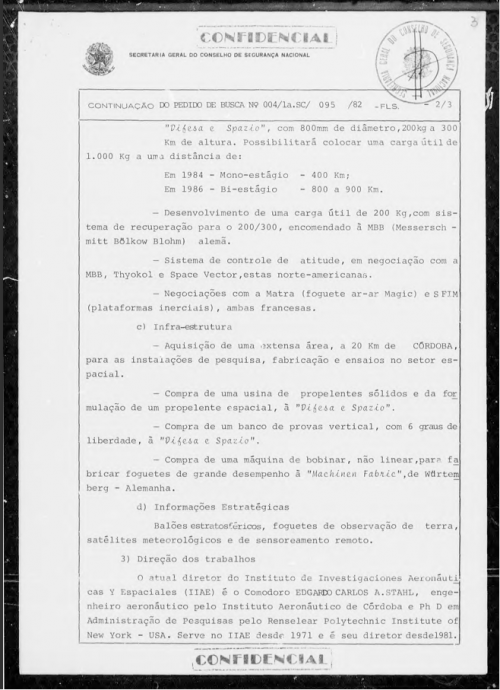
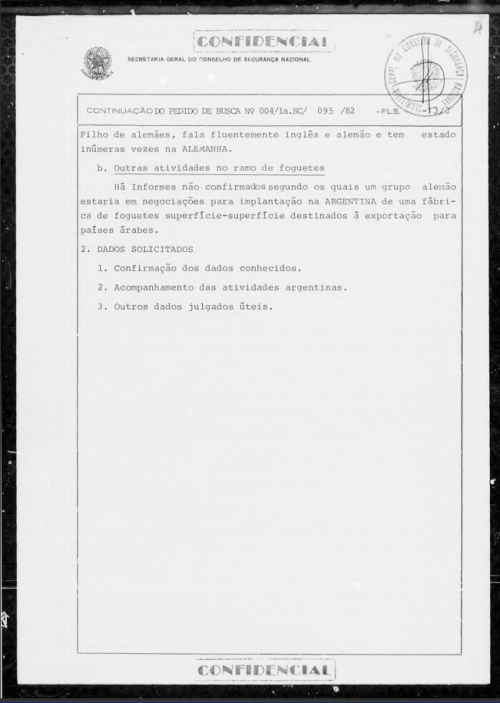
- The Brazilian report (December 1982): document "004/1a. SC/095/82," from the General Secretariat of Brazil's National Security Council, accurately identified the purchase of land at Falda del Cañete and the training of 61 engineers in Germany, Austria, and Italy. It attributed to SNIA-BPD (Difesa & Spazio) and MBB the development of an 800 mm-diameter vector with projected ranges of up to 900 km in a two-stage configuration. The report closed with an accurate warning: that a German group was negotiating to set up a surface-to-surface missile factory in Argentina for export to the Arab world.
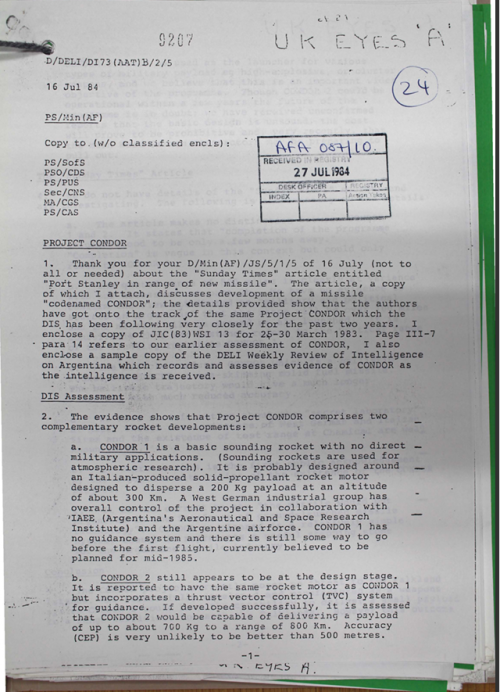
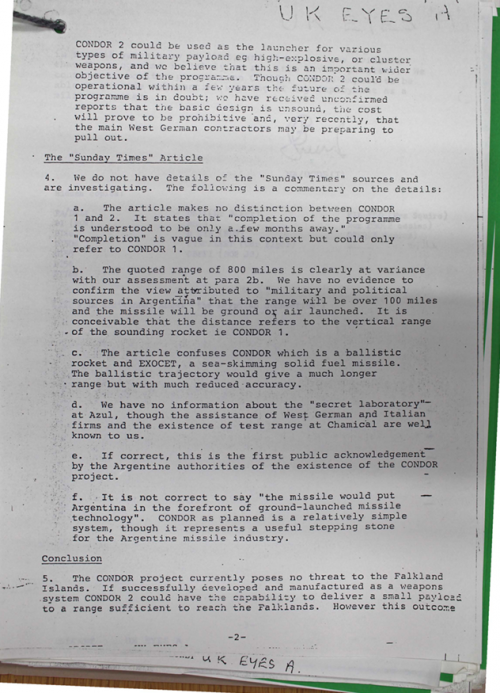
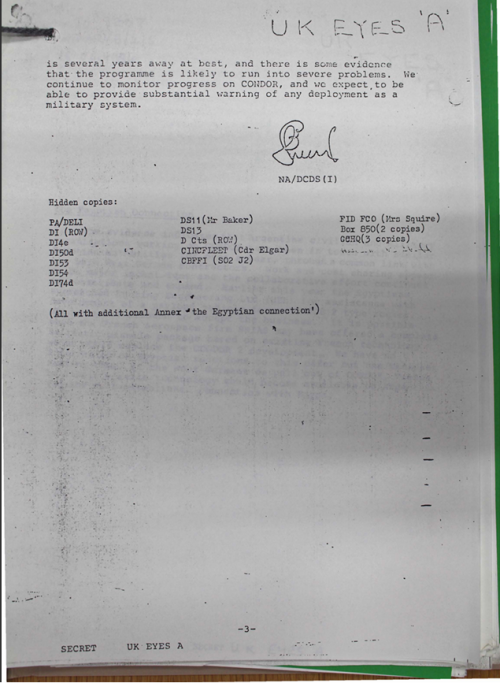
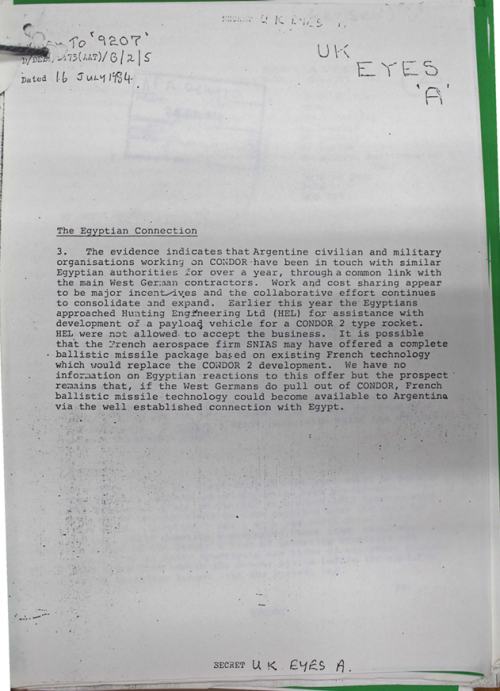
- London's view (1984): following the Sunday Times' alarmist 1984 article warning of an imminent missile threat to the islands, internal Foreign Office analyses and the briefing sent to Rex Hunt downplayed the urgency, calling the warning "exaggerated." The British documents reveal full awareness of the scheme: they knew cooperation was being triangulated through German firms and had identified early on that Egypt was seeking to develop the re-entry vehicle through Hunting Engineering (a contract specifically vetoed by the United Kingdom).
The Macro-Geopolitical Context and the Outcome
Egypt formally joined via Presidential Decree "S" 604 in April 1985, by which time international intelligence already took its role for granted. During its most active phase, Condor operated under a financial engineering of "political credit" underwritten by the Arab League.
Consequently, the program's downfall was not the result of a monolithic British diplomatic push following the 1982 war. The collapse of Condor II was the direct consequence of a systemic paradigm shift in the global order between 1987 and 1988 — a process that begins with, but is not exhausted by, the creation of the Missile Technology Control Regime (MTCR) in April 1987.
For years, Washington and London had turned a blind eye to the program's triangulation networks because they indirectly served Saddam Hussein's Iraq in containing Iran; the MTCR was born, in that context, as a regime still lax in its enforcement — more a signal of intent than an effective cordon. What finally turned it into an instrument of force were the two events that followed:
- The INF Treaty (December 1987): signed between the US and the USSR, it outlawed intermediate-range missiles held by the superpowers and stripped away the doctrinal cover for any similar-range program held by third countries.
- The end of the Iran–Iraq War (August 1988): this removed Condor's last tacit strategic justification in the eyes of Washington and London.
Once Saddam Hussein redirected his threatening gaze toward Israel and his former Arab League allies, and as Western and Soviet powers were dismantling their own intermediate-range arsenals, Condor II went from being a tolerated development to an intolerable anomaly. The MTCR, born a year earlier as little more than a dead letter, only then became the legal and punitive vise that choked off the supply chains of the FAA and its partners, forcing the network's dismantlement and Egypt's definitive alignment with Washington — leaving the Argentine program without political cover or financial sustainability.
It is worth noting, however, that the British role in this final stage should not be oversimplified either. The available documentation suggests that Margaret Thatcher had no particular or personal interest in Condor; the most decisive British push came only under her successor at 10 Downing Street, and intensified markedly after the 1991 Gulf War. It was at that point — with Iraqi ballistic missiles already a demonstrated threat to Israel and to Western troops — that London decided to actively join the American effort to definitively shut down the Argentine program. Washington, for its part, openly declared that its goal was to prevent Argentina from achieving the capability to develop an IRBM (Intermediate-Range Ballistic Missile, with a range greater than the MRBM Condor had demonstrated up to that point) before that technological leap became irreversible.
Conclusions
Condor II was not the weapon Argentina built to answer a defeat, but the one it was already designing to gain entry to a market; the 1982 war did not originate it — it merely interrupted it for a few months. Behind the facade of a sounding rocket that never flew lay a corporate structure designed to dodge controls, a client that arrived late on borrowed credit, and a network of European suppliers that sustained the project well beyond any boundary formal diplomacy would recognize.
Its end, too, was not London's doing: it was killed, between 1987 and 1991, by the very international order Argentina had spent fifteen years learning to dodge — and by the technological challenges the program never managed to overcome.