I would temper this assertion by reminding to all that, all along those late releases of seemingly new airframes, we have identified phony designs and a constant sophisticated willingness to trump observers... (see my late posts for example)

I choose my words.
 
Last edited:
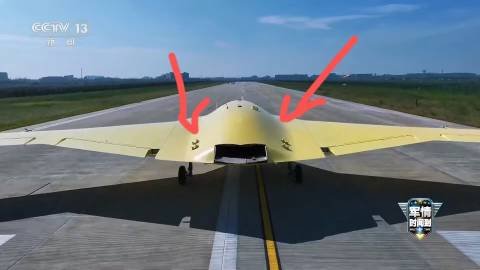
There appears to be only one exhaust in the picture, which would suggest a rather low MTOW for the size.
 
Could be one large engine or two smaller engines sharing an exhaust exit.

In any case, it seems unlikely it is a B-21 level of thrust. We will know more when there are clearer pictures, but my guess is it is a competing ISR platform, possibly with a small secondary strike role payload.
 
In any case, it seems unlikely it is a B-21 level of thrust. We will know more when there are clearer pictures, but my guess is it is a competing ISR platform, possibly with a small secondary strike role payload.
I don't see why can't it have B-21 level of thrust, that "exhaust" simply might be some kind of blanket, it looks too irregularly shaped and off center for a single large exhaust. It is far more likely to be a two engine design like the earlier WZ-X.
 
I would temper this assertion by reminding to all that, all along those late releases of seemingly new airframes, we have identified phony designs and a constant sophisticated willingness to trump observers... (see my late posts for example)

I choose my words.

Which "phony designs" are you referring to?

There aren't any particular mind games that I can refer to where the PLA or PRC has tried to fool outsiders into thinking they had something which they didn't.

What does happen is if foreign observers are unable to read Chinese and then walk away with false impressions (like believing a sci fi IP fantasy jet is actually a real world aircraft)
 
PLA(N)AF really seems to be living through their equivalent of what the 60s–90s were for the USAF/USN, huh?
It is because they have the industrial economy to do such things. The US and Russians no longer have that ability. In the time frame you listed, the US dominated (I would modify it to be 20's through mid-70's) manufacturing globally. They pulled stuff out of the ground, refined it, turned those refined goods into inputs, and built huge assembly lines to turn those inputs into finished products. They did this on the regular. Just look at US production capacity vs. the rest of the world during World War II.

They no longer have that capability which is why so little development happens. China on the other hand has a massive industrial economy in which they do everything the US/Russian's used to. It seems impressive today, but it is really just because the industrial economies of the West have totally collapsed over the past 30 or so years.
 
Could be one large engine or two smaller engines sharing an exhaust exit.
Actually, given its size, it's probable we are looking at a 60 ton (empty weight) plane, with a 130-140 ton MTOW. One engine is all but impossible to drive such a plane. China doesn't have anything like such a hypothetical engine.
Two engines would be a minimum for this thing, and even then, probably two pretty big engines. More like WS-15 cores rather than WS-10 cores. But as we saw on J-36, there's nothing really stopping the designers for going with 3 engines. I do think 4 (100 or less kn thrust) engines are unlikely, as that seems an inefficient design. I don't think the image itself is clear enough to be able to discern the number of engines or the exhaust shape.

 
Actually, given its size, it's probable we are looking at a 60 ton (empty weight) plane, with a 130-140 ton MTOW. One engine is all but impossible to drive such a plane. China doesn't have anything like such a hypothetical engine.
Two engines would be a minimum for this thing, and even then, probably two pretty big engines. More like WS-15 cores rather than WS-10 cores. But as we saw on J-36, there's nothing really stopping the designers for going with 3 engines. I do think 4 (100 or less kn thrust) engines are unlikely, as that seems an inefficient design. I don't think the image itself is clear enough to be able to discern the number of engines or the exhaust shape.
Three engines would also be very unlikely because that'll limit the central bay's height. J-36 doesn't really need extremely deep bays like a strike aircraft or bomber.
 
Actually, given its size, it's probable we are looking at a 60 ton (empty weight) plane, with a 130-140 ton MTOW. One engine is all but impossible to drive such a plane. China doesn't have anything like such a hypothetical engine.
Two engines would be a minimum for this thing, and even then, probably two pretty big engines. More like WS-15 cores rather than WS-10 cores. But as we saw on J-36, there's nothing really stopping the designers for going with 3 engines. I do think 4 (100 or less kn thrust) engines are unlikely, as that seems an inefficient design. I don't think the image itself is clear enough to be able to discern the number of engines or the exhaust shape.

Rather I think 130-140 ton MTOW is far too high. To me I think it should be around 110-120 ton MTOW with a 45-50 ton empty weight. Material science and composites have advanced a fair bit, and I remember there being some grapevine info that the J-35 uses an impressive amount of new manufacturing techniques and materials to get a fairly low empty weight. For such a new platform, I'd too expect it to use more advanced materials to be far lighter, and as a UCAV it can be lighter than a manned aircraft of the same size. As for engines, I wouldn't pass the possibility of it using something like 2 upgraded WS-18/D-30KP-2 medium bypass turbofans either, similar to that of the B-21.
 
Which "phony designs" are you referring to?

There aren't any particular mind games that I can refer to where the PLA or PRC has tried to fool outsiders into thinking they had something which they didn't.

What does happen is if foreign observers are unable to read Chinese and then walk away with false impressions (like believing a sci fi IP fantasy jet is actually a real world aircraft)
Ignore him. Most of us do.
 
Rather I think 130-140 ton MTOW is far too high. To me I think it should be around 110-120 ton MTOW with a 45-50 ton empty weight. Material science and composites have advanced a fair bit, and I remember there being some grapevine info that the J-35 uses an impressive amount of new manufacturing techniques and materials to get a fairly low empty weight. For such a new platform, I'd too expect it to use more advanced materials to be far lighter, and as a UCAV it can be lighter than a manned aircraft of the same size. As for engines, I wouldn't pass the possibility of it using something like 2 upgraded WS-18/D-30KP-2 medium bypass turbofans either, similar to that of the B-21.
I guess 50 tons empty and 115 tons mtow sounds about right. After all, B-2 flies with approximately 308 kn of thrust. (allegedly 72 tons empty, 170 tons mtow) Given the difference in size and, lets say material/construction advances, it's plausible GJ-X is a fair bit lighter. Though the best indication for 50/115 ton class values would simply be the fact such weight class is doable for china with two engines, which should be the optimal choice. I am not sure about WS18 or anything like that, a medium bypass engine. For a flying wing, something slimmer may be more desirable. F118 used in b2 is after all a derivation of F110. Since WS15 should be all but ready, It sounds sensible that this GJ-X plane actually waited until WS15 is mature enough. Of course, we'd certainly be looking at a non-afterburning variant of WS15, with further optimization for subsonic envelope.
If anything like F119 and F135, and if around 170-180 kn in its afterburning variant, non-afterburning ws15 variant might be be able to output 115 to 120 kn of dry thrust. So, for a 50/115 ton subsonic strike plane, 230 to 240 kn of thrust sounds about right. It's a bit higher thrust to weight ratio than the B-2, but the B-2 is likely more optimized for long cruises, given it's an intercontinental bomber. GJ-X is more of a theater bomber.
 
WS-10C1 and C2? Well, these are fighter jets, but unmanned... I suddenly recalled a report I read about a Chinese academician's vision for next-generation air superiority combat platforms' auxiliary unmanned combat aircraft: they would form networks and fly in teams autonomously, learn enemy flight combat trajectories on their own, and most importantly, develop intelligent predictions of probable enemy military actions and battlefield trends, automatically matching the optimal course of action... and all of this would rely on support from some heavy platform. In this sense, each sixth-generation aircraft's pilot would be both a frontline flyer and, benefiting from drones and their powerful situational awareness, a sort of commander to some extent... It seems that some aspects have already been realized, while others are bound to arrive.
 
View attachment 791042
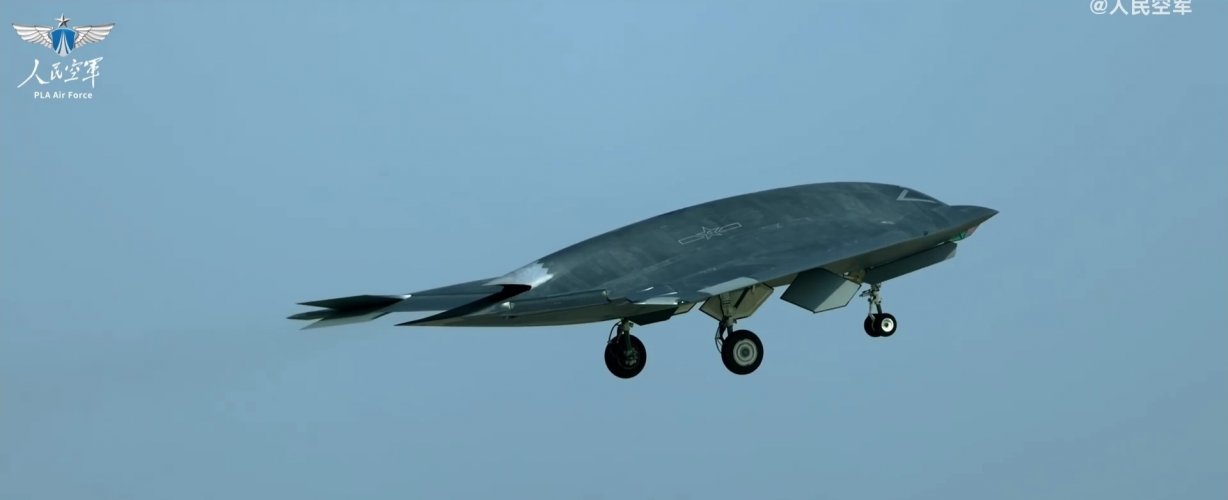
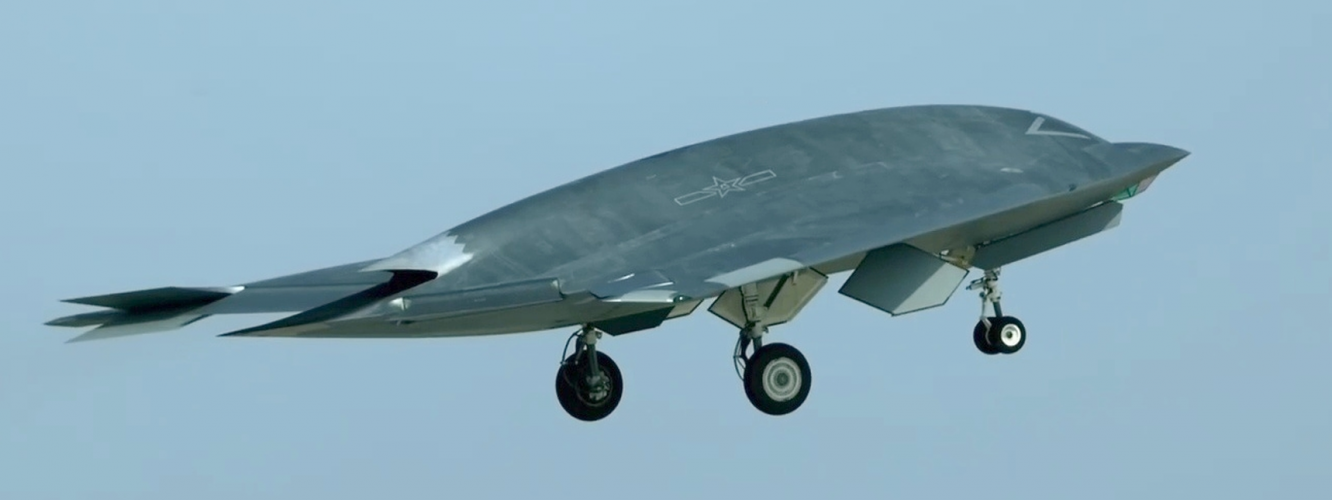
Official photos of GJ-11 from PLAAF
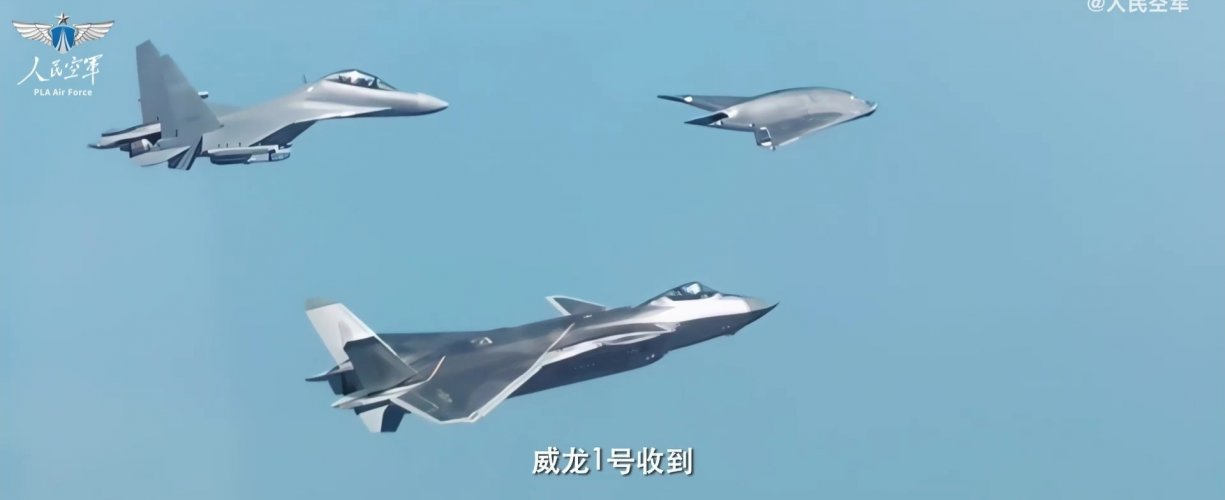
It appears that the GJ-11's codename is "玄龙"("Xuanlong"), which means "Mysterious/Black Dragon". The one shown in the video is "Xuanlong 08", with the J-20 pilot reporting "coordinates with Xuanlong confirmed," it suggests the drone has undergone small-batch deployment for some time. :D
 
In reality, networks are unlikely to operate in such a tight formation. This is more likely a dramatized portrayal by the airforce to help the audience understand. In any case, the message they want to convey is: we possess the capability for manned-unmanned teaming.
 
I haven't seen any other of these flying wing strike drone examples have an under chin EOTS window before. Perhaps it could be a bit more autonomous and do it's own search and track without the need of solely relying on a controller plane. Unlike all previous examples shown by other nations.
In order to combat endless off topic discussions I'll reply here (and encourage anyone for that matter to make liberal use of the quote function to reply in appropriate threads).

As far as the EOTS is concerned, it only appeared on the production model, no? So I'm not surprised many of the other prototypes around the world didn't feature it, although some feature similar or other types of sensor arrays instead, like the Kizilelma, MQ-28 or S-70. Either way, sticking an EOTS onto well understood planform is, yet again, not groundbreaking. The GJ-11 is neither particularly unconventional nor is it a significant aircraft on it's own.

What has incredible weight however, is the fact that it's the first of it's kind to enter service, beating out all the other designs which are either still in the process of getting into production and then service, or were forever relegated to being just technology demonstrators. That's what makes the GJ-11 special, what it represents and the time frame in which it entered service and is to operate alongside advanced, manned, PLA assets.
 
What has incredible weight however, is the fact that it's the first of it's kind to enter service, beating out all the other designs which are either still in the process of getting into production and then service, or were forever relegated to being just technology demonstrators. That's what makes the GJ-11 special, what it represents and the time frame in which it entered service and is to operate alongside advanced, manned, PLA assets.
To be fair, had their priorities changed earlier, the Americans could've turned their demonstrators into real projects and made them service-ready. The problem is they can't manage their projects as well as the PLA.

Besides that, the fighter lobby is also responsible for killing these projects.

No one could say these projects wouldn’t have faced serious obstacles either; I mean, just look at the MQ-25 for example. The EMD prototype of the MQ-25 still hasn't flown yet, let alone an operational airframe.
 
The vertical slabs are fixed attachments and don’t have actuators.

View attachment 791108

I agree with Blitzo on this one, there are bigger fish to fry.
Tailless flying wings since the Horten Ho 229 have been designed with a lift curve that's less aggressive towards the sides than would be optimal. This is to reduce the yawing moment that gets stronger with the increased leverage the further you go from the centerline. This reduces the overall efficiency of the wing. I remember reading a test report written by US engineers after WW2 when they tested the Horten. They found the overall airframe underwhelming, in one part due the errors in the design of the aircraft, with badly positioned features leading to more drag than necessary.
But beyond even that, they said the worse lift profile of the Horten led to less efficient lift than a traditional configuration, even accounting for the extra drag of the vertical tails.
I guess the Chinese are building a flying wing with tails (even if said tails don't have rudders) for the same reason.
 
... and if you look at Type A & B (not even speaking about the WZ-X & GJ-X), even significantly larger and more capable CCAs available – in testing and is already training them with J-20s...
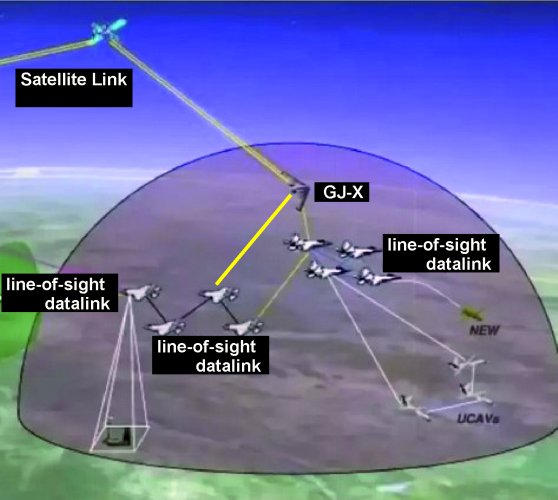
I think the real “oh-shit” moment for the US will happen if the GJ-X becomes something like an information gateway aircraft – similar to the RQ-180 Drone.
China having a stealthy Battlefield Airborne Communication Node before them and linking their 5.Gen fighters with UCAV, to sensors in space, on the ground and at sea... That would be fun to watch
Untitled-1.jpg
 
I think the real “oh-shit” moment for the US will happen if the GJ-X becomes something like an information gateway aircraft – similar to the RQ-180 Drone.
China having a stealthy Battlefield Airborne Communication Node before them and linking their 5.Gen fighters with UCAV, to sensors in space, on the ground and at sea... That would be fun to watch
View attachment 791307
The US already has prototype AMTI targeting satellites in space.
https://aviationweek.com/defense/se...ommander-amti-prototype-sensors-are-orbit-now
 
I think the real “oh-shit” moment for the US will happen if the GJ-X becomes something like an information gateway aircraft – similar to the RQ-180 Drone.
China having a stealthy Battlefield Airborne Communication Node before them and linking their 5.Gen fighters with UCAV, to sensors in space, on the ground and at sea... That would be fun to watch
View attachment 791307
it seems unlikely the RQ-180 operates in this role; this probably will be a dedicated CCA platform in the future. But in any case, what exactly would be the advantage of such a link for China? What information would be passed this way?
 
I think the real “oh-shit” moment for the US will happen if the GJ-X becomes something like an information gateway aircraft – similar to the RQ-180 Drone.
China having a stealthy Battlefield Airborne Communication Node before them and linking their 5.Gen fighters with UCAV, to sensors in space, on the ground and at sea... That would be fun to watch
View attachment 791307
A stealthy BACN is fun to have but looking at the radiating behaviors.. yeah. Much as I dislike using MOTS airliners for that role, they are cheap and do the job right.
 
I think the real “oh-shit” moment for the US will happen if the GJ-X becomes something like an information gateway aircraft – similar to the RQ-180 Drone.
China having a stealthy Battlefield Airborne Communication Node before them and linking their 5.Gen fighters with UCAV, to sensors in space, on the ground and at sea... That would be fun to watch
View attachment 791307
It has a civilian version. Haha.

http://www.81.cn/ChinaMilitary/BILINGUAL/10066349.htmlhttps://www.globaltimes.cn/page/202107/1229363.shtml
 

Similar threads

Back
Top Bottom