Information on the mission of the Pakistani astronaut, as well as astronauts from Hong Kong and Macao to the Tiangong station:

https://www.china-in-space.com/p/pakistani-astronaut-may-visit-tiangong
In similar reports a few months ago, Chief Executive of the Hong Kong Special Administrative Region John Lee Ka-chiu (李家超) mentioned that the city’s first spacefarer could fly in 2026 too. Differing from Pakistan’s astronauts, however, Hong Kong’s taikonaut was selected as part of a regular group by the China Manned Space Agency, as well as another from the neighbouring Macao Special Administrative Region. Through that selection, Hong Kong and Macao’s taikonauts have the opportunity to fly for additional missions after their first, possibly including those out to the Moon.

See also the article from July:
https://www.china-in-space.com/p/hong-kongs-taikonaut-could-fly-in
Hong Kong’s taikonaut passed selection just over a year ago, in June 2024, as a payload specialist along with one from Macao and eight pilots from the mainland. At that time, Lee thanked the central government for drawing upon candidates from the Special Administrative Region, deeming it a show of confidence in the city’s scientific development.
 
1761858119220.jpeg
Official biographies
Zhang Lu, male, Han nationality, native of Hanshou, Hunan Province, holds a master's degree. Born in November 1976, he joined the army in August 1996 and the Communist Party of China in April 1999. He is currently a first-class astronaut in the Astronaut Corps of the Chinese People's Liberation Army, with the rank of Senior Colonel in the Army. He previously served as the chief of air combat shooting at the headquarters of a regiment at an Air Force training base and was rated as a first-class pilot in the Air Force. In May 2010, he was selected as part of my country's second batch of astronauts. In November 2022, he participated in the Shenzhou-15 manned spaceflight mission. In September 2023, he was awarded the honorary title of "Heroic Astronaut" by the CPC Central Committee, the State Council, and the Central Military Commission, and received the "Third-Class Spaceflight Merit Medal." After comprehensive evaluation, he was selected for the Shenzhou-21 manned spaceflight mission crew and served as the commander.

Wu Fei, male, Han nationality, native of Baotou, Inner Mongolia, holds a master's degree. Born in October 1993, he enlisted in the army in January 2021 and joined the Communist Party of China in October 2015. He is currently a third-level astronaut in the Astronaut Corps of the Chinese People's Liberation Army, with the rank of Major in the Army. He previously served as an engineer at the China Aerospace Science and Technology Corporation. In September 2020, as a flight engineer, he was selected as part of my country's third batch of astronauts and, after comprehensive evaluation, was selected for the Shenzhou-21 manned spaceflight mission crew.
Zhang Hongzhang, male, Han nationality, native of Zouping, Shandong Province, holds a doctoral degree. Born in April 1986, he started working in July 2013 and joined the Communist Party of China in August 2004. He is a researcher at the Chinese Academy of Sciences. In September 2020, he was selected as a payload specialist for my country's third batch of astronauts. After comprehensive evaluation, he was selected for the Shenzhou-21 manned spaceflight mission crew.
Updates were also given about the Crewed Lunar Landing program:
The Mengzhou-1 mission is announced as one of four CMSA missions in 2026, along with Shenzhou-22, Shenzhou-23, and Tianzhou-10. As has been the custom for the past few years, the public will be invited to submit patch designs.

The main prototyping phase of the CZ-10 launch vehicle, Mengzhou Capsule, Lanyue Lander, Tansuo Rover, and Wangyu Spacesuit is complete.The design of the scientific payloads for each mission is finalized.The development and construction of ground infrastructure, such as the launch site, the telemetry, tracking, and command (TT&C) system, and the landing site, are accelerating. (The later is currently thought to be the bottleneck)

In addition to the tests already conducted this year, the CZ-10's second stage has been hot-fired in a test bench firing.

The next major tests will be the integration tests of the lunar lander, the thermal (TVAC) and Max-Q flight backup system tests of the Mengzhou crewed spacecraft, as well as the low-altitude flight tests and technology verification of the CZ-10 launch vehicle.
Effectively, the second launch of the CZ-10A with the second Mengzhou has slipped from late 2026 (official date as of November 2024) to 2027, the maiden launch of Mengzhou/CZ-10A is still planned for 2026
 
China's manned space program is set to carry out four missions in 2026: the Tianzhou-10 cargo spacecraft, the Shenzhou-22 and Shenzhou-23 manned spacecraft, and the uncrewed Mengzhou-1 manned spacecraft.

The Shenzhou-22 crew, a astronauts will undertake an in-orbit stay of more than one year.

The Mengzhou-1 spacecraft will dock with the Chinese space station autonomously without crew.
8484984.png
 
China-led moon mission’s water probe will be ‘first for humanity’: space agency [Oct 23]

China could beat the United States to become the first country to find water on the moon, with all international payloads already handed over for its next robotic lunar mission which is slated for launch in August.

Tang Yuhua, deputy chief designer for the Chang’e-7 mission, said the spacecraft’s development was progressing smoothly, with scientific instruments from six national partners and one NGO delivered to the China National Space Administration.

[...]

The mission will focus on studying the environment and searching for water ice near the moon’s south pole – a vital resource for future crewed space exploration because of its potential to be converted into drinking water, breathable oxygen and even rocket fuel.

The Chang’e-7 spacecraft is the most complex ever built for China’s lunar programme, Tang told state broadcaster CCTV on Saturday. It would consist of an orbiter, lander, rover, hopper and a relay satellite, she said.

Wu Weiren, chief designer of the country’s lunar exploration programme, said Chang’e-7 was likely to touch down “at a spot with more than 100 days of continuous sunlight” – ideal for long-term operations.

After the landing, the hopper will dive into the deep lunar craters where it will conduct on-site analysis and test for water, Wu told CCTV.
 

Ya know, I think they do have a point there,

The oven not only serves as a powerful technology demonstration for the microgravity microwave (which actually functions more like an air fryer), but it also provides a welcome flavor of home for the astronauts living aboard the station.

Kang Guohua, a senior member of the Chinese Society of Astronautics and a professor of aerospace engineering at Nanjing University of Aeronautics and Astronautics, told Chinese state media that comforts such as hot meals are important to keep crews psychologically "grounded."

And I have been wondering if there will ever be standard saucepot and frying pan style cooking where there is gravity on the Moon and on Mars.
And if environmental systems will be designed to deal with the vapors, humidity, fragrances, heat, smoke, which comes from those.
 
Cold tests are tests without actual ignition - the pumps & tubes are run at working condition to test how the feeding system handles the load.

Didn't actually read my post did ya, it itself answered the question:

ZhuQue-3 hot fire test:
All of a sudden my brain wonders, okay, there is a hot fire test, is there such a thing as a cold fire test?

-> Keep in mind that I'm dealing with neurological autoimmune disease & some memories can be intermittently inaccessible.

Google is like a playground to me ...

Test Stand Automation and Regulation: Data Acquisition and Control for the Liquid Fuel Engine Test Stand | Oregon NASA Space Grant Consortium ​


The Portland State Aerospace Society (PSAS) is developing a liquid fueled rocket engine. A major part of this development is the ability to test such an engine. A rocket engine test stand stores the oxidizer and fuel, as well as holding the rocket engine in place while it is activated. This...

spacegrant.oregonstate.edu

The Portland State Aerospace Society (PSAS) is developing a liquid fueled rocket engine. A major part of this development is the ability to test such an engine. A rocket engine test stand stores the oxidizer and fuel, as well as holding the rocket engine in place while it is activated. This allows for cold fire and hot fire testing of the rocket engine. Cold fire testing is to ensure fluids are flowing properly, and the cryogenic conditions do not compromise any of the parts. Hot fire testing is to ensure the rocket engine bell can withstand the extreme pressures and temperatures which occur when the rocket is fired
 
Explanation of the launch mission of Ceres-1 (Y19) carrier rocket

At 12:02 PM on November 10th, the Ceres-1 (Y19) carrier rocket was launched from the Jiuquan Satellite Launch Center in my country. The first, second, and third stages of the rocket flew normally, and separation was also normal. However, 510 seconds after the fourth stage ignition, an abnormality occurred during the final stage of flight, resulting in an premature shutdown and failure to deliver the satellite into orbit. The specific cause is under further analysis and investigation.

We extend our sincerest apologies to our customers and all friends who care about and support Galactic Energy. We will always maintain a deep respect for aerospace technology, do our utmost to investigate the cause of the failure, and meticulously organize the Ceres-1's re-entry and re-launch process to ensure the continued success of subsequent launch missions.

We will learn profound lessons from this mission failure, continuously optimize rocket design and quality management systems, and continue to dedicate ourselves to the exploration and development of China's commercial space industry with more reliable performance and a more stable approach. We thank all sectors of society for their understanding and support. Galactic Energy will face challenges head-on and move forward firmly, contributing its due strength to the cause of space exploration.
 
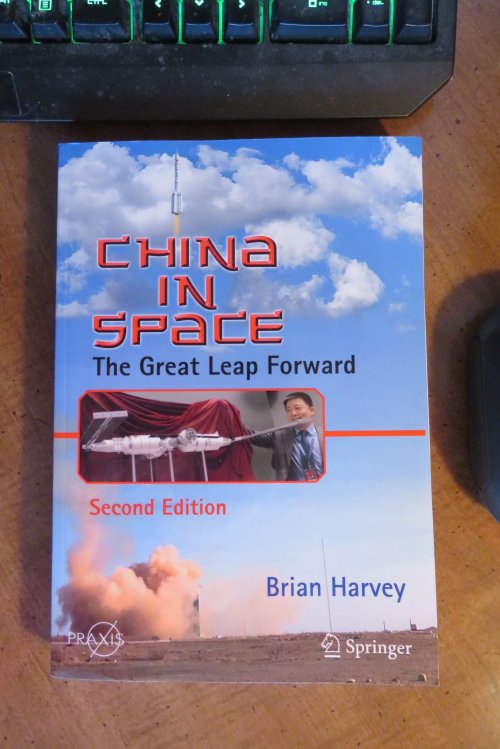
Arrived today. Is copyright 2013 and 2019, so it does not cover successfully baking barbecue chicken wings in zero G.
I've only read introduction and a couple pages of 1st chapter.
Is printed on shiny clay coated paper, has 564 pages, so is heavy for its size.
Lots of color photos and illustrations.
Is 4th in the author's series of books about China.
Is the only one of that series I've acquired.

IMG_9032.JPG
 
I like that. It's ride is essentially a hypergolic R-7.

Anything in that book as to why China didn't look into RD-270? They could always have put off kerolox and other combos later. A nine RD-270 monoblock could be a non-cryogenic Falcon 9 but with Raptor type engines.

No ice worries. If you already have hypergolics--go all in.
 
I like that. It's ride is essentially a hypergolic R-7.

Anything in that book as to why China didn't look into RD-270? They could always have put off kerolox and other combos later. A nine RD-270 monoblock could be a non-cryogenic Falcon 9 but with Raptor type engines.

No ice worries. If you already have hypergolics--go all in.
RD-270 is too expensive and too big
The Chinese early launch vehicles used the same engine as ICBMs
 
The Shenzhou 20 crew will return on Shenzhou 21. Today, November 14 at 11:14 a.m. (Beijing Time), the Shenzhou 20 crew began their journey home. After a comprehensive assessment, the windows of the Shenzhou 20 spacecraft were found to be damaged and did not meet the conditions for a safe return, so it will remain in orbit to continue relevant experiments.
 

Similar threads

Back
Top Bottom