This is more likely for ARRW itself, as I believe that requirement originally came about when ARRW/HCSW were being developed. But the new ALBM or HACM might be driving the requirement instead, or in addition too. I suspect HACM is two heavy for deployment on the HSAB - I think the attachment points are limited to 2,000 lb class munitions. There was an RFI for rewiring the SUU-67 (AGM-86 pylon) with 1760 databus to allow for heavy hyper cruise missile carriage (HACM or a black program - it explicitly referred to hypersonic weapons with a “1000 mile” range).

So any of those could be candidates. In the case of ARRW I think the intention was to carry three missiles; in the case of HACM (or other hypersonic CM, HCCW?) six. The ALBM is such a new program that I doubt it is related; there have been pylon upgrade requests and studies for at least half a decade.
 
From elsewhere in the press:

The Air Force awarded Boeing a $162.97 million contract to manufacture, produce and deliver Bomb Rack Modernization System kits for the B-52. The upgraded bomb racks, which hold and release munitions, will communicate with the AN/APQ-188 radars to enable precision targeting and utilize guided or "smart" munitions.
 
Defense Updates has put out a video concerning the new AN/APQ-188 AESA radar:


The U.S. Air Force has awarded contracts totaling up to $766 million to advance the modernization of the B-52 Stratofortress, covering production of the new AN/APQ-188 radar as well as upgrades to the bomber’s weapons-carrying systems.The latest awards represent another significant investment in extending the operational relevance of an aircraft that first entered service in the 1950s and is expected to remain in service for decades to come.

The larger of the two contracts is a $603 million indefinite-delivery/indefinite-quantity (IDIQ) award to Raytheon, an RTX business, for the production and sustainment of the AN/APQ-188 radar which will replace the aging AN/APQ-166 radar across the Air Force’s fleet of 76 active B-52s.

Boeing received a separate contract valued at nearly $163 million for bomb rack modernization kits as part of the broader B-52 upgrade effort.

According to the Government Accountability Office (GAO), the modernization is designed to preserve mission-critical navigation and weather-avoidance capabilities while enhancing the B-52’s effectiveness in both conventional and nuclear missions.Let’s dissect this.​
https://www.youtube.com/hashtag/defenseupdates
#defenseupdates #b52bomber #usweapons

Chapters:
0:00 TITLE
00:11 INTRODUCTION
01:36 SPONSORSHIP - NordVPN
02:10 PLAN IN MOTION
03:39 PATRIOT WITH NEW RADAR
07:04 ANALYSIS
 
The program keeps running into issues; 2028 is the current estimate with updates carrying through til the late 30s. I am sure they go through with it since there are basically no other options outside grounding B-52s when they run out of engines.
 
Funny how they were able to design the B-52H, and BUILD them all,

When the B-52H was designed and built right at the end of the 1950s the B-52 production line had been humming along since 1954 so it was a well established and mature production line also the B-52H was basically a B-52G with low-bypass ratio TF33-P-3 turbofans (The B-52G used J57s).

Edited: to correct the engine used by the B-52G.​
 
Last edited:
Wikipedia is wrong. J57s on B-52A thru G, TF33 (derived from the J57) on the H models.

If I remember correctly, J57-P-43W on the G model.
 
I'd thought that it was J57s but according to the wikipedia article it was J75s.
From the B-52 wiki entry:
The B-52G was proposed to extend the B-52's service life during delays in the B-58 Hustler program. At first, a radical redesign was envisioned with a completely new wing and Pratt & Whitney J75 engines. This was rejected to avoid slowdowns in production, although a large number of changes were implemented
J75 for B-52G also mentioned in Boeing B-52 Stratofortress by Peter E Davies and Tony Thornborough (with Tony Cassanova), Crowood 1998, page 39.
much more powerful J75 turbojets
[...]
By mid-1957 this over-ambitious project had evaporated
 
Last edited:
So Boeing had intended to equip the B-52G with J75s but ended up instead using uprated J57s?
 
That is my understanding, yes.
How would that work when the J57s were producing 12,000 lbf of thrust with water injection and J75/JT4As produce about 17,000 lbf of thrust? The J75s wouldn't be any more powerful than TF33s unless they used after burning engines. The 707s with JT4As had an MTOW around 140 tons.
 
Like the J75 variants used in the F-106 and the Arrow Mk-1?
A J75 with an afterburner would put out 25,000 lbf of thrust, so 4 of them with 100k lbf of thrust could match 8 J57s, but basically only for takeoff and climb thrust. They would still fall well short of the 8 TF33s, which put out about 140k lbf of thrust. I don't know if anybody ever put after burning engines in underwing nacelles, but that would add several feet of length.
 
A J75 with an afterburner would put out 25,000 lbf of thrust, so 4 of them with 100k lbf of thrust could match 8 J57s, but basically only for takeoff and climb thrust. They would still fall well short of the 8 TF33s, which put out about 140k lbf of thrust. I don't know if anybody ever put after burning engines in underwing nacelles, but that would add several feet of length.
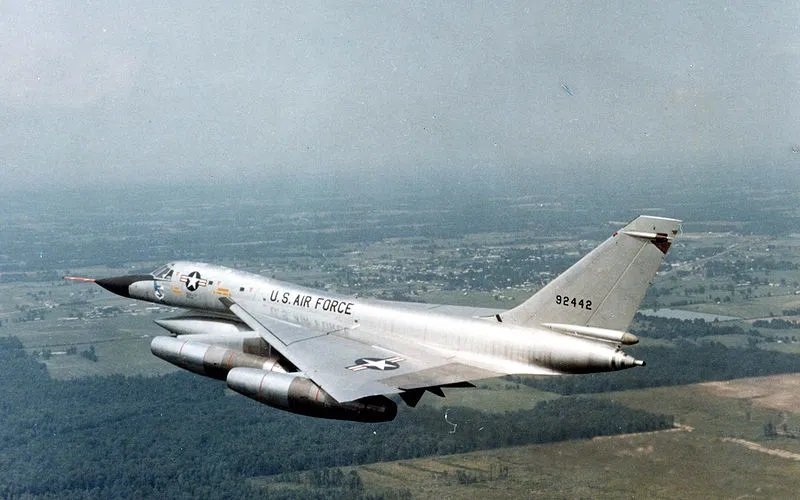
Ahem.
 

Attachments

  • 800px-convair_b-58a_hustler_in_flight_sn_59-2442_photo_taken_on_june_29_1967_061101-f-1234p-019.jpg
    800px-convair_b-58a_hustler_in_flight_sn_59-2442_photo_taken_on_june_29_1967_061101-f-1234p-019.jpg
    122.3 KB · Views: 19
https://www.airandspaceforces.com/b-52-engine-radar-upgrades-hit-new-milestones/

The Air Force’s program to re-engine the B-52H Stratofortresshas moved from its technology maturation and risk reduction phase to engineering and manufacturing development, marking a new milestone in the sweeping overhaul of the Cold War-era bomber, a top official said Sept. 15.

William Bailey, who is performing the duties of assistant secretary of the Air Force for acquisition, technology and logistics, told reporters at AFA’s Air, Space & Cyber conference that the B-52’s Commercial Engine Replacement Program entered the EMD phase in June.

The B-52’s Radar Modernization Program, which will replace the bomber’s legacy analog AN/APQ-166 radar with an active electronically scanned array AN/APQ-188 radar, also entered low-rate initial production in August, Bailey said.
 

Similar threads

Back
Top Bottom