The manned fighters needing to do fleet defense and offense by themselves. They simply dont need a dedicated fleet defender. There are CCAs F-35s etc.
The point of my original post on Trimble's comments. We r into circulars now
Focusing on a single plane taken out of its operational context to fulfill some theory of yours that has neither evidence nor logic - despite numerous people telling you otherwise with factual or at least supported information
There are either necessary capabilites or there are not.
You dont have to agree with nayone, but being unwilling to entertain presentedbfacts and continually pushing a theory around is ....

Insidersource-like
Always entertaining counters...havent heard one.
 
Which is precisely my point. It's not a process whose advantage is rooted in subcontractors outperforming Boeing, but in comparing different technologies. Apply the same technology in Boeing's production flow as opposed to the supply chains and you will see the same improvement.

The question then becomes why is it advantageous to Boeing to apply that technology in their supply chain, but not on their own shop floor?
I'm assuming you don't work in the industry because you seem to be missing some fundamental knowledge about how the machining/manufacturing and assembly process works. The whole concept of drill on assembly vs. FSDA is not unique to Boeing.

In legacy programs (pretty much anything developed F-35 and prior) they all used drill on assembly. As the aircraft was being assembled and bolted together, holes would have to be drilled by hand for brackets, components, bulkhead fittings, substructure, etc. None of the companies have CNC jigs to bolt up every single piece of structure and re-machine pieces of structure. That would be way too much money, resources, and time to re-jig every single component and drill all the holes. This is why you have the sub contracted companies do it while its already being CNC'd.

Not to mention, you cannot just remount an entire keel or frame on a jig and drill the holes and expect it to be dead on. During the CNC process materials expand and contract. The suppliers' machines are calibrated to compensate for all varying factors during the CNC process.

And at the base of it all, machining large keels and frames are not the expertise of companies like Boeing, LM, or NG. They design airframes and put them together. They definitely don't do everything in between that.

It's the same reason car companies buy Brembo brakes instead of making them in house. There's companies out there that just are better suited and more knowledgeable at making certain things.
 
Last edited:
increasing demand for capable EW (maximized AESA array space/capability et al
Growler is to be replaced by FA-XX) & PCA as well as the growing size of missiles/munitions which must be internally stored for stealth. Still patiently waiting to hear any viable counter.
What am I missing? Can someone on this forum tell me what jsport's point is?

Because if thats the evidence you are citing for:
why is ur carrier primarily full of self defense fighters. We have to protect the carrier.' What is carrier's mission again? We have to protect the carrier.

What youve listed - big AESA, EW, internal carriage - is now par for course - for all fighters for any role. It means literally nothing, let alone the absurd point you keep trying to make.

All of these things are a reaction to increasingly more powerful area denial and ground based radars as well as to the general advancement of sensors that has made the job of offensive fighters increasingly more difficult.

Maybe I just dont get what you think is evidence for your argument. Are we even talking about the same ice cream cone?

I copy pasted your comments to chat gpt to organize them and your confusion seems to be:

If F/A-XX is primarily an air-defense/air-superiority fighter protecting the carrier, then where is the “A” for Attack?

The A is in the jammer for jamming air and ground radars. Its in the big AESA for air and ground targets so it can fly either with cover or self escort. Its in the strike sized weapon bays and the munitions that are being developed for the navy (all kinds of fast standoff munitions).

Trimble said it doesnt have the PCA mission. PCA stands for penetrating counter air lol. Which is why I have no idea how you concluded that F/A-XX is a fleet defense fighter.
 
Last edited:
What am I missing? Can someone on this forum tell me what jsport's point is?

Because if thats the evidence you are citing for:


What youve listed - big AESA, EW, internal carriage - is now par for course - for all fighters for any role. It means literally nothing, let alone the absurd point you keep trying to make.
As JoshN points out (it is great when neither can read or listen). Pods cause drag and slow. EW must be accomplished from internal AESAs. The FA-XX specifically points out replacing the Growler.
For strike fighters to do their job now, you need multirole fighters either capable of self escort or a fleet air arm consisting of air to air fighters. You need big AESAs to increase detection range, mapping resolution and GMTI accuracy. You need jamming for ground based detection systems of many kinds. You need AEW because your strikers and escorts need to preposition to ensure your strike package gets thru. You need internal carriage because you arent getting any where close to launch range if you hange muntions externally.
Is the above a self tutorial?
What am I missing? Do you think internal carriage, jammers and AESA radars are only applicable for air to air or something?

Maybe I just dont get what you think is evidence for your argument. Are we even talking about the same ice cream cone?
As from the beginning post was responding to Trimble's statement, that the FA-XX is not to perform PCA, and its primarily mission is fleet defense along w/ long range strike. The argument remains no genuine long range strike w/o PCA . ie FA-XX is primarily a fleet defense fighter essentially an interceptor. Filling a carrier w/ interceptors which primarily protect the carrier is a self licking ice cream cone.
 
Last edited:
I honestly thought NG would win it, due to their performance on the B-21, but I guess that didn't really count for much.
As did I.


Now after Boeing has won we can go to the important part. Will the use the McDonnell Douglas name for this fighter, i sure hope so.
Wraith/Phantom/Demon etc?


What the Navy needs and what the Navy wants are two different things. To their credit in more recent years that gap has closed significantly. Right now what they want and how to get there quickly is a problem.
Finally NAVAIR has internalized how stealth worked. And/or had their heads removed from their ass, whichever.


@quellish's point about the logistics chain is certainly valid but I think that could be alleviated by having a "high-low" mix of carriers with F/A-XX and F-35C respectively so that the carriers only need to be resupplied with F-110 and F-414 OR F-135 and F-414, instead of all 3 together.
You've got that backwards, boss.

F110 (FAXX) and F135 (F-35C) or F414 (Super Bug) and F135 (F-35C).


None of the Lockheed ATF proposals looked like those renderings. None had a canard for example. Those renderings fed into the expectations of the time. The perception it would be a canard-equipped, twin-tail, TVC aircraft was almost universal.
Agreed, the shock that they'd figured out how to stealth a supersonic fighter was pretty palpabable.


You can get one for the low-low price of $499. :eek:
So, not that different from current specialty law books then.

But definitely no longer something that the interested layman would be buying.


I had ruled out a single F-135 as an option, but maybe if you were not too concerned with acceleration and time to altitude, F-135 would be enough? For a strike platform, it would not necessarily be that underpowered, and there would be huge cost and logistical advantages.
A single F135 would give the notional fighter a takeoff TWR of about 0.5, and a combat (50% fuel) TWR of about 0.75. Which is about what the F-4 had in 1965.


I realize multiple people who are better informed are saying F110 (presumably two). Even if that is the case, just curious what other engine installations would be practical.
Twin F135s would make sense for something in the J36/F-111 weight class. 105,000lbs+ MTOW, and something around 90,000lbs at 50% fuel.

Twin F414s are a little wimpy for something with a 66,000lb MTOW, nevermind something with an ~80,000lb MTOW. Even the F414 EPEs that made 26,500lbs thrust. (USN decided they'd rather take the higher-temp-tolerant EPE turbines and install them in the standard F414 to make the Enhanced Durability Engines, instead of keeping the short time between overhauls but make more power.) Twin M88s or EJ2x0s have the same wimpy problem as F414s.

Twin late F110s (or F119s) would be about right for something in the ~80-90klb MTOW range, which is about the maximum size you can operate off a carrier.

F100s are a little weaker than F110s but are better than F414s.


The question then becomes why is it advantageous to Boeing to apply that technology in their supply chain, but not on their own shop floor?
Because it would involve (expensive) highly-trained machinists setting up the parts in fixtures to drill some holes using a stupid-expensive CNC machine that Boeing would have to buy.

While Boeing's suppliers already have said machines and machinists and are doing the parts setups anyway for the rest of the machining of those parts.

 
The argument remain,s no genuine long range strike w/o PCA capabilty . ie FA-XX is primarily a fleet defense fighter essentially an interceptor.

Have standoff munitions stopped existing since I last checked or what ? Cause your aircraft doesn't need to penetrate an enemies air defence network to engage targets within it anymore, that's the point of having long range cruise missiles and the like
 
JASSM is just one such weapon for the F/A-XX and there will be many more to come.
 
As JoshN points out (it is great when neither can read or listen). Pods cause drag and slow. EW must be accomplished from internal AESAs. The FA-XX specifically points out replacing the Growler.
No. Not at all. If a nose mounted AESA can do the job, what the hell do we need pods for? and so what if its replacing the growler? Growlers dont just do fleet defense.
Is the above a self tutorial?
No. Its because your posts are literally all over the damn place that it sounds like word salad.
As from the beginning post was responding to Trimble's statement, that the FA-XX is not to perform PCA, and its primarily mission is fleet defense along w/ long range strike. The argument remains no genuine long range strike w/o PCA.
Lol because in your ice cream cone world a carrier born fighter must do some sort of air to air only? It doesnt have to PCA because it does penetrating strike as its main role with air to air as a tacit capability.

Do you actually know what you're talking about?
ie FA-XX is primarily a fleet defense fighter essentially an interceptor.
No it isnt. It was not. Still isnt. Never was. Never will be.

Again - cold war mindset that a plane whose main purpose is A cant possibly do B.
Filling a carrier w/ interceptors which primarily protect the carrier is a self licking ice cream cone.
And it is not an interceptor.

It. Is. A. Long range. Penetrating. Strike. Fighter

Strike

Fighter

Strike

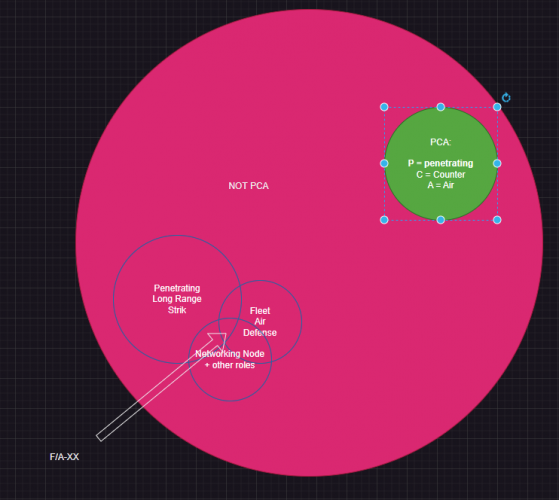
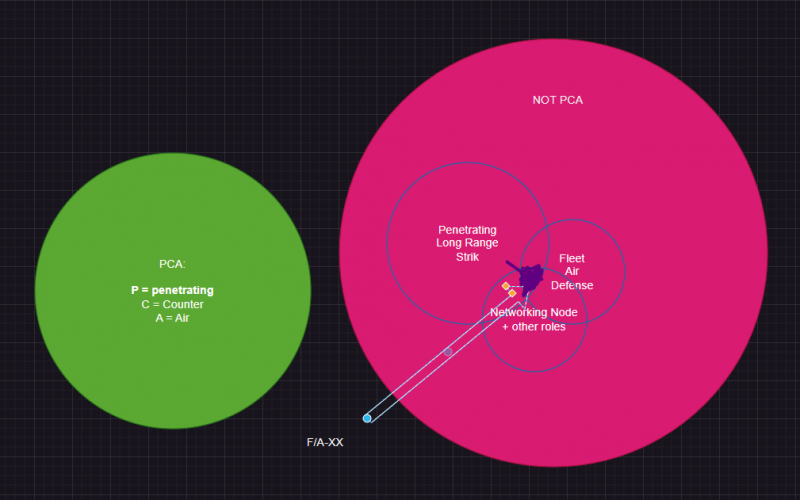
"not PCA" = not Pentrating Counter Air.

"Everything else that is not PCA" != fleet defense fighter.

Would it help if I drew a venn diagram?
image (1).png
Or maybe a logically stupid version?

diagram.png
 
Last edited:
BARCAP would be useful too Scott Kenny, especially to protect the carriers from enemy aircraft with anti-ship missiles at long range hence the need for the AIM-424 Malice.
 
Have standoff munitions stopped existing since I last checked or what ? Cause your aircraft doesn't need to penetrate an enemies air defence network to engage targets within it anymore, that's the point of having long range cruise missiles and the like
Maybe, fair point, ...could actually support probably classifed so don know. why does the AF NGAD stil have a PCA requiremnet. then? Why would PCA even be discussed if there was no requirement? Thes missiles would need to arrive from extreme distances or be carried internally by a mini-carrier borne B-21....
 
Maybe, fair point, ...could actually support probably classifed so don know. why does the AF NGAD stil have a PCA requiremnet. then? Why would PCA even be discussed if there was no requirement? Thes missiles would need to arrive from extreme distances or be carried internally by a mini-carrier borne B-21....
This is partially a valid point, but PCA as a requirement is tangential to this conversation.

PCA exists to send a manned fighter to be the eyes ears and occasionally, the shooter against air targets. Its a requirement for the F-47 because it is the door kicker for the rest of everything that follows behind - be it B21s, strike fighters, hypersonic weapons etc. This requirement is established to secure temporary air superiority or to degrade the enemys aerial formations from within.

The penetrating requirement (a superset of PCA) if you can even call it a requirement doesnt just apply to the F-47. There are numerous other systems meant to do that as well. A penetrating system can sit inside the area denial zone and loiter to provide targeting or actually enegaging high value targets themselves. That can mean ground targets or air targets (which is what PCA does as a subset of penetration type requirments). F/A-XX is not doing PCA but it can still be a penetrating fighter that can sit in pr near enemy networksband attack / acquire ground targets.

Again - PCA = penetrating counter air. Its
to fight stuff in the air. Its got not a whole lot to do with strike. Something that is not PCA fulfilling can still be penetrating.
 

Similar threads

Back
Top Bottom