Blohm und Voss Asymmetric Projects

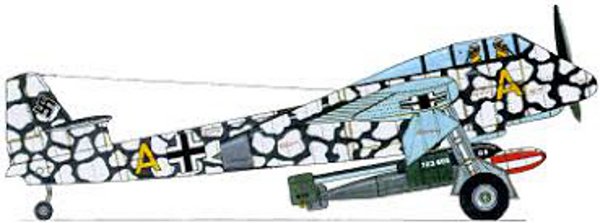
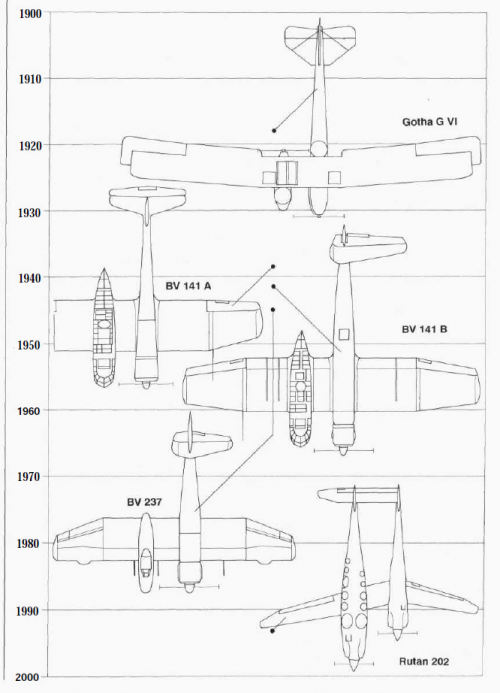
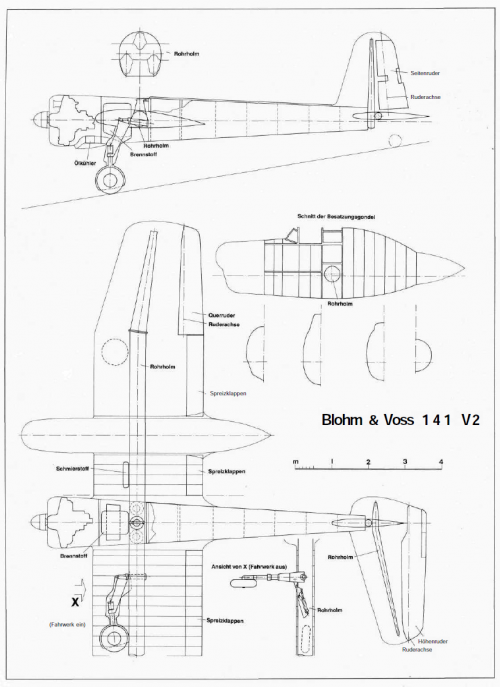
Issue 15 of the magzine Luftfahrt History is dedicated to Blohm und Voss designs, particularly Bv141 , Bv237 and Bv P194.
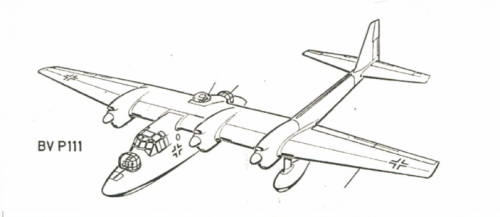
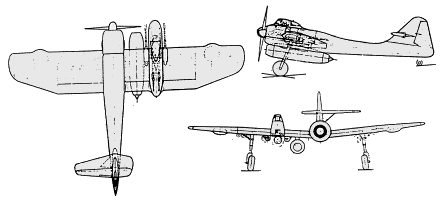
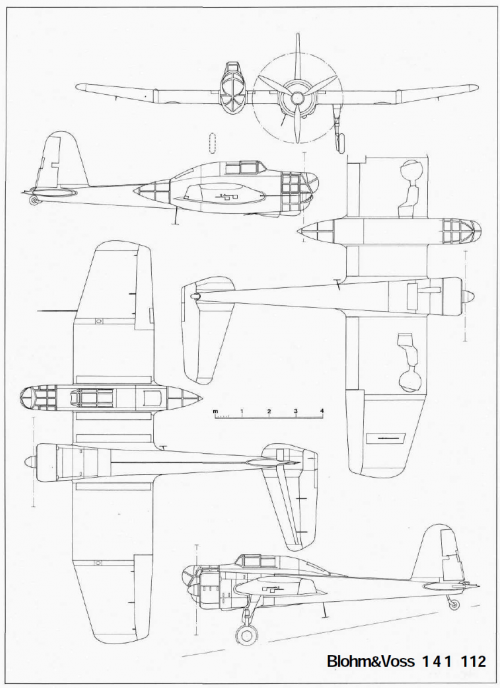
However, tucked away at the back is this drawing if the BV 111 asymetric flying boat mentioned in the first message in this thread.

Source: Luftfahrt History 15
 

Attachments

  • Bv_P111_Luftfahrt_History_15_RVogt.png
    Bv_P111_Luftfahrt_History_15_RVogt.png
    98.6 KB · Views: 284
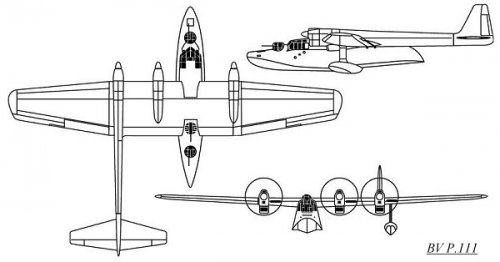
3view
 

Attachments

  • Blohm & Voss P-111-.jpg
    Blohm & Voss P-111-.jpg
    26.5 KB · Views: 256
Issue 15 of the magzine Luftfahrt History is dedicated to Blohm und Voss designs

Hi Cy-27, does that magazine hold more B&V projects?
 
The designer of this aircraft may be a paranoia. ;D
Perhaps he did every calculation what he can imagine.
I can't understand the necessity of this configulation. ???
 
Hi Wurger, I have the magazine. Not more as B.V. 141, B.V. 237 and P. 194.

Servus, Maveric
 
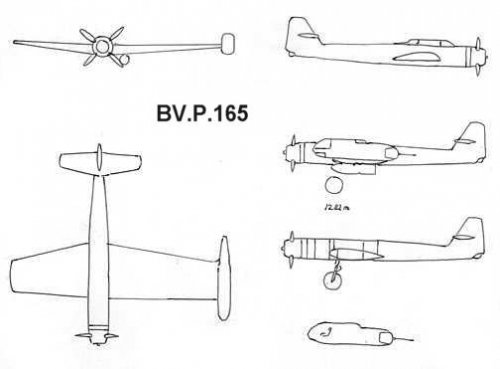
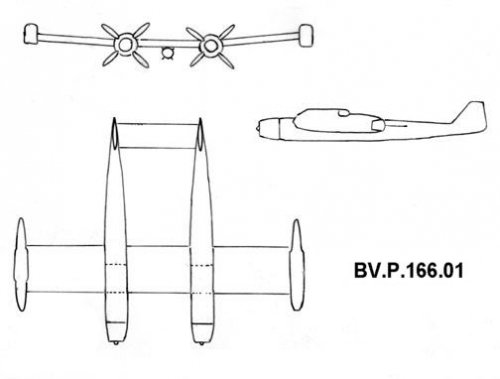
Re: Blohm and Voss P.165 & P.166

Hi!

http://www.oocities.org/asymmetrics/bv165.htm
 

Attachments

  • bv1653v.jpg
    bv1653v.jpg
    15.2 KB · Views: 288
  • bv1663v.jpg
    bv1663v.jpg
    13.5 KB · Views: 291
Re: Blohm and Voss P.165 & P.166

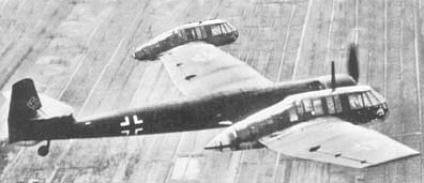
Blohm & Voss tested the wingtip Cockpit at a BV141 (fly with two cockpits ! )
After those test they abandoned the Wingtip Cockpit concept fast

stop work on P.165 & P.166 and went on with P.177, P.204 and P.237 design.

According some stories was Göring outrage about the asymmetric design of Dr. Richard Vogt...
 

Attachments

  • bv141tip2.jpg
    bv141tip2.jpg
    12.5 KB · Views: 284
Re: Blohm and Voss P.165 & P.166

Super picture! Thanks a lot. (What is the meaning of "Artwork by Igor Shestakov"? )

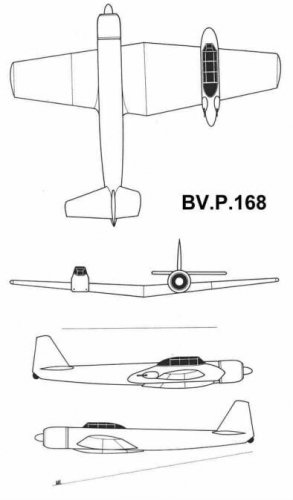
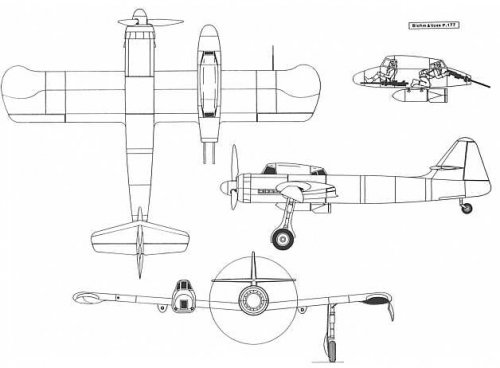
Also P.168 was almost same shape compared with P.177.

http://www.oocities.org/asymmetrics/bv168.htm

Luft46
"Additional versions included a two seat cockpit, and even a provision was made for a single Jumo 004 jet engine to be mounted beneath the wing between the fuselage and cockpit. Although a wooden mockup was constructed, the unusual asymmetric design was not accepted, plus there was really no need for a new ground attack/dive bomber this late in the war. "

https://www.youtube.com/watch?v=ubd0fAayVS4
 

Attachments

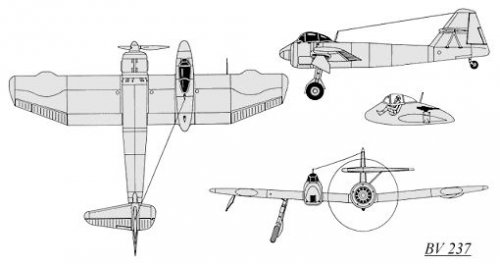
  • bv237-3.jpg
    bv237-3.jpg
    14.2 KB · Views: 204
  • 3bb237.jpg
    3bb237.jpg
    16.5 KB · Views: 199
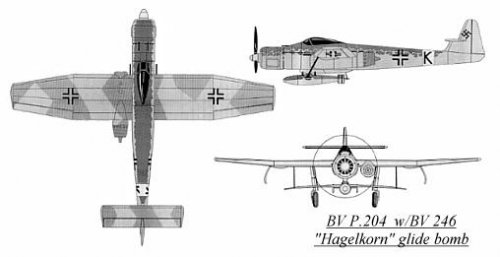
  • bv2043v.jpg
    bv2043v.jpg
    15.4 KB · Views: 206
  • bv p.168.jpg
    bv p.168.jpg
    17.2 KB · Views: 206
  • bv p.177.jpg
    bv p.177.jpg
    21.2 KB · Views: 228
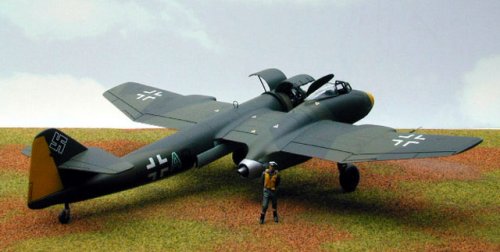
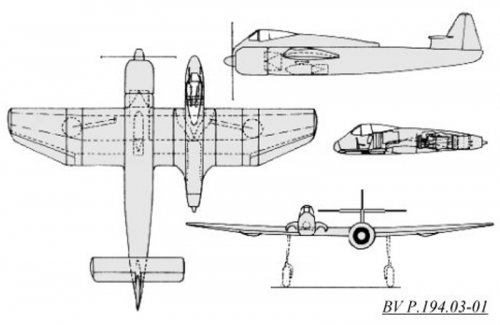
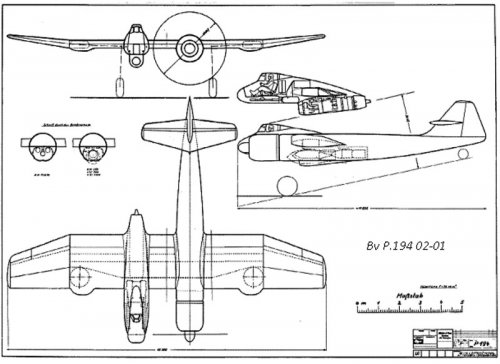
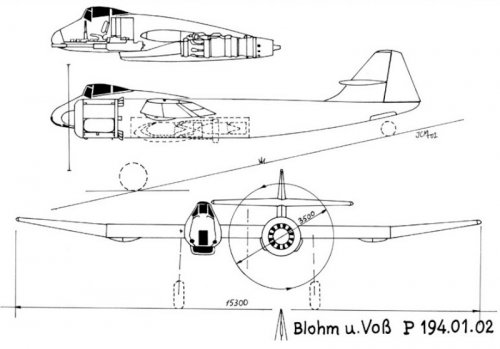
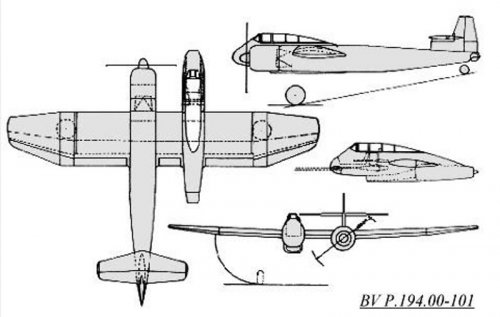
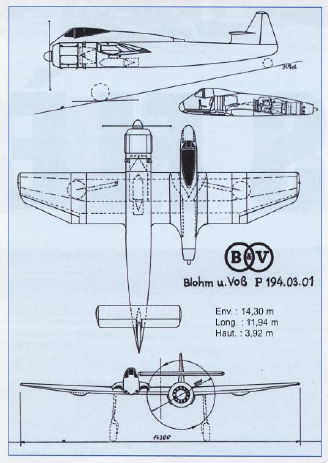
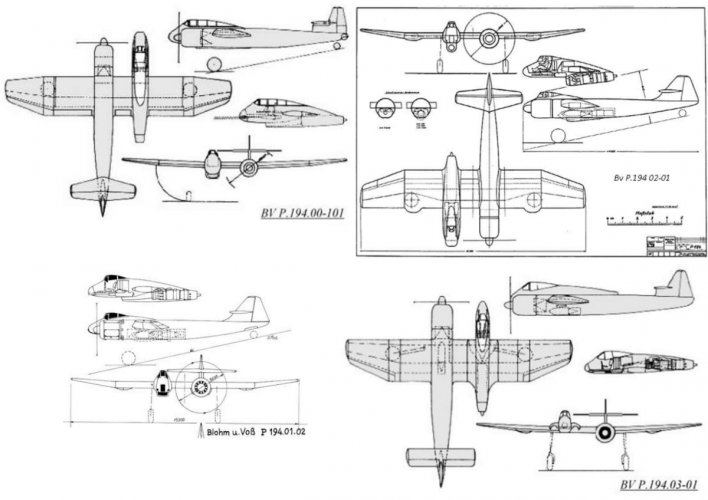
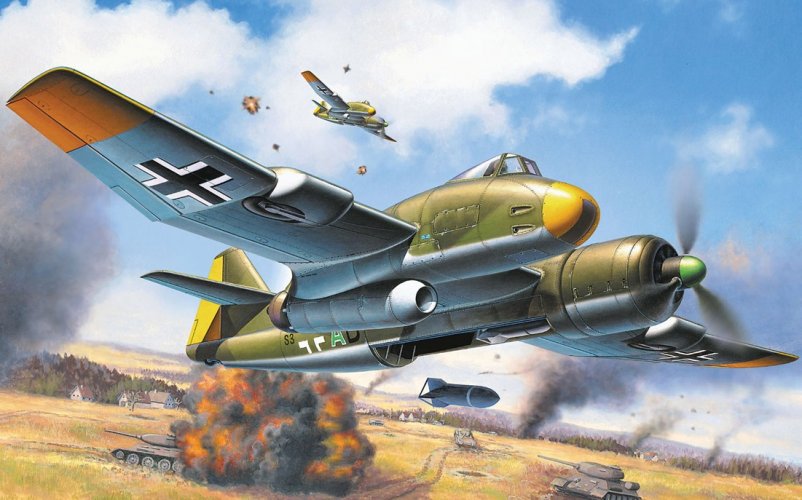
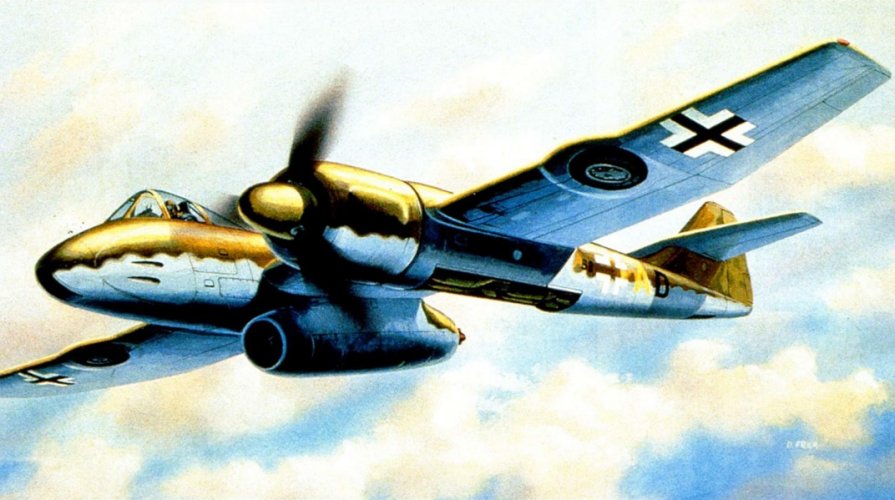
Bv P.194.
https://en.wikipedia.org/wiki/Blohm_%26_Voss_P.194

"P.194.00-101 version with 16 m (52 ft) wingspan and jet intake under cockpit pod
P.194.01-02 version with 15.3 m (50.2 ft) wingspan, bubble canopy and jet intake under cockpit pod
P.194.02-01 as above, but with turbojet located beneath cockpit
P.194.03-01 as P.194.01-02, but with jet intakes located in the wing roots at the sides of the cockpit pod."

Russian site.
Justo-san's many amazing drawings here.
http://alternathistory.com/proekt-asimmetrichnogo-samoleta-blohm-voss-bv-p194

"In March 1944 onwards, Blohm Voss & Rejhcministerstvu aviation offer new project asymmetric aircraft which could be used as a fighter, attack aircraft, bombers and reconnaissance aircraft. Blohm Voss worked on & BV 237 and BV P. 179, two other asymmetric projects diploma Engineer Richard Vogt (Richard Vogt). However, this project was different from others in that they intend to use a mixed scheme of the engine, and propeller and Jet engine, plus domestic accommodation bomb loads in the main fuselage. This made it possible to offset the main disadvantage of the first jet engines-small cravings, and as a result low tâgovooružënnosti-bad landing runway and exceptional characteristics. Jet engine had to be placed in the gondola, and the internal placement of bombs in fûzelâžnom bombootseke allowed to keep high speed even with bomb load. Here is an excerpt from the original proposal Blohm Voss &: "this scheme gives an asymmetric plane many advantages, the primary is a good view from the cockpit, as well as the possibility of a large concentration of armament in the nose of the fuselage. This scheme reduces the torque produced around a vertical axis propeller if you use one of the traditional engine. On takeoff this time is expected to be less than half of such on the BV 141. After the take-off time is reduced to less than one third, and completely disappears during high-speed cruising.
In total there were four versions of the project BV p. 194, the constructive scheme of all remained unchanged. Due to the fact that the project had been proposed by 194 P at the end of the war, he received no further development."(Auto translation)

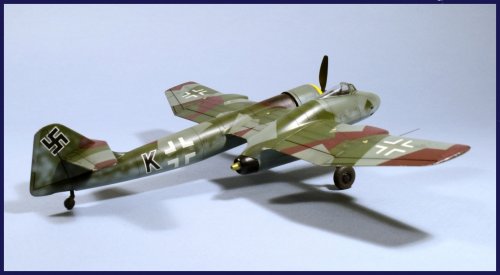
Revell model instruction manual for P.194.02-01. Wing leading edge shape is impressive. ;D
http://manuals.hobbico.com/rvl/80-4335.pdf
 

Attachments

  • blohm_n_voss_bv_p_194_by_vladimiraranovich-d6i3lzj.jpg
    blohm_n_voss_bv_p_194_by_vladimiraranovich-d6i3lzj.jpg
    358.4 KB · Views: 227
  • bvp194cd_4.jpg
    bvp194cd_4.jpg
    62.3 KB · Views: 192
  • bvp194cd_6.jpg
    bvp194cd_6.jpg
    49.8 KB · Views: 251
  • P.194.03-01.jpg
    P.194.03-01.jpg
    49.9 KB · Views: 210
  • P.194.02-01.jpg
    P.194.02-01.jpg
    82.2 KB · Views: 217
  • P.194.01-02.jpg
    P.194.01-02.jpg
    56.4 KB · Views: 213
  • P.194.00-101.jpg
    P.194.00-101.jpg
    57.2 KB · Views: 213
One disadvantage of assymetrical thrust is that the airplane yaws (turns) every time the pilot adjusts the throttle.

It gets even more complicated with two different types of power (e.g. B&V 204 with a jet engine under the right wing and a piston engine in the boom).
For example, when you slam the throttle on a piston engine, it increases power almost instantaineously .... albeit with a dose of yaw.
OTOH slamming the throttle on an early jet produces lacklustre acceleration ...... eventually ..... with zero yaw.
The worst case is slamming both throttles - on an assymetrically powered airplane with two different power plants - and having your airplane yaw all over the sky as you are trying to lay a gun sight on a fleeing foe.
 
riggerrob said:
One disadvantage of assymetrical thrust is that the airplane yaws (turns) every time the pilot adjusts the throttle.

True enough, but then again even an aircraft that looks symmetrical may not be so in practice, especially a single-engine propeller type because of the very asymmetrical propeller slipstream. Rudder and/or aileron trim changes with power and speed are not uncommon. Plus, just about every aircraft ever made is vertically asymmetrical, so pitch trim changes with power and speed are normal. By all accounts, the Blohm & Voss BV 141 was quite pleasant to fly.
 
index.php
index.php

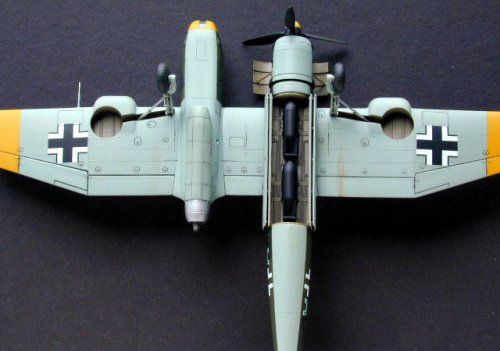
Astounding models! It would be nice to have the source and/or the name of the builder(s)...
 
cluttonfred said:
riggerrob said:
One disadvantage of assymetrical thrust is that the airplane yaws (turns) every time the pilot adjusts the throttle.

True enough, but then again even an aircraft that looks symmetrical may not be so in practice, especially a single-engine propeller type because of the very asymmetrical propeller slipstream. Rudder and/or aileron trim changes with power and speed are not uncommon. Plus, just about every aircraft ever made is vertically asymmetrical, so pitch trim changes with power and speed are normal. By all accounts, the Blohm & Voss BV 141 was quite pleasant to fly.

Exactly. Single-engined, propeller-driven airplanes sometimes have offset vertical tails or longer wings or tailplanes on one side in order to counter torque.

I wonder if the B & V designs weren't conceived with single-engine ground handling in mind. The offset gondolas and the unusually wide, near wingtip undercarriages would resist torque and prevent ground loops on rough ground.
 

Attachments

  • 1.png
    1.png
    95.5 KB · Views: 166
  • 2.png
    2.png
    32 KB · Views: 159
  • BV Projects list 2.jpg
    BV Projects list 2.jpg
    3.3 MB · Views: 194
Last edited:
Nope. Blohm & Voss's own register of projects says the P 157 designation was unallocated.

View attachment 619913

My dear Dan,

I know you are expert in this field,but their list is not measure,no reason for slip some numbers,just the author
didn't know them or lost their reports,anther example for your list also,there was no P.174 & P.191,but in many
source they are known ?!.


Okay, let's unravel this. We're looking at three lists.
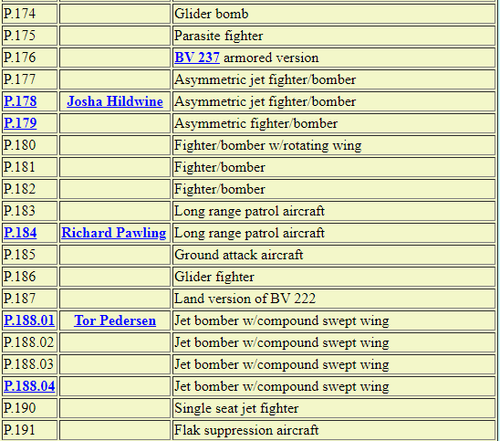
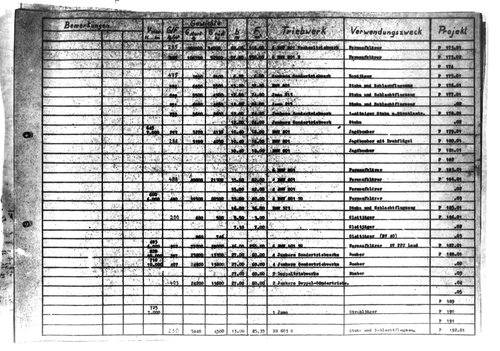
The list on Luft46.com is based on the one which appears on p122-123 of Heinz J. Nowarra's Die Deutsche Luftruestung 1933-1945 Vol. 1. 1993 version. I'll call this the 'Nowarra list'.
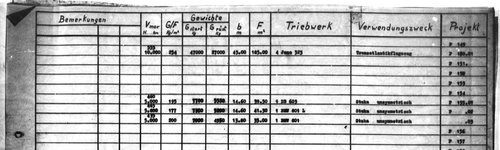
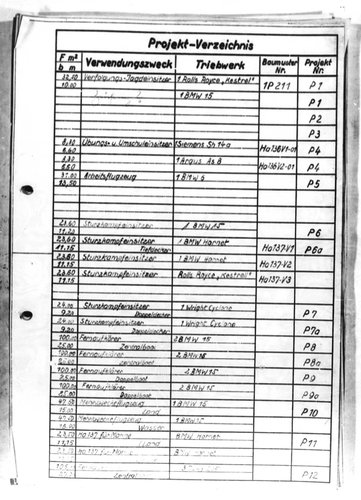
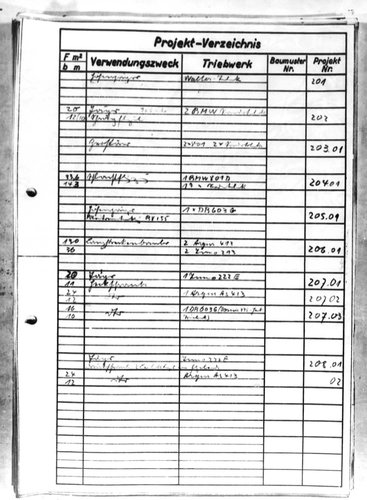
I have two wartime lists from T-2 microfilm obtained from NASM: One is handwritten onto printed sheets, with various different handwriting filling it in from P 1 to where it ends at P 208.02. This has no details other than project number, aircraft role and engine type used. I'll call this the 'handwritten list'.
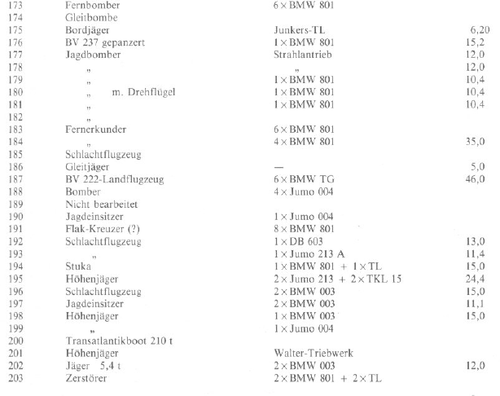
The other list is the printed list I've uploaded a few sections from, which runs from P 1 up to P 212.01 and includes lots of other details including weights, wingspan etc. as you have seen. I'll call this the 'printed list'.
There are certain gaps in common with all three, a handful of instances where the Nowarra list has details the others lack, instances where the handwritten list has more detail and instances where the printed list has detail where the others don't.
There are 40 project numbers where one, two or all three lists have gaps as follows:
P 2 (gap on all three)
P 3 (gap on all three)
P 26 (gap on all three)
P 30 (gap on Nowarra and handwritten list, stats given on printed list)
P 31 (gap on Nowarra and handwritten list, stats given on printed list)
P 32 (gap on Nowarra and handwritten list, stats given on printed list)
P 34 (gap on all three)
P 35 (gap on Nowarra and handwritten list, Landmaschine Lufthansa in printed list)
P 36 (gap on Nowarra and handwritten list, Wassermachine Lufthansa in printed list)
P 87 (gap on all three)
P 91 (gap on all three)
P 93 (gap on Nowarra, ‘Aenderung der Nr. [illegible] P 96, P 103 on handwritten list, gap on printed list)
P 101 ('Zielflugzeug' in Nowarra, gap in both handwritten and printed lists)
P 102 (gap in all three)
P 106 (BV 222 development in Nowarra, ‘222’ with ‘?’ under engines in handwritten list, blank in printed list)
P 107 (BV 222 development in Nowarra, ‘222’ with ‘?’ under engines in handwritten list, blank in printed list)
P 120 (gap on all three)
P 121 (gap on all three)
P 129 ('Jagdeinsitzer' in Nowarra, gap in handwritten and printed lists)
P 130 (gap on all three)
P 132 (gap on all three)
P 133 (gap on all three)
P 136 (gap on all three)
P 137 (gap on all three)
P 139 ('Flugboot' in Nowarra, gap in handwritten and printed lists)
P 147 ('P 142 als Transporter' in Nowarra and handwritten list, gap in printed list)
P 148 ('Flugboot' in Nowarra, gap in handwritten and printed lists)
P 149 ('Flugboot' in Nowarra, gap in handwritten and printed lists)
P 151 (gap on all three)
P 152 (gap on all three)
P 153 (gap on all three)
P 154 (gap on all three)
P 156 (gap on all three)
P 157 (gap on all three)
P 158 (gap on all three)
P 159 (gap on all three)
P 174 ('Gleitbombe' in Nowarra and handwritten list, gap in printed list)
P 182 ('Jagdbomber' in Nowarra, blank in handwritten and printed lists)
P 189 (gap on all three)
P 191 ('Flak-Kreuzer (?)' in Nowarra, unclear on handwritten list but looks like Fernbomber with 8 x BMW 801 to me, blank on printed list)

Eliminating the 23 instances where all three agree, we're left with the following 17 points of disagreement:
P 30 (gap on Nowarra and handwritten list, stats given on printed list)
P 31 (gap on Nowarra and handwritten list, stats given on printed list)
P 32 (gap on Nowarra and handwritten list, stats given on printed list)
P 35 (gap on Nowarra and handwritten list, Landmaschine Lufthansa in printed list)
P 36 (gap on Nowarra and handwritten list, Wassermachine Lufthansa in printed list)
P 93 (gap in Nowarra, ‘Aenderung der Nr. [illegible] P 96, P 103 on handwritten list, gap on printed list)
P 101 ('Zielflugzeug' in Nowarra, gap in both handwritten and printed lists)
P 106 (BV 222 development in Nowarra, ‘222’ with ‘?’ under engines in handwritten list, blank in printed list)
P 107 (BV 222 development in Nowarra, ‘222’ with ‘?’ under engines in handwritten list, blank in printed list)
P 129 ('Jagdeinsitzer' in Nowarra, gap in handwritten and printed lists)
P 139 ('Flugboot' in Nowarra, gap in handwritten and printed lists)
P 147 ('P 142 als Transporter' in Nowarra and handwritten list, gap in printed list)
P 148 ('Flugboot' in Nowarra, gap in handwritten and printed lists)
P 149 ('Flugboot' in Nowarra, gap in handwritten and printed lists)
P 174 ('Gleitbombe' in Nowarra and handwritten list, gap in printed list)
P 182 ('Jagdbomber' in Nowarra, blank in handwritten and printed lists)
P 191 ('Flak-Kreuzer (?)' in Nowarra, unclear on handwritten list but looks like Fernbomber with 8 x BMW 801 to me, blank on printed list)

Looking a little more closely at these 17:
P 30 The printed list fails to give a role for this aircraft but gives the engines as 4 x Jumo 206, wing area 125m2 and a starting weight of 17,600kg.
P 31 Again, no role from the printed list but it does give the engine as Jumo 210. No wing area but starting weight was 2450kg.
P 32 No role or engine but wing area was 30m2 and starting weight was 6000kg.
P 35 The printed list gives only 'Landmaschine Lufthansa' with 4 x DB 601 and a top speed of 445km/h at 6000m.
P 36 The printed list gives 'Wassermaschine Lufthansa' with 4 x DB 601 and a top speed of 410km/h at 4000m.
P 93 One of very few instances where the handwritten list differs from Nowarra, this has only a tiny note on it which says ‘Aenderung der Nr. [illegible] P 96, P 103'
P 101 Clearly blank in both period lists. In Nowarra this is given as 'Dasselbe' below the P 100 Zielflugzeug but above the P 102 described as 'Nicht bearbeitet'. My guess would be that it should say 'Nicht bearbeitet' next to P 101 and 'Dasselbe' should be next to P 102 instead. Basically a simple typo.
P 106 The handwritten list has a very faintly pencilled in '222' on this one, with a question mark for the engines. The author clearly wasn't sure about this one.
P 107 The same faint '222' and '?' as P 106.
P 129 This appears to be another typo in Nowarra's list, as with the P 101. The P 130 is 'Nicht bearbeitet' and the P 128 is shown only as '"' from the P 127 Jagdeinsitzer.
P 139 Nowarra just gives this as 'Flugboot' where both period lists are blank. Perhaps some confusion with the Ha 139 - otherwise inexplicable.
P 147 This is blank on the printed list but the handwritten list does clearly have P 147 as 'P 142 als Transporter'.
P 148 Like P 139, Nowarra gives this simply as 'Flugboot' with no other details when both period lists have it as a gap. Inexplicable.
P 149 As with P 148 - Nowarra has no engine or wingspan data - he just gives 'Flugboot' where both period lists have a clear gap.
P 174 The handwritten list very clearly agrees with Nowarra where the printed list is blank - 'Gleitbombe'.
P 182 As with P 101 and P 129, I think this is a typo. It comes at the bottom of a very long list of '"' and probably ought to have been 'Nicht bearbeitet' instead.
P 191 Curiously described by Nowarra as 'Flak-Kreuzer (?) 8 x BMW 801'. It is pretty unclear on the handwritten list, but it looks to me more like 'Fernbomber 8 x BMW 801'.

I would conclude that the Nowarra list is based on the T-2 captured 'handwritten list' but with a few basic inaccuracies where the information hasn't been transcribed correctly. The 'handwritten list' itself is, as noted, in a number of different hands and gets visibly scrappier as it gets towards the end. I would guess that this was the ongoing company list, which stopped being updated after the P 208.02. The printed list is much more useful because it includes lots more technical detail but it does exclude more projects than the handwritten list. This might be because the files had been lost, as you suppose. Perhaps it was intended to replace the scrappy handwritten list and was produced as work was being carried out on the P 208.02 in the autumn of 1944. The fact remains, however, that Blohm & Voss clearly did not use every number they could have used for their projects. At least 23 went unused and we will probably never know why. And P 157 was among them.

 
Last edited:
OK my dear Dan,

my point is there was many and a lot of reports lost,and we can judge only on one source,for example,
Messerschmitt had a P list,we can see a gaps from P.1021 to P.1050,they were unknown,but they were
really existed.
 
OK my dear Dan,

my point is there was many and a lot of reports lost,and we can judge only on one source,for example,
Messerschmitt had a P list,we can see a gaps from P.1021 to P.1050,they were unknown,but they were
really existed.

My research goal is to expand my/our knowledge of previously unknown projects through primary source research. The sources I use often turn out to be those previously used at various points over the last 75 years or so by other writers and researchers. I sometimes therefore find myself treading the same ground and in a position to comment on previous writers' interpretation of the documents they likely used.
You're right that there are 'known unknowns' to coin a phrase, but I'm certain that some projects are simply gone forever (although I always hope that new evidence will emerge that proves me wrong!). In the absence of any evidence for these sadly lost projects, I prefer to discuss and interpret the evidence that we do have.
 
Incidentally, for the record, here are the first and last pages of the 'handwritten list' of Blohm & Voss projects, as evidently used by Nowarra. You can see what I mean about the handwriting change from the start to what it was like at the end.


Handwritten list first page.jpg


Handwritten list last page.jpg
 
B & V 171, twin-engined dive bomber is the cover story on Dan Sharp's book-zine: “ Luftwaffe Secret Projects of the Third Reich, volume 6” (Morton’s, UK, 2019). ISBN: 978-1-911639-06-0.
This book-zine contains dozens of never-before published WW2- vintage sketches, plus new coloured paintings of a variety of weird-waffle concepts most of which never reached mock-up stage. Fascinating!

Sully spell-check is more interested in the waffles that I ate for breakfast than any old Air Force! Silly!


Disclaimer: I paid full retail price for this at my local “Chapters.”
 
Last edited:
"
Re: Blohm and Voss P.165 & P.166

Blohm & Voss tested the wingtip Cockpit at a BV141 (fly with two cockpits ! )
After those test they abandoned the Wingtip Cockpit concept fast

stop work on P.165 & P.166 and went on with P.177, P.204 and P.237 design.

According some stories was Göring outrage about the asymmetric design of Dr. Richard Vogt...
"

Yes, mounting cockpits too far from the centre of gravity can create problems.
For example, if the cockpit is too far from the roll axis, the cockpit will experience dramatic positive or negative Gs during rolls. Before they North American Aviation built any Twin Mustangs, they experimented by adding a cockpit to the right tail boom of a Lockheed P-38 Lightning.

Similarly, modern RAF Tornado fighters mount the pilot's head a long way above the roll axis. During rolls, dramatic lateral Gs bounced a few pilots' heads off the sides of the caoopy before they learned how to brace their necks before rolling.

Another problem with mounting heavy weights on wingtips is that they increase rotational momentum, making it more difficult to recover from spins. For example, try to picture a T-33 with tip tanks full of fuel, machine guns in the nose and lots of ammunition well forward of the C. of G.
 
"
When I see these asymmetrical designs, I wonder why. What was the aerodynamic advantage?

Where was the longitudinal (roll) axis?
"

Longitudinal roll ) axis on BV 141 was along the wing centre section - between the boom and gondola. It probably coincided with the lateral centre of gravity. The roll axis was slightly closer to the boom because I suspect that the BMW radial engine weighed more than crew.

To understand the aerodynamic advantages of asymmetric airplanes, you first need to understand the finer points of propeller aerodynamics. Even single propeller airplanes are not perfectly symmetrical. When they climb (nose high) , the descending propeller blade bites the air more, creating more thrust, ergo the "P factor" that pushes the airplane nose to the left (clockwise rotating propeller). That is why prop pilots need to dance on rudder pedals during landings and take-offs.

Now consider the dilemma of a twin-engine airplane (e.g. FW 189) when both engines rotate clockwise. If the left engine quits, only the right engine is pulling and the descending propeller blade is a long way from the centre-line requiring lots of rudder deflection to keep it flying straight.
OTOH If the right engine quits, the left engine provides thrust and the descending blade is closer to the centre-line, reducing the amount of rudder trim needed to fly straight.
IOW try to think of a BV 141 as a FW 189 that the right engine quit and fell off. It can still fly straight because the descending propeller blade overlaps the centre-line.

The primary tactical advantage is better visibility. Asymmetric airplanes can also have less drag because they only need 1.5 fuselages compared with the 1 fuselage plus two engine nacelles on conventional twins.
 
Are there any drawings survivor to P.194.00.102 and P.194.03.01 to P.194.03.013 ?.
 
My dear Dan,

I know you are expert in this field,but their list is not measure,no reason for slip some numbers,just the author
didn't know them or lost their reports,anther example for your list also,there was no P.174 & P.191,but in many
source they are known ?!.

Hello hesham, Where do you find handwritten list? Do you have full list?
 
Hello HortenVIII,

you can ask my dear Dan (Newsdeskdan),he knows the source and he has a full list.
 

Similar threads

Back
Top Bottom