Bernard Designations

Cy-27

ACCESS: Top Secret
Senior Member
Joined
28 January 2008
Messages
656
Reaction score
615
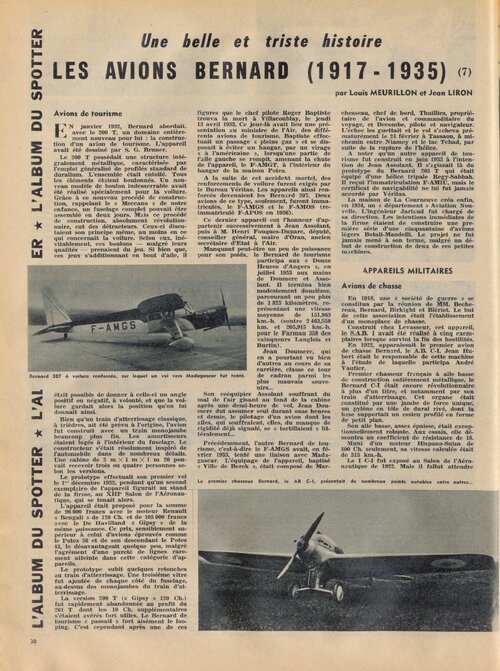
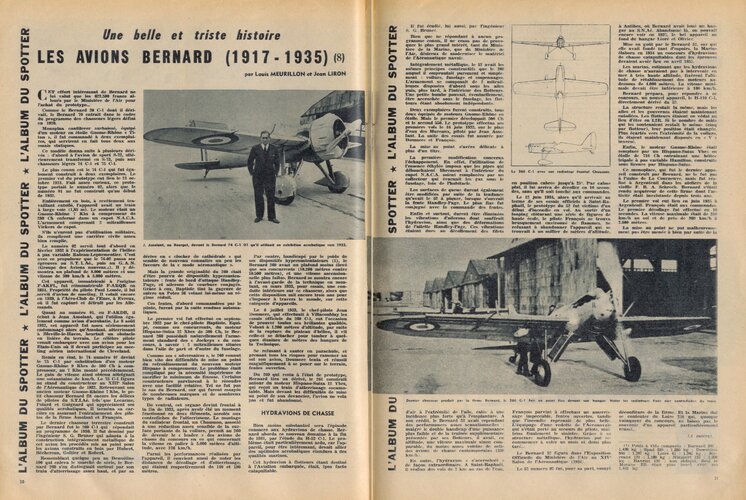
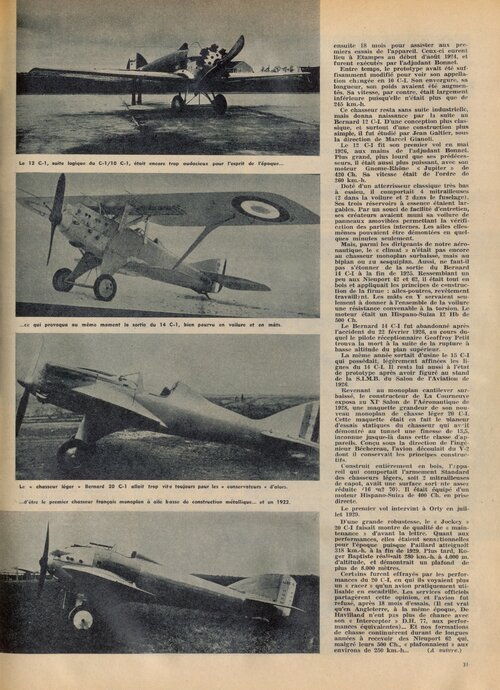
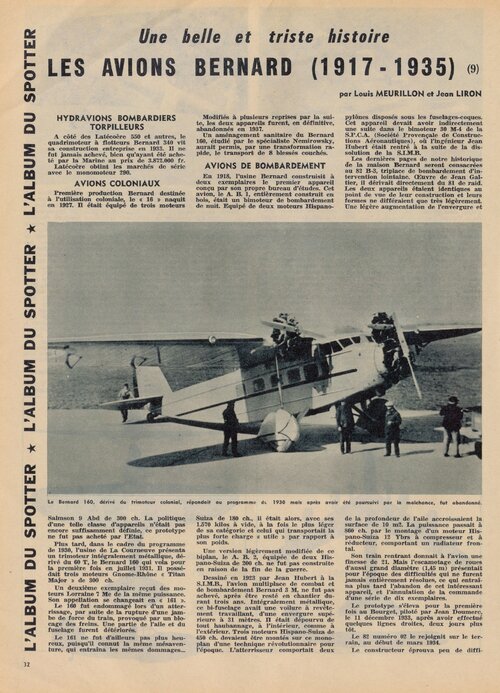
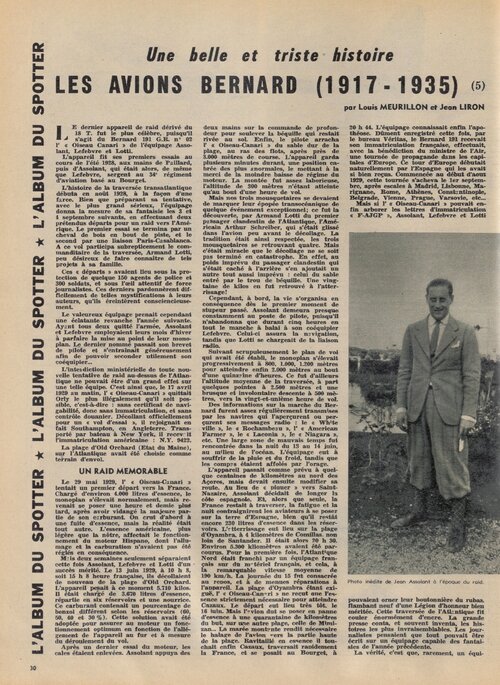
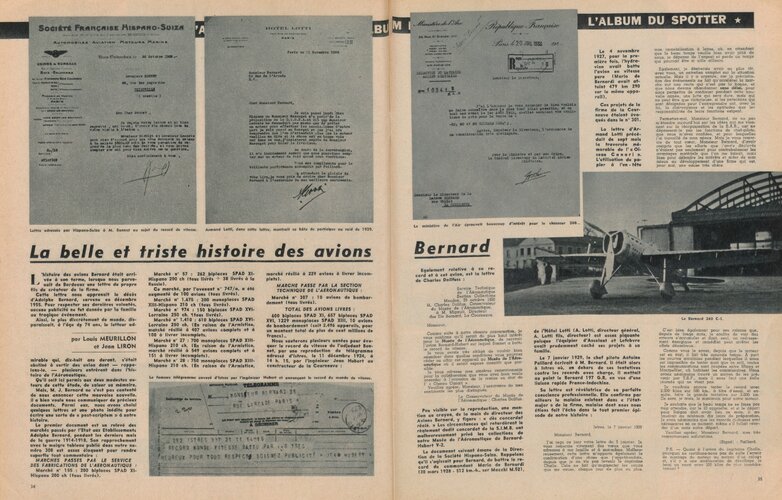
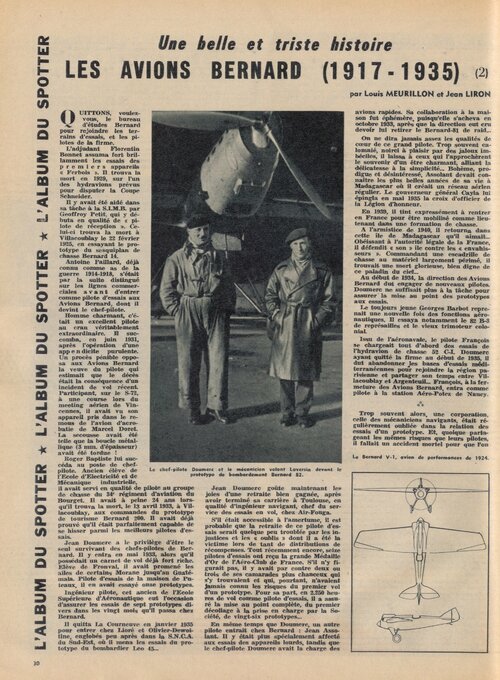
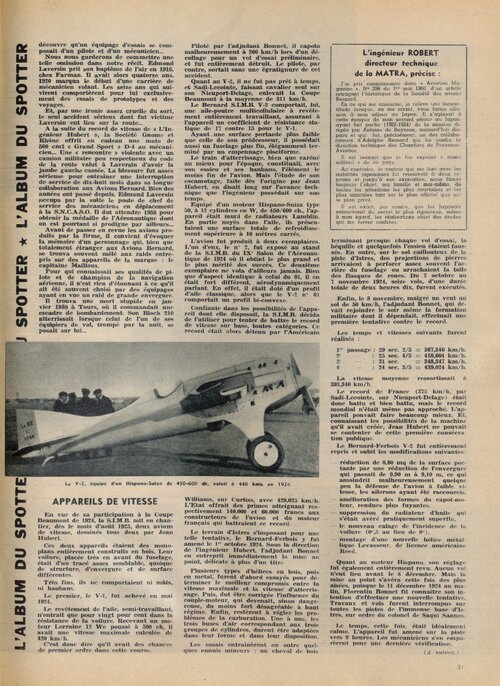
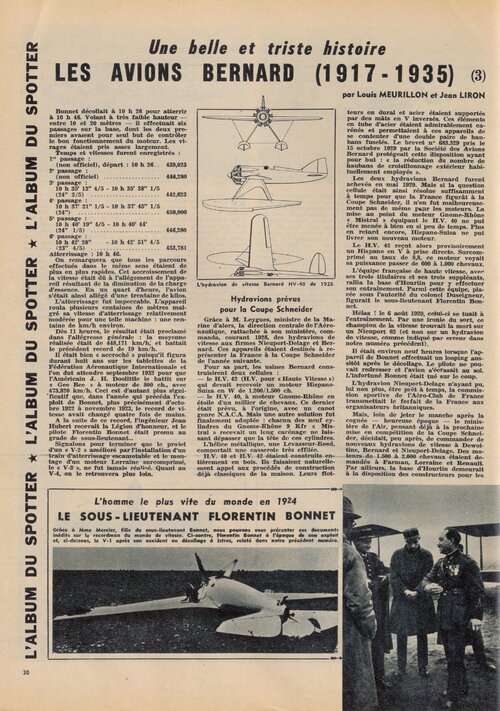
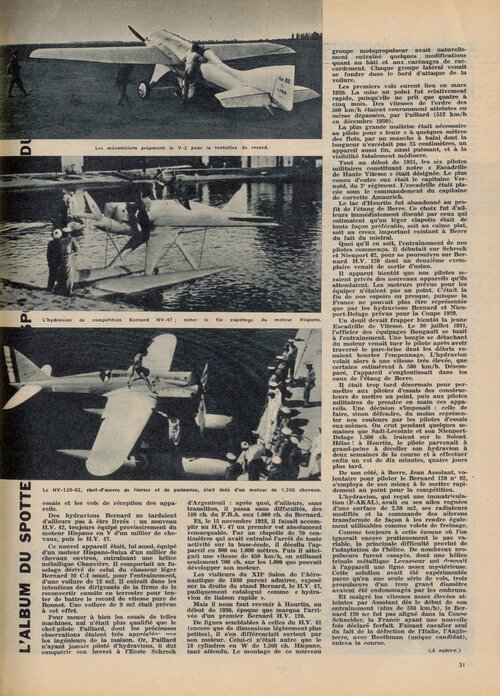
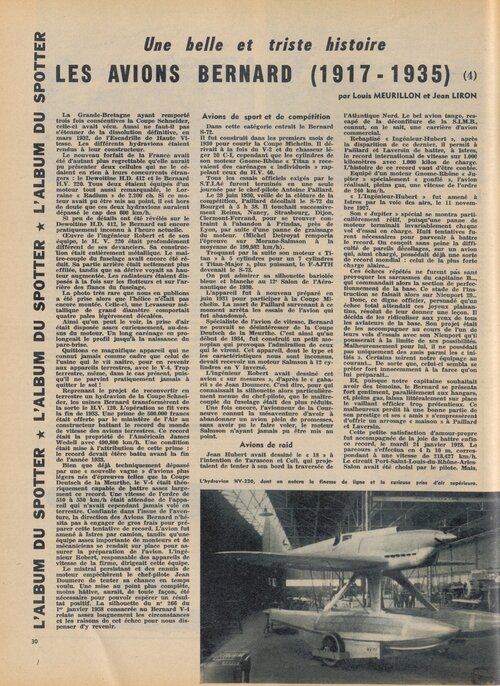
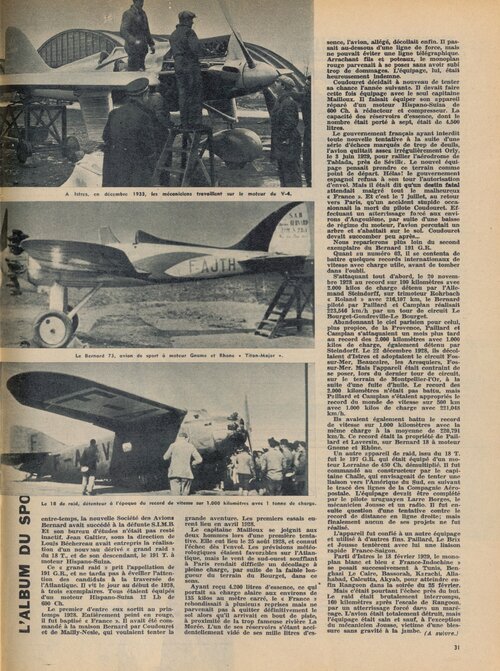
I suspect the attached scan of designations may be from Les Avions Bernard by Jean Liron - can anyone confirm?

I presume the projects are the items with the exemplaire column set to 0 (I'm not a French speaker, I have more of an 'Allo 'Allo style).

I had no idea so many designs came from Avions Bernard.
 

Attachments

  • Bernard_Aircraft_Designations_Article.pdf
    557.2 KB · Views: 95
Cy-27 said:
I suspect the attached scan of designations may be from Les Avions Bernard by Jean Liron - can anyone confirm?

I presume the projects are the items with the exemplaire column set to 0 (I'm not a French speaker, I have more of an 'Allo 'Allo style).
Yes, you're right. Columns are: type/engine/hp/wingspan/length/height/wing area/empty weight/gross weight/max speed/range/ceiling/category/year/prototype registration/number built/remarks.
 
Many thanks C460, now I must try and source a copy of the book, not just two pages ! It sounds quite extensive even for non-French speakers...
 
Great list my dear Cy-27,


and I know the Bernard series 80 reach to designation 88,that's from Trait d'Union
magazine.
 
hesham said:
I know the Bernard series 80 reach to designation 88,that's from Trait d'Union magazine.

Le Trait d'Union was wrong then. The list is pretty clear that the numbers went much higher than 88.
 
Stargazer,


may be you don't understand me,I meant the series 80 only,it ended by 88,and
that Info is not available by Internet.
 
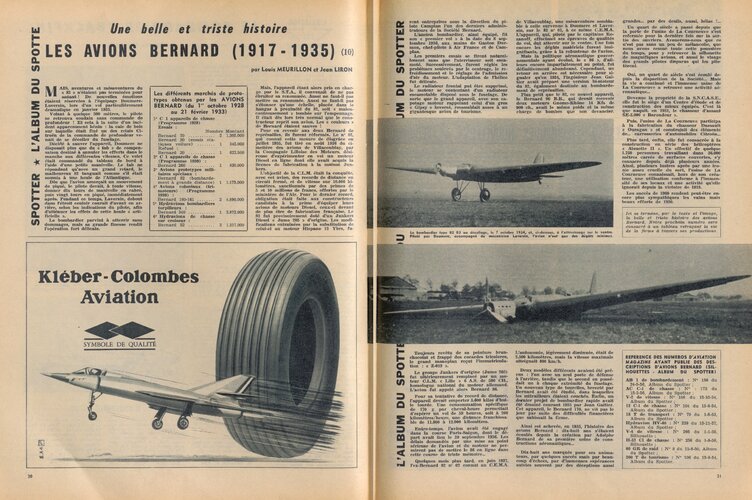
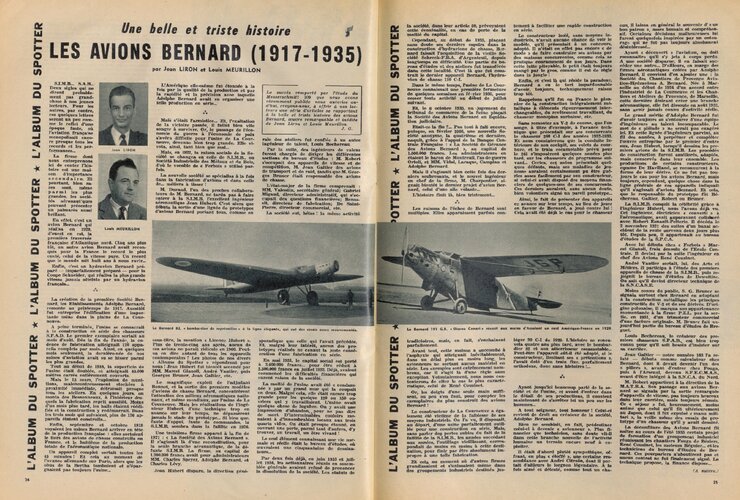
Here is a list of Bernard designations. The main sources are the book Les avions Bernard by Liron, and the articles by Claveau in Trait d'Union no.146 (and 205).

Main aircraft companies founded by Adolphe Bernard:
  • Établissements Adolphe Bernard Company created in 1917 to manufacture Spad fighters.
  • Société Industrielle des Métaux et du Bois (SIMB) Nicknamed Ferbois. Active from 1919 to 1926, made aircraft from 1922.
  • Société des Avions Bernard (SAB) Active from 1927 to 1935.
The former Bernard design team was dispersed after 1935. Georges Bruner and Jean Galtier were briefly hired by Fouga, then Bruner worked for Gourdou and Galtier went to Arsenal. Roger Robert went to CAPRA, predecessor of Matra.

Bernard aircraft

  • AB.1 Biplane bomber, two Hispano 180 hp engines. One prototype and ten series production aircraft.
  • AB.2 Variant of the AB.1 with two Hispano 200 hp engines. Project only.
  • AB.3 Mail transport derivative of the AB.1, two Hispano 180 hp engines. Not sure if built.
  • AB.3 M Large twin boom monoplane bomber with three Hispano 12 G engines, two tractor and one pusher. One example started but unfinished.
  • AB.3 T Civilian transport derivative of the AB.3 M, with three tractor engines. Project only.
  • AB.4 Passenger trapnsport variant of the AB.3, two Hispano 200 hp. One example partly built.
  • V.1 (V = Vitesse) Monoplane racer, Lorraine 12 E. One built for the 1924 Coupe Beaumont.
  • V.2 Monoplane racer, Hispano 12 Gb. One built, won the world speed record in 1924.
  • V.3 Monoplane racer project, retractable gear, Lorraine engine. Project only.
  • V.4 Monoplane racer for the landbased world speed record. One built in 1933, converted from HV.120 no.1, never flew.
  • AB C1 Single-seat low-wing monoplane fighter, Hispano 300 hp engine. One example built, became the AB.10.
  • AB.10 C1 One example, converted from the AB C1 with larger wings and fin.
  • AB.10 T Three-engine monoplane flying boat for commercial transport, Lorraine 320 hp tractor engines. Construction unfinished.
  • AB.12 C1 Derivative of the AB.10 C1 with GR Jupiter 420 hp engine. One example built.
  • AB.14 C1 Single-seat sesquiplane fighter, Hispano 12 Hb 500 hp engine. One example built.
  • AB.15 C1 Derivative of the AB.14 with smaller wings, same engine. One example built.
  • AB.16 Colonial aircraft, three Salmson 9 Abd engines. Unsure if built.
  • Name unknown Two-engine monoplane transport for 12 passengers, with Hispano 350 hp. Project only.
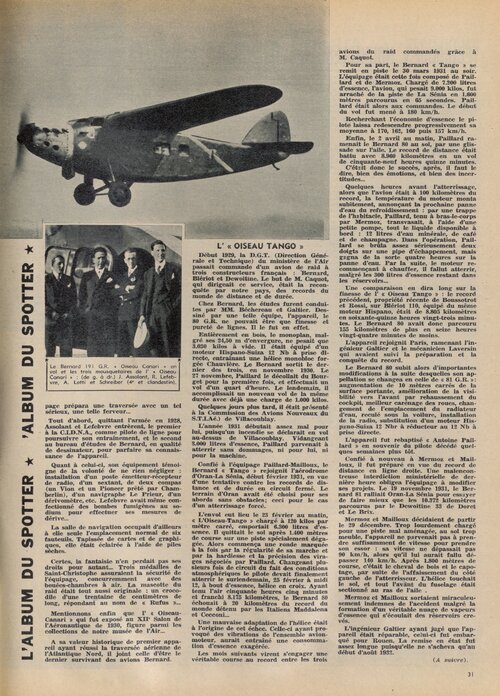
  • 18 T High-wing cantilever transport aircraft, one GR 9 Ab engine. The first example was exclusively used as a long-distance aircraft, named "Oiseau Tango" then "Ingénieur Hubert". The second example was used for static testing.
  • 18 T bis Projected evolution of the 18 T, became the 190.
  • 18 GR Semi-official name for the 18 T modified as a long-distance aircraft (GR = Grand Raid).
  • 181 GR Long-distance aircraft, derivative of the 18 T with Hispano 500 hp engine. Project only.
  • 190 T Transport aircraft, enlarged derivative of the 18 T, GR 9Ady 420 hp engine. Eight built.
  • 191 T Variant of the 190 T with Hispano 12 Ga. One example started, finished as the 191 GR no.3.
  • 191 GR Long-distance aircraft, derivative of the 190 T, Hispano 12 Lb 600 hp engine. Three examples built, no.1 "France", no.2 "Oiseau Canari" that crossed the Atlantic, no.3 was the converted 191 T.
  • 192 T Variant of the 190 T with GR 9 Akx 480 hp.
  • 193 T Variant of the 190 T with Lorraine 12 Eb 450 hp.
  • 194 T Variant of the 190 T with Renault 12 Ja 450 hp.
  • 195 T Variant of the 190 T with Farman 12 We 500 hp.
  • 197 GR Long-distance aircraft, similar to the 191 GR with Lorraine 12 Eb 450 hp engine. One examples built, no.1 "France-Indochine".
  • 20 C1 Single-seat mid-wing monoplane fighter, Hispano 12 Jb 400 hp engine. One example built.
  • 30 T Twin-boom four-engine transport aircraft, four Hispano 18 Sb 1000 hp. Project only.
  • HV.40 High-speed single-seat seaplane, GR 9K Mistral. One built in 1929 as a trainer for the Schneider team.
  • HV.41 Evolution of the HV.40 with Hispano 12-cylinder engine. One built in 1929 as a trainer for the Schneider team.
  • HV.42 Evolution of the HV.41. Three built in 1929 as a trainer for the Schneider team.
  • H.52 Single-seat floatplane fighter, GR 9 Kdrs engine. Two examples built.
  • 60 T Three-engine high-wing transport aircraft, with one GR Jupiter and two GR Titan. One example built, engines later replaced by three GR Titan Major.
  • 61 T Evolution of the 60 T with metal fuselage, three GR 7 Kb. One example built.
  • 70 Single-seat monoplane fighter, GR 5 Bc 240 hp engine. Nicknamed "Super Jockey". Two examples were ordered, one was used for structural tests, the other was completed as the S.72.
  • 71 Variant of the 70 with GR 5 Kb supercharged engine. Project only.
  • S.72 Single-seat sports aircraft for racing and aerobatics, GR Titan engine, 1930. One built, conversion of the 70 C1.
  • S.73 Sports aircraft for racing and aerobatics, conversion of the S.72 with GR 7Kb engine, 1931.
  • 74 C1 Fighter derivative of the S.73, with GR 7 Kbs 360 hp engine. Two examples built.
  • 74 S Aerobatics aircraft, conversion of the second 74 C1, with GR 7 Kc.
  • 75 C1 Single-seat fighter, conversion of the first 74 C1, with GR 9 Kbrs.
  • 80 GR Long-distance mid-wing monoplane, Hispano 12 Nb 650 hp. One example built, named "Oiseau Tango".
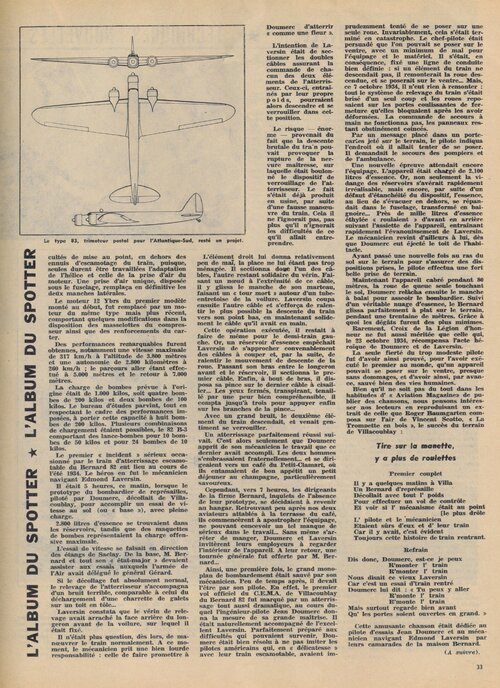
  • 81 GR Improved version of the 80 GR, Hispano 12 Nbr 650 hp. One example converted from the 80 GR, named "Antoine Paillard" then "Oiseau Canari II".
  • 81 Bn3 Bomber variant of the 81 GR, unconfirmed project.
  • 82 B3 Bomber derivative of the 81 GR, Hispano 12 Y 860 hp engine. Two examples built, no.02 was converted into the 86.
  • 82 Jumo Other name for the 82 no.02 converted with Jumo engine, see 86.
  • 83 Three-engine mail transport derivative of the 82 B3, three GR 7 Kds 360 hp. Project only.
  • 84 GR Version of the 81 GR with Gnome-Rhône 14 Kfs 900 hp radial engine. Conversion of the 81 GR was announced but perhaps not completed.
  • 85 Unconfirmed name for a two-engine bomber derivative of the 82.
  • 86 Experimental long-distance aircraft with Diesel engine. One example, converted from the 82 B3 no.02 by the engine company CLM. First had a Jumo 205 535 hp, then a CLM 6 As 560 hp.
  • 88 Derivative of the 83 with three Diesel engines CLM 6 As 560 hp. Project by CLM studied after Bernard's demise.
  • 90 BR Two-engine monoplane bomber, two GR 14 Kfs 900 hp.
  • HV.100 Flying boat racer for the Schneider Trophy, with two push-pull Farman 18 T engines. Project only. (Name HV.100 mentioned in Trait d'Union no.205.)
  • H.110 Single-seat floatplane fighter, evolved from the H.52, Hispano 9 Vbs engine. One example built.
  • HV.120 Seaplane racer, HS 18 R. Two built in 1929 for the Schneider Trophy.
  • HV.120-1 Name sometimes used for the second HV.120 with gear-reduced engine.
  • 160 High-wing colonial aircraft with three GR 7 Kb, evolved from the 60 T. One built, flew in 1932.
  • 161 Version of the 160 with three Lorraine 9 Na. One built, flew in 1932.
  • 170 V Lightweight racer project, 1930.
  • 170 Designation re-used in 1935 for a two-engine rapid bomber, project only.
  • 200 T High-wing tourism aircraft, DH Gipsy III 120 hp engine. Four examples started, converted into 201 T, 205 T or 207 T.
  • 200 TS Variant of the 200 T with leading edge slats. Project only.
  • 201 T Variant of the 200 T with DH Gipsy Major I 135 hp engine. Two examples, converted from 200 T no.1 and 4.
  • 202 T Variant of the 200 T with Chaise 4 A 100 hp engine, not built.
  • 203 T Variant of the 200 T with Chaise 4 B 120 hp engine, not built.
  • 204 T Variant of the 200 T with Renault 4 Pdi 120 hp engine, not built.
  • 205 T Variant of the 201 T with the same engine and a three-blade propeller. One example, converted from 201 T no.1.
  • 206 T Unknown, speculated by Jean Liron as a floatplane or radial engine variant.
  • 207 T Variant of the 201 T with reinforced wing. Two examples, converted from 200 T no.2 and 3.
  • 210 T Planned version of the 207 T license built in Britain, project only.
  • HV.220 Seaplane racer with Lorraine 12 Rcr Radium engine, for the 1931 Schneider Cup. Airframe was finished and assembled but the engine was never delivered.
  • 260 C1 Single-seat low-wing monoplane fighter, HS 12 Xbrs engine. One example built.
  • 261 C1 Derivative of the 260 with HS 12 Ybrs and retractable gear. One example started but unfinished.
  • 262 C1 Carrier-borne fighter, derivative of the 260 with GR 9 Kdrs. Project only.
  • 290 T All-metal derivative of the 190 T, project only.
  • HV.300 Seaplane racer for the Schneider Trophy, with two tandem Hispano 18 Sb engines inside the fuselage hull.
  • HV.320 Seaplane racer with Renault 12 Ncr engine, for the 1931 Schneider Cup. Construction started but not finished, engine not available.
  • H.340 Bn5 Four-engine bomber and torpedo floatplane, two fins, four GR engines. Project only.
  • 370 Racer for the 1934 Coupe Deutsch, Salmson 12-cylinder engine. Project only, one mock-up built.
  • 500 T Derivative of the 200 T with more classical landing gear legs. Project only.

Other aircraft related to Bernard
  • SAB.1 Single-seat biplane fighter, 1918, five examples built. This project was undertaken by Béchereau, Blériot, Bernard and Birkigt in cooperation. I'm not sure of the meaning of the initials SAB: some Internet sources say "Société et Ateliers Béchereau" but this is unconfirmed.
  • CPA 1 High-wing twin engine light attack ("combat") and observation aircraft, 1926. One example built by the Chantiers de Provence Aviation, another company founded by Adolphe Bernard together with the Chantiers et Ateliers de Provence shipbuilding company.
 
Gosh!! You've been busy! Brilliant stuff, thank you so much, c460.
 
Also from Onera Archive,

90H was a seaplane of flying boat Project of 1929,maybe developed from Type-90 ?
140,140H & 140Mod was a three airplanes,a landplane and a seaplane
also there was a modified version Projects from 1932 ?
340H maybe a seaplane version of Type-340 BN.5,Project of 1933 ?
50 or H-50 maybe proceeded H-52,was a single seat seaplane fighter
Project of 1932 ?
Four-Eng was a four engined seaplane or flying boat Project ?

https://docplayer.fr/62076991-Onera-archives-des-essais-en-soufflerie.html
 
Last edited:
90H was a seaplane of flying boat Project of 1929,maybe developed from Type-90 ?

If by 'Type-90' you are referring to the 90 BR, it would be the other way around. The Bernard 90 hydravion dates from 1929, the Bombardier de Représailles (Reprisal Bomber) programme from 1933. Since this hydravion predates the 90 BR by four years, the question becomes: Was the 1933 Bombardier de Représailles a land-based development of the earlier Bernard 90 hydravion?

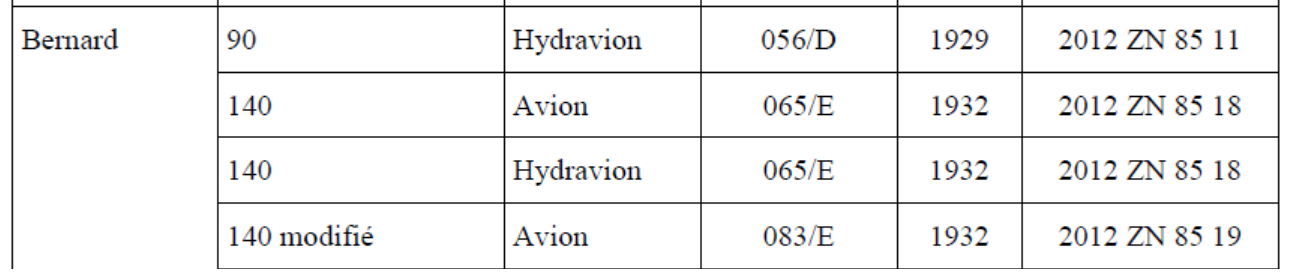
That said, I think we need to be very careful about using short forms that resemble official designations - eg: '90H', '140Mod', '340H', etc. The ONERA (L'Office National d'Etudes et de Recherches Aéronautiques) pdf ONERA: Essais en Soufflerie lists the designation the type numbers 90, 140, and 340 with 'Hydravion' solely as their description. (ONERA also lists the type 140 and 340 as 'Avion' but we feel no compulsion to create a '140A' or '340A' designation.)

Where Bernard applied 'H' for hydravion, it seems always to be as a prefix (eg: the H.50 listed by ONERA, the H.52 float-fighter, or HV.100 - for Hydravion de Vitesse - flying boat racer). So, it possible that a built Bernard 90 may well have been designated 'H.90' ... but we have no evidence for that. Ditto for the '140H' and.

There are similar issues with '140Mod'. ONERA lists "140 modifié", obviously refering to a variant of the original 140 landplane (or its wind tunnel model). When existing Bernard types were given minor modifications, they seem always to take on a new role designator suffix - eg: Bernard 18 T modified for distance flying becomes the 18 GR (Grand Raid). More serious modification of the Bernard 18 T were first indicated by bis ('again') as in 18 T bis or re-designated (as, in this case, the Bernard 190 T).

340H maybe a seaplane version of Type-340 BN.5,Project of 1933 ?

Same issue, the 1933 340 BN 5 was likely a derivative of that 1929 340 hydravion. Oh, and the undated four-engined seaplane is listed as Quadrimoteur, not 'Four-Eng'.

There are also some glitches in the ONERA listings. The V 3, HV 40, and HV 41 - all wind tunnel tested in 1929 - show up with numeral prefixes '9' or '12'. Other than that '9' or '12', there is no change in the listings. Under the '9' prefix, the V 3 bis also shows up (a variant which is not on c460's designation list). There is also a glitch in the C1 chasseurs monoplaces suffix listings where the '1' is displayed as a superscript ... Okay, pedant-mode off ;)

Another designation of interest in the ONERA listings is the Bernard 15 C1 hydravion wind tunnel tested in 1929. Presumably, Bernard was considering a float fighter derivative ... but why three years after the SIMB AB 15 prototype had flown?

Undesignated in the ONERA listing is the twin-engined Bernard-Ferbois hydravion wind tunnel tested in 1926. I presume that this would be a float version of the "Bernard-Ferbois V 2 racer? (I rule out a V 3 derivative only because that design was wind tunnel tested in 1929.)
 
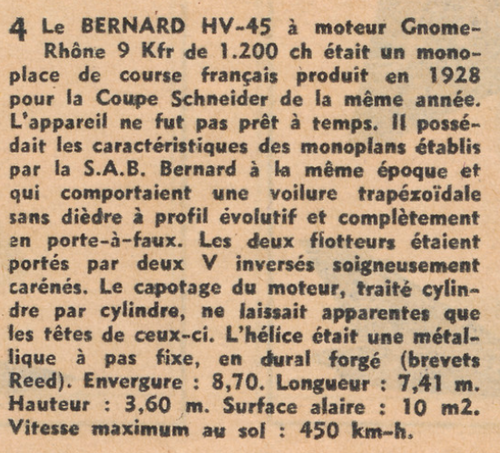
From Aviation magazine 1957,

I found this strange designation,HV.45,also in Avions magazine,they mentioned the same thing ?.
 

Attachments

  • 45.png
    45.png
    635.4 KB · Views: 71
From Aviation magazine 1960,

here is the list,and we can add AB.13T & HV.47.
 

Attachments

  • Aviation_magazine___président-directeur_général_[...]_bpt6k53234292_26.jpeg
    Aviation_magazine___président-directeur_général_[...]_bpt6k53234292_26.jpeg
    1.7 MB · Views: 57
I think we have already shown that HV47 is a mistake, a misreading of HV41.
 
From Aviation magazine 1960,

So weird,

in this list,Bernard Type-60 was developed at first as single engined
transport airplane,later improved into three engined.

Also Type-260 at first was powered by one 500 hp Hispano-Suiza 12
Xbrs engine and had a rounded wing tips, later developed with 690 hp
Hispano-Suiza 12 Xbrs engine and square wing with front radiator.
 
Last edited:
From Onera archive,

I think both of those airplanes are the same (four engined),but one was a seaplane and the other was a landplane,please see wing tunnel number ?,
and definitely they were from 1923/24.
 

Attachments

  • 1.png
    1.png
    12.2 KB · Views: 44
From Onera archive,

I think both of those airplanes are the same (four engined),but one was a seaplane and the other was a landplane,please see wing tunnel number ?,
and definitely they were from 1923/24.

Sorry, I'm having trouble following some your reasoning here.

"I think both of those airplanes are the same (four engined) ..."

Can we accurately draw that conclusion solely from these two wind tunnel models being included in N° rapport 180/A? Related airframe shapes makes sense but plenty of related models are tested with differing numbers of nacelles (or even interchangeable model parts). Or have I missed something here?

"please see wing tunnel number ?,"

Yes, all three models in your clipping shown testing in 2012 ZN 85 1 - soufflerie n°1 (aka S1) at the Institut Aérotechnique (IAT) at Saint-Cyr. But so too were more than 60 other entries in that ONERA list.

"and definitely they were from 1923/24."

I assume that your certainty about dates is based on rapport 140/A being from 1923 while rapport 188/A was from 1924? That makes sense. So why does ONERA's 'Date' column lists "s.d." (sans date)?

If report numbering was sequential, the date would clearly be 1924 - witness rapports 173/A, 177/A, 182/A, and 188/A - all tested in 2012 ZN 85 1 during 1924. Those report numbers bracket 180/A. But ONERA doesn't draw this seemingly obvious conclusion in Série 5 F 9. Perhaps they just missed the connections?
 
Also from Onera Archive,

90H was a seaplane of flying boat Project of 1929,maybe developed from Type-90 ?
140,140H & 140Mod was a three airplanes,a landplane and a seaplane
also there was a modified version Projects from 1932 ?
340H maybe a seaplane version of Type-340 BN.5,Project of 1933 ?
50 or H-50 maybe proceeded H-52,was a single seat seaplane fighter
Project of 1932 ?
Four-Eng was a four engined seaplane or flying boat Project ?

https://docplayer.fr/62076991-Onera-archives-des-essais-en-soufflerie.html
 

Attachments

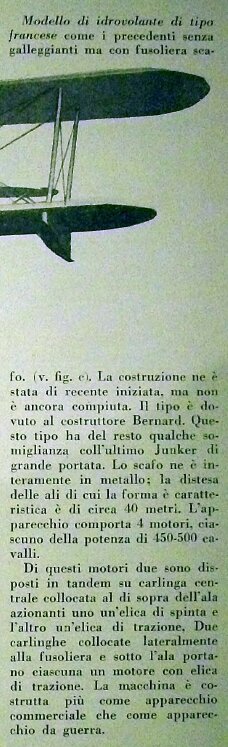
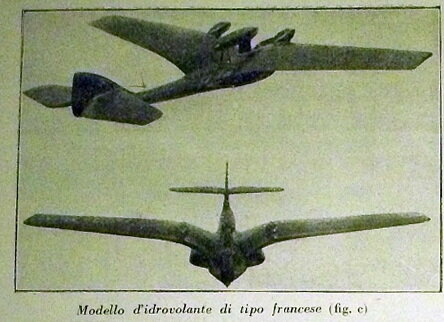
  • 1928 L'Ala D'Italia-20210618-007.jpg
    1928 L'Ala D'Italia-20210618-007.jpg
    184.7 KB · Views: 31
  • 1928 L'Ala D'Italia-20210618-008.jpg
    1928 L'Ala D'Italia-20210618-008.jpg
    62.3 KB · Views: 42
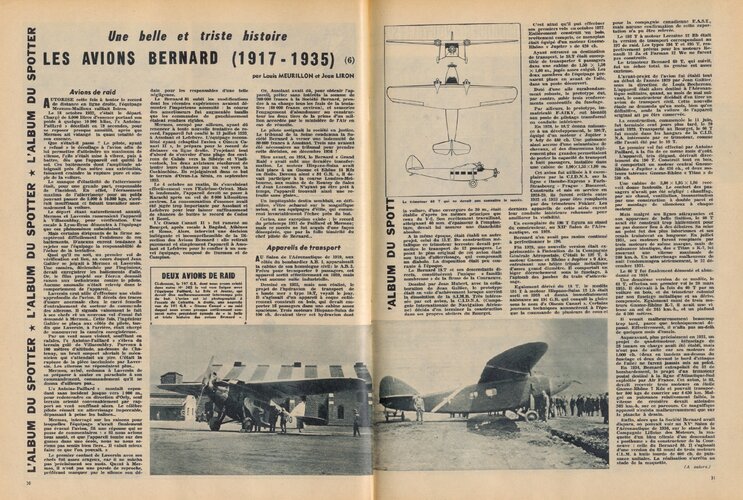
1960 Aviation Magazine articles
 

Attachments

  • 1960 Aviation Magazine 20200408-011.jpg
    1960 Aviation Magazine 20200408-011.jpg
    4.1 MB · Views: 43
  • 1960 Aviation Magazine 20200408-012.jpg
    1960 Aviation Magazine 20200408-012.jpg
    2.1 MB · Views: 37
  • 1960 Aviation Magazine 20200408-013.jpg
    1960 Aviation Magazine 20200408-013.jpg
    4.3 MB · Views: 42
  • 1960 Aviation Magazine 20200408-014.jpg
    1960 Aviation Magazine 20200408-014.jpg
    2.1 MB · Views: 38
  • 1960 Aviation Magazine 20200408-015.jpg
    1960 Aviation Magazine 20200408-015.jpg
    2 MB · Views: 45
  • 1960 Aviation Magazine 20200408-016.jpg
    1960 Aviation Magazine 20200408-016.jpg
    2.2 MB · Views: 39
  • 1960 Aviation Magazine 20200408-017.jpg
    1960 Aviation Magazine 20200408-017.jpg
    4.1 MB · Views: 35
  • 1960 Aviation Magazine 20200408-010.jpg
    1960 Aviation Magazine 20200408-010.jpg
    4.2 MB · Views: 47
  • 1960 Aviation Magazine 20200408-009.jpg
    1960 Aviation Magazine 20200408-009.jpg
    2.2 MB · Views: 34
  • 1960 Aviation Magazine 20200408-008.jpg
    1960 Aviation Magazine 20200408-008.jpg
    2.2 MB · Views: 33
  • 1960 Aviation Magazine 20200408-001.jpg
    1960 Aviation Magazine 20200408-001.jpg
    4.7 MB · Views: 44
  • 1960 Aviation Magazine 20200408-002.jpg
    1960 Aviation Magazine 20200408-002.jpg
    2.1 MB · Views: 36
  • 1960 Aviation Magazine 20200408-003.jpg
    1960 Aviation Magazine 20200408-003.jpg
    2.3 MB · Views: 36
  • 1960 Aviation Magazine 20200408-004.jpg
    1960 Aviation Magazine 20200408-004.jpg
    2.1 MB · Views: 36
  • 1960 Aviation Magazine 20200408-005.jpg
    1960 Aviation Magazine 20200408-005.jpg
    2.2 MB · Views: 33
  • 1960 Aviation Magazine 20200408-006.jpg
    1960 Aviation Magazine 20200408-006.jpg
    2.2 MB · Views: 30
  • 1960 Aviation Magazine 20200408-007.jpg
    1960 Aviation Magazine 20200408-007.jpg
    2.2 MB · Views: 31
Thanks for those very interesting scans, Bazinga.

Surprising name for Bernard 82, "bombardier de représailles" sounds like a forerunner of the infamous Vergeltungswaffe. Vergeltungsbombenflugzeug ?
 
From George Messier's site,

Three Engines was a three engined airplane project of 1928/29,may it was
a transport,Model-130 ?.
 
Last edited:
From George Messier's site,

Three Engines was a three engined airplane project of 1928/29,may it was
a transport,Model-130 ?.

From Onera and other sources,

Twin Engined it was a twin engined aircraft project of 1923,may a cargo version of AB.1,could
be AB.5 ?

Three Engined
it was a three engined landplane of 1923/24,there is no definition of its function,could
be AB.6 ?
 
From Onera and other sources,

Twin Engined it was a twin engined aircraft project of 1923,may a cargo version of AB.1,could
be AB.5 ?

Three Engined
it was a three engined landplane of 1923/24,there is no definition of its function,could
be AB.6 ?

To complete this unknown series,

Four Engined it was a four engined aircraft of 1924,could be AB.7 ?

Four Engined Seaplane
it was a four engined sealane version of above of 1924,could
be AB.8 ?
 
With all respect to C460 (Adrien) and Stargazer,I want to make exculsive
list for all of his aircraft,please note that,there are many unknown concepts,
which mentioned in reliable sources,such as,Docavia,Onera archive,George
Messier,Aviation magazine and some of Italian magazines,but I only put
my speculations about their designations,but they are really existed.


AB.1 Biplane bomber, two Hispano 180 hp engines. One prototype and ten series production aircraft.
AB.2 Variant of the AB.1 with two Hispano 200 hp engines. Project only.
AB.3 Mail transport derivative of the AB.1, two Hispano 180 hp engines. Not sure if built.
AB.3 M Large twin boom monoplane bomber with three Hispano 12 G engines, two tractor and one pusher. One example started but unfinished.
AB.3 T Civilian transport derivative of the AB.3 M, with three tractor engines. Project only.
AB.4 Passenger transport variant of the AB.3, two Hispano 200 hp. One example partly built.
Twin Engined it was a twin engined aircraft project of 1923,may a cargo version of AB.1,could be AB.5 ?
Three Engined
it was a three engined landplane of 1923/24,there is no definition of its function,could be AB.6 ?
Four Engined
it was a four engined aircraft of 1924,could be AB.7 ?
Four Engined Seaplane
it was a four engined seaplane version of above of 1924,could be AB.8 ?
AB C1
Single-seat low-wing monoplane fighter, Hispano 300 hp engine. One example built, became the AB.10,may
be earlier known as AB.9 ?.
AB.10 C1 One example, converted from the AB C1 with larger wings and fin.
AB.10 T Three-engine monoplane flying boat for commercial transport, Lorraine 320 hp tractor engines. Construction unfinished.
Flying Boat was a four engined flying boat project,could be AB.11 ?
AB.12 C1
Derivative of the AB.10 C1 with GR Jupiter 420 hp engine. One example built.
AB.13T was a three engined,14 passenger transport project of 1926,had a cantilever wing and all metal construction,powered by three Hispano-Suiza engines
AB.14 C1 Single-seat sesquiplane fighter, Hispano 12 Hb 500 hp engine. One example built.
AB.15 C1 Derivative of the AB.14 with smaller wings, same engine. One example built.
AB.16 Colonial aircraft, three Salmson 9 Abd engines. Unsure if built.
Twin Engined was a two-engines monoplane transport for 12 passengers, with Hispano 350 hp. Project only,may be AB.17 ?.
Type-18 T High-wing cantilever transport aircraft, one GR 9 Ab engine. The first example was exclusively used as a long-distance aircraft, named "Oiseau Tango" then "Ingénieur Hubert". The second example was used for static testing.
Type-18 T bis Projected evolution of the 18 T, became the 190.
Type-18 GR Semi-official name for the 18 T modified as a long-distance aircraft (GR = Grand Raid).
Type-181 GR Long-distance aircraft, derivative of the 18 T with Hispano 500 hp engine. Project only.
Type-190 T Transport aircraft, enlarged derivative of the 18 T, GR 9Ady 420 hp engine. Eight built.
Type-191 T Variant of the 190 T with Hispano 12 Ga. One example started, finished as the 191 GR no.3.
Type-191 GR Long-distance aircraft, derivative of the 190 T, Hispano 12 Lb 600 hp engine. Three examples built, no.1 "France", no.2 "Oiseau Canari" that crossed the Atlantic, no.3 was the converted 191 T.
Type-192 T Variant of the 190 T with GR 9 Akx 480 hp.
Type-193 T Variant of the 190 T with Lorraine 12 Eb 450 hp.
Type-194 T Variant of the 190 T with Renault 12 Ja 450 hp.
Type-195 T Variant of the 190 T with Farman 12 We 500 hp.
Type-197 GR Long-distance aircraft, similar to the 191 GR with Lorraine 12 Eb 450 hp engine. One examples built, no.1 "France-Indochine".
Type-20 C1 Single-seat mid-wing monoplane fighter, Hispano 12 Jb 400 hp engine. One example built.
Type-30 T Twin-boom four-engine transport aircraft, four Hispano 18 Sb 1000 hp. Project only.
HV.40 High-speed single-seat seaplane, GR 9K Mistral. One built in 1929 as a trainer for the Schneider team.
HV.41 Evolution of the HV.40 with Hispano 12-cylinder engine. One built in 1929 as a trainer for the Schneider team.
HV.42 Evolution of the HV.41. Three built in 1929 as a trainer for the Schneider team.
H.50 may it was earlier single seat seaplane fighter project,led to develop H.52
H.52 Single-seat floatplane fighter, GR 9 Kdrs engine. Two examples built.
Type-60 Earlier was developed at first as three engined,powered by one 420 hp GR 9 Ady,plus two 240 hp GR 5 Kd engines,developed from AB.16.
Type-60 T Three-engine high-wing transport aircraft, with one GR Jupiter and two GR Titan. One example built, engines later replaced by three GR Titan Major.
Type-61 T Evolution of the 60 T with metal fuselage, three GR 7 Kb. One example built.
Type-70 Single-seat monoplane fighter, GR 5 Bc 240 hp engine. Nicknamed "Super Jockey". Two examples were ordered, one was used for structural tests, the other was completed as the S.72.
Type-71 Variant of the 70 with GR 5 Kb supercharged engine. Project only.
Type-S.72 Single-seat sports aircraft for racing and aerobatics, GR Titan engine, 1930. One built, conversion of the 70 C1.
Type-S.73 Sports aircraft for racing and aerobatics, conversion of the S.72 with GR 7Kb engine, 1931.
Type-74 C1 Fighter derivative of the S.73, with GR 7 Kbs 360 hp engine. Two examples built.
Type-74 S Aerobatics aircraft, conversion of the second 74 C1, with GR 7 Kc.
Type-75 C1 Single-seat fighter, conversion of the first 74 C1, with GR 9 Kbrs.
Type-80 GR Long-distance mid-wing monoplane, Hispano 12 Nb 650 hp. One example built, named "Oiseau Tango".
Type-81 GR Improved version of the 80 GR, Hispano 12 Nbr 650 hp. One example converted from the 80 GR, named "Antoine Paillard" then "Oiseau Canari II".
Type-81 Bn3 Bomber variant of the 81 GR, unconfirmed project.
Type-82 B3 Bomber derivative of the 81 GR, Hispano 12 Y 860 hp engine. Two examples built, no.02 was converted into the 86.
Type-82 Jumo Other name for the 82 no.02 converted with Jumo engine, see 86.
Type-83 Three-engine mail transport derivative of the 82 B3, three GR 7 Kds 360 hp. Project only.
Type-84 GR Version of the 81 GR with Gnome-Rhône 14 Kfs 900 hp radial engine. Conversion of the 81 GR was announced but perhaps not completed.
Type-85 Unconfirmed name for a two-engine bomber derivative of the 82.
Type-86 Experimental long-distance aircraft with Diesel engine. One example, converted from the 82 B3 no.02 by the engine company CLM. First had a Jumo 205 535 hp, then a CLM 6 As 560 hp.
Type-87 ? was unknown,but it could be a bomber project also.
Type-88 Derivative of the 83 with three Diesel engines CLM 6 As 560 hp. Project by CLM studied after Bernard's demise.
H.90 may it was a seaplane bomber project of 1929,led to develop Type-90 ?
Type-90 BR Two-engine monoplane bomber, two GR 14 Kfs 900 hp.
HV.100 Flying boat racer for the Schneider Trophy, with two push-pull Farman 18 T engines. Project only. (Name HV.100 mentioned in Trait d'Union no.205.)
H.110 Single-seat floatplane fighter, evolved from the H.52, Hispano 9 Vbs engine. One example built.
HV.120 Seaplane racer, HS 18 R. Two built in 1929 for the Schneider Trophy.
HV.120-1 Name sometimes used for the second HV.120 with gear-reduced engine.
Three Engine was a three engined airplane project of 1928/29, Type-130 ?.
H.140 was a seaplane project
Type-140 & 140Mod may it was a landplane project version of H.140, and its modified variant.
Twin Engined was a single seat twin engined reconnaissance fighter project,Type-150 ?.
Type-160 High-wing colonial aircraft with three GR 7 Kb, evolved from the 60 T. One built, flew in 1932.
Type-161 Version of the 160 with three Lorraine 9 Na. One built, flew in 1932.
Type-170 V Lightweight racer project, 1930.
Type-170 Designation re-used in 1935 for a two-engine rapid bomber, project only.
Type-200 T High-wing tourism aircraft, DH Gipsy III 120 hp engine. Four examples started, converted into 201 T, 205 T or 207 T.
Type-200 TS Variant of the 200 T with leading edge slats. Project only.
Type-201 T Variant of the 200 T with DH Gipsy Major I 135 hp engine. Two examples, converted from 200 T no.1 and 4.
Type-202 T Variant of the 200 T with Chaise 4 A 100 hp engine, not built.
Type-203 T Variant of the 200 T with Chaise 4 B 120 hp engine, not built.
Type-204 T Variant of the 200 T with Renault 4 Pdi 120 hp engine, not built.
Type-205 T Variant of the 201 T with the same engine and a three-blade propeller. One example, converted from 201 T no.1.
Type-206 T Unknown, speculated by Jean Liron as a floatplane or radial engine variant.
Type-207 T Variant of the 201 T with reinforced wing. Two examples, converted from 200 T no.2 and 3.
Type-210 T Planned version of the 207 T license built in Britain, project only.
HV.220 Seaplane racer with Lorraine 12 Rcr Radium engine, for the 1931 Schneider Cup. Airframe was finished and assembled but the engine was never delivered.
Type-260 Earlier at first was powered by one 500 hp Hispano-Suiza 12
Xbrs engine and had a rounded wing tips, later developed with 690 hp
Hispano-Suiza 12 Xbrs engine and square wing with front radiator.
Type-260 C1 Single-seat low-wing monoplane fighter, HS 12 Xbrs engine. One example built.
Type-261 C1 Derivative of the 260 with HS 12 Ybrs and retractable gear. One example started but unfinished.
Type-262 C1 Carrier-borne fighter, derivative of the 260 with GR 9 Kdrs. Project only.
Type-290 T All-metal derivative of the 190 T, project only.
HV.300 Seaplane racer for the Schneider Trophy, with two tandem Hispano 18 Sb engines inside the fuselage hull.
Racer was seaplane racer of 1930,powered by two 1500 hp Fiat 18T engines,could
be HV.310 ?
HV.320
Seaplane racer with Renault 12 Ncr engine, for the 1931 Schneider Cup. Construction started but not finished, engine not available.
Racer/II was a single seat mid-wing seaplane racer project of 1933,intended for
Schneider Trophy,could be HV.330 ?.
H.340 Bn5 Four-engine bomber and torpedo floatplane, two fins, four GR engines. Project only.
Type-340 was a landplane version of H.340,project of 1933
Racer/III was another single seat racer and experimental landplane project,
could be Type-350 ?
Type-370
Racer for the 1934 Coupe Deutsch, Salmson 12-cylinder engine. Project only, one mock-up built.
Type-500 T Derivative of the 200 T with more classical landing gear legs. Project only.

- To be continued

 
Last edited:
I complete it,any corrections or additions are welcome.
 
My dear Apophenia,

you are right about HV.120-1,it's HV.120-2,but what do you mean by 140mod
was not a designation ?.
 

Attachments

  • 1.png
    1.png
    75.3 KB · Views: 22
Just as I said. The ONERA entry '140 modifié' is a description rather than a designation. The fact that this form is not reflected by any of the other Bernard designations in your listing helps to confirm this.

Going back to ONERA's listing of Bernard aircraft, we have a [Type] 140 listed as a Hydravion and a 140 modifié given as a plain Avion. From that, you have inferred three separate variants:

- 1: "H.140 was a seaplane project";
- 2: "Type-140 ... a landplane project version of H.140"; and
- 3: [Type] "140Mod" a "modified variant" of that landplane derivative

There is a simpler interpretation available to us. As the ONERA listing suggests, the Type 140 was the hydravion. In other words, the Type 140, given a class designation prefix, is the same thing as the H 140. And then, this Type 140 concept was modified in some unspecified way. Thus, we have:

- 1: Type 140: (Project) aka H 140; seaplane (probably a floatplane); and
- 2: Type 140: (Project) modified H 140 concept; perhaps as a landplane

So, again, what I am asking is: Do you have any contemporary evidence to confirm the existence of a Bernard design 'Type-140Mod'?

Please look to the wind tunnel model's number,they are different ?.
 
With all respect to C460 (Adrien) and Stargazer,I want to make exculsive
list for all of his aircraft,please note that,there are many unknown concepts,
which mentioned in reliable sources,such as,Docavia,Onera archive,George
Messier,Aviation magazine and some of Italian magazines,but I only put
my speculations about their designations,but they are really existed.


AB.1 Biplane bomber, two Hispano 180 hp engines. One prototype and ten series production aircraft.
AB.2 Variant of the AB.1 with two Hispano 200 hp engines. Project only.
AB.3 Mail transport derivative of the AB.1, two Hispano 180 hp engines. Not sure if built.
AB.3 M Large twin boom monoplane bomber with three Hispano 12 G engines, two tractor and one pusher. One example started but unfinished.
AB.3 T Civilian transport derivative of the AB.3 M, with three tractor engines. Project only.
AB.4 Passenger transport variant of the AB.3, two Hispano 200 hp. One example partly built.
Twin Engined it was a twin engined aircraft project of 1923,may a cargo version of AB.1,could be AB.5 ?
Three Engined
it was a three engined landplane of 1923/24,there is no definition of its function,could be AB.6 ?
Four Engined
it was a four engined aircraft of 1924,could be AB.7 ?
Four Engined Seaplane
it was a four engined seaplane version of above of 1924,could be AB.8 ?
AB C1
Single-seat low-wing monoplane fighter, Hispano 300 hp engine. One example built, became the AB.10,may be earlier known as AB.9 ?.
AB.10 C1 One example, converted from the AB C1 with larger wings and fin.
AB.10 T Three-engine monoplane flying boat for commercial transport, Lorraine 320 hp tractor engines. Construction unfinished.
Flying Boat was a four engined flying boat project,could be AB.11 ?
AB.12 C1
Derivative of the AB.10 C1 with GR Jupiter 420 hp engine. One example built.
AB.13T was a three engined,14 passenger transport project of 1926,had a cantilever wing and all metal construction,powered by three Hispano-Suiza engines
AB.14 C1 Single-seat sesquiplane fighter, Hispano 12 Hb 500 hp engine. One example built.
AB.15 C1 Derivative of the AB.14 with smaller wings, same engine. One example built.
AB.16 Colonial aircraft, three Salmson 9 Abd engines. Unsure if built.
Twin Engined was a two-engines monoplane transport for 12 passengers, with Hispano 350 hp. Project only,may be AB.17 ?.
Type-18 T High-wing cantilever transport aircraft, one GR 9 Ab engine. The first example was exclusively used as a long-distance aircraft, named "Oiseau Tango" then "Ingénieur Hubert". The second example was used for static testing.
Type-18 T bis Projected evolution of the 18 T, became the 190.
Type-18 GR Semi-official name for the 18 T modified as a long-distance aircraft (GR = Grand Raid).
Type-181 GR Long-distance aircraft, derivative of the 18 T with Hispano 500 hp engine. Project only.
Type-190 T Transport aircraft, enlarged derivative of the 18 T, GR 9Ady 420 hp engine. Eight built.
Type-191 T Variant of the 190 T with Hispano 12 Ga. One example started, finished as the 191 GR no.3.
Type-191 GR Long-distance aircraft, derivative of the 190 T, Hispano 12 Lb 600 hp engine. Three examples built, no.1 "France", no.2 "Oiseau Canari" that crossed the Atlantic, no.3 was the converted 191 T.
Type-192 T Variant of the 190 T with GR 9 Akx 480 hp.
Type-193 T Variant of the 190 T with Lorraine 12 Eb 450 hp.
Type-194 T Variant of the 190 T with Renault 12 Ja 450 hp.
Type-195 T Variant of the 190 T with Farman 12 We 500 hp.
Type-197 GR Long-distance aircraft, similar to the 191 GR with Lorraine 12 Eb 450 hp engine. One examples built, no.1 "France-Indochine".
Type-20 C1 Single-seat mid-wing monoplane fighter, Hispano 12 Jb 400 hp engine. One example built.
Type-30 T Twin-boom four-engine transport aircraft, four Hispano 18 Sb 1000 hp. Project only.
HV.40 High-speed single-seat seaplane, GR 9K Mistral. One built in 1929 as a trainer for the Schneider team.
HV.41 Evolution of the HV.40 with Hispano 12-cylinder engine. One built in 1929 as a trainer for the Schneider team.
HV.42 Evolution of the HV.41. Three built in 1929 as a trainer for the Schneider team.
H.50 may it was earlier single seat seaplane fighter project,led to develop H.52
H.52 Single-seat floatplane fighter, GR 9 Kdrs engine. Two examples built.
Type-60 Earlier was developed at first as three engined,powered by one 420 hp GR 9 Ady,plus two 240 hp GR 5 Kd engines,developed from AB.16.
Type-60 T Three-engine high-wing transport aircraft, with one GR Jupiter and two GR Titan. One example built, engines later replaced by three GR Titan Major.
Type-61 T Evolution of the 60 T with metal fuselage, three GR 7 Kb. One example built.
Type-70 Single-seat monoplane fighter, GR 5 Bc 240 hp engine. Nicknamed "Super Jockey". Two examples were ordered, one was used for structural tests, the other was completed as the S.72.
Type-71 Variant of the 70 with GR 5 Kb supercharged engine. Project only.
Type-S.72 Single-seat sports aircraft for racing and aerobatics, GR Titan engine, 1930. One built, conversion of the 70 C1.
Type-S.73 Sports aircraft for racing and aerobatics, conversion of the S.72 with GR 7Kb engine, 1931.
Type-74 C1 Fighter derivative of the S.73, with GR 7 Kbs 360 hp engine. Two examples built.
Type-74 S Aerobatics aircraft, conversion of the second 74 C1, with GR 7 Kc.
Type-75 C1 Single-seat fighter, conversion of the first 74 C1, with GR 9 Kbrs.
Type-80 GR Long-distance mid-wing monoplane, Hispano 12 Nb 650 hp. One example built, named "Oiseau Tango".
Type-81 GR Improved version of the 80 GR, Hispano 12 Nbr 650 hp. One example converted from the 80 GR, named "Antoine Paillard" then "Oiseau Canari II".
Type-81 Bn3 Bomber variant of the 81 GR, unconfirmed project.
Type-82 B3 Bomber derivative of the 81 GR, Hispano 12 Y 860 hp engine. Two examples built, no.02 was converted into the 86.
Type-82 Jumo Other name for the 82 no.02 converted with Jumo engine, see 86.
Type-83 Three-engine mail transport derivative of the 82 B3, three GR 7 Kds 360 hp. Project only.
Type-84 GR Version of the 81 GR with Gnome-Rhône 14 Kfs 900 hp radial engine. Conversion of the 81 GR was announced but perhaps not completed.
Type-85 Unconfirmed name for a two-engine bomber derivative of the 82.
Type-86 Experimental long-distance aircraft with Diesel engine. One example, converted from the 82 B3 no.02 by the engine company CLM. First had a Jumo 205 535 hp, then a CLM 6 As 560 hp.
Type-87 ? was unknown,but it could be a bomber project also.
Type-88 Derivative of the 83 with three Diesel engines CLM 6 As 560 hp. Project by CLM studied after Bernard's demise.
H.90 may it was a seaplane bomber project of 1929,led to develop Type-90 ?
Type-90 BR Two-engine monoplane bomber, two GR 14 Kfs 900 hp.
HV.100 Flying boat racer for the Schneider Trophy, with two push-pull Farman 18 T engines. Project only. (Name HV.100 mentioned in Trait d'Union no.205.)
H.110 Single-seat floatplane fighter, evolved from the H.52, Hispano 9 Vbs engine. One example built.
HV.120 Seaplane racer, HS 18 R. Two built in 1929 for the Schneider Trophy.
HV.120-1 Name sometimes used for the second HV.120 with gear-reduced engine.
Three Engine was a three engined airplane project of 1928/29, Type-130 ?.
H.140 was a seaplane project
Type-140 & 140Mod may it was a landplane project version of H.140, and its modified variant.
Twin Engined was a single seat twin engined reconnaissance fighter project,Type-150 ?.
Type-160 High-wing colonial aircraft with three GR 7 Kb, evolved from the 60 T. One built, flew in 1932.
Type-161 Version of the 160 with three Lorraine 9 Na. One built, flew in 1932.
Type-170 V Lightweight racer project, 1930.
Type-170 Designation re-used in 1935 for a two-engine rapid bomber, project only.
Type-200 T High-wing tourism aircraft, DH Gipsy III 120 hp engine. Four examples started, converted into 201 T, 205 T or 207 T.
Type-200 TS Variant of the 200 T with leading edge slats. Project only.
Type-201 T Variant of the 200 T with DH Gipsy Major I 135 hp engine. Two examples, converted from 200 T no.1 and 4.
Type-202 T Variant of the 200 T with Chaise 4 A 100 hp engine, not built.
Type-203 T Variant of the 200 T with Chaise 4 B 120 hp engine, not built.
Type-204 T Variant of the 200 T with Renault 4 Pdi 120 hp engine, not built.
Type-205 T Variant of the 201 T with the same engine and a three-blade propeller. One example, converted from 201 T no.1.
Type-206 T Unknown, speculated by Jean Liron as a floatplane or radial engine variant.
Type-207 T Variant of the 201 T with reinforced wing. Two examples, converted from 200 T no.2 and 3.
Type-210 T Planned version of the 207 T license built in Britain, project only.
HV.220 Seaplane racer with Lorraine 12 Rcr Radium engine, for the 1931 Schneider Cup. Airframe was finished and assembled but the engine was never delivered.
Type-260 Earlier at first was powered by one 500 hp Hispano-Suiza 12
Xbrs engine and had a rounded wing tips, later developed with 690 hp
Hispano-Suiza 12 Xbrs engine and square wing with front radiator.
Type-260 C1 Single-seat low-wing monoplane fighter, HS 12 Xbrs engine. One example built.
Type-261 C1 Derivative of the 260 with HS 12 Ybrs and retractable gear. One example started but unfinished.
Type-262 C1 Carrier-borne fighter, derivative of the 260 with GR 9 Kdrs. Project only.
Type-290 T All-metal derivative of the 190 T, project only.
HV.300 Seaplane racer for the Schneider Trophy, with two tandem Hispano 18 Sb engines inside the fuselage hull.
Racer was seaplane racer of 1930,powered by two 1500 hp Fiat 18T engines,could
be HV.310 ?
HV.320
Seaplane racer with Renault 12 Ncr engine, for the 1931 Schneider Cup. Construction started but not finished, engine not available.
Racer/II was a single seat mid-wing seaplane racer project of 1933,intended for
Schneider Trophy,could be HV.330 ?.
H.340 Bn5 Four-engine bomber and torpedo floatplane, two fins, four GR engines. Project only.
Type-340 was a landplane version of H.340,project of 1933
Racer/III was another single seat racer and experimental landplane project,
could be Type-350 ?
Type-370
Racer for the 1934 Coupe Deutsch, Salmson 12-cylinder engine. Project only, one mock-up built.
Type-500 T Derivative of the 200 T with more classical landing gear legs. Project only.

- To be continued

Again and again,please don't be worried or upset from the unknown aircraft
in the list,all of them are from a reliable sources as I mentioned before,but I
only added the speculations of their designations.no more.
 
I have finally taken the type to properly organize my Bernard models list and to go to the source of each designation so as to verify as much as I could from period publications. Everything is in the Excel file below (I have chosen to share my lists in that manner from now on, because it's simpler to update them (you simply replace the file) and it also prevents possible mistakes to find their way in search engine results.

Here are my conclusions regarding a few controversial questions (you don't have to agree of course), and a few reflections/hypotheses:
  • The A.B. list started at A.B. 1 (Type 1) under Établissements Adolphe Bernard in 1918 and continued all the way up to 370 (Type 37) in more or less chronological order. One additional designation, 500 T, was just given out of sequence and does not imply the existence of any designations between 380 and 490.

  • Types A.B.-1 to -4 applied to Établissements Adolphe Bernard types.
    Types A.B.-5 to -18 applied to Société industrielle des métaux et du bois (SIMB, a.k.a. "Ferbois") types.
    Types 18 (181) to 370 applied to Société des Avions Bernard (SAB) types.
    One additional aircraft is associated with Bernard, the Chantiers de Provence C.P.A.-1 (which NASM has as "CPA-1M"—the suffix "M" probably being for "military" rather than "multiplace" since it was only a two-seater).

  • Although the precise allocation of A.B. 5 to 9 is not clearly stated, we find exactly five types between A.B 4 and A.B. 10:
    - the so-called A.B. C1
    - the A.B. 3M and 3T projects
    - the V-1
    - the V-2
    - the V-3
    It seems quite obvious to me that the 3M/3T projects had nothing to do with the earlier A.B.3 and could not therefore carry the Type 3 number. As a matter of fact, 3M probably just meant "trimotor, multiplace", while 3T indicated "3 tractor engines", as opposed to the 2 tractors/1 pusher configuration of the 3M. Besides, 3M and 3T they never show up hyphenated.
    And so, we have five slots which COULD be broken down as Types A.B. 5 to A.B. 9, although we have little to back it up.
    There is of course the cryptic ONERA entries "9 V-3" and "9 V-3 bis" which could confirm the V-3 as A.B. 9... except the list also has "12 V-3", invalidating the whole thing. My hunch is that the numbers "9" and "12" before designations V-3, HV 40 and HV 41 probably indicated different engine configurations with either 9- or 12-cylinder engines.

  • A.B. 10 is a little tricky, because we find both A.B-10 C1, which was the former A.B. C1 reworked, and A.B. 10T, a totally distinct and huge flying boat project. So which was the actual Type 10? Since the former is from 1924 and the latter from 1925, I'm tempted to keep the first one, and assign the second one to the missing "A.B.-11"... My reasoning is that "10T", like 3T before it, might refer to something else... The "T" could mean "tractor", or more likely "trimotor", but it could also be the weight (10 tons?) One thing is for sure: both types could not be A.B.10, unless the designation was reused of course, which remains a possibility.

  • Besides Type 11, Types 13 and 17 are also not clearly established. However, the Type 13 was described in Les Ailes as a landplane trimotor passenger transport project (see clipping shared by hesham earlier in the thread), from which we can infer that the undesignated all-metal transport project was most likely the Type 17. Type 18 was started under SIMB, but I've chosen to place it under SAB as it had its career during the SAB years.

  • Type 19 (190) was planned from the very start with seven possible engines (Hispano, Gnome-Rhône, Lorraine, Renault, Farman, Liberty and Pratt & Whitney), and designations 191 up allocated. That explains why the 197 GR got such a high number before the 192 T and 193 T were even flown. Although the exact allocation of "196" is not known, we can assume it was reserved for either the Liberty or P&W version, cancelled at an early stage.

  • Types 45 and 47 never existed! The articles that mention them fail to show photo of the aircraft's tails that would validate those designations, and given that both are said to have been 1928 types, it seems obvious that "45" was just Type 40 while "47" was just Type 41—the latter typo being easily-made since the French "1", when in italics, could almost pass off as a seven.

  • Producing the Type 50 as "H 52 C1" implies that two earlier designs were considered. And indeed, the ONERA list mentions an H 50 C1 seaplane. We can therefore imagine that an H 51 C1 version was also studied in-between, although no source mentions any such designation.

  • The Type 80 series consisted of several built and unbuilt versions: 80 GR, 81 GR, 81 Bn3, 82 B3, 83 P3, 84 Cr2, 86 and 88. Two numbers remain undocumented: Jean Liron suggested that Type 85 may be a twin-engined bomber project, but Type 87 definitely remains something of a mystery.

  • The Type designation "90" was allocated twice: first to an unspecified seaplane tested at ONERA in 1929 (probably H 90 for Bernard) and a much later 1934 "Retaliation Bomber" derived from Type 82 B3 and studied in two different versions.

  • It is not clear why the very last Bernard airplane, derived from the H 52 C1, was designated H 110 C1. I can see two possible explanations: either the number had not been used before, or the project existed long before F.B.A. actually built the aircraft.

  • If it weren't for ONERA, we wouldn't know about Type 140. Their records show that no less that three versions were tested in 1932: 140, modified 140 and 140 seaplane (probably H 140 for Bernard).

  • The Type designation "170" was allocated twice: 170 V was a single-engine racer officially requested from Bernard but not proceeded with for lack of funds; the 170 B3 was a twin-engine bomber project.

  • Type numbers "180" and "190" were skipped, since these numbers were already in use for versions of Types 18 and 19.

  • A Type 260 G found in the Messier projects list as a 1931 study is undocumented.

  • As-yet unknown Type number allocations are as follows: 130, 150, 230, 240, 250, 270, 280, 310, 330, 350 and 360.

  • Confirmed existing aircraft which I haven not found any photo of:
    - A.B. 3 (postal aircraft)
    - A.B. 16 Col5 (general purpose aircraft)
    - 60 T (Titan-powered and G-R 7 Kdrs-powered variant)
    - 61 T (former 60 T modified with metallic fuselage)
    - 70 C1 (two prototypes used for static tests, one became S 72)
    - 73 S (Lorraine-powered former S 73)
    - 82 (Diesel modification)
    - 84 Cr2 (former 81 GR modified for London-Melbourne race)
    - 161 T (second prototype with Lorraine Algol engines)
    - 205 T (former 200 T with four-blade propeller)
    - 261 C1 (like 260 C1 but with retractable gear)

  • Projects known to have existed but with no identified designations:
    - Two wooden wind-tunnel test models (one of which I guess could be the V-3)

  • Remaining questions / uncertainties:
    - Were the first four Types 190 T upgraded to the later raised/enclosed cockpit standard?
    - Was Type 193 T actually built, as Liron initially suggested in Aviation Magazine, or was it a mistake?
    - Did Type 207 T N° 2 [F-AMOS] become [F-APOS] as found, or is it a mistake?
    -Type "350" project of 1933, mentioned by hesham: can't seem to find anything related to it. Any clues?
    - Finally, the specific engine versions/power of several types vary depending on sources, and still need to be confirmed.
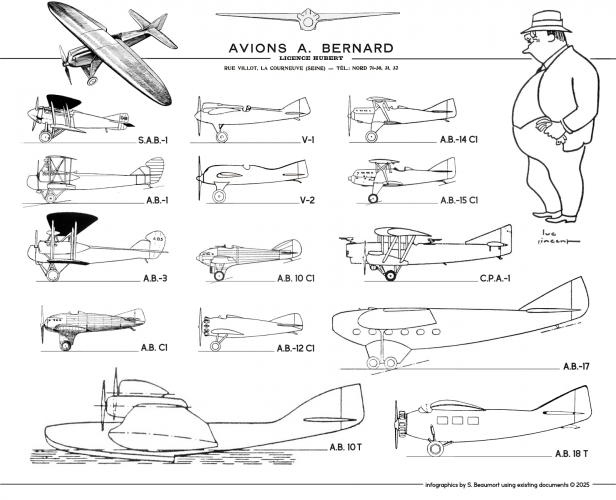
As a bonus, here's a little infographic I created to present most of the early Bernard airplanes, using period documents whenever possible (only the 10 C1 comes from a more recent plan). The caricature on the right depicts Adolphe Bernard himself, of course!
(please bear in mind that relative sizes are very approximate—the A.B.-1 and -3 ought to be as large as the C.P.A.-1 for instance)

1758069711337.png
 

Attachments

  • BERNARD models list by Stéphane Beaumort © 2025-09-17.xlsx
    51.2 KB · Views: 9
Last edited:
Type-71 Variant of the 70 with GR 5 Kb supercharged engine. Project only.
The Type 71 designation seems to be missing. I have it noted in my list somehow, with the mention "no data" but I don't know where I got it from initially or if it was a typo.

Amazing work of course,and about Type-71,it's a project.
 

Similar threads

Back
Top Bottom