The only feasible B-70 was going to need to be scaled down in complexity, so was Mach 3.1 really a necessity? Seems like competitors all suggested Mach 3 was more realistic, but North American was the only competitor that was deadset on pushing that extra tenth of a Mach. Even Mach 2.5 would have been a huge threat for the Soviets but more importantly was a significantly lower bar to hit. So a four engine design probably doesnt need to worry about Mach 3.

You are using an out of date browser. It may not display this or other websites correctly.
You should upgrade or use an alternative browser.
You should upgrade or use an alternative browser.
B-70A Valkyrie in service
- Thread starter uk 75
- Start date
FYI AV2 AF 62-207 had no such skin issues, had already done full heat soaking 33 minute sustained Mach 3 flight with many longer Mach 3+ flights scheduled ahead before it was lost in the mid-air.The B-70 also had a lot of development problems to still overcome that they never really had the chance to. For example the prototypes had a lot of issues with shedding skin/ parts with clear manufacturing issues that needed to be resolved.
Could be; yet It cruised at Mach 3+ at considerably less than Full Military Power.I severely doubt that an XB-70 with a sizeable belly fairing and associated additional aerodynamic drag would still be able to achieve Mach 3.
Proof please.Could be; yet It cruised at Mach 3+ at considerably less than Full Military Power.
Christopher Wang
ACCESS: Secret
- Joined
- 3 June 2021
- Messages
- 347
- Reaction score
- 825
As explained in Valkyrie: The North American XB-70 by Graham M. Simons (2011), the XB-70 / B-70 Valkyrie has a pair of tandem 14-foot weapons bays separated by a one-foot section. Due to the placement of the sliding weapons bay doors, each of the weapons bays could only be opened and used one at a time. This meant that the Valkyrie could not carry weapons longer than about 13 feet within its weapons bays.
@Scott Kenny also suggested that the Valkyrie's bomb bays could carry a pair of bomb "clips" similar to those used on the B-52 Stratofortress. These pair of "clips" could enable the Valkyrie to carry up to eight 2000-lb or two 9000-lb thermonuclear bombs.
If I understand correctly, the following thermonuclear bombs would have been available for the Valkyrie in the late 1950s thru late 1960s:
@Scott Kenny also suggested that the Valkyrie's bomb bays could carry a pair of bomb "clips" similar to those used on the B-52 Stratofortress. These pair of "clips" could enable the Valkyrie to carry up to eight 2000-lb or two 9000-lb thermonuclear bombs.
If I understand correctly, the following thermonuclear bombs would have been available for the Valkyrie in the late 1950s thru late 1960s:
- B28
- B39
- B41
- B43
- B53
- B57
- B61

Dilandu
I'm dissatisfied, which means, I exist.
Which would make a Valkyrie kinda redundant by itself, since B-52 could also do it.There is also the possibility that the Valkyrie could carry a pair of GAM-87 Skybolt ALBMs underneath its wings, but at the cost of increased drag.
As explained in Valkyrie: The North American XB-70 by Graham M. Simons (2011), the XB-70 / B-70 Valkyrie has a pair of tandem 14-foot weapons bays separated by a one-foot section. Due to the placement of the sliding weapons bay doors, each of the weapons bays could only be opened and used one at a time. This meant that the Valkyrie could not carry weapons longer than about 13 feet within its weapons bays.
If they couldn't do longer than 13 feet, and certainly no more than 14 feet, that would rule out the carriage of SRAMs or quite a few guided weapons.
- Joined
- 5 May 2007
- Messages
- 2,018
- Reaction score
- 4,280
Except that if the B-70 was in service, the SRAM would have been designed to fit in it.If they couldn't do longer than 13 feet, and certainly no more than 14 feet, that would rule out the carriage of SRAMs or quite a few guided weapons.
Christopher Wang
ACCESS: Secret
- Joined
- 3 June 2021
- Messages
- 347
- Reaction score
- 825
If they couldn't do longer than 13 feet, and certainly no more than 14 feet, that would rule out the carriage of SRAMs or quite a few guided weapons.
The Valkyrie could have carried the SRAMs externally underneath its wings and possibly the centerline, but at the cost of increased drag. It could have carried at least four SRAMs underneath the same pylons for the Skybolts, plus possibly four more SRAMs on the centerline.Except that if the B-70 was in service, the SRAM would have been designed to fit in it.
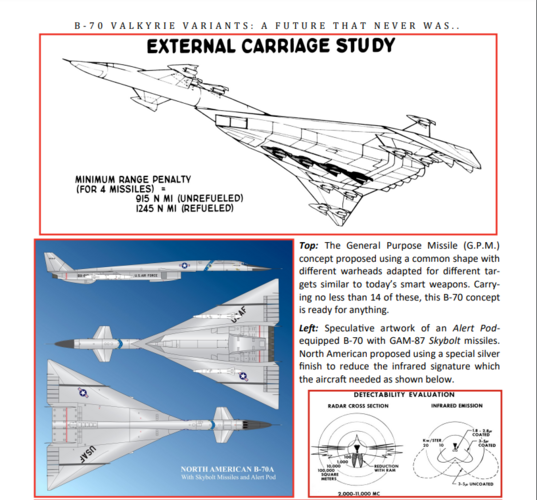
SOURCE: Landis, T. R. (2020, November 23). NAA B-70 Valkyrie Variants: A Future That Never Was. AFMC History & Heritage Program. Retrieved from https://media.defense.gov/2020/Nov/23/2002540204/-1/-1/0/B-70 VARIANTS.PDF
- Joined
- 5 May 2007
- Messages
- 2,018
- Reaction score
- 4,280
Yes, but why would you do that when you can make a missile that fits internally? The historical missile was 14 feet long because that's what fit in the B-52. If it needed to fit in a B-70, it would be 13 feet long.The Valkyrie could have carried the SRAMs externally underneath its wings and possibly the centerline, but at the cost of increased drag. It could have carried at least four SRAMs underneath the same pylons for the Skybolts, plus possibly four more SRAMs on the centerline.
Scott Kenny
ACCESS: USAP
- Joined
- 15 May 2023
- Messages
- 19,662
- Reaction score
- 28,140
Don't forget that the SRAMs wouldn't exactly be "short-ranged" when launched from 70kft and M3. 600nmi downrange and IIRC 200nmi cross range.
Sure I'll try to put it aside for you when I see it again.Proof please.
As I recall it was around the 80-90 % range after acceleration to high Mach. I believe that info is in the NAA pilots reports, and maybe also in the thrust settings charts in the T.O.
Similar threads
-

-
Armed to the teeth: B-70 with underwing Skybolts and SRAM internally
- Started by Archibald
- Replies: 67
-
Longer B-58 Hustler service?
- Started by Rule of cool
- Replies: 56
-

-
Alt 1945 Nuclear Weapons fail
- Started by uk 75
- Replies: 13