B-36 w/turboprop

Orionblamblam

ACCESS: USAP
Senior Member
Joined
5 April 2006
Messages
12,411
Reaction score
12,233
Website
www.aerospaceprojectsreview.com
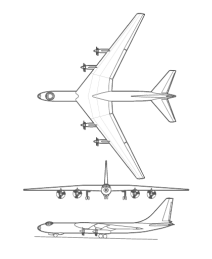
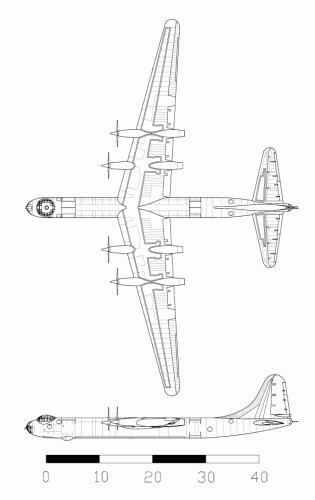
An illustration from the next issue of Aerospace Projects Review, showing a top & side view of a proposed B-36 variant with four turboprop engines. The article itself was written by Dennis R. Jenkins.

(Damn drawing took near two weeks to put together... mostly in trying to put together a decent drawing of the basic B-36, of which there are surprisingly few such drawings)
 

Attachments

  • smallB-36 turbo.gif
    smallB-36 turbo.gif
    55.3 KB · Views: 1,072
Orionblamblam said:
(Damn drawing took near two weeks to put together... mostly in trying to put together a decent drawing of the basic B-36, of which there are surprisingly few such drawings)

You're terribly right Scott!!!
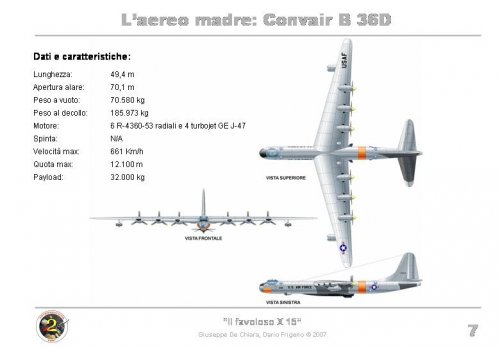
I had the same problem when I realized a 3-views drawing of a B 36D as mothership for NAA ESO 7487, for a presentation I did las November at AstronautiCon 2 (Italian Astronautical Convention).
 

Attachments

  • Slide7.JPG
    Slide7.JPG
    35.4 KB · Views: 991
question

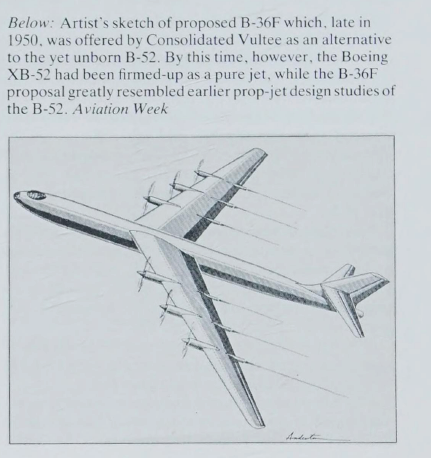
why was the B-36 not adaptet to four turboprop engines.?
Those 6 Pusher engine gave the B-36 bad nickname "Six turning and four burning!"

or came that proposal to late ?
or was magnesium-rich airframe of B-36 not ready for that.

more on B-36 and X-15
http://www.air-and-space.com/peacemkr.htm

that they use a B-36 als "Nuclear Reactor in Fight Test" as The NB-36H
give me the crepps :eek:
 
Michel Van said:
question

why was the B-36 not adaptet to four turboprop engines.?

Short answer: it was a lot easier to simply add the jet engine pods. Modifying the wings to allow turboprops would have been tricky, especially with those really long propeller drive shafts.

The B-60 most likely would have wound up with turboprops rather than turbojets, though.
 
Orionblamblam said:
The B-60 most likely would have wound up with turboprops rather than turbojets, though.

But, in this way, it could really look like the Tupolev Tu 20 "Bear"....or not??
 
Hello, everyone!

My first posting here!

In reply to the comment about the B-36, "6 turning, and 4 burning", refered to the engines of the later, mixed power ships: ' "If all engines functioned normally at full power during the pre-takeoff warm up, the lead flight engineer would say to the captain "six [engines] turning and four [engines] burning". Erratic engine reliability led to the wisecrack "two turning, two burning, two joking and two smoking," with two engines not accounted for or referred to as dead" '. Qute attributed to a Capt. Banda, C-99 pilot.

Russ
 
Orionblamblam said:
"Not." Engines would have been slung well below the wings.

Why this "odd" configuration??
There are some advantages to take the propellers so close to ground, or it is only the desire to not put forward wing the nacelles??
 
archipeppe said:
Orionblamblam said:
"Not." Engines would have been slung well below the wings.

Why this "odd" configuration??
There are some advantages to take the propellers so close to ground, or it is only the desire to not put forward wing the nacelles??

Separating the engines from the airframe makes servicing the engiens a lot easier, as well as making replacing the engines with some,thgin very different a lot easier. Same reason why the DeHaviland Comet layout became a historical footnote while the 707 layout remains the standard.
 
We may see new craft fly with a lay-out like B-36.

Podded engine nacelles with no propellor could perhaps power electric motors with props higher up. Those would simply slide in and out. Electric motors looked over inside a building. Being mounted higher up means propellor blades can be wider but still have better ground clearance.

Engine-only pods would be safer to be around.

This mixed use wouldn't be a kludge, but designed for safety.

Perhaps some nacelles could contain batteries, others would contain motors/props, and some nacelles only contain combustion engines.

Anyone ever try that type of modularity?
A B-36 lay-out might be best for that. We are seeing electric aircraft with more propellors than the -overcast ever had.
 
What engines were available in the power level to replace those big R4360s (plus jets)?

T40s were crap.
T56s?
 
Separating the engines from the airframe makes servicing the engiens a lot easier, as well as making replacing the engines with some,thgin very different a lot easier. Same reason why the DeHaviland Comet layout became a historical footnote while the 707 layout remains the standard.

It might also result in a more laminar flow over the wing. The original B36 had pusher engines for better aerodynamics and a conversion to tractor engines on the height of the wing would have surly resulted in increased drag. It looks like, the turboprop version would have had very small propellers for higher speeds, like the Tu-95. I think, the turboprop version would have been much faster, but with a much shorter range than the piston variant.
 
What engines were available in the power level to replace those big R4360s (plus jets)?

T40s were crap.
T56s?
Timeline-wise, the best turboprop option seems to be a P&W T57. Yes, a J57 converted into a turboprop. 15,000 shaft horsepower, and 5000lbs residual thrust. 20ft diameter prop to handle all that horsepower.

Though the B-60 might well be the recipient of those engines, making it an American Bear.
 
... the proportion between shp and residual thrust would change with flight speed and altitude. For the T57, the 20 ft prop would have been used for the proposed Douglas transport aircraft. For the faster B-36 a staggered 6-blade transsonic prop (single rotation 11 ft diameter) or something similar would probably have been chosen.
 
Last edited:
Timeline-wise, the best turboprop option seems to be a P&W T57
Timeline-wise, the T57 was five to seven years too late to be incorporated into the B-36, with flight testing (nose-mounted on a C-124) circa 1956, targeting for a 1959 (or so) first flight on the Douglas XC-132.

A more plausible substitute could have been the Northrop/Hendy Turbodyne, but that was canceled when the B-52 was transitioned to pure jet (the J40 initially, then the J57).

The turboprop that was pursued for the B-36 was the Wright XT35-3 with three (!) centrifugal compressors (mounted axially on a single shaft) see AEHS T35 page. However, Wright was able to snatch defeat from the jaws of victory on that engine project.
 
Last edited:
Timeline-wise, the best turboprop option seems to be a P&W T57. Yes, a J57 converted into a turboprop. 15,000 shaft horsepower, and 5000lbs residual thrust. 20ft diameter prop to handle all that horsepower.

Though the B-60 might well be the recipient of those engines, making it an American Bear.
The final B-60 production proposal by Convair had P&W T57 in four under-wing nacelles.
Contemporary were also turboprop engine projects or prototypes that Wright Aero-Engines tried to evolve from their English turbojet licences : T49 (derived from J65 / AS Sapphire) and T47 (derived from J67 / BE Olympus). And P&W's T45 (PT4), ancestor of J57. Many potential candidates. But one has to remember that the B-36 aerodynamics, especially the very thick and large wing, were obsolete, and compromised by the mission profile needed to reach the requested range with piston engines. In a 28-hour nuclear bombing mission to Moscow from Carswell AFB, only 30 minutes were spent at maximum speed and altitude, over the target. Those 30 minutes were preceeded by hours of slow, medium-altitude flight on the 4 outer R4360, climbing very slowly. Shifting efficiently to turboprop/turbojet, cruising almost at max speed / max altitude probably would have dictated a new wing design.
 
The B-36 could cruize at 40.000-40.000 ft with its piston engines.
 
Last edited:
The B-36 could cruize at 40.000-40.000 ft with its piston engines.
It could but the mission profile described above was the only one providing the expected range with payload. And B-36 was all about range.
Dennis R. Jenkins "B-36 Magnesium Overcast". If you have a better source:...
 
Last edited:

Similar threads

Back
Top Bottom