Barrington Bond

ACCESS: Top Secret
Senior Member
Joined
4 May 2007
Messages
1,007
Reaction score
1,040
Website
www.flickr.com
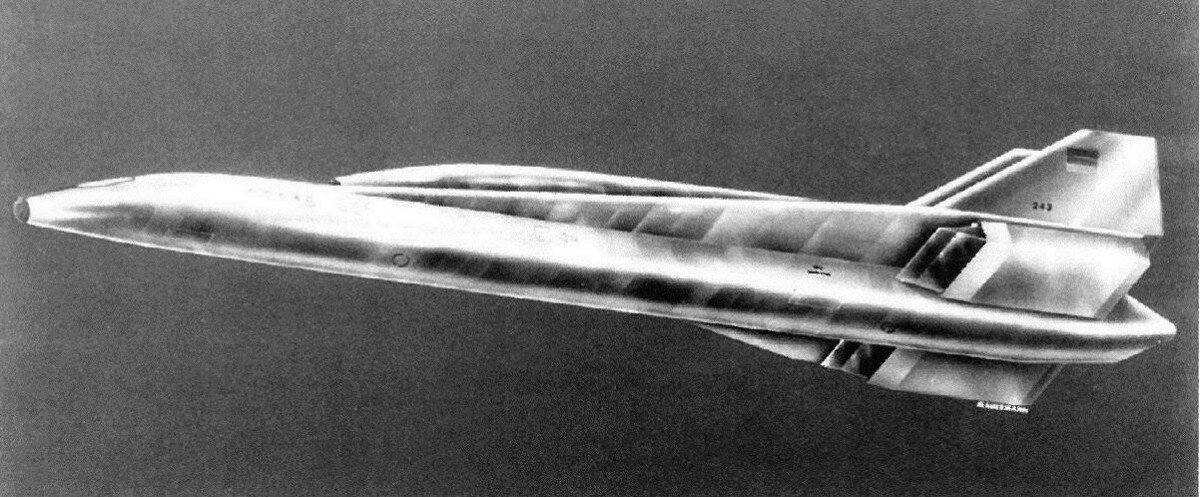
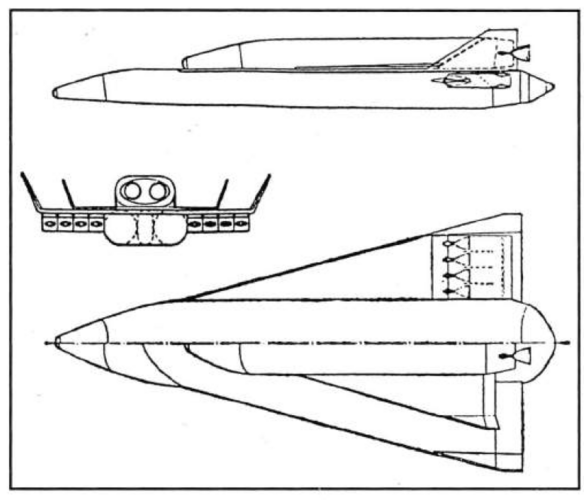
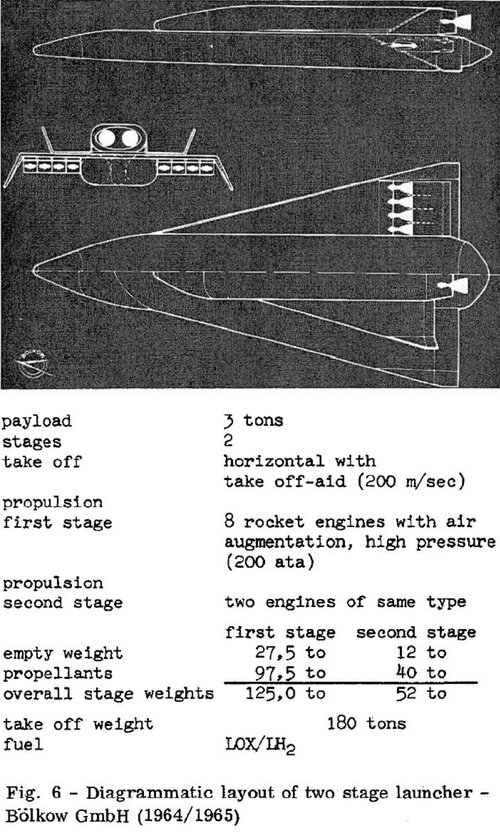
Space Transporter concept "BORAS" – Bolkow Raum Transporter. Bolkow Developments KG Two stage space transporter with horizontal take-off. First stage uses 8 high – pressure ejector rocket engines. Each engine has 248 kN thrust. Upper stage has 2 rocket engines and a payload of 3 t. Launcher mass of 200t. 1967?


Anyone have more detail on this one?
 

Attachments

  • Bolkow BORAS 01.jpg
    Bolkow BORAS 01.jpg
    177.1 KB · Views: 87
French Secret Project 3 and British Secret Project 5 relatively briefly go over it.
Not a lot more information, Bolkow joined Junker's Raumtransporter study in 1963, and the study continued in 1964-1965.
British Secret Project 5 Mentions the use of Ramjet-Rocket mix on the booster stage, but French Secret Project 3 says the Booster engines are air augmented ("partially shrouded combustion chamber"), like in your second post, the figures given are identical to your second post.
"In 1966, research [At Bolköw] focused on re-entry vehicles along the "lifting body" design methodology"

Think this is earlier version.
1714049665557.png
Version with up-angled wing-tips.
 
Last edited:
In the course of research about German Raumtransporters, I have seen one tantalizing illustration which has a transcript "BRT X7" aka "Bölkow raumtransporter" or "Bölkow Raumtransportgleiter". Almost looks out of "Star Wars". The names that come up are Karl Stöckel as Bölkow engineer (already at MBB) and Theodore Lässig for illustrations. I was asked not to publish the illustration :/ but am interested in finding out more. For example, are there any Bölkow / MBB technical reports out there about BORAS/BRT ?
 
Found some information to BRT X7
launch on Katapult (+200 m/s take off aid)
The Booster use eight Hydrolox rocket engines, high pressure 200 bar, staged combustion cycle
each with 248 kN thrust
To increase thrust, the concept envisaged encasing of the rocket motors
to allow for the mixing of air into the exhaust jet.
The Orbiter use two same Hydrolox with out the encasing

Bölkow study also use of Hydrogen Fluorine in Orbiter

Source:
Schubkraft für die Raumfahrt
by Helmut Hopmann
Isbn 3-927 697-22-2
 
Found some information to BRT X7
launch on Katapult (+200 m/s take off aid)
The Booster use eight Hydrolox rocket engines, high pressure 200 bar, staged combustion cycle
each with 248 kN thrust
To increase thrust, the concept envisaged encasing of the rocket motors
to allow for the mixing of air into the exhaust jet.
The Orbiter use two same Hydrolox with out the encasing

Bölkow study also use of Hydrogen Fluorine in Orbiter

Source:
Schubkraft für die Raumfahrt
by Helmut Hopmann
Isbn 3-927 697-22-2
Thanks Michael. I will read the book when I am in Munich next time. In the meantime, are there any references to Bölkow technical reports and authors in there? Based on those, I might be able to locate them in the archives.

> Bölkow study also use of Hydrogen Fluorine in Orbiter
They were not the only ones. I have a draft article on another spaceplane where fluorine was one of the options as well.

PS: The book is at
https://opac.deutsches-museum.de/TouchPoint/perma.do?q=+1035="BV012780697"+IN+[2]&v=dmm&l=de
 
Last edited:
Looking back into BORAS data
there estimations on empty mass and full mass far too optimistic
alone Orbiter empty mass of 12 metric ton is total unrealistic
like wise Booster empty mass of 27,5 metric ton
 

Similar threads

Back
Top Bottom