Astronomy and Planetary Science Thread

ASTEROID (44) NYSA MAY BE THE FIRST-KNOWN THREE-LOBED WORLD
Previously unknown moon orbiting Asteroid (44) Nysa is also detected.


An international team of astronomers has uncovered striking new evidence that asteroid (44) Nysa, one of the brightest and largest asteroids with an enstatite-like (E-type) surface composition in the main belt, possesses an extraordinary three-lobed structure and is accompanied by a small moon. The discovery, based on high-resolution adaptive optics imaging from some of the world’s most advanced telescopes, provides a rare glimpse into the complex history of one of the solar system’s most enigmatic asteroids.
 
Tabby's star may be orbited by a planetary-mass companion

According to the study, the companion would have a radius of about 1.7 Jupiter radii, a mass of around 9.4 Jupiter masses and a density of 2.2 g/cm3. It would be a cool object with an equilibrium temperature of 268 K, orbiting its host on a slightly eccentric orbit at a distance of some 2.35 AU.
 
The images of the recently discovered companion star of Alpha Orionis has been released, from Anton Petrov:


Hello and welcome! My name is Anton and in this video, we will talk about a new definitive image of Betelgeuse's partner that solves so many mysteries!
Links:
https://www.eso.org/public/archives/r...
https://arxiv.org/pdf/2601.00470https://www.youtube.com/redirect?ev...ttps://arxiv.org/pdf/2601.00470&v=ZOCAZvEU_L8
#betelgeuse #astronomy #stars

0:00 Betelgeuse updates
1:30 How this started and initial observations
3:25 Strange mystery and the anomaly of 2019
4:35 The companion hypothesis - Beetlebuddy
5:20 First clues
7:20 Recent study and an actual image
8:50 Unusual stellar object
9:30 Additional mysteries
11:30 How this applies to other famous stars
12:10 Conclusions and what's next?
 
Ranking the “Great Filters”: Where Does Alien Life Fail?

View: https://youtu.be/dchBY5XO6Qg
Some comments.

The argument revolves around what are dubbed 'loud aliens', that is, those that are detectable by us, here, now.

Webb's 'monocultural fallacy' is almost there. I.e., his argument is that cultures are diverse, so even if one explanation for 'Fact A' (that earth has not been colonised) that still allows alien technological civilisations, then surely the inevitable outliers will expand and colonise the galaxy. Webb unconsciously assumes that only one explanation at a time can be considered and be then falsified. In fact, many of the explanations offered are not exclusive and can therefore be cumulative in their effect. He shows that he almost understands when at the end of his book he runs a kind of reverse Drake equation adding up all the impediments to the development of complex life and their cumulative effect. If he'd thought just five seconds longer...

The great filter is a hypothetical concept with no hard evidence or constraints, so therefore I think it's premature to start talking about how it works with any confidence. A one-dimensional line with filters built across it at right angles is how a physicist thinks. Evolution is not a car driven at high speed at a wall in the hope that it will break through or the sad outcome that it crashes. To extend the metaphor a little, crisis requires adaptation or extinction and adaptation is not breaking through, it's bending the path. The resulting line of evolution will not be a direct linear extrapolation from a starting point, but diverted unpredictably by major contingencies. The point is it's a drunkard's walk and the form of life that develops far down the line cannot be predicted from the starting point. Looking for radio signals and Dyson swarms is like a chimp looking for giant bananas. Or, try asking an anglerfish about how a mountain goat lives. If it could speak, it would ask you what a mountain is.

Biologists, evolutionists, sociologists and experts in every discipline outside of pure theory laugh at scenarios of infinite linear extrapolation because they've all seen that complex factors inevitably accumulate and interfere.

'Fact B', I will have to say, is that we have absolutely no practical experience of interstellar colonisation (if that term is even meaningful). The proof of the pudding is in the eating and we haven't even baked it yet. In fact we only have hypothetical recipes, no oven, and no ingredients (the map is not the territory and all that).

David Kipping points to the history of life on earth in search of prior great filters. Fair enough, it's the only example we have - but that's also the problem. There's what's called the 'Whig interpretation of history':

https://en.wikipedia.org/wiki/Whig_history

In a nutshell, it holds that the past is prologue to the inevitable and ideal telos of the present.

https://en.wikipedia.org/wiki/Telos

For example, an astronomer looking at biology only sees a straight line. He says that photosynthesis is the necessary prerequisite for earth's biosphere. Almost. On earth, we do know that photosynthesis was able to become dominant where we see it. Yet there are biospheres that don't rely on it, such as geothermal ocean vents, and some proposes that life began in such environments. Sure, photosynthetic autotrophy (growing like a plant) is an efficient way of getting usable energy and using it continuously, and heterotrophy (eating other living things) is even better, but it's not the only source. Even slow accumulation of energy is good, given time - the big advantage that seeds have over spores is their accumulated energy store held until a flurry of activity when conditions are right. Nature uses what is possible with what it has and is adequate for the situation, not what is ideal for an external perspective.

(Some optimists have proposed 'aestivation' as a viable survival strategy over cosmological time scales as the universe expands and cools - wake up, stoke the fire, go back to sleep for another trillion years.)

Next he goes on about the 'rare complexity scenario.' He argues that all eukaryotic life today is descended from one genetic lineage. Again, he proposes this as a great filter, but it's not rare. Symbiosis at sub-cellular and super-cellular scale has happened repeatedly and independently (like the evolution of the eye) - the discovery of nitroplasts is a recent example.

And so on. Essentially, it all amounts to Whigism. We have exactly one planet's history, incompletely understood, as a case study. That is not sufficient to be true to scientific method.

In response to Occam's razor, Einstein is supposed to have said that an hypothesis should be as simple as possible, but not simpler than possible. Whigism is at least simpler than is actual.

And then there's a Tier List. Head/desk interface imminent. I will accept that you need some kind of infrastructure for a civilisation to arise and that ones able to support a civilisation might be rare, and that only a few will become loud, but that list only compounds and makes rigid the faults of the prior reasoning.

To be fair to Kipping, he does know that he doesn't know and is interested in many different possibilities. The 'Eschatian hypothesis' is another.

View: https://www.youtube.com/watch?v=jSlbplt7GhA


Basically, that holds that loud civilisations are by definition in disequilibrium and they must either evolve towards equilibrium (which looks like quietness) or die. A fast and loud civilisation is not pre-adapted to the constraints of the interstellar environment which is resource-thin and takes millennia to traverse. That is a condition of the universe that biases evolution towards quietness or strangeness (see above on unpredictability, evolution that veers off a straight line) - both ways of being undetectable by us, by our available means, here, now.

So, overall, I'm not impressed at all by Webb and I think that the great filter hypothesis is so oversimplified as to be seriously misleading. Whigism (unconscious as it may be) is unscientific. The conditions of the interstellar environment bias the development of interstellar organisation - however diverse it may be in its origins - towards quietness or strangeness.

 
Last edited:
Efforts Continue to Stabilize LINK Spacecraft for NASA’s Swift Boost

Teams at Katalyst Space are making progress slowing the spin of their LINK spacecraft, which is designed to boost the orbit of NASA’s Neil Gehrels Swift Observatory. A series of thruster burns this week reduced the rate of spin from approximately 9 degrees per second to less than 4 degrees per second. Katalyst is continuing with this approach to restabilize the spacecraft in the coming days.

Teams also further evaluated LINK’s functionality and determined there are still potential paths forward for a boost. NASA is working closely with Katalyst to consider revised, innovative approaches. The agency will continue to provide updates about stabilization of LINK and next steps for the mission. LINK is now expected to approach Swift around the end of August.
 
Some comments.

The argument revolves around what are dubbed 'loud aliens', that is, those that are detectable by us, here, now.
It's always come down to ressource(management) and the political and social will whether "loud" can be expected. Numerous researches on this have been published a decade ago on survival of planetary civilizations... Suffice to say the majority will fail and we are among them. It takes radical changes to get past this hurdle. All these changes border on extinction level reduction of the population. The sooner this happens the better and less sacrifices have to be made. But historically people are not willing to do the smart thing but the cheap thing. Self-extinction is the rule and "loud" an extreme exception. We emit a lot EM but it all will become noise past the oortcloud and uninteligible and too weak compared to star's random signals.
 
First SETI Survey Using ALMA Looked For Aliens Where We've Never Looked For Them Before

What you'll discover in this article​


  • The Search for Extraterrestrial Intelligence has mostly focused on a narrow range of radio frequencies.
  • A team has now used a completely different range of wavelengths to look for alien signals.
  • They did not find any; but as PhD researcher Louisa Mason told IFLScience, "My work at the moment is less about looking if aliens are sending messages and more about thinking about how we use these radio telescopes and even maximising the data, thinking about how we could search for it."
 
Biologists, evolutionists, sociologists and experts in every discipline outside of pure theory laugh at scenarios of infinite linear extrapolation because they've all seen that complex factors inevitably accumulate and interfere.

This reminds me about a recent discussion about von Neumann probes on Centauri Dreams where a metallurgist (Peter Marinko) having specialized on industrial process engineering weighs in. It's an excellent walkthrough on the constraints of such things beyond mere resource availability:

A Metallurgist's Doubts About Self-Replicating Probes (Jul 10, 2026):
https://www.centauri-dreams.org/2026/07/10/a-metallurgists-doubts-about-self-replicating-probes/

Peter Marinko said:
My suspicion, as a practitioner, is that von Neumann probes are constrained not by the laws of physics but by process-chain closure and materials aging — both, at root, thermodynamic limits. If that is right, it bears directly on the Fermi paradox: the galaxy may be quiet not because nobody tried, but because replication is harder than arithmetic suggests.

There was also a follow up, What the Comments Taught Me: A Reply on Self-Replicating Probes (Jul 13, 2026):
https://www.centauri-dreams.org/202...taught-me-a-reply-on-self-replicating-probes/

Marinko has also written a more wide ranging paper, "Material Limits and the True Value of L: A Thermodynamic Framework for the Longevity of Technological Civilizations" (preprint) which I haven't gotten around to reading yet:
https://zenodo.org/records/20859222
 
A star, S301, is orbiting the Sagittarius A* supermassive blackhole at the centre of the Milky Way and at its closest approach is travelling at 8% light-speed, from Anton Petrov:


0:00 Discovery from a center of the galaxy
1:35 S-stars and what they are
2:25 Extreme star S301
3:50 What this may teach us
5:30 How and what was found
8:10 Solving mysteries of s-stars
9:58 Implications for astronomy
 
NASA measures the fiery heat inside Jupiter's volcanic moon Io

New observations have finally started to answer that question. For the first time, scientists have measured temperatures beneath Io’s surface instead of only observing the heat radiating from above.

The results show that heat is rising from below across much of the moon, offering fresh clues about what powers the most volcanic world in our solar system.
 
It would appear that the mystery of Tabby's star has been solved, from Anton Petrov:


0:00 Tabby's star updates
1:40 New study and data from TESS and Gaia
2:40 Transits and dimming events
4:50 Why this is an important discovery
6:50 Additional discoveries and solving mysteries
7:50 Other similar dimming stars
10:25 Unanswered questions
12:05 Conclusions and what's next?
 
A six year old video I just stumbled across from PBS Space Time concerning the boundary between neutron-stars and blackholes:


When we detected the very first gravitational wave, a new window was opened to the mysteries of the universe. We knew we’d see things previously thought impossible. And we just did - an object on the boundary between neutron stars and black holes, which promises to reveal the secrets of both.​
Hosted by Matt O'Dowd
Written by Matt O'Dowd
Graphics by Leonardo Scholzer, Yago Ballarini, & Pedro Osinski
Directed by: Andrew Kornhaber
Camera Operator: Bahaar Gholipour
Executive Producers: Eric Brown & Andrew Kornhaber
 
Don't get me started on MOND theory Michel Van, I have hated it ever since I first heard about it. There is another theory that explaines that gravity could be a by product of another universe (the so called Brane theory) aspect of the Multiverse which explains that the universe is just one but many universes in the Bulk.
 
GEO GIRL video on the "Smoking gun" evidence for the Great Oxidation Event:


Did you know that sulfur isotopes could tell us when molecular oxygen began to accumulate in Earth's atmosphere around 2.4 billion years ago?

References:
Thiemens, 2013. Introduction to Chemistry and Applications in Nature of Mass Independent Isotope Effects Special Feature. (and references therein) - https://doi.org/10.1073/pnas.1312926110
Thiemens and Lin, 2019. Use of Isotope Effects To Understand the Present and Past of the Atmosphere and Climate and Track the Origin of Life. (and references therein) - https://doi.org/10.1002/anie.201812322https://www.youtube.com/redirect?ev.../doi.org/10.1002/anie.201812322&v=cXaCtdpOvbY
Other GOE and oxygen related videos:
Banded Iron Formation (BIF) Deep Dive (with expert) - • Answering All Your Banded Iron Formation Q...
Potential oxygen oases before the GOE (~3.5 billion years ago) - • New Study Finds Evidence for Stromatolites... https://www.youtube.com/watch?v=7zZct1gfNO4
Evidence for spread of oxygen prior to the GOE - • Evidence For Oxygen On Earth Before The ‘G...
Potential oxygen oases during the Boring Billion (between the GOE and NOE) - • New Study Suggests a Rise in Oxygen During... https://www.youtube.com/watch?v=u9YeX1S48mc
Mass Extinction associated with the Great Oxidation Event - • The Time Bacteria Caused The Largest Extin...
Oxygen's Role in Animal Evolution During Snowball Earth? - • New Findings De-emphasize Oxygen's Role in... https://www.youtube.com/watch?v=T4YP8gMtpvU


0:00 Great Oxidation Event (GOE)
1:44 Evidence for GOE
2:15 Mysterious sulfur isotope signal
2:50 Isotope basics
4:05 Sulfur stable isotope basics
6:33 Measuring stable isotope composition
8:38 Isotope "offset"
10:25 Sulfur "MIF" signal
11:27 Atmospheric answer...
12:40 Why this is our "smoking gun"
 
This reminds me about a recent discussion about von Neumann probes on Centauri Dreams where a metallurgist (Peter Marinko) having specialized on industrial process engineering weighs in. It's an excellent walkthrough on the constraints of such things beyond mere resource availability:

A Metallurgist's Doubts About Self-Replicating Probes (Jul 10, 2026):
https://www.centauri-dreams.org/2026/07/10/a-metallurgists-doubts-about-self-replicating-probes/


There was also a follow up, What the Comments Taught Me: A Reply on Self-Replicating Probes (Jul 13, 2026):
https://www.centauri-dreams.org/202...taught-me-a-reply-on-self-replicating-probes/

Marinko has also written a more wide ranging paper, "Material Limits and the True Value of L: A Thermodynamic Framework for the Longevity of Technological Civilizations" (preprint) which I haven't gotten around to reading yet:
https://zenodo.org/records/20859222
Funny, I raised that argument over a decade or two ago and why a (spacefaring) aquatic civilisation cannot to have come into their own.
People have now idea how much science, ideas, inventions we rely on from the past 5-12k years. The past few hundreds-2k years were just the collection of it all via empire stealing and gathering and compiling it into a comprehensive & uniform education format & standard.
Establishing norms that would allow faster referencing, learning, and furthering progress thereof. If burning books persisted constantly we would never have come this far. Technology, science was never the problem it's people.
 
An interesting short video on Uranus and Neptune about how they might not actually be ice-giants:


New research suggests Uranus and Neptune may not be ice giants after all, but worlds hiding vast oceans of molten rock beneath their hydrogen atmospheres. This video explores what may really be inside these distant planets, why scientists are questioning the old model, and how the answer could reshape our understanding of planets across the galaxy.​
 
1000042604.jpg
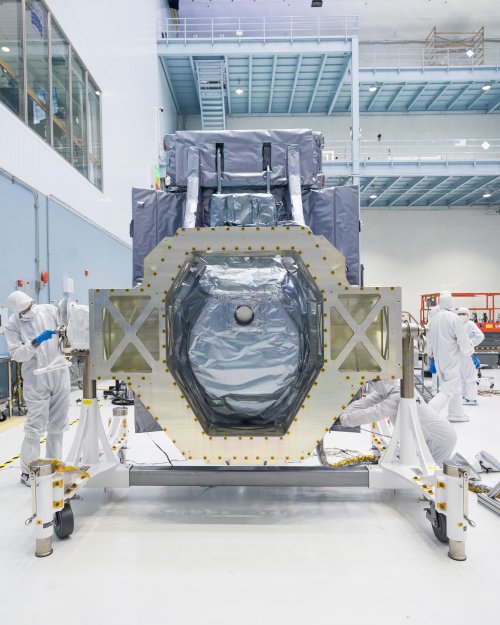
NASA is preparing new Nancy Grace Space telescope for launch in 30th August. When finisjed itll have an impressive 10,000x Hubbles Resolution. What's more impressive is unlike James webb its on time, and under budget.
 
Wednesday, August 5, 2026
6:30PM ET
The Katalyst team is continuing recovery operations and making steady progress toward returning LINK to its mission to rendezvous with and boost NASA’s Neil Gehrels Swift Observatory.
LINK was spinning at approximately 9 degrees per second when recovery operations began. The team has since reduced the spacecraft’s body rate to 1.47 degrees per second, where it will remain while the team prepares for the next phase of the mission.
The team used one of LINK's electric propulsion thrusters to slow the spacecraft down, consuming less than 100 grams of propellant to conserve fuel for the rendezvous and boost phase of the mission.
Over the next few days, we will upload a significant flight software update that includes new attitude controllers for LINK’s current configuration. This will restore full attitude control and allow the team to begin the phasing maneuvers needed to align LINK’s orbit with Swift.
https://www.katalystspace.com/mission/link
 
A video about what if Earth survives the Sun's red-giant phase:


When the Sun becomes a red giant, people often talk about what will happen to Earth, and how Earth could even be destroyed by the Sun. But what if Earth survives?
 
Jupiter early in its' early days was a puff-ball planet:


During the formation of the Solar System, Jupiter had a very different environment than it does today, including potentially being a puffball planet twice as wide as it is now.

Why the Grand Tack hypothesis may be wrong:


The Grand Tack hypothesis proposes that Jupiter nearly migrated into the inner Solar System and destroyed everything before being pulled back by Saturn. But is this actually likely to be true?
 
The speculated far future of Jupiter:


When the Sun becomes a red giant, Jupiter and the galilean moons will eventually enter the habitable zone. These moons, like Europa, already have subsurface oceans of water. But will Europa, Ganymede and Callisto become habitable?
 
Again quantum gravity
Vlatgo Vedral and Team from Oxford, propose a test for measurement of quantum gravity and anti gravity
This test use superposition of nitrogen atom inside two Nano diamonds (with NV center) and cloud of caesium atoms as sensor
with help of weak-value amplification should read the extrem weak reaction.
However Vedral point out that many disturbing influences will distort the results (like Casimir-Polder force)

If this works it could give new insight in quantum physics and on Gravity
and as Spin off give new generation of Quantum computers using spintronic or quantum gravity.

View: https://www.youtube.com/watch?v=u54rwhqOwzg

(audio German / english)

Paper
https://arxiv.org/pdf/2602.12266
 
NASA’s New Horizons Finds Evidence of Recent Liquid on Pluto’s Surface

A new analysis of imagery collected during NASA’s New Horizons spacecraft’s 2015 encounter with Pluto provides evidence that liquid nitrogen is rising to Pluto’s surface through cracks in the northern edge of the Sputnik Planitia, part of the massive heart-shaped glacier on the dwarf planet’s surface. This is the first evidence of recently flowing liquid on Pluto.
 
Complex multicellular life may've got an asteroid delivered fertiliser kickstart 800 million years ago, from Anton Petrov:


Hello and welcome! My name is Anton and in this video, we will talk about the asteroid impact on Earth 800M years ago and its potential impact on complex life
Links:
https://iopscience.iop.org/article/10...https://www.youtube.com/redirect?ev.../article/10.3847/PSJ/ae74cc/pdf&v=8hhsrk6xfLI
https://www.nature.com/articles/s4146...https://www.youtube.com/redirect?ev...com/articles/s41467-020-17115-6&v=8hhsrk6xfLI
#earth #impact #evolutionoflife

0:00 Collisions, Earth and evolution of animal life
0:50 Massive impact discovery
3:10 Strange cluster of time
4:20 What happened here 800 million years ago?
7:00 Asteroid bombardment
8:15 Snowball Earth and the beginning of animal life
10:40 What about Venus and Mars?
12:18 Conclusions
 
The fate of Red-giant planets:


The Sun will become a red giant in about 5 billion years. But what happens to the planets of a red giant system? Will Earth be destroyed when the Sun becomes a red giant? (probably) But what about other stars? What are red giants exactly?

The ultimate fate of Uranus:


When the Sun becomes a red giant, every planet in the Solar System will get hotter, and each planet has its own unique future. But what will happen to Uranus and its moons?LINK: https://arxiv.org/pdf/1408.2543
 
The Sun will turn into a red-giant twice:


Near the end of the Sun's life, it will expand into a red giant, but will it destroy Earth? To find out, we need to delve into stellar evolution, fusion, and hydrostatic equilibrium.
00:00 Cold Open
00:49 Mass of the Sun
01:50 Origin of the Sun
02:40 Hydrogen Fusion
03:58 The Desert Earth
04:50 Red Giant Phase
06:38 Helium Fusion
08:19 Summary
10:04 Outro1
0:23 Sponsor Message
11:08 Featured Comment
 

Similar threads

Back
Top Bottom