Astronomy and Planetary Science Thread

Here's some interesting news concerning Europa and recent sensor-data from the Juno probe:


In September 2023, NASA’s Juno spacecraft performed a close flyby of Jupiter’s moon Europa and measured oxygen production at levels far higher than scientists had predicted. This discovery doesn’t just revise a number—it challenges decades of assumptions about how Europa’s surface chemistry works and whether its subsurface ocean could support life. Scientists are now focusing on a critical question: can this oxygen move through the moon’s thick ice shell and reach the ocean below? The answer could reshape how we evaluate habitability beyond Earth.​
This content is based on current scientific research and theoretical physical models. It is intended for educational and discussion purposes only and does not claim that any hypotheses presented are definitive or proven facts.
Source & Reference
● NASA – NASA’s Juno Mission Measures Oxygen Production on Europa
https://www.nasa.gov/missions/juno/na...https://www.youtube.com/redirect?ev...nds-europa-is-producing-oxygen/&v=cCZliLPrtco
● NASA JPL – Europa Clipper Mission Overview
https://europa.nasa.gov/mission/overv...https://www.youtube.com/redirect?ev...ropa.nasa.gov/mission/overview/&v=cCZliLPrtco
● Nature Astronomy – Surface composition and radiolysis-driven chemistry on Europa
● Science Advances – Oxygen production from radiolysis on icy moons
● NASA Webb Telescope Blog – Webb Detects Carbon Dioxide on Europa’s Surface (2023)
https://blogs.nasa.gov/webb/2023/09/2...https://www.youtube.com/redirect?ev...bon-dioxide-on-europas-surface/&v=cCZliLPrtco
● ESA – JUICE: Jupiter Icy Moons Explorer Mission
https://www.esa.int/Science_Explorati...https://www.youtube.com/redirect?ev...Exploration/Space_Science/Juice&v=cCZliLPrtco


#europa #junomission #astrobiology #jupiter #spacediscovery #spacescience #science #space
 
New mystery in Solarsystem

They found Atmosphere on trans neptunian object 2002 XV93 !
it 39x44 AU orbit around the Sun, behind Pluto.
however it's only 562 km in diameter.
if got a density like Pluto of 1,85 g/cubic cm, it gravity would be too low to hold a atmosphere
in comparison Pluto got thin Atmosphere at 0.620 m/s gravity.

So what is going on ?
the Atmosphere could be replenished, but by what ? vulcanism ? it too small, maybe comet impact ?
or got it far higher density ? if that the case why end up so far outside the Solarsystem and not in asteroid belt ?

https://www.heise.de/en/news/Surpri...-trans-Neptunian-object-2002-XV-11281848.html
 
Interesting discovery, I wonder how many trans neptunian object will have an atmosphere Michel Van? There will probably be a lot more out there waiting to be discovered I would think.
 
I wonder how many trans neptunian object will have an atmosphere Michel Van?
Pluto has very thin atmosphere during it's "summertime"
and there far bigger trans neptunian object out there
like Eris and it moon Dysnomia
and Haumea with it two moons or Orcus and it large moon
They could have tidal heat induce geysers that produce a Atmosphere

but it take time until those world pass-by a star so we can find out more,

more data on 2002 VX93
https://en.wikipedia.org/wiki/(612533)_2002_XV93#Physical_characteristics
 
Pluto has very thin atmosphere during it's "summertime"
I wonder if there may be different regimes, different scales where gases "feel" forces differently.

If Pluto were closer to the Sun, it would very well lose its atmosphere as Mars...which loses in in puffs.

Spring a leak in your suit, the gases just disperse.

But these size objects recently seen--might they inhabit a sweet spot such they become some kind of cold plasma or something?

If they were a bit larger with more gravity...they might start losing gases faster? You don't want Hadley cells tearing things off. Field effects may play a role in why gases stick around at that scale.

For disasters
https://phys.org/news/2026-05-ground-atmosphere-swarm-satellites-characterize.html

Cosmology
https://phys.org/news/2026-05-universe-sharpen-cosmic-expansion-dark.html
https://phys.org/news/2026-05-monster-black-holes-usual-history.html
https://forum.cosmoquest.org/forum/...3753621-the-universe-builds-stars-by-the-book

Rogue worlds
https://phys.org/news/2026-05-planets-bouncers-rogue-worlds.html

The winds of Venus
https://phys.org/news/2026-05-vast-atmospheric-venus-largest-hydraulic.html

The Moon
https://phys.org/news/2026-05-moon-formation-mystery-ways.html
https://oikofuge.com/lunar-libration/

Mars
https://phys.org/news/2026-05-gen-mars-helicopter-rotor-blades.html
https://phys.org/news/2026-05-fusion-high-definition-mars-temperature.html

Io
https://phys.org/news/2026-05-massively-underestimated-io-thermal-output.html

Black holes
https://forum.cosmoquest.org/forum/...ght-live-long-enough-to-look-like-white-holes

Huh?
https://phys.org/news/2026-05-flying-discs-orbs-newly-pentagon.html
 
Last edited:
NASA's Roman Poised to Transform Hunt for Elusive Neutron Stars

Summary​

Tiny shifts in starlight could reveal otherwise hidden objects
Although neutron stars were theorized nearly a century ago and later identified through the discovery of pulsars, astronomers have only detected a small, biased sample of what is believed to be a vast population across the Milky Way galaxy. Now, researchers are planning to get creative with NASA’s Nancy Grace Roman Space Telescope to uncover and weigh these elusive objects. By measuring tiny shifts in starlight caused by their gravity, Roman may reveal a hidden population of isolated neutron stars and open a new window on extreme physics.
 
Jupiter is not what you think it is:


Almost everything you were taught about Jupiter is wrong.
Jupiter is not a giant ball of gas. Beneath those iconic clouds lies a liquid planet — and deeper still, a planet made of liquid metal. In this video, we go layer by layer into the interior of the largest planet in our solar system, from the ammonia clouds and the Great Red Spot all the way down to a core that shouldn't exist the way it does.​
Jupiter is a giant mystery in the sky. And the more we learn about it, the stranger it gets.
 
Astronomers pin down the origins of a planetary odd couple

New measurements of a hot Jupiter and its mini-Neptune companion suggest both planets formed surprisingly far away from their host star
NASA’s Perseverance Mars Rover Surveys ‘Crocodile Bridge’

NASA’s Perseverance Mars rover used its Mastcam-Z camera system to capture this 360-degree panorama of a region nicknamed “Crocodile Bridge” on Jezero Crater’s rim. The panorama is made up of 980 images, 971 of which were taken on Dec. 18, 2025, the 1,717th Martian day, or sol, of the mission. An additional nine were taken on Jan. 25, 2026, Sol 1,754. This natural-color view has been processed to show the landscape as the human eye would see it.
 
Last edited:
Odyssey Team Celebrates on a Global Map of Mars [Apr. 30]

Team members past and present from NASA’s 2001 Mars Odyssey orbiter mission gathered on April 15, 2026, to celebrate 25 years since the spacecraft’s launch, which took place April 7, 2001. For the occasion, the team rolled out a giant global map of Mars created using imagery from Odyssey’s THEMIS (Thermal Emission Imaging System) infrared camera. The celebration took place at NASA’s Jet Propulsion Laboratory in Southern California, which leads the mission.
 
Here's some interesting news concerning Europa and recent sensor-data from the Juno probe:

Interesting implications for rogue planets and their satellite systems too - miniature, lightless systems with 'failed stars' that nonetheless might be very complex and interesting places. We know that some at least have strong magnetic fields, and there are going to be powerful tidal effects.

UPDATE

However...

Not to rain on anyone's parade, that study needs context. Here are a range of reports expressing various degrees of optimism and pessimism regarding the results of Juno's observations.

https://www.devdiscourse.com/articl...churns-out-1000-tons-of-oxygen-every-24-hours

Jupiter's ice-covered moon Europa generates 1,000 tons of oxygen every 24 hours - that's enough to keep a million Earthlings breathing for a day. The findings are based on data collected by the Jovian Auroral Distributions Experiment (JADE) instrument on NASA's Juno spacecraft.

https://nasaspaceflight.com/2024/03/juno-europa/

“Before Juno, previous estimates ranged from a few kilograms per second to over 1,000 kilograms per second,” said Szalay. “The findings unambiguously demonstrate oxygen is continuously produced in the surface, just a good bit lower than we expected.”

https://scienceblog.com/nasas-juno-mission-measures-oxygen-production-at-europa/

The paper’s authors estimate the amount of oxygen produced to be around 26 pounds every second (12 kilograms per second). Previous estimates range from a few pounds to over 2,000 pounds per second (over 1,000 kilograms per second).

https://www.earth.com/news/jupiters-moon-europa-creates-enormous-amount-of-oxygen/

The team has pinpointed the rate to be about 26 pounds (12 kilograms) per second, a figure that sharply contrasts with past estimates ranging up to over 2,000 pounds (over 1,000 kilograms) per second.

https://astrobiology.com/2024/03/juno-measures-oxygen-production-on-europa.html

“We put narrow constraints on the total oxygen production at Europa currently at around 12 kg per second. Before Juno, previous estimates ranged from a few kg per second to over 1,000 kg per second. The findings unambiguously demonstrate oxygen is continuously produced in the surface, just a good bit lower than we expected.”

The Nature Astronomy paper:

https://www.nature.com/articles/s41550-024-02206-x

And a point o add of my own, oxygen is not being introduced into Earth's biosphere in large quantities, oxygen atoms already present are being cycled back and forth. The issue is therefore not whether new oxygen is being introduced into the Europan ocean, but whether there's a sufficient accumulated supply now present that could be circulating in an active biosphere.

Apologies for the repetition, but this is a demonstration of how varying interpretations can be made of data. The YouTube video focusses on the optimistic range of possibility, but that's not supported by other interpretations of the data and the very same study the video references.

If you don't think trendy postmodern university departments like Media Studies are jokes, this is the sort of thing they study - how information can be variously interpreted and (mis)understood. It's especially important when living in a zone that's already flooded with bullshit to be able to look a little more analytically at the medium itself.

Anyway, it sounds like a cop-out, but another probe, more data. Roll on Europa Clipper and JUICE.
 
Last edited:
That oxygen could be harvested.

A similar world
https://phys.org/news/2026-05-ganymede-unique-magnetic-field-powered.html
Now, a new model of Ganymede's inner evolution suggests different processes may be at play. The new model, described in a study published in Science Advances, indicates that Ganymede's core is actually still forming, and this formation is driving the magnetic field...

Flyby
https://phys.org/news/2026-05-mars-reshape-nasa-psyche-journey.html
https://phys.org/news/2026-05-asteroid-apophis-skim-earth-joint.html

exo-world
https://phys.org/news/2026-05-lonely-jupiter-planet-years-gas.html

X-Ray jets
https://phys.org/news/2026-04-astronomers-mind-power-black-hole.html

A strange
https://phys.org/news/2026-05-rotating-early-galaxy-astronomers.html
Astronomers using the James Webb Space Telescope have made a surprising discovery about a galaxy long, long ago and far, far away: It isn't rotating.
 
Make Pluto a planet again: Nasa chief’s big mission

Recent declarations by the head of Nasa, Jared Isaacman, that the space agency is working on settling the contention in Pluto’s favour once and for all are moot, in [Alan] Stern’s view.

“No one ever heard of the IAU until they did this vote … they derive power from this keeping on coming up, but it’s a settled matter,” Stern told The Times. “I’m only half joking when I sometimes say IAU stands for Irrelevant Astronomical Union. What the IAU did in 2006 is an anomaly … Pluto is a planet.”

...

“The IAU was just trying to find a reason to have a smaller number of planets because they didn’t want to confuse schoolchildren with too many,” Stern scoffed.

“By the IAU’s argument, there should only be eight states in the United States and only eight elements on the Periodic Table, because the rest are confusing to children. That’s an anti-scientific way to do science. It’s a bad pedagogical moment when we say the ability to memorise things is a criteria for their scientific categorisation.”

...

Stern said: “Across the entirety of literature in planetary science, the IAU’s definition is universally ignored … Science works by individual scientists making up their minds and when enough of them do, it’s called consensus. We look at data, we look at theory … No one votes. The lay person’s view that there is some adjudicating body that gets the definitive say is invalid.”

He added: “Of course the IAU says nothing will change until they vote again but … no one pays any attention to them anyway. If someone said you could only have X number of species on Earth, would we listen to that?”
 
New method sharpens the search for alien biology

For decades, the search for life beyond Earth has revolved around a key question: What molecules should scientists be looking for on other planets or moons?

A new study, published in Nature Astronomy, suggests the more revealing clue may not be the molecules themselves, but the hidden order connecting them.
Ultramassive Black Hole Pair Might Be The Biggest Ever Found, And They’ve Carved Out The Center Of An Enormous Galaxy

An international team of astronomers reports an incredible discovery: A massive elliptical galaxy appears to have a hollow cavity in its core, like a billion stars had been kicked out from it. The observation suggests the presence of not one but two ultramassive black holes. If confirmed, one of them might be the largest black hole known, and it would definitely be the heaviest pair ever found.
Newly Discovered Asteroid 2026 JH2 Is About To Have A Very Close Encounter With Earth, At A Distance Of Just 0.00064 AU

A newly-discovered asteroid, dubbed 2026 JH2, is about to have a very close encounter with Earth, coming so close that it should be visible to observers on our planet with some fairly modest equipment.
 
Last edited:
This month’s episode of the Sky at Night looks at the history of Jodrell Bank including its links to GCHQ. This includes looking at some recently declassified documents with GCHQ’s current Chief Scientific Adviser for National Security. She talks about the cooperation lasting into the eighties but after that gets vague and says I cannot talk about that. It also covers Jodrell’s work in space situational awareness.

It started 80 years ago with a field, army surplus, wartime radar and a visionary idea - and it changed how we see the universe forever. In this episode, we step inside the remarkable story of Jodrell Bank Observatory and its towering Lovell Telescope, an instrument that scientists have used to listen to the cosmos for almost 70 years.
Taking us on this journey, Maggie Aderin meets research scientist Dr Emmanuel K Bempong-Manful to discover how the team he is in decide who gets time on the renowned Lovell Telescope, and what it can reveal. But connect this giant telescope with telescopes across the UK, and it becomes the headquarters of E-Merlin. That gives astronomers incredible resolution with which to view the universe in ways never seen before - delivering powerful results that deepen our understanding of how the cosmos works.
But how did this site become home to such an iconic scientific landmark, nestled in the Cheshire countryside? Professor Tim O’Brien takes Maggie on a tour of Jodrell Bank’s early history, from its beginnings as a botanist’s field, through the adaptation of wartime radar using army surplus, to the construction of what was, at the time, the world’s largest steerable radio telescope - an ambition many believed impossible. Driven by the vision of Bernard Lovell, the project ran dramatically over budget and needed a miracle to be completed - which arrived with the onset of the Cold War.
At the University of Manchester Library, Chris Lintott joins Professor Danielle George, GCHQ’s chief scientific adviser for national security, to examine previously top-secret files revealing Jodrell Bank’s role at the height of Cold War tensions. From tracking potential intercontinental missiles to listening in on the Soviet race to the moon, Chris uncovers the ingenious technologies and human stories playing out during one of the most perilous periods in modern history.
Back at Jodrell Bank, the telescope’s constant watch on the sky continues. George Dransfield meets PhD student Phoebe Ryder, who is exploring how the Lovell’s extraordinary sensitivity can be adapted to study threats orbiting Earth - helping scientists anticipate potentially catastrophic collisions that could prevent any space launches - for years to come.
Moving between past, present and future, this is a story of ambition, ingenuity and quiet vigilance - a reminder that some of the most important frontiers are explored not just by looking deeper into space, but by listening carefully to what the universe is telling us.

https://www.bbc.co.uk/iplayer/episo...t-night-jodrell-bank-tuning-into-the-universe
 
Last edited:
The universe on one graph
https://phys.org/news/2026-05-graph-universe.html

the universe is full of more than just stars, and a new paper in the journal Publications of the Astronomical Society of the Pacific by Gabriel Steward and Matthew Hedman of the University of Idaho, attempts to do for the density and mass of all objects what the HR diagram did for the lifecycle of stars—provide a coherent, visual map to represent them. Their effort, which they call the Cohesive Object Sequence, is based on a plot of the density of over 2,000 astronomical objects against their mass. The sizes range from Itokawa, one of the small asteroids, to blue supergiant stars, and the map covers a shocking 12 orders of magnitude. But, critically, they only mapped "cohesive objects," which they define as any astronomical body that has a relatively well-defined surface resulting from the direct physical interactions of its components.

The invisible
https://phys.org/news/2026-05-twinkling-pulsar-reveals-invisible-space.html
An international team led by Tim Sprenger from the Max Planck Institute for Radio Astronomy (MPIfR) has measured the flickering radio radiation from an object using an innovative observation technique. The results are published in Astronomy & Astrophysics. Co-author Olaf Wucknitz notes, "Taking advantage of the large distance between the two radio telescopes and of the Earth's motion relative to the observed structures, we were able to achieve a resolution that is not possible with any other technique in the observed frequency range."

String theory
https://phys.org/news/2026-05-theory-uniquely-derived-basic-assumptions.html

"If you take general relativity and scatter at very high energies at the so-called Planck scale—that is roughly 19 orders of magnitude greater than a proton's mass—you get a result that makes no sense. Everything completely breaks down," Cheung says.

This is where string theory shines. It prevents the math from going to infinity in a few ways, one of which is called ultrasoftness, whereby the strings soften, or smear out, interactions at extreme high energies, making them more manageable mathematically.

"In a string theory framework, as you increase the energy transfer between particles, you will see a swift falloff in the probability that the particles will scatter. It's like the particles don't even want to scatter off one another, but rather pass freely," Cheung says. "The scattering amplitudes don't go to infinity. It's better behaved."


Quantum Gravity
https://phys.org/news/2026-05-quantum-gravity-cosmological-constant-similar.html

The authors find that for a particular model known as the Chern-Simons-Kodama state, the cosmological constant is locked into discrete values in the way the Hall state can be quantized. This means that the cosmological constant isn't affected by secondary quantum fluctuations. The energy of those fluctuations is too small or improbable to shift the cosmological constant to a new value. This could explain why simply fixing the value of the constant works. Within certain limits, the value is locked by the quantum effect itself.

As the authors point out, the real work is in the details. They plan to explore the idea further in future work. But the paper does show that perhaps we understand quantum cosmology a bit better than we thought
.

Early galaxy
https://phys.org/news/2026-05-webb-universe-galaxies.html
In a paper published in the journal Nature, a team of scientists led by Kimihiko Nakajima, an astronomer at Kanazawa University, Japan, describes how they used the telescope to study a part of the deep universe and discovered a faint galaxy called LAP1-B. "LAP1-B establishes a 'fossil in the making,' a direct high-redshift progenitor of the ancient ultra-faint dwarf galaxies observed in the local universe," they wrote.
 
Last edited:
The universe on one graph
https://phys.org/news/2026-05-graph-universe.html

the universe is full of more than just stars, and a new paper in the journal Publications of the Astronomical Society of the Pacific by Gabriel Steward and Matthew Hedman of the University of Idaho, attempts to do for the density and mass of all objects what the HR diagram did for the lifecycle of stars—provide a coherent, visual map to represent them. Their effort, which they call the Cohesive Object Sequence, is based on a plot of the density of over 2,000 astronomical objects against their mass. The sizes range from Itokawa, one of the small asteroids, to blue supergiant stars, and the map covers a shocking 12 orders of magnitude. But, critically, they only mapped "cohesive objects," which they define as any astronomical body that has a relatively well-defined surface resulting from the direct physical interactions of its components.
Finaly, this basic key issue is being addressed. But until we get to all those celestial bodies our data will remain uncertain.
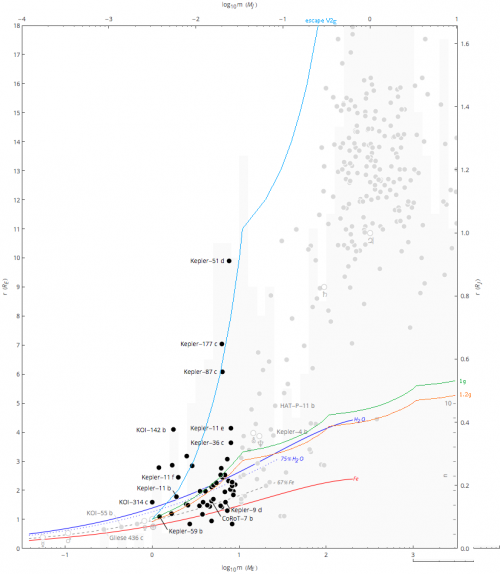
I'm more interested in the bigger and more convenient & useful picture like this graph I've made:
 

Attachments

  • Exoplanet_Mass-Radius_Scatter_Super-Earth-custom.png
    Exoplanet_Mass-Radius_Scatter_Super-Earth-custom.png
    80 KB · Views: 2
Well, per natural development we humans can only live on Earth for another 600 million years before heat changes plant life etc. making it inhospitable. We kill each other in the next few decades or be gone for other reasons a billion years before any slow major cosmic catastrophs could hit us. A close Hypernova might have a higher chance, though.
 
Not looking good for the Swift observatory Flyaway, it will be an expensive loss if it does burn up in the atmosphere.
 
Not looking good for the Swift observatory Flyaway, it will be an expensive loss if it does burn up in the atmosphere.
Not "expensive" loss. It was planned for 2 year mission duration and it has lasted more than 21 years
 
Surrounded by stardust

Our Solar System is currently passing through the Local Interstellar Cloud, a region of highly diluted gas and dust between the stars. On its path, Earth continuously accumulates iron-60, a rare radioactive isotope of iron produced in stellar explosions. This has now been confirmed by an international research team led by the Helmholtz-Zentrum Dresden-Rossendorf (HZDR) through the analysis of Antarctic ice tens of thousands of years old. From the steady but time-varying influx, the researchers conclude that the radioactive isotope has been stored within the cloud since a long-past stellar explosion. The results have been published in the journal Physical Review Letters (DOI:10.1103/nxjq-jwgp).
NASA’s Planet-Hunting TESS Reveals Dazzling Night Sky

NASA’s TESS (Transiting Exoplanet Survey Satellite) has released its most complete view of the starry sky to date, filling in gaps from previous observations. Nearly 6,000 colored dots scattered across the image show the locations of either confirmed or candidate exoplanets — worlds beyond our solar system — identified by the mission as of September 2025 at the end of TESS’s second extended mission.
Lonely Jupiter-like planet tells us more about gas giants
 
Last edited:

Similar threads

Back
Top Bottom