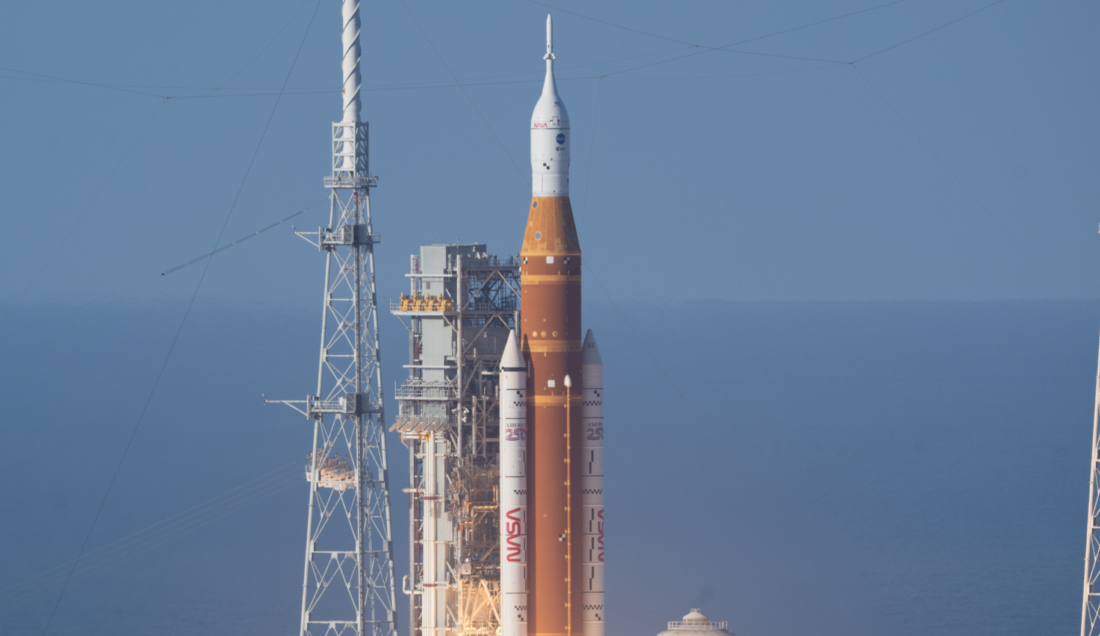
Beautiful
Every industry has its fan. No different than gear heads, railroad foamers,
foamers?

All I heard was "FRNs"

Finding their footing

Cute
 
Last edited:
Opening the path to the lunar surface

“We have to find a common orbit. We have to find a common launch opportunity, and orchestrating a launch of an SLS and two HLS’s will be some kind of feat,” said Kent Chojnacki, HLS deputy program manager, in an interview before the Artemis 2 launch. “So, we’re working on what the art of the possible is there.”

That would need to be done on a tight timeframe. Chojnacki said he had been instructed to prepare for an Artemis 3 launch no earlier than March 2027 and no later than June.

The landers, he said, would not have to be the full versions needed for a lunar landing: the landers would not need landing gear or the guidance, navigation and control systems needed for landing.

“We asked for ideas ranging anywhere from doing proximity operations,” he said, similar to what took place on Artemis 2 where Orion flew around the SLS upper stage, “all the way to a docking with a crew cabin, where you can cross the hatch and do operations within the common atmosphere.”
 
I am a railfan and railroad modeler & yep foamers exist and are a thing.
As for me, I am fortunate in a twisted sort of way with having endocrine and mitochondrial disease and simply not having energy to expend on foaming.

Here, read this from 2009,

https://forum.trains.com/t/what-is-a-foamer/197230

Oh, and have this about that locomotive,
And its road number of 2 is unrelated to the 2 in its type designation.
NOTE to the airplane foamers, EMD locomotive designations do not use a dash like aircraft designations.
Its BL2 instead of BL-2

https://www.american-rails.com/bl2.html
 
What Happens Next For Artemis? Can NASA Launch Artemis III Next Year?

With the Artemis II mission successfully completed NASA has set itself a high bar to prepare Artemis III to fly next year, at least it's a high bar compared to the 3 years between flights 1 and 2. It has to assemble a rocket, decide on the mission and then make sure the other parts of the mission are ready for the flight.

View: https://youtu.be/n19xfIxu8_4
 
Moonbound Episode 1 | Charting the Course

Apr 17, 2026
Artemis II and its test flight around the Moon transformed plans and preparation into execution and exploration. The first episode of our NASA+ documentary series, "Moonbound," explores how NASA prepared to launch new systems and hardware for lunar exploration for the first time with crew.

Under Artemis, NASA will send astronauts on increasingly difficult missions to explore more of the Moon for scientific discovery, economic benefits, and to build on our foundation for the first crewed missions to Mars.

Credit: NASA

View: https://www.youtube.com/watch?v=bfw4G59j9uw
 
I was thinking about how lunar lava caves might be put to work if filled with air.

Here, a cute mechanism uses a slip of paper as a governor:
View: https://m.youtube.com/shorts/YKny2kmx3YM


Imagine a system like this....with a cable played out above the lunar surface.

In the past, I suggested two lunarvator cables in an "X" configuration with statites at the ends...
allowing the intersection to rise and fall via tacking.

A flying windlass is at the intersection, dangling a net.

Asteroid hits the net. A massive windstorm generates power and blows dust into corners.

The asteroid/spacecraft slows.

It descends over a huge staple type structure like the St. Louis arch... descending to the surface ever slower.

Do-able?

That could also drag things across the lunar surface using the asteroid as the tractor.

Green...space
 
Last edited:
Scott Manley has uploaded a video about what happens next for Artemis:


With the Artemis II mission successfully completed NASA has set itself a high bar to prepare Artemis III to fly next year, at least it's a high bar compared to the 3 years between flights 1 and 2. It has to assemble a rocket, decide on the mission and then make sure the other parts of the mission are ready for the flight.​
https://www.youtube.com/redirect?ev...s://www.patreon.com/scottmanley&v=n19xfIxu8_4
0:00 Intro
1:07 The Plan For Artemis III
1:49 The Landers Question
3:45 And now....
5:38 But Isn't SLS The Slow Part?
8:00 Changes Needed For Artemis III
9:33 The ICPS question
11:51 Compare to Artemis II Timeline
13:47 Other NASA Missions To The Moon
 
I was thinking about how lunar lava caves might be put to work if filled with air.

Here, a cute mechanism uses a slip of paper as a governor:
View: https://m.youtube.com/shorts/YKny2kmx3YM


Imagine a system like this....with a cable played out above the lunar surface.

In the past, I suggested two lunarvator cables in an "X" configuration with statites at the ends...
allowing the intersection to rise and fall via tacking.

A flying windlass is at the intersection, dangling a net.

Asteroid hits the net. A massive windstorm generates power and blows dust into corners.

The asteroid/spacecraft slows.

It descends over a huge staple type structure like the St. Louis arch... descending to the surface ever slower.

Do-able?

That could also drag things across the lunar surface using the asteroid as the tractor.

Green...space
You *cannot* design *any* infrastructure to depend on *random* asteroid hits. Human extraterrestrial settlements *cannot* operate like Venus Fly Traps. But do you mind me asking what recreational substance you might be partaking of tonight? An inquiring mind wants to know...
 
Last edited:
Casey Handmer owes the Orion guys an apology. I tell you this--there are those who would have cheered if it didn't hold up.

The "Orion Guys" couldn't deliver a heat shield in which NASA had confidence, so they had to change the re-entry profile to a more aggressive and violent one to get through the heating phase faster. Not a great endorsement.

Artemis III will fly with a heat shield with gas permeability, returning to the honeycomb arrangement of Apollo rather than the solid bricks of I/II.
 
This was actually a steeper profile---they avoided the "skip" that one would imagine is more gentle.

Titan Dragonfly testing also surprised a few

"What was very surprising about the study is that, when we changed the gas, the ablation phenomenon behaved in different ways. In a classical air environment where you have oxygen present, the ablation happens in a steady way. The flow around the spacecraft erodes the surface and particles get ejected as a constant stream.

"But, when the oxygen is removed, this phenomenon becomes unsteady. Intermittent bursts of particles are ejected and, at times, the process becomes violent. I've been around ablation research for over 15 years and I've never seen this. We were all really surprised when we first observed this behavior in the tunnel.
"

Who would think hot oxygen would make re-entry better?

up next

The parachutes
The capsule's three-parachute system—responsible for slowing Orion's descent and ensuring a safe landing—was developed with key computational parachute fluid-structure interaction (FSI) analysis from mechanical engineer Tayfun E. Tezduyar and longtime collaborator Kenji Takizawa, working alongside NASA Johnson Space Center. Their team was the only group providing computational FSI analysis for the parachute system—work completed in 2013, years before Orion's return to Earth.

That modeling proved essential to solving one of the most complex challenges in spacecraft parachute design: how to ensure the parachute is both large enough to slow the spacecraft to a safe landing speed and free from descent speed oscillations associated with shape instabilities
.

Q&A

Another threat?

For decades, we've relied on a NASA test known as NASA-STD-6001B to screen material flammability for flight. But space is much more complicated than an Earth-bound test provides for. A new paper from researchers at NASA's Glenn Research Center and Johnson Space Center and Case Western Reserve University details a planned mission to test the flammability of materials on the moon's surface—where they expect flame to act much differently than it does here on Earth.
New Children's book

NASA underated brand

Artemis II distilled (needs an SLS decanter)

SLS recovery ;)

Of all the Artemis II reactions---this Planetary Society reaction is the one that I cherish the most...since both Louis Friedman and Bill Nye (who has since come around) both trashed SLS. But this day would not be denied--and the look of wonder of these dear individuals gives me hope for the future:


It's been a long time...getting from there to here...
 
Last edited:
False Dichotomy

Both/and not either/or

Besides, I guessed Gateway was a Mars craft on the sly---the propulsion segment is going that way.

Starship had better work for a lunarvator to be constructed. No ice problems at least.

And now the private space world can use a Constellation asset--you know---the one Obama killed?

Originally built in 2005 for NASA's Constellation Space Exploration Program, the centrifuge was designed to help scientists explore how astronauts respond physiologically to reduced-gravity environments experienced on the moon, and eventually Mars. When the program was canceled in 2009, the facility was disassembled and stored at the NASA Johnson Space Center, where it remained in controlled storage for more than a decade.

 
Last edited:
This time on Ripley's Believe it or Don't:

"Is it on the ramps? Is it on the ramps? Here, wait" (push)... inaudible cursing during a cracking sound--"dammit Billy! You said you had it! Just blame it on re-entry like we did the last time."

I'm Dan Aykroyd....more NASA secrets revealed, tonight!

Paper model

View: https://m.youtube.com/shorts/8bYHU9AV8PE
 
Last edited:
NASA on Track for Future Missions with Initial Artemis II Assessments

Following NASA’s Artemis II mission successfully splashing down on Earth, engineers started diving into detailed analysis of data to assess how key systems and subsystems on the Orion spacecraft, SLS (Space Launch System) rocket, and systems at the launch pad at the agency’s Kennedy Space Center in Florida performed. The Artemis II test flight successfully began a new era of exploration, laying the groundwork for the third Artemis mission next year, lunar surface missions, a Moon base, and future missions to Mars.
 
Last edited:
Well, Artemis III isn't even going to have a second stage., and everything is going to stay in LEO.
View: https://m.youtube.com/watch?v=GqmcEFFM_k4


I don't expect any lander.

I say put this module in place of the ICPS---bolt it to the Artemis III core--and have Orion dock with that near ISS so they can get a look at a wet-workshop under construction. Even if the SLS core stays in vacuum, you can have reels of that fancy fiber that start up wants rest against the slosh baffles.

People like SLS, whether folks like that or not. They want ISS too.

Dennis Wingo wanted to use both--he's a pretty bright guy---does good work

Rather than spending all of our time and efforts peeing in each other’s shoe to either get rid of the ISS to free up more spending for payloads for the SLS, or to try and kill the SLS in order to create some new architecture with Falcon Heavies or other commercial vehicles, why not integrate the SLS into an ISS centric architecture?

Arty III's core is in Florida already:

Time for some spontaneity.

And don't talk to me about foam popcorning---if Elon and Bezos don't care about debris, then I don't either. If it is near ISS or along its spine---you can cover it up with spacewalks.

Time they ate NASA's dust for a change.

You don't need tech-bros to do big. Let's prove it.

Besides, Artemis III's core with a rusted Gateway makes a fine Lunar Starship docking target for Orion--since I don't see Lunar Starship flying before the Sun goes Red Giant.

Artemis II SLS

Artemis III core

The women of SLS
 
Last edited:
https://europeanspaceflight.com/esa-sheds-light-on-nasa-administrators-claims-on-gateway-modules/

ESA confirmed that the HALO module, which had been delivered to Northrop Grumman in April 2025 for final outfitting before being handed over to NASA, had arrived with signs of corrosion. While the agency confirmed that I-HAB had a similar but less severe issue, it clarified that the module had not yet been shipped to NASA.

Following the identification of corrosion on HALO, a comprehensive investigation was promptly initiated. Preliminary findings indicate that the issue likely results from a combination of factors, including aspects of the forging process, surface treatment, and material properties. A dedicated tiger team was established for I-Hab under the guidance of ESA to solve this issue. Based on the investigation and available data, the corrosion issue was understood to be technically manageable and did not constitute a showstopper for I-Hab, which was, in any case, in better condition than HALO from a corrosion point of view.”

Based on programme information shared by NASA, other elements provided by the US supply chain, such as the life support system and the thermal control pump, were also experiencing notable delays and technical complexity
 
We have raised earlier the issue of their staff broking clean rooms rules with an apparent very relaxed way. To say the least, nobody should be surprised today.

Epicurean engineering scarcely brings you were you really wanted.
 

Similar threads

Back
Top Bottom