That's a huge article, might take a month to read.
But good that it has black box simulation video.
After getting low & high speed warnings, while the true air speed was near stall, the pilots disengaged auto-pilot & pushed throttle to max, but unfortunately left engine malfunctioned, otherwise they could have survived.
With 1 engine,
B-757-300 with RR RB-211-542G/H engine, max T/MTOW = 264000/(9.8*123830) = 0.217
But Birgen air 757-200 with RB-211-535E4 engine, 178000/(9.8*115660) = 0.157
B-777-300-ER with GE-90-115B engine, max T/MTOW = 513000/(9.8*351533) = 0.149
B-787-10 with GenX-1B76/78 engine, max T/MTOW = 340000/(9.8*254000) = 0.136
A-330-300 with PW-4000-112 engine, max T/MTOW = 441000/(9.8*242000) = 0.186
A-350-941 with Trent XWB-97 engines, max T/MTOW = 431000/(9.8*283000) = 0.155
B-777 & 787 having worse T/MTOW, are said to be survivable with 1x engine failure.
After getting low & high speed warnings, while the true air speed was near stall, the pilots disengaged auto-pilot & pushed throttle to max, but unfortunately left engine malfunctioned, otherwise they could have survived.
If the article is accurate - there's a lot of supposition going on and he's not always clear where the data supports his theories and where he's guessing - the left engine didn't malfunction. The airflow into it was disrupted by the stall/high-AoA and caused a compressor surge - it's an airflow problem caused by the stall/aircraft attitude, not an engine problem.
They were in a stall, with the autopilot pushing the nose past 21 degrees AoA in an attempt to slow down what its sensors were telling it was a dangerous overspeed. Increasing thrust would only delay the inevitable, which might well be further complicated by one or both engines entering a compressor stall - and that would be the inevitable spin, because there's no way that would happen symmetrically. What they needed to do was drop the nose, and increase speed to exit the stall, which would also remove the risk of compressor stall, but they didn't even realise they were in a stall, and dropping the nose as they're bleeding altitude past 5000 feet probably seemed contra-intuitive.
Power to weight ratios are utterly irrelevant to the situation.
If the article is accurate - there's a lot of supposition going on and he's not always clear where the data supports his theories and where he's guessing - the left engine didn't malfunction. The airflow into it was disrupted by the stall/high-AoA and caused a compressor surge - it's an airflow problem caused by the stall/aircraft attitude, not an engine problem.
They were in a stall, with the autopilot pushing the nose past 21 degrees AoA in an attempt to slow down what its sensors were telling it was a dangerous overspeed. Increasing thrust would only delay the inevitable, which might well be further complicated by one or both engines entering a compressor stall - and that would be the inevitable spin, because there's no way that would happen symmetrically. What they needed to do was drop the nose, and increase speed to exit the stall, which would also remove the risk of compressor stall, but they didn't even realise they were in a stall, and dropping the nose as they're bleeding altitude past 5000 feet probably seemed contra-intuitive.
Power to weight ratios are utterly irrelevant to the situation.
Should airliners also implement slant intakes like in F-14/15/22 to trap air in high AoA?
Although F-22/35 have static port & pitot's tubes on cheeks, they got IMU (Inertial Measurement Unit) aiding in speed, orientation. The airliners also got INS (Inertial Navigation System), so is there any speed reference by this system?
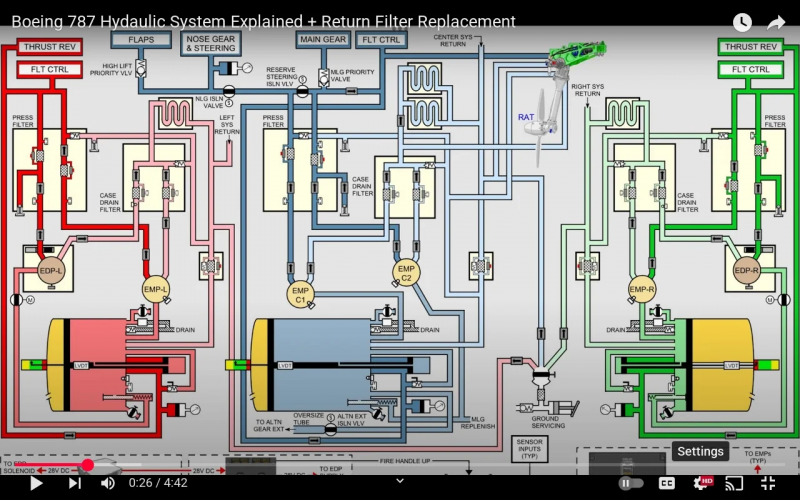
Also found a detailed diagram in video for changing hydraulic filter.
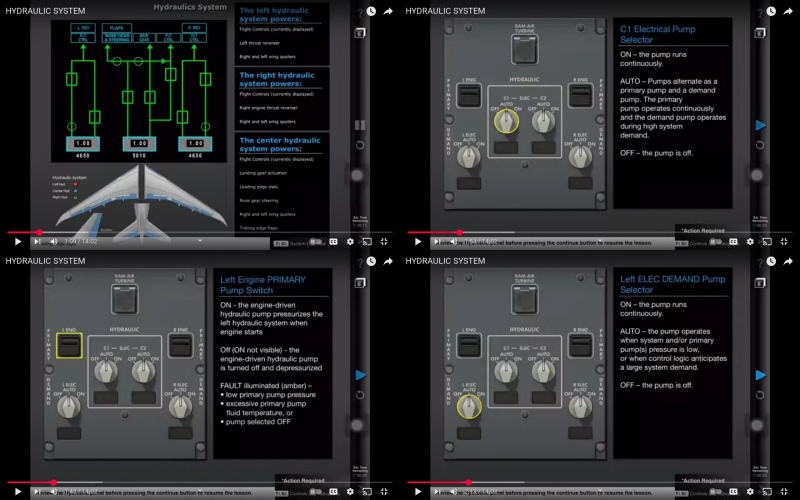
OBSERVATIONS from CBT video -
> There are 3 hydraulic systems - center, left, right, with their reservoirs.
> The center one has control over highest # of control surfaces.
> The left & right systems seem to have very limited controls, but the CBT says it is adequate.
> Left system controls -
- some flight control surfaces - 1 flaperon pair, 1 spoiler pair.
- thrust reverser
- left tail-stab
- rudder
> Right system controls -
- some flight control surfaces - aeleron, 1 flaperon pair, 1 spoiler pair.
- thrust reverser
- right tail-stab
- rudder
> Center system controls -
- aelerons, flaps, most flaperons, 2 spoiler pairs.
- both tail stabs
- rudder
> Total 7 hydraulic pumps - 2 engine driven left/right, 2 electrical left/right, 2 electrical central, 1 RAT.
> Engine driven pumps are primary & mechanically driven by N2 spool.
> Demand pumps are secondary/supplementary & electrical & work under conditions -
- system pressure low.
- for 3 mins after both engines started on ground.
- from time the T/o thrust is set to flaps retraction or Radar Altitude >2000 ft.
- flaps or slats are in motion.
- from gear down or Radar Altimeter <1000 ft. to ground speed <40 knots.
- for thrust reverser.
> Secondary Demand electric pumps &/or central electric pumps will display fault when -
- low pressure
- excess fluid temperature
- switched OFF
> The 2 central electric pumps take primary/secondary role based on odd/even calendar days.
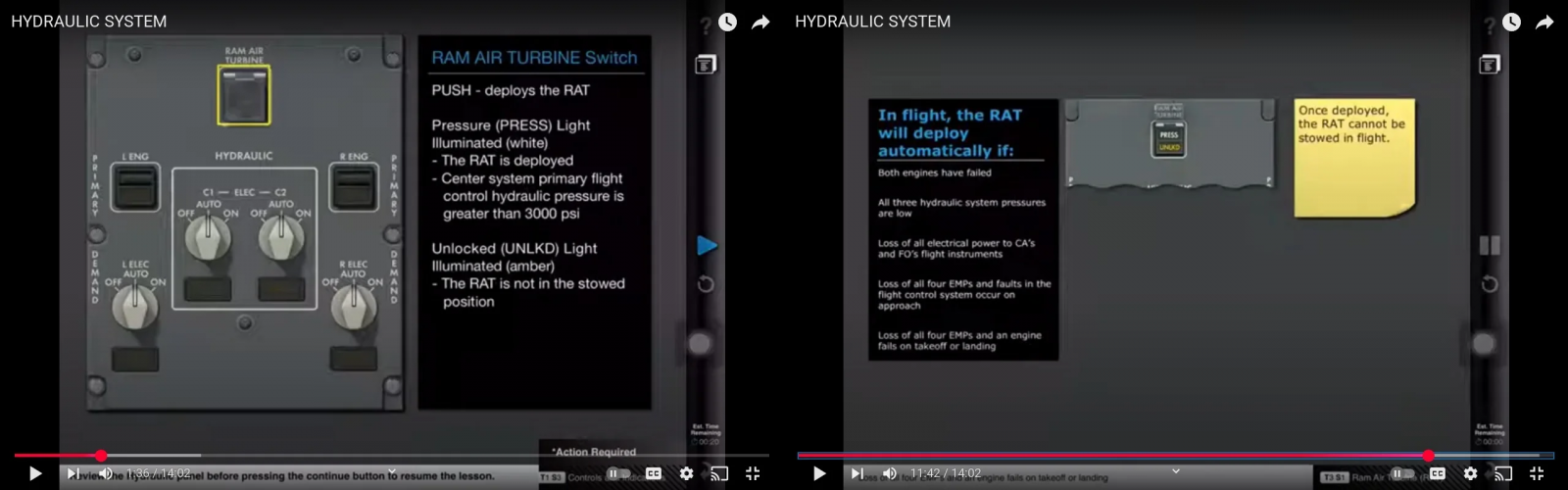
> RAT pump in emergency caters to flight controls of center hydraulic system.
> RAT will auto-deploy when -
- both engines have failed.
- all 3 hydraulic system pressure low.
- loss of electricity to Captain's & FO's flight instruments.
- loss of all 4 EMPs & FCS fault on approach.
- loss of all 4 EMPs & 1 engine fail on T/o or landing.
> Hydraulic isolation function gives safety during leaks by -
- Nose gear isolation valve.
- Reserve steering isolation valve.
- Alternate extended isolation valve.
- Reserve standpipe.
- All isolation valves are automatic FMC controlled, no manual operation available.
> When fire handle is pulled up, it shuts the EDP valve depressurising the EDP.
> If big electrical failure happens then load shed might disable 1 or more Demand electrical pumps, but RAT pump will backup central system.
DERIVATIONS from observations -
> During T/o, central EMPs, primary EDPs & secondary EMPs are operational.
> Hydraulic isolation function may not be for gear retraction.
> RAT pump may not retract the landing gears. I guess it would be last priority. Or may be the RAT electricity might do it if/when sufficient.
> The hydraulic & electrical videos don't say about secondary electricity to central EMPs or secondary Demand EMPs.
The 28 VDC system & additional battery are backups of 3x PMGs, they support fuel pumps, but may not be for hydraulic EMPs.
Soperhaps EMPs don't have backup directly from generators or PMGs, but only indirect loop from central busses.
> We saw in Electrical video that central electrical bus fail should not affect basic flight due to battery+RAT for cockpit & FMC; 2x PMAs for their EECs, 3x PMGs for GCUs & hence generators should function.
> If electricals fine but some glitch in air data sensors &/or FMC &/or EEC pulling back the engine RPMs, then primary EDPs will be INOP but secondary Demand EMPs would function.
> If central electric busses fail then central EMPs & secondary Demand EMPs would be INOP but RAT pump will backup central hydraulics & the primary EDPs will still remain primary.
> If central busses fail & RPM glitch then central EMPs, primary EDPs & secondary Demand EMPs would be INOP, but RAT pump would backup central hydraulics enough for emergency flight & landing.
If the article is accurate - there's a lot of supposition going on and he's not always clear where the data supports his theories and where he's guessing -
Despite the name, Admiral Cloudberg is female, and an amateur. She bases her articles on the official accident reports, so, if those are lacking in information, so will her articles. As I've posted above, I linked to this article purely to show the effects of the blocked pitot and static ports . . .
Despite the name, Admiral Cloudberg is female, and an amateur. She bases her articles on the official accident reports, so, if those are lacking in information, so will her articles. As I've posted above, I linked to this article purely to show the effects of the blocked pitot and static ports . . .
It's the reference to the compressor stall that doesn't seem to have any explicit supporting data. I can't see any reason to suggest one unless there is data to say it happened. As you say the issue is really the air data system, but once people started interpreting it as an engine failure, it needed clarifying.
Okay, yes, turning the fuel switches OFF would physically account for how the crash could have happened.
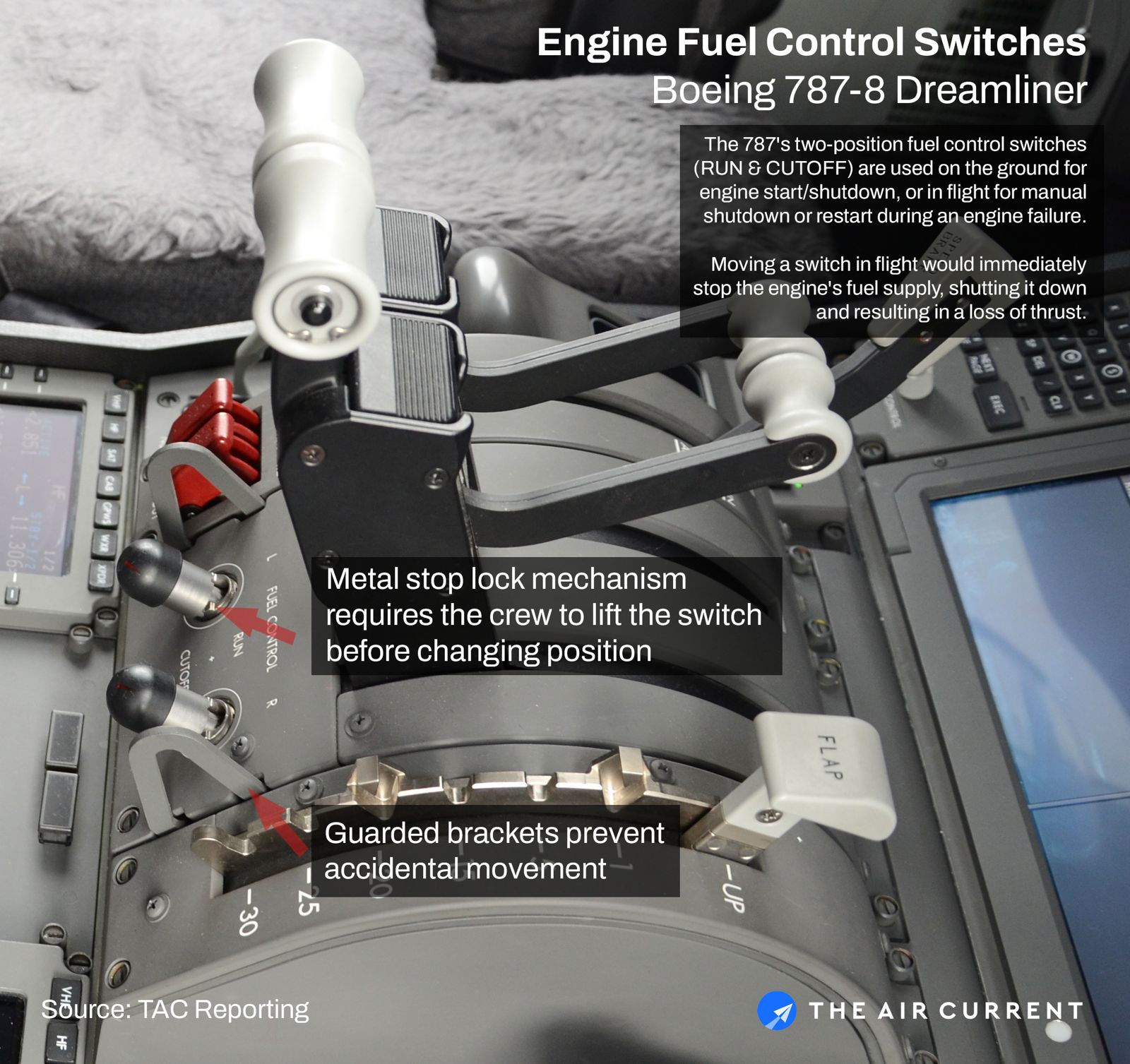
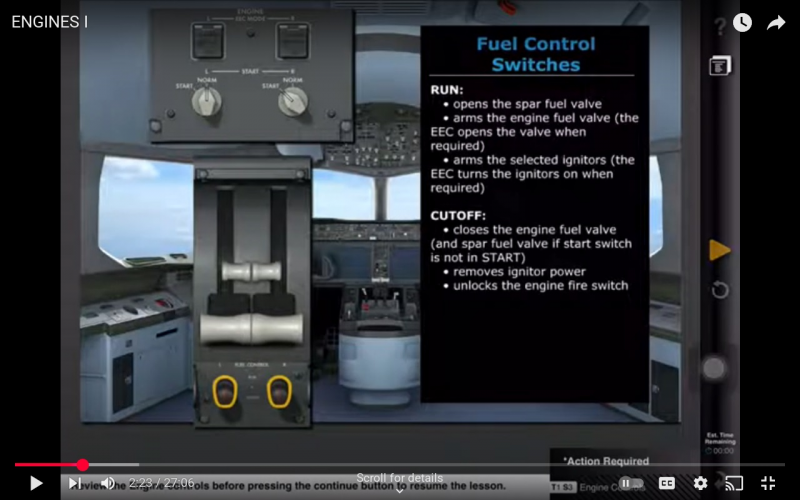
But as that picture shows, there are two mechanical protections on those switches to prevent accidentally moving them! Both a physical guard bracket and a spring-loaded pull-up-to-move latch.
Pilot errors have been there but the accusation theory needs to be careful.
All journalists should come to forums like this.
Most Indian aviation/defence journalists & media houses are funny & incompetent, don't do their own homework, dependent on foreign media.
Shiv Aroor is defence journalist working for top media house NDTV. Their videos are waste. They focus more on politics, money, numbers, timeline, etc but technical coverage is very poor.
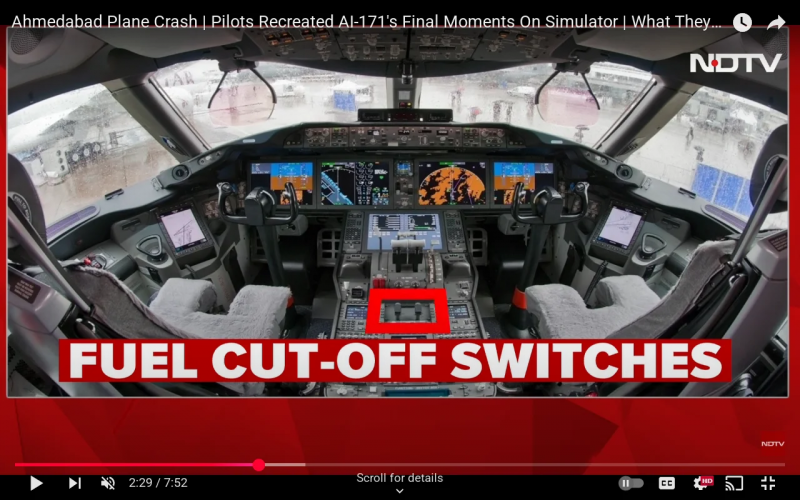
Here is a screenshot from their video where they highlighted fire handle as fuel switch. For some this could be a small mistake but when suspecting pilot of pulling flaps lever instead of gear handle then such highlighting is big blunder which can change people's belief & narrative.
It takes just 5-10mins of searching on Google, YouTube, etc.
1 person in big team makes mistake, entire team or media house will lose competition to other media sources.
> But if we consider this wild theory of fuel switches also, why/how would a pilot wrongly close BOTH fuel switches????
Or it sounds like a "Final Destination" movie script that some object like a diary, logbook, iPad, handbag, coffee mug, etc dropped on both the fuel switches???
IMO such critical switches should have a guard cap, however, the pilots would immediately switch them on back,
- re-opening the fuel valves &
- arming the ignitors which EEC would ignite.
That's exacty what historically pilots did in other mid-air incidents globally at higher altitudes.
> Historically, proving error of defenceless dead pilots benfits the airframe & engine makers, airline operator. Many engineers & lawyers globally have pointed this possible corruption.
> Tomorrow these guys might say that the pilot accidentally pressed fuel pumps, electrical or hydraullic buttons!!!
Or it sounds like a "Final Destination" movie script that some object like a diary, logbook, iPad, handbag, coffee mug, etc dropped on both the fuel switches???
IMO such critical switches should have a guard cap, however, the pilots would immediately switch them on back,
There are two physical guards on the fuel cutoff switches!
Also, having messed with those types of switches before, dropping an object on them would be more likely to bend the switch handles than to force the switches into the OFF position.
There are two physical guards on the fuel cutoff switches!
Also, having messed with those types of switches before, dropping an object on them would be more likely to bend the switch handles than to force the switches into the OFF position.
Yeah, so we should consider this theory debunked unless 1 of the pilots wanted to commit suicide for which there are many better ways rather than killing many along self.
Another thing -
- IDK if the spools have rotation braking kind of thing upon shut off.
- Zero to idle RPM takes 45-60 seconds for any engine.
- From numerous take-off videos we see that idle to 100% RPM takes 2-3 seconds only, considering EEC/FADEC avoiding engine damage by sudden rapid RPM change.
- So under full throttle IFF fuel switch is turned off for few seconds & then on again considering exceptional stupidity, then the 100% RPM would not drop rapidly, may be to say 70-80%, then again fuel supplied & ignitors on, the engine(s) should relight to 100% power.
- Total flight time was 32 seconds.
- This RPM glitch or mistake would happen just after takeoff around say 25% of horizontal distance & 50% of vertical height, around 8 seconds after take-off.
- In next 8 seconds till Apogee the error should be expected to be corrected after quickly checking fire, fuel, electricity, then switches back to ON, the engines should drop to 70-80% RPM then back to 100%. There is no time to follow a slow checklist of 1 engine failure.
- In next 8 seconds after Apogee, the temporary loss of thrust would lower the jet's altitude but regain of thrust should allow a narrow escape just above the buildings, similar to Go-Around 'touch & go' scenario.
Pilot errors have been there but the accusation theory needs to be careful.
All journalists should come to forums like this.
Most Indian aviation/defence journalists & media houses are funny & incompetent, don't do their own homework, dependent on foreign media.
Shiv Aroor is defence journalist working for top media house NDTV. Their videos are waste. They focus more on politics, money, numbers, timeline, etc but technical coverage is very poor.
It's not a report from Shiv Aroor, it's a report from Jon Ostrower, at his newsletter the Air Current, which is as serious an aviation source as you can get.
It's not a report from Shiv Aroor, it's a report from Jon Ostrower, at his newsletter the Air Current, which is as serious an aviation source as you can get.
Just because it would be difficult to activate a switch doesn't mean that the switch wasn't activated, there are plenty of accidents where that happened. Pilots reach for one thing, accidentally hit another and muscle memory takes over.
Just because it would be difficult to activate a switch doesn't mean that the switch wasn't activated, there are plenty of accidents where that happened. Pilots reach for one thing, accidentally hit another and muscle memory takes over.
Just because it would be difficult to activate a switch doesn't mean that the switch wasn't activated, there are plenty of accidents where that happened. Pilots reach for one thing, accidentally hit another and muscle memory takes over.
The speculations can be endless till Black Box data is made transparent & publicly understandable under judicial enquiry.
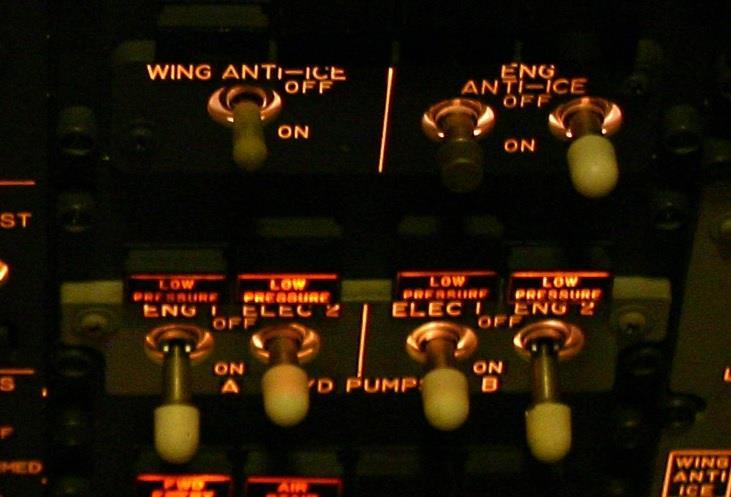
In B-737 those overhead hydraulics & anti-ice switches are adjacant & look identical.
And there is no immediate sound or vibration to notice the functions like engines rev up/down.
So muscle memory error by a pilot not serious about his/her life threatening job can be understood.
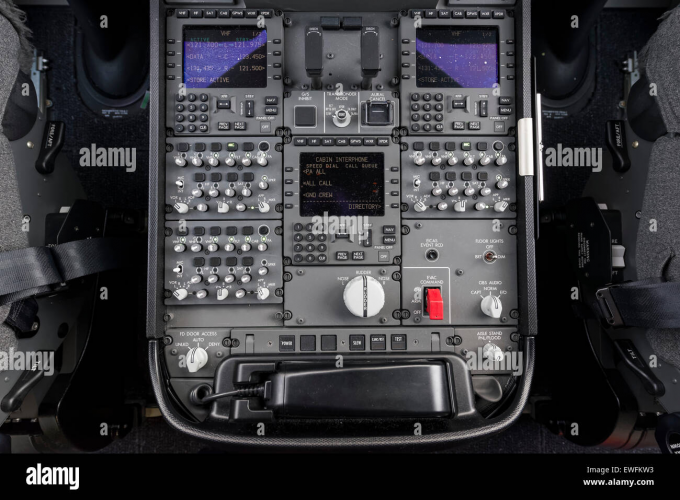
But in B-787 during T/o, as per checklist & real videos, the pilots don't have any need to reach the center panel behind throttle having communications & navigation setup before flight.
The fuel switches are adjacant to flaps lever but they look/feel different & the T/o flaps position in the notches is well ahead.
And 1st the co-pilot would retract the gear & then the flaps as speed increases.
As the gear was seen tipped front means gear lever was put up. During this time some glitch or mistake is suspected.
Black box data can reveal the most unexpected thing but at this time it is difficult to imagine that pilot reached for fuel switches instead of or after gear lever, flaps lever.
But assuming this pilot error also i said that they might immediately switch them back on by muscle memory.
They would be cursing themselves "Oh! shit! What the hell did i do? Damn!"
This should happen around Apogee, the engine would stutter, RPM coming down to 70-80% & then again catching up. The lone survivor said he heard the engines RPM going up, but it was too late.
Reading Ostrower’s article in TAC I noted that it says that the investigation “has narrowed its focus to the movement of the engine fuel control switches”. Now this could of course refer to the cockpit switches (as everyone seems to be assuming it means), but I don’t think we should rule out that “switches” could also be lawyer-speak for valves.
Further, the article says: “All of the people who spoke to TAC said that the details surrounding movement of the engine fuel control switches will take months –if not longer-to analyze alongside other available data and findings”
Really? If it was pilot error or even sabotage (as in the cockpit fuel valves the pilots have control over having been lifted from the run position, moved back down to the cutoff position), would that not be immediately obvious from the flight data recording?
And if so, i.e. as in this being a pilot error/sabotage action would this not be immediately communicated or even leaked by Boeing? They have every interest to clear this up as soon as possible and what would be better for an aircraft company than to conclude that this was a pilot error and no fault in the aircraft? As it is now the suspicion of a fault in the aircraft’s design is still casting a long shadow over Boeing’s design and the flight recorder should be able to give a simple yes/no answer to if the pilots closed the cockpit fuel switches or not.
The statement in the TAC article that it will take months to determine “the movement of the engine fuel control switches” makes me suspect that we should rather interpret this as the investigating focusing on ALL the valves and switches in the chain from the fuel tank to the engine. Else why would it take months? To determine the position of two pilot-controlled switches in the cockpit? Really?
Maybe I’m being overly conspiratorial in interpreting Ostrower’s text and the information leaked so far, but since lawyers are probably involved in what’s being communicated I would not be surprised if “switches” could actually mean valves as well and the general chain between fuel tanks and engines. Else why is this projected to take months to investigate?
As it is now the article hints that the cause may be human error which certainly may be true since we can’t rule that out, but if not, this would not be the first time a big company with muscles and lawyers used this sort of communication via backchannels as damage control.
It is very, very hard to see how it could be an accident to move those switches in the cockpit.
What other systems provide control signals to the FSOVs? If you pull the fire handles, do those also tell the FSOVs to shut? Or is there a separate fire shutoff?
Logic suggests that fire switches would cut fuel pumps to that particular enbgine so, both switches would shut off both engines. However, I am aware that logic and cogent thought on the matter can often lead to different results. COULD this be dependant on pressure in the fuel lines?
Not sure if an engine fire would alter the pressure in the fuel lines tbh.
Industry partners in air crash investigations are generally forbidden from communicating details outside of the official releases from the investigation. Boeing were publicly sanctioned by the NTSB when they leaked information on the door plug investigation last year and their further participation in the investigation was restricted.
It's probably important to remember that just because the FDR records a switch as operated doesn't mean the switch was physically moved. What the FDR is recording is the electric signal that corresponds to that switch. It could have been moved, or it could be a short, a software logic error, mis-wiring, even a bit-flip from a cosmic ray, or potentially a range of other things that aren't occurring to me right now.
It's exponentially more difficult to come up with a scenario that covers both switches, but I don't think it's necessarily impossible.
Logic suggests that fire switches would cut fuel pumps to that particular enbgine so, both switches would shut off both engines. However, I am aware that logic and cogent thought on the matter can often lead to different results.
It's probably important to remember that just because the FDR records a switch as operated doesn't mean the switch was physically moved. What the FDR is recording is the electric signal that corresponds to that switch. It could have been moved, or it could be a short, a software logic error, mis-wiring, even a bit-flip from a cosmic ray, or potentially a range of other things that aren't occurring to me right now.
It's exponentially more difficult to come up with a scenario that covers both switches, but I don't think it's necessarily impossible.
Fair point and I get it. What I am hinting at is something you pointed out in your post, deliberate action to shut off the fuel pumps. Something that the bleep bleep cee nooz have stated is in the prelim report this evening.
I have to admit to finding the nooz reports dump facts and even the ability to convey the English language in a meaningful manner. Leaving no more than a suggestion of the truth.
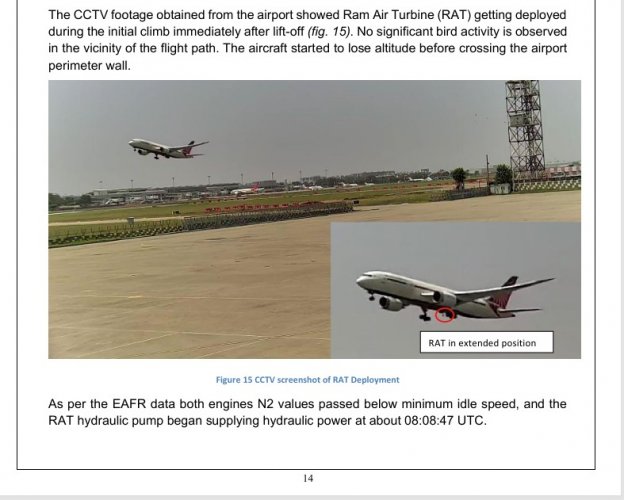
Page 10, bottom paragraph: "Both fuel control switch were found in the “RUN”position. (fig.13)"
Top of page 15: "As per the EAFR, the Engine 1 fuel cutoff switch transitioned from CUTOFF to RUN at about 08:08:52 UTC. ... Thereafter at 08:08:56 UTC the Engine 2 fuel cutoff switch also transitions from CUTOFF to RUN."
It's a peculiarly imprecise way to commit suicide, a few tens of yards to the left and they might have bellied down in open ground with significant numbers of survivors, potentially including the pilots.
While deliberate action is definitely in the ballpark, the investigators will also have to rule out brain-fart.
Definitely baffling. My suspicion is a really poorly timed brain fart. Seems about the right time they'd be commanding landing gear up, and in some completely bizarre mental oops, the pilot instead flipped the cutoff switches. This fits with the audible comment, and the switches being restored in about the amount of time it would take to process the monumental lapse, get over the lapse and take action.
The suicide theory seems implausible to me for a number of reasons, one being the timing - given that both engines were restarted at the time of the crash, and one was beginning to increase rpm, it seems likely hitting the cutoff even a short time later could have been survivable. Likewise, slightly earlier likely could have been as well. I struggle to believe someone would put the effort into a rather sophisticated method yet one with a significant risk of failure. One also has to assume that the other crew didn't see anything out of the ordinary, and a pilot who is waiting the exact moment to flip a switch and kill several hundred people seems likely to be in a noticeably different mental state. Another factor is resetting the switch, and the apparently well controlled flight after cutoff. Assuming it was deliberate, it seems likely the pilot doing so would not allow the other to reset the switches, or at a minimum there'd be a struggle, and the pilot struggling to reset the switches would also be the one flying the plane, so very likely unable to devote much energy to a struggle. Hence it's really rather difficult to align this scenario with the comment on the CVR, short time to switch reset (10-14 sec), and controlled purposeful flight.
Page 10, bottom paragraph: "Both fuel control switch were found in the “RUN”position. (fig.13)"
Top of page 15: "As per the EAFR, the Engine 1 fuel cutoff switch transitioned from CUTOFF to RUN at about 08:08:52 UTC. ... Thereafter at 08:08:56 UTC the Engine 2 fuel cutoff switch also transitions from CUTOFF to RUN."
Still doesn't make sense for a pilot to shut down the engines. I mean, that'd be muscle memory so far out of norms that it's not even in the same continent. Gear levers aren't close, not even the correct direction of motion for pilot reaching for gear.
Still doesn't make sense for a pilot to shut down the engines. I mean, that'd be muscle memory so far out of norms that it's not even in the same continent. Gear levers aren't close, not even the correct direction of motion for pilot reaching for gear.
This site uses cookies to help personalise content, tailor your experience and to keep you logged in if you register.
By continuing to use this site, you are consenting to our use of cookies.