And unless there's been a physical failure inside the engine accessory gearbox, at least one hydraulic pump per engine will still work. (There's a mechanical hyd pump and a mechanical generator on each engine)
787 has two generators, two electrically-driven pumps and one mechanically driven pump per engine as part of Boeing's "more-electric airplane" initiative (plus two generators on the APU). While there's more redundancy, it's also a more complex system for failure management, and we've seen weaknesses in Boeing's safety case analysis on other aircraft.
Fuel issue. IIRC tropical airports are notorious for algae contamination, which plugs the fuel filters after a few minutes. Engines choke, plane becomes a glider.
Possibility of maintenance issues are there.
But if it is a case of tropical weather then all equatorial countries should face ALGAE issues. Multiple jets should get affected, how only just 1?
The same fuel companies supply fuel for other industrial & household purposes. So ALGAE issue should be there too, choking industrial machines, bikes, cars, trucks.
In a default scenario, there are S.O.P.s & ISO standards to follow, multiple quality checks, quick checks & elaborated checks.
The ALGAE or any contamination cannot build up so rapidly to suddenly stop 2x internal combustion engines & crash a vehicle. Otherwise it should stall bikes, cars, trucks too. When initial contamination builds up then engine will sputter/shudder/stutter, forcing for maintenance.
It is analogous to us sneezing, coughing & not straight away dropping dead on floor.
Captain Steve in his videos & statements said the fuelling trucks have contamination detection mechanism, IDK technical detail of that.
So if those fuel giants are so careless then not just airports but entire country will face issue of some kind of contamination & issues with vehicles.
It would be a scam of unprecedented scale.
Citizens will stop taking fuel from them, their shares in stock market will collapse, the company or subsidiary might go bankrupt.
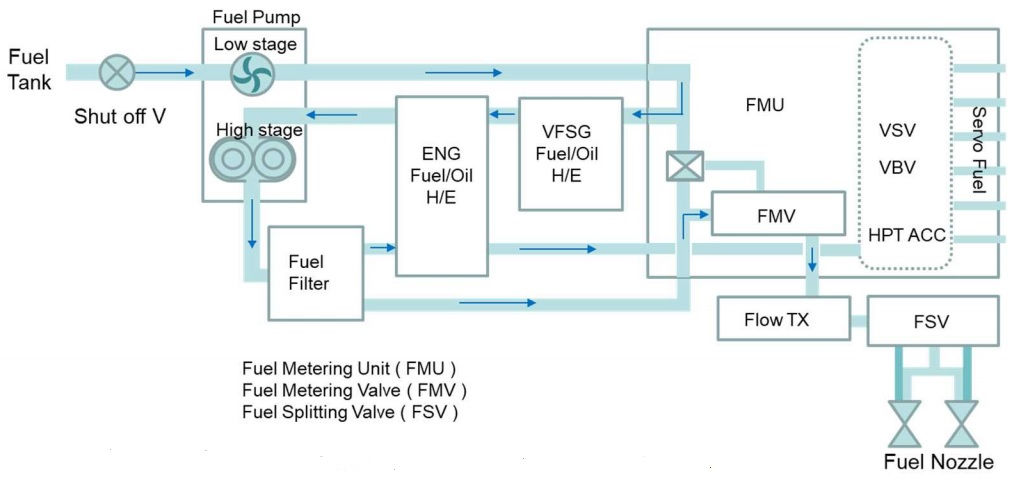
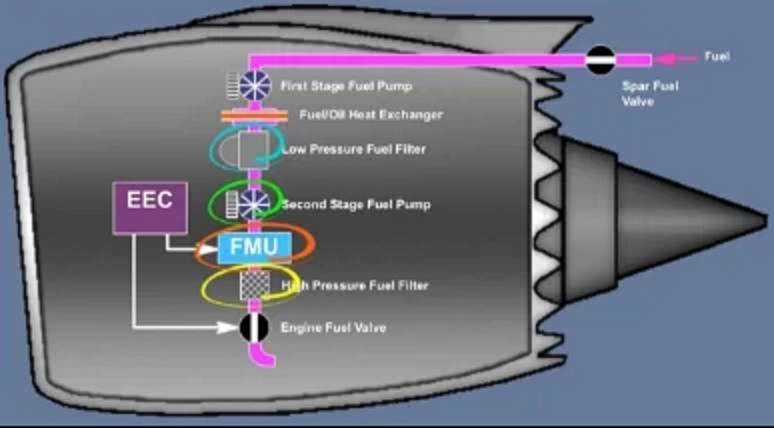
Each GenX-1B engine has -
- Fule Metering Unit
- LP & HP pumps
- LP & HP filters
So contamination should cause pressure & flow irregularities recorded by FMU, forcing for maintenance.
IDK the Black Box contains data of how many flights.
The data can be recorded in redundant bit level for max data.
If it has last few flights data then irregulaties will be recorded there.
However, the Indians are also considering different types of poor quality components & sabotages, a criminal/terror/geopolitical angle.
I've writen there-
+ve mean something natural, factual, usual, agreeable, concluding.
-ve mean something alarming, critical, dangerous, should not happen.
Possibility of maintenance issues are there.
But if it is a case of tropical weather then all equatorial countries should face ALGAE issues. Multiple jets should get affected, how only just 1?
The same fuel companies supply fuel for other industrial & household purposes. So ALGAE issue should be there too, choking industrial machines, bikes, cars, trucks.
Jet fuel is carried separately from other fuels, in dedicated tanks. Or in tanks that have been specially cleaned between carrying whatever load was in there previously and jet fuel. It's usually cheaper for dedicated tanks, but there is a procedure in place if you have to use a non-dedicated tank. Jet fuel does not go through pipelines for delivery unless the pipeline is only ever used for jet fuel.
In a default scenario, there are S.O.P.s & ISO standards to follow, multiple quality checks, quick checks & elaborated checks.
The ALGAE or any contamination cannot build up so rapidly to suddenly stop 2x internal combustion engines & crash a vehicle. Otherwise it should stall bikes, cars, trucks too.
Usually caused by a failure of the pump truck operator to do some things on the checklist.
Note that for whatever reason algae doesn't like gasoline, so bike or most cars will not fail. Road diesel engines do not have as fine a filter as jet engines do.
Correct. And a road diesel doesn't have the aircraft-quality filters. And in general, "Oh, dammit, the fuel filter's clogged. It'll take 5 minutes to swap in a new one on the side of the road." It's a non-event in a ground vehicle, other than the vehicle stopping running.
Plus, ground vehicles get more crap in their fuel that cause filters to clog. Water? yup. A fuel filter will not pass water. Dirt. Debris.
If the fuel came out of a tank that has been sitting a long time, even varnish deposits. Those were gross, and I think we replaced the fuel filter 5 times before the varnish was out of the tank.
Jet fuel is carried separately from other fuels, in dedicated tanks. Or in tanks that have been specially cleaned between carrying whatever load was in there previously and jet fuel. It's usually cheaper for dedicated tanks, but there is a procedure in place if you have to use a non-dedicated tank. Jet fuel does not go through pipelines for delivery unless the pipeline is only ever used for jet fuel.
Usually caused by a failure of the pump truck operator to do some things on the checklist.
Note that for whatever reason algae doesn't like gasoline, so bike or most cars will not fail. Road diesel engines do not have as fine a filter as jet engines do.
When i Google searched "algae contamination in jet fuel", it didn't show any incident. On that contrary, it shows jet fuel from algae.
Can you share some links of historical reports?
Correct. And a road diesel doesn't have the aircraft-quality filters. And in general, "Oh, dammit, the fuel filter's clogged. It'll take 5 minutes to swap in a new one on the side of the road." It's a non-event in a ground vehicle, other than the vehicle stopping running.
Plus, ground vehicles get more crap in their fuel that cause filters to clog. Water? yup. A fuel filter will not pass water. Dirt. Debris.
If the fuel came out of a tank that has been sitting a long time, ]even varnish deposits. Those were gross, and I think we replaced the fuel filter 5 times before the varnish was out of the tank.
On an international busy airport there is no reason to keep a filled fuel tank exceptionally isolated to keep algae growing, unless the ground crew including management is mentally retarded.
MODERATELY USED & INFESTED TANK will also cause engine sputter/stuter/shudder, that too in multiple jets, on multiple days & time, not a sudden crash only for 1 jet,
that too late at 1:38 pm local time.
IMO, i'm not 100% negating it, but for now i would not consider it.
Although maintenance issues overall still considered but it spans numerous things.
> Both these examples show blunder mistakes of adding 38x fuel-additive biocide & bad construction practices of fuel storage area. This is different from algae growing in tank over time.
They don't match the situation of AI-171.
Here the faults by inorganic chemicals like SAP & biocide is proven,
but not by organic algae.
> These incidents happened either mid-flight, means issues took time to manifest. In 2nd one engine start fault happened on ground bcoz it is a unique series of blunder mistakes, but then ultimately in 3rd flight during T/o.
> In these 2 cases both the engines did not cease but ran at low RPMs due choking of piston of FMU (Fuel Metering Unit) & valve of HMU (Hydro Mechanical Unit). While in case of AI-171 the pilot's Mayday call reported something like "no thrust, no power, losing lift, going down", speculating 0% RPM.
Common enthusiasts like us consider contamination as water, paste like dirt, some solid particles but not to the limit of 100% blocking valves, filters, etc causing complete loss of thrust.
+ we would expect many filters & quality checks at every step used while transferring fuel from beginning till end -
- refinery to transport tanker
- transport tanker to airport storage
- airport storage to fuelling tanker
- fuelling tanker to aircraft
> Most IT/Electronics/Electrical/Mechanical, even Civil engineers can never guess rapid reaction of salt water corroding SAP filter during refuelling.
None the less, this is definitely educating & a qualitative addition to knowledge.
And overall maintenance issues are still being considered.
This one happened due to multiple mistakes, that too on ground on multiple flights & ultimately in 5th flight during takeoff -
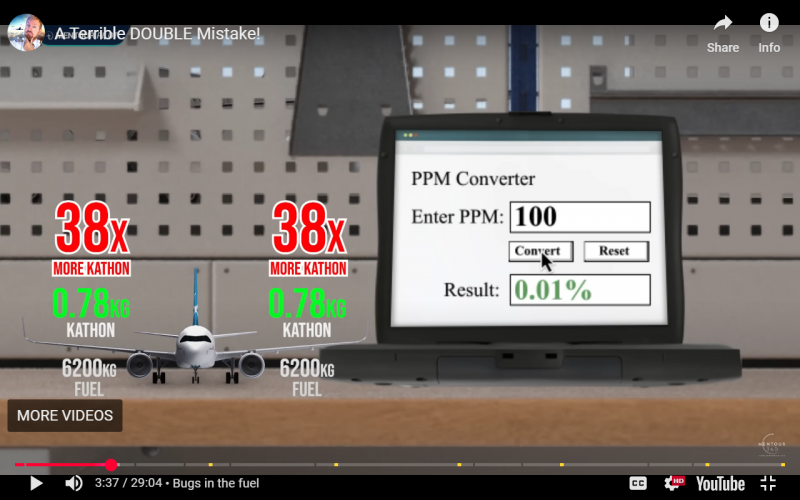
- Language barrier in Cyprus, not understanding what is PPM (Parts Per Million).
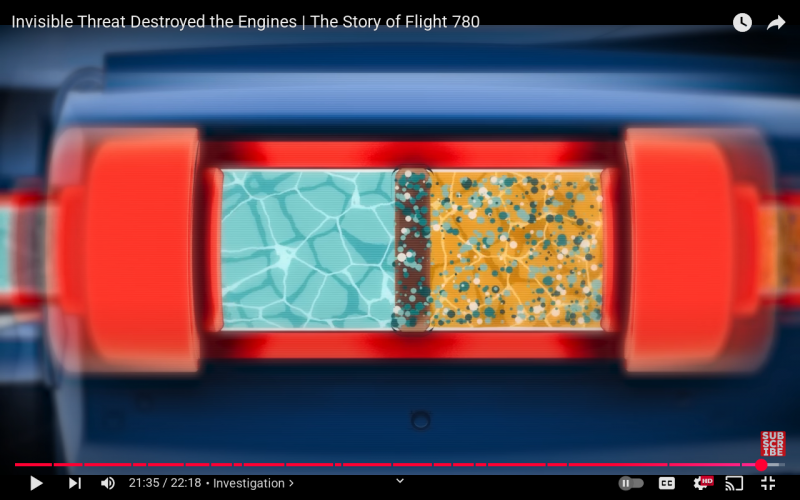
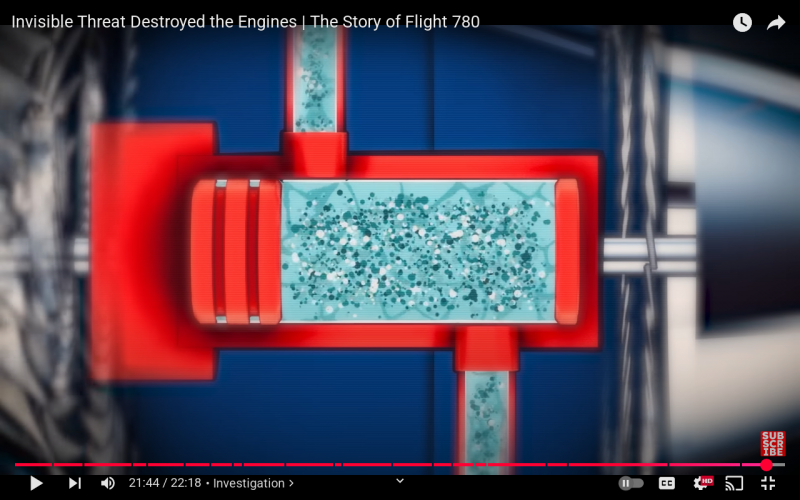
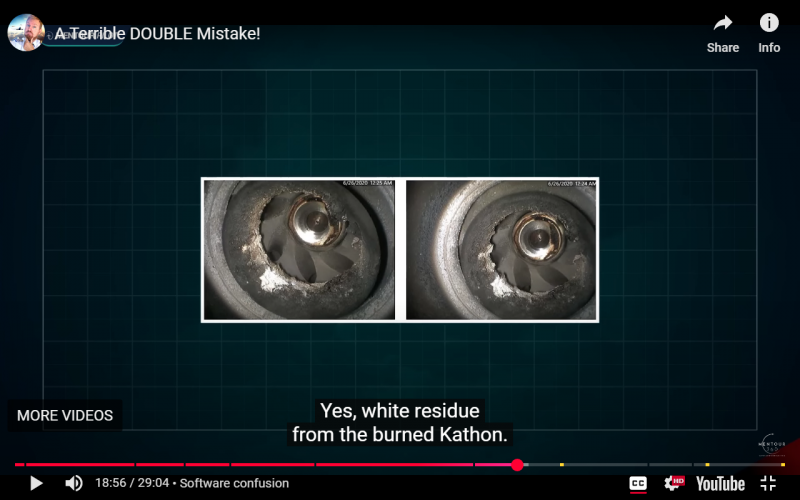
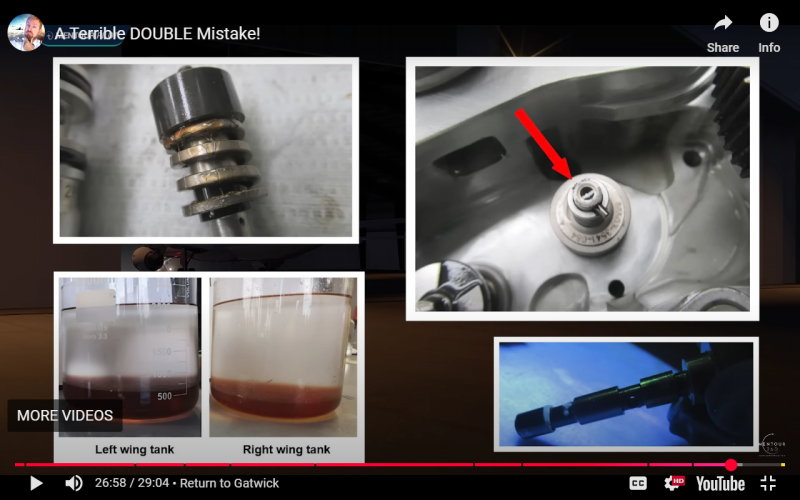
- Wrong calculation & 38x quantity of Kathon biocide over-use & concentration in HMU, not due to algae.
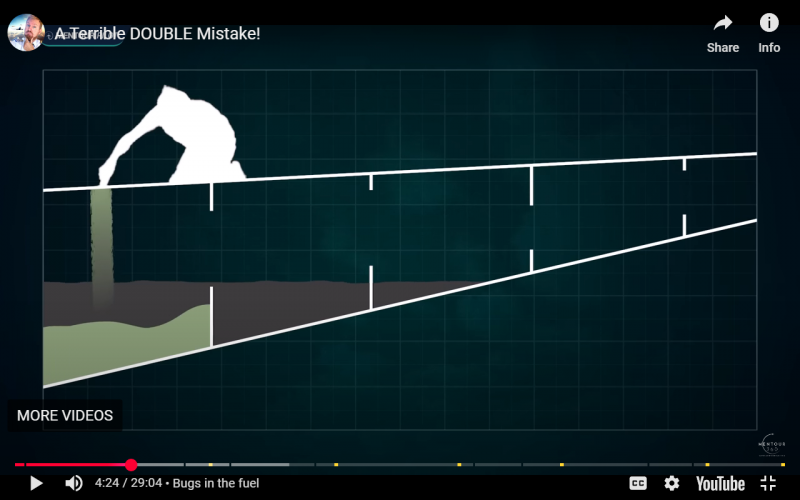
- As per re-enacted animation it seems that biocide was added improperly from top access port, not mixed well with proper tools, leaving sludge on bottom & tank outlet, went into HMU & choked it. Hence right engine started but left engine took 4 attempts to start on ground.
- Before next flight the ground engineer referred to troubleshooting by fault code rather than engine model, hence of wrong engine.
- & no boroscope inspection was done.
+ we would expect many filters & quality checks at every step used while transfering fuel from beginning till end -
- refinery to transport tanker
- transport tanker to airport storage
- airport storage to fuelling tanker
- fuelling tanker to aircraft
I'll try my best to use common sense & significantly reduce color & large fonts. And i never use slangs or personal comments.
I know this forum since more than a decade. This is probably the best forum i've come across with actual diagrams, graphs, pics, tables, specs, etc. I have huge respect for such members.
Lastly, newspapers, magazines & TV news channels are best examples of variable fonts & colors. Forum members here joining across the globe are heterogenous.
So some minimum sparing freedom shoud be allowed, or disable the features.
Algae need sunlight to survive, so there is no danger of having algae in Jet or Diesel fuel. Funghi are a well known real problem (I drove about 100.000 km with Salat oil, so I know what I'm talking about...) which can grow inside fuel tanks. To be really able to do so, they not only need fuel, but water as well, than they can form a layer between water an fuel. It usually happens when the fuel is stored for longer time (condensation of water). Since it forms only a layer, it is very well possible, that only one jet was affected, when this layer reached the intake of the pumping system.
Yes, all maintenance areas should be investigated.
But also remembering different geographical situations & contamination can/should throw errors in advance on ground itself.
Titan Airways, Airbus A321, the incident spanned across 5 flights.
24 Feb 2020, Cyprus - London, no errors !!!!!!.
25 Feb 2020, London - Gatwick, On ground for left engine -HP Fuel valve warning, engine took 2 attempts to start.
25 Feb 2020, Gatwick - Balice (Poland), no errors !!!!!!
26 Febl 2020, Balice (Poland) - Gatwick, On groundfor left engine -2 timesHP Fuel valve warning,
engine stall warning once,
left engine took 3 attempts to start,
momentary errors in flight
& thumping sound after landing.
26 Feb 2020, Gatwick - London, On ground for left engine - ignitor fail alert,
engine fail alert 2 times,
engine took 4 attempts to start, incident on take-off,
Fortunately the engines didn't fail completely & the jet could turn around & land, thumping sound after landing.
And getting back to the subject of the thread, I can't find the link where I read it this morning - probably on FlightGlobal - but India has had Air India checking their 787s (as has Japan), and the results so far are of 33 aircraft, 24 checked, 3 in progress, 4 not yet checked, and 2 AOG that won't be checked until they're fixed and airworthy again, there have been no problems found. The investigators did have some comments on maintenance systems and spares holdings, but nothing of direct relevance to the investigation.
There will always be That One Outlier that forces a change in the rules or introduces an entirely new extra gray area nobody considered to be a problem until the issue gets forced.
"Findings from the wreckage suggest the flaps and other control surfaces were correctly configured for takeoff, indicating the flight crew followed standard procedures, the WSJ said, citing investigators."
For redundancy, I would assume that everything that has to do with the engines was duplicated and that the engines were fed from two totally independent fuel systems. What are the odds that both these would clog up due contamination at exactly the same instant? Why no spluttering and varied trust? Why does it seem like they lose thrust on both engines at basically the same instant?
Unfortunately I think we have to add SW to the list of possible causes. For Boeing's sake I hope it's something else but with their recent history of quality control issues I don't think it can be ruled out. Especially so since it seems like we are talking about both engines shutting down almost at the same time.
Maybe some SW engineer got the job to see to it that the system would not allow pilots to take off if the reading on some temperature sensor somewhere was approaching the vapor lock level. Then wrote the code for that but forgot/missed to factor in that they could already be airborne. Or the code was there but was bugged or never validated properly. The possible SW faults in a computer controlled airplane are endless.
I've had it there since the beginning, and in general I think it needs to be there in every crash of a modern airliner. Whether FBW or not, there are so many critical control systems, and their reversionary systems, that can fail just as blatantly, or just as subtly, as a mechanical system. And an emergency, where things are reverting to less commonly used modes, and less commonly used systems, is precisely where less commonly exercised code and less commonly encountered combinations of circumstances are brought into play.
Even if something mechanical failed, did the software side do what it was supposed to? And even if something mechanical failed, did it fail because the software drove it to?
Maybe some SW engineer got the job to see to it that the system would not allow pilots to take off if the reading on some temperature sensor somewhere was approaching the vapor lock level. Then wrote the code for that but forgot/missed to factor in that they could already be airborne. Or the code was there but was bugged or never validated properly.
Just for precision, that would be a systems engineering job to specify, not at the individual coder level, and that requirement should go to at least six separate people - systems engineer, coder, tester, and their respective reviewers*, plus potentially integration testers and reviewers. It's very difficult to get that kind of failure through if it's in the code. But if it's in the systems requirement that's only a couple of people. And if it's in the customer requirements.....
Nowadays, if it's safety critical, you're hopefully doing Design by Contract and there's also a compiler-like proof checker (eg the SPARK Examiner) to verify the correctness of your implementation.
And then there's the safety analysis and the failure scenarios. The MCAS investigation did show up not just major failings in the overall requirements, but also in the safety case/fault tree evaluation, with entire branches of the fault tree not evaluated.
* I've worked on projects where all code went through multi-person reviews.
Algae need sunlight to survive, so there is no danger of having algae in Jet or Diesel fuel. Funghi are a well known real problem (I drove about 100.000 km with Salat oil, so I know what I'm talking about...) which can grow inside fuel tanks. To be really able to do so, they not only need fuel, but water as well, than they can form a layer between water an fuel. It usually happens when the fuel is stored for longer time (condensation of water). Since it forms only a layer, it is very well possible, that only one jet was affected, when this layer reached the intake of the pumping system.
I had hoped that what I wrote would be understood for what it was, i.e. just as an example that sometimes there are unintended consequences in SW design and not as an expose of SW development which of course is a bit more complex than my example. I’m quite aware of this having worked for more than 30 years as a systems engineer both in the aviation industry and with mobile systems. So I’ve been around to see quite a few different work models starting off with the waterfall model, via concurrent engineering, to where we are today.
But my point was not about any particular work process, because there are many ways to skin the cat, and how you structure the chain from specification, system design, implementation to verification can vary, but as long as you do it right then faults should not slip through, whatever the work process. Especially for flight critical systems, which when I was working with SW development in the aviation industry had (for obvious reasons) a wholly different level of verification requirements than other systems.
However, even classing something as flight critical is no guarantee, because in a complex system you will have something called a verification matrix, and this will be huge. And at the top level, the problem could originate from not even being in the matrix. On a second level, it could actually be in the test matrix but was for some reason not included in the verification. On a third level, top management in their wisdom may have fretted over verification costs and the time plan, and gotten some ambitious mid-level manger to strike it out of testing, thereby getting an attaboy for keeping the costs down and saving the time plan.
So maybe there are some very worried managers, system engineers, SW development and verification people looking at the flight data recording output right now. Or maybe they can continue to sleep well since it was all due to contaminated fuel or something else. We just don’t know at this stage. But seeing that both engines seem to have died basically at the same time, I would not be surprised if this turned out to have something to do with the fuel control system.
Curiouser and curiouser. The engines were able to drag the fully-fueled, very heavy plane well past V1, hence takeoff : yet once in the air, pooof : thrust went away and the plane could only crash down.
What can disturb engine thrust that way ? that's the main question.
My (limited) understanding is that for takeoff there are things like TOGA, which means : maximum thrust to get past V1 and off the ground. Right ? so, if thrust was about to die, why did the thrust anomaly did not manifested itself down on the solid ground, for example when the pilots went TOGA / full throttle to takeoff ?
Since the RAT was working, could a massive electrical short impact both engines; to such extend, it killed thrust to zero ?
FADEC glitch taking down both engines at the same time is super unlikely.
My A&P is from before widespread FADECs in planes, so I tend to assume mechanical causes instead of software.
But yes, software cause(s) is possible here. My personal problem is not knowing what all inputs are going into the FADEC, and what the various sensor faults do to the program. Too many possibilities with all the sensors plugged in.
Old school mechanical fuel control usually has spool RPMs, commanded throttle position, and usually an air pressure reference or two. And leaves it the pilot's job to watch Turbine Inlet Temperature (usually. Blackbirds were unusual in limiting Compressor Inlet Temps)
Curiouser and curiouser. The engines were able to drag the fully-fueled, very heavy plane well past V1, hence takeoff : yet once in the air, pooof : thrust went away and the plane could only crash down.
What can disturb engine thrust that way ? that's the main question.
A clocked filter for example, you don't recognize, when the filter surface is 95 % blocked, but after a certain point, it all happens very fast. The last 5 % have a very high specific flow ratio which means, also a very high dirt flow rate.
I know this from driving my camping bus with salat oil....
A clocked filter for example, you don't recognize, when the filter surface is 95 % blocked, but after a certain point, it all happens very fast. The last 5 % have a very high specific flow ratio which means, also a very high dirt flow rate.
I know this from driving my camping bus with salat oil....
Yes, it's mostly humidity, though the heat helps it grow faster. I'm sure it happens equally as often in the southern US, where it's 100% humidity and 100degF all summer long.
Water contamination in the storage tanks, fueler tech doesn't look at the fuel coming out of the tanks. Single-point refueling means you don't see the fuel going into the plane.
On a third level, top management in their wisdom may have fretted over verification costs and the time plan, and gotten some ambitious mid-level manger to strike it out of testing, thereby getting an attaboy for keeping the costs down and saving the time plan.
The national airworthiness authorities would have something to say about that scenario. And yes, I've had them leaning over my shoulder saying "show me where you did <this>".
The national airworthiness authorities would have something to say about that scenario. And yes, I've had them leaning over my shoulder saying "show me where you did <this>".
I'm sure you have but you seem to be missing the point yet again: Of course the airworthiness authorities are very interested that you ticked all the boxes but how would they catch something that is not even on the list of verification items supplied by the contractor because the management wanted to speed up the verification process?
A few items for what appears to be a community much better informed than me. First, aren't there sensors on the fuel trucks to specifically cut off fuel supply if an impurity or water is detected? Also, does anyone think that vapor lock could be a possibility. I think (not sure) the ambient temperature was 110 degrees F. The B787 has a limitation of 122 degrees F (I think). But that depends on other ambient conditions including altitude and relative humidity. To those that understand the situation better, is vapor lock a plausible contributor? All best.
I'm sure you have but you seem to be missing the point yet again: Of course the airworthiness authorities are very interested that you ticked all the boxes but how would they catch something that is not even on the list of verification items supplied by the contractor because the management wanted to speed up the verification process?
You can outright lie to the airworthiness authorities, but that can see you facing criminal charges as the Boeing 737 MAX test pilot found out. You're also assuming none of your colleagues are going to flag it up either internally - we all had multiple managers we reported to, project manager, professional manager, and on top of that was the Chief Engineer, explicitly for this kind of scenario - or externally. If you want a significant enough saving to be worthwhile, then it's going to be obvious.
When I say I had NAA reps demanding to see where a change was implemented, they didn't just want a tick in the box, they wanted to see the relevant files at all stages - systems, software, testing, and integration testing going into our configuration management system with the sign-offs from the reviewers. And while one set of NAA reps were checking the config management system with me, others would be looking at sample changes all through the process. And these weren't simply admin guys, they were experts in their field - spent a fascinating afternoon chatting to one of them about the early work on Design by Contract they were involved with for the MoD. There's no way you could slice out a whole layer of testing and not be caught out.
TLDR: No, I didn't miss your point, I just didn't find it very likely.
You can outright lie to the airworthiness authorities, but that can see you facing criminal charges as the Boeing 737 MAX test pilot found out. You're also assuming none of your colleagues are going to flag it up either internally - we all had multiple managers we reported to, project manager, professional manager, and on top of that was the Chief Engineer, explicitly for this kind of scenario - or externally. If you want a significant enough saving to be worthwhile, then it's going to be obvious.
When I say I had NAA reps demanding to see where a change was implemented, they didn't just want a tick in the box, they wanted to see the relevant files at all stages - systems, software, testing, and integration testing going into our configuration management system with the sign-offs from the reviewers. And while one set of NAA reps were checking the config management system with me, others would be looking at sample changes all through the process. And these weren't simply admin guys, they were experts in their field - spent a fascinating afternoon chatting to one of them about the early work on Design by Contract they were involved with for the MoD. There's no way you could slice out a whole layer of testing and not be caught out.
TLDR: No, I didn't miss your point, I just didn't find it very likely.
I see you are very much an engineering type of personality, believing that since there are checks and balances and there are procedures to follow then there is no way to get things past the controllers etc, etc. But then OTOH you yourself mention the MCAS debacle: Now how did that happen if things don’t sometimes slip through? And why did doors get blown out of jetliners recently? Well because a contractor was not manufacturing stuff according to specs, and when this was dutifully reported up the chain those who did so were side-tracked by management who swept it all under the rug and kept production running with known results.
It takes a special kind of naiveté not to understand that no matter how ISO-certified your work process may be, and how stringent your verification process is, cutting corners for some comes naturally. Especially since people who are “flexible” and do so get promoted. Autistic always-by-the-book engineers who are not “co-operative” don’t. And while some pick this up during their career (but even so don’t play ball), for some it’s not even an active choice because it all just flies over their head.
Anyway, to get back to the issue at hand: I´m not saying it has to be another SW scandal. I’m just saying it COULD be. And personal anecdotes of just how good and professional people you worked with, and how things cannot slip through on your watch won’t change that.
S/w glitches & clogged sensors leadin to dillema for S/w decision, have history in civil & military aviation.
YF-22 crashed
F-22 crashed
F-35 crashed
B-2 crashed
F-117 crashed
Bo-737 MAX crashed
For Titan Airways A-321 with kathon over-use, the ground crew used fault code to filter database rather than engine model leading to wrong troubleshooting. Such things can lead to wrong S/w patch update too.
So theoretically, on a Bo-787 the FMC/EEC could also have glitch due to many reasons.
S/w glitches & clogged sensors leadin to dillema for S/w decision, have history in civil & military aviation.
YF-22 crashed
F-22 crashed
F-35 crashed
B-2 crashed
F-117 crashed
Bo-737 MAX crashed
For Titan Airways A-321 with kathon over-use, the ground crew used fault code to filter database rather than engine model leading to wrong troubleshooting. Such things can lead to wrong S/w patch update too.
So theoretically, on a Bo-787 the FMC/EEC could also have glitch due to many reasons.
Yes, and the second JAS 39 Gripen crash was even due to a known SW limitation. But is was declared airworthy even so because the airworthiness authorities agreed with SAAB's and FMV's assessment that the special circumstances that would cause this were very unlikely to happen. Somewhat laconically, they (the airworthiness authorities) themselves later on concluded that this proved not to be the case.....
I am sorry but fuel contamination is the less probable factor. Only that plane that day had thrust problem.
Also, the pilots reported no thrust and not "engine out" or "flame out". A nearly 10000 flying hours pilot would have made the difference.
"No thrust", I think refers to the plane being in the high drag corner with its flaps up. The most probable reason: hydraulic failure. That would be confirmed by cockpit indicators not informing the crew that the flaps were nearly completly retracted, the spoilers deployed (free floating) and leaving them tho think that the gear was retracting as the lock position was not indicated anymore (see @zoo Tycoon post).
I am sorry but fuel contamination is the less probable factor. Only that plane that day had thrust problem.
Also, the pilots reported no thrust and not "engine out" or "flame out". A nearly 10000 flying hours pilot would have made the difference.
"No thrust", I think refers to the plane being in the high drag corner with its flaps up. The most probable reason: hydraulic failure. That would be confirmed by cockpit indicators not informing the crew that the flaps were nearly completly retracted, the spoilers deployed (free floating) and leaving them tho think that the gear was retracting as the lock position was not indicated anymore (see @zoo Tycoon post).
The original FHD 1080p video can be enhanced to see that flaps are in T/o position. Some people could make it out from "video of video" also, intially floating for viewership, shame on those news channels.
Hence pilot error on flaps instead of gear was initially floating but thereafter debunked & discontinued even by those pilots who raised it.
Some pilots have shown in S/w sim & H/w sim that flaps retraction at low speed would have rolled, yawed & stalled the jet rather than a level stall.
I could be inaccurate but from original video it seems that RAT & engines were running but at idle kind of RPM. If true then it could be FMC/EEC glitch.
Let's wait and see. The recorders have been recovered. If they are exploitable, an early report might well be available soon.
For the original video, there was a story (by the BBC?) on the kid that filmed it on his (or dad's) mobile phone. A remarkable story of a young air fana, with the good quality footage included.
This site uses cookies to help personalise content, tailor your experience and to keep you logged in if you register.
By continuing to use this site, you are consenting to our use of cookies.