Stargazer

ACCESS: USAP
Top Contributor
Senior Member
Joined
25 June 2009
Messages
15,515
Reaction score
9,424
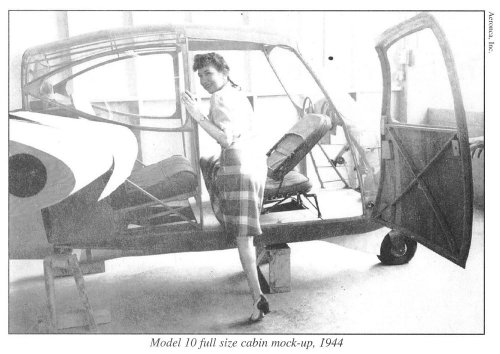
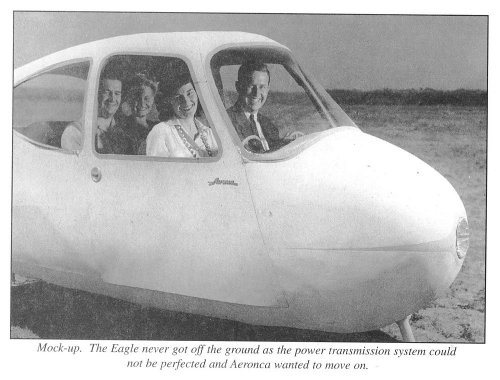
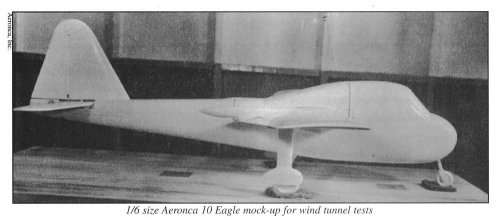
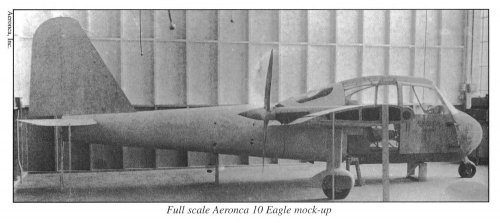
Designed to meet the transportation needs of family and business air travel, the four-place Aeronca Model 10 Eaglewas to be roomier than any other plane in its price class.

Peter Altman, Detroit University aeronautical engineer and consultant to Aeronca, designed the Eagle. It was to have retractable tricycle landing gear and powered by twin pusher gas turbines driving the propeller. Altman's patent application was filed on August 2, 1945. This airplane never got off the ground, figuratively or literally, as the power transmission system could not be perfected and Aeronca wanted to move on.


Source: Aeronca's Golden Age by Alan Abel, Wind Canyon Books, 2001.
 

Attachments

  • Eagle_01s.jpg
    Eagle_01s.jpg
    79.9 KB · Views: 236
  • Eagle_02s.jpg
    Eagle_02s.jpg
    88.5 KB · Views: 230
  • Eagle_03s.jpg
    Eagle_03s.jpg
    131.3 KB · Views: 212
  • Eagle_04s.jpg
    Eagle_04s.jpg
    169.9 KB · Views: 182
Great find Stargazer,


for the Aeronaca,its projects are very rare.
 
Designed to meet the transportation needs of family and business air travel, the four-place Aeronca Model 10 Eaglewas to be roomier than any other plane in its price class.

Peter Altman, Detroit University aeronautical engineer and consultant to Aeronca, designed the Eagle. It was to have retractable tricycle landing gear and powered by twin pusher gas turbines driving the propeller. Altman's patent application was filed on August 2, 1945. This airplane never got off the ground, figuratively or literally, as the power transmission system could not be perfected and Aeronca wanted to move on.


Source: Aeronca's Golden Age by Alan Abel, Wind Canyon Books, 2001.
Very unique and much interesting civil plane!!
Is it possible a 3-view drawing to be find??
 
Not surprising.
Circa 1945, dozens of American airplane manufacturers projected a massive surge in sale of private airplanes immediately post-war. Traditional manufactures (e.g. Aeronca) geared up to produce thousands of Champs, Chiefs, etc. but sales were no where near expectations. Dozens of factories went bankrupt and closed.
Plenty of projects - like the above never got beyond mockup stage.
The market was further diluted by thousands of war-surplus trainers auctioned off for pennies on the dollar.
Canadian farmers often bought war-surplus planes, drained the gasoline and pushed the remnants behind the barn to rot.
 
General Question,

we know from Aeronca Model-6 to Model-12,then came Model-15,what about
Model 13 & 14 ?.
 
Very unique and much interesting civil plane!!
Is it possible a 3-view drawing to be find??
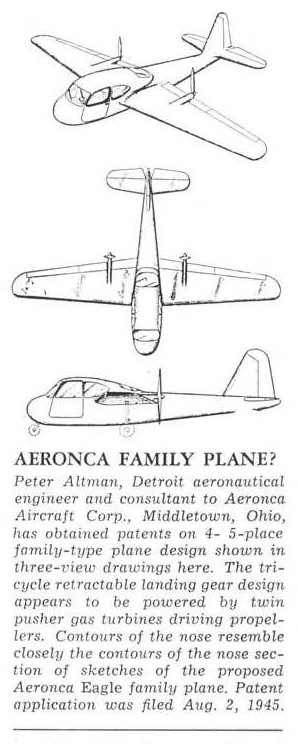
Not quite a three-view drawing as we understand it, but probably the closest we can get: the patent artwork (from Aviation Week, 18 March 1946). Finding the original patent (see attachment) was a little tough because 1°) the Aeronca name does not appear in it, and 2°) Google Patents wrongly filed it under "Peter Altaian" instead of Peter Altman...

1752223359385.png
 

Attachments

  • USD144020.pdf
    118.1 KB · Views: 6
Not quite a three-view drawing as we understand it, but probably the closest we can get: the patent artwork (from Aviation Week, 18 March 1946). Finding the original patent (see attachment) was a little tough because 1°) the Aeronca name does not appear in it, and 2°) Google Patents wrongly filed it under "Peter Altaian" instead of Peter Altman...

View attachment 777587
Thanks a lot for that!
 
Thanks a lot for that!
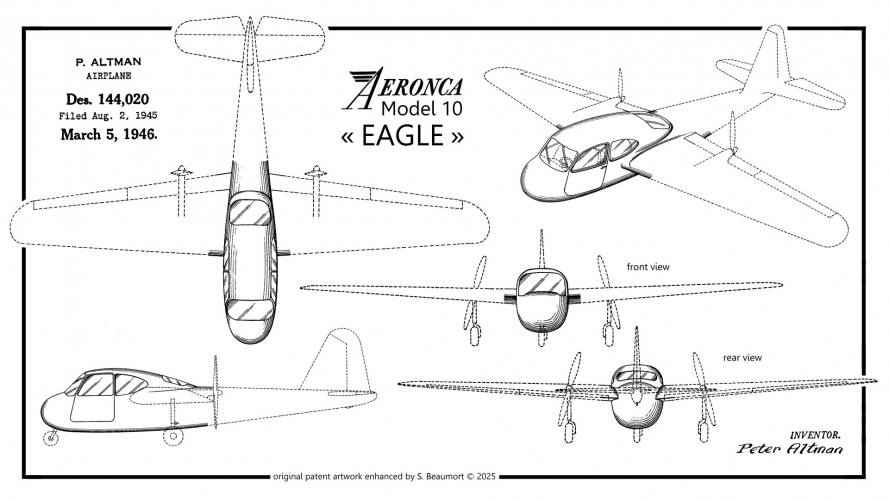
My pleasure. I have just finished reworking the design patent PDF into a clean, single image plan.
Eventually I'd like to completely redraw the plan as a proper three-view arrangement without the dotted lines (which incidentally do not appear in the Aviation Week item).

1752227881350.png
 
My pleasure. I have just finished reworking the design patent PDF into a clean, single image plan.
Eventually I'd like to completely redraw the plan as a proper three-view arrangement without the dotted lines (which incidentally do not appear in the Aviation Week item).

View attachment 777592
Excellent drawings indeed! Since there are no dimensions or even a scale ruler, I was wondering what the estimated wingspan was. Do you have any idea?
Also, since there was noted that it would be pushed by “... twin pusher gas turbines driving the propeller ...”, I am wondering, where were supposed to be located the turbine intakes?? I can't see them in any of the above 3-view drawings!
 
Also, since there was noted that it would be pushed by “... twin pusher gas turbines driving the propeller ...”, I am wondering, where were supposed to be located the turbine intakes?? I can't see them in any of the above 3-view drawings!
Possibly within the leading edges of the wings? A huge part of the patent drawings is made up of dashed lines instead of full ones; since this was a design patent, not a technology patent, there was no need to reveal the technicalities I guess. Also the Aviation Week drawings do NOT show the front view, which may also indicate that Aeronca was keeping the technical aspects hush-hush... The leading edge is also covered in the mockup photos...
 
Possibly within the leading edges of the wings? A huge part of the patent drawings is made up of dashed lines instead of full ones; since this was a design patent, not a technology patent, there was no need to reveal the technicalities I guess. Also the Aviation Week drawings do NOT show the front view, which may also indicate that Aeronca was keeping the technical aspects hush-hush... The leading edge is also covered in the mockup photos...
as about the wingspan, I asked ChatGPT (!) and the answer I've got was an estimation of around 36 feet.
 

Similar threads

Back
Top Bottom