Aeronautical Syndicate Ltd.

hesham

ACCESS: USAP
Senior Member
Joined
26 May 2006
Messages
38,285
Reaction score
20,424
Hi,

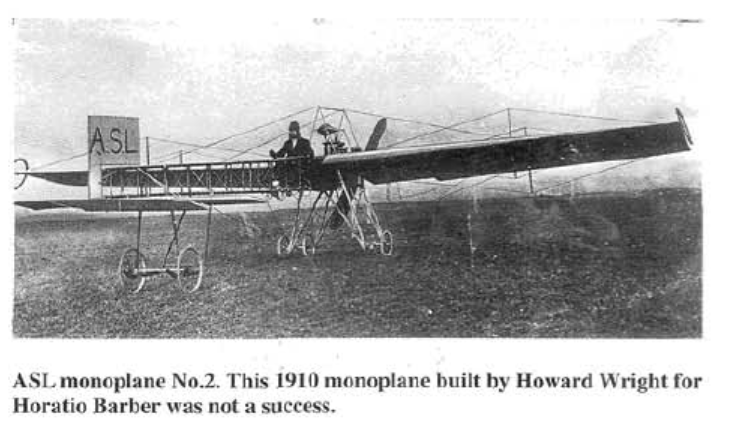
it was formed in 1909,by Horatio Barber,this company built Monoplane No.1 and
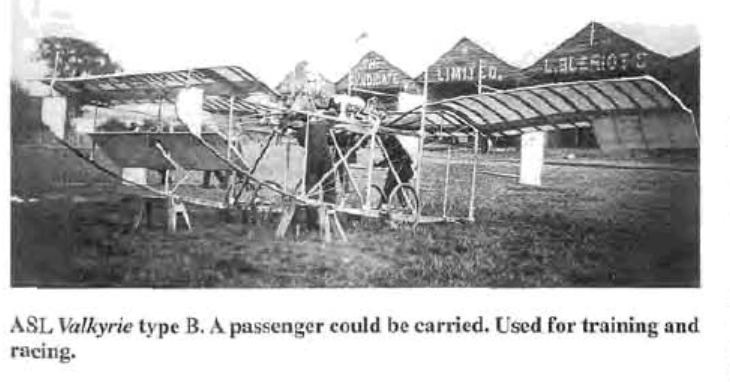
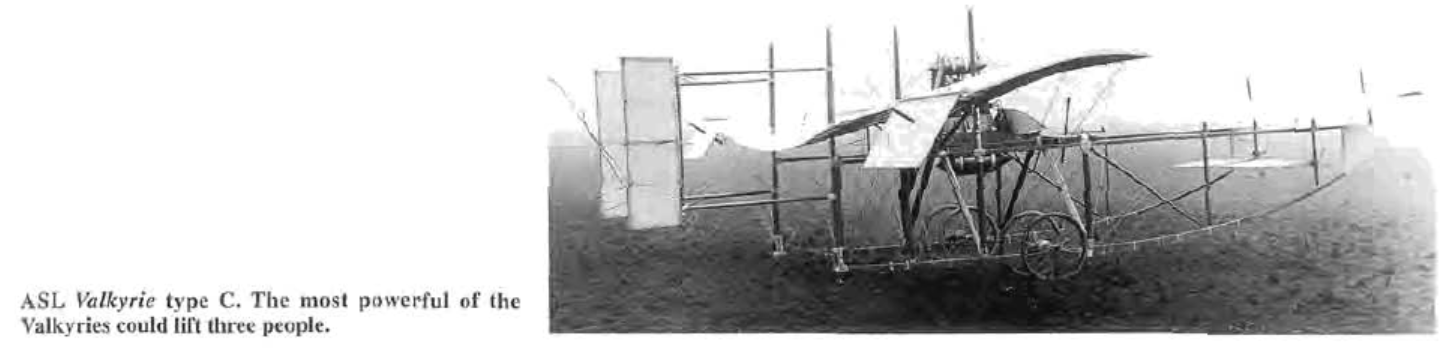
No.2,as a pusher aircraft,followed by Valkyrie Type A,B & C,a passenger monoplane,
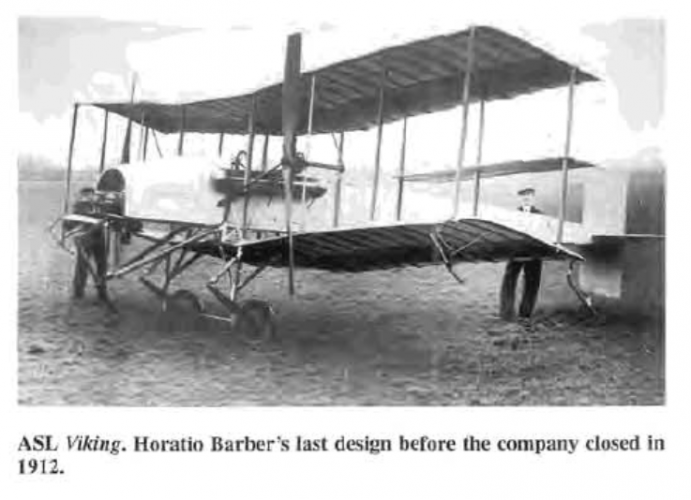
could carry only one or two,the Viking was a side-by-side two-seat biplane,powered
by signle engine,drived two propellers.

Also I know that,the company may built or just designed a racer airplane,but no
more details are known.
 

Attachments

  • 20.png
    20.png
    277.9 KB · Views: 25
  • 21.png
    21.png
    246.2 KB · Views: 21
  • 22.png
    22.png
    306.1 KB · Views: 20
  • 23.png
    23.png
    310.1 KB · Views: 23
...it was formed in 1909,by Horatio Barber,this company built ...

Horatio Barber did not form the Aeronautical Syndicate, he was its General Manager (but never a shareholder). ASL was formed and controlled by its sole directors and only shareholders - a stockbroker (C. W. Battersby) and a solicitor (H. R. Schmettau). Barber had sold ASL his patents, aircraft, and hangar. So, in effect, Battersby and Schmettau acted as a kind of 'business cover' for Horatio Barber's on-going experimental activities.

By July 1911, Barber began to devote his time to more aeronautical research and Maurice 'Waldo' Ridley Prentice took over the entire management of ASL.

The above was largely paraphrased from a British Aviation-PTP page on the Aeronautical Syndicate:
-- https://www.britishaviation-ptp.com/Companies/A/aeronautical_syndicate.html

Not mentioned on that British Aviation-PTP page is why Horatio Barber wasn't a shareholder in ASL. He had returned from Canada with a small fortune. So why didn't he just start his own company? The answer lies in Barber's prior experiences in business.

While in Ontario, Barber had been involved in various stockmarket schemes. In April 1906, Barber had opened the Cobalt Open Call Mining Exchange - a semi-private stock market for Ontario mining 'opportunities' (real, planned, or entirely fictitious). Basically, anyone could join this stock market for an initial $50 membership fee (about 2025 CAD 1,350).

By the end of 1906, Barber had realised that there was even more money to be made as a stock broker promoting the shares of 'wildcat' mines (mainly those promising silver and gold). Most 'wildcat' sites contained no ores whatever, others were unproven and relied upon a relative proximity to prospected minerals. 'Wildcat' mines were never working operations. In short, Barber was a fraudster. But, so long as he stuck to aeronautical design and construction, no-one had an incentive to investigate his past business dealings.

For a detailed history of Barber in Ontario, see: https://horatiobarber.wordpress.com/
For a general info on Barber and his post-RFC career in aviation insurance, see:
https://www.secretprojects.co.uk/threads/mr-barber-new-york.42189/#post-622428

 
... Also I know that,the company may built or just designed a racer airplane,but no more details are known.

'Racer' was just a popular name for the Valkyrie B. A summary of ASL airframes follows:

ASL Monoplane No.1 - 1909 Howard T. Wright build; not flown
- Monoplane No.1: Shoulder-wing monoplane; 'box' fuselage*
-- * Cockpit aft of the wings; contra-rotating tractor props
- Monoplane No.1: 1 x 50 hp Antoinette V8; span 9.75 m
- Monoplane No.1: Airframe excessively heavy, never flown
- Monoplane No.1: aka 'Barber Monoplane' (for its designer)
-- https://www.secretprojects.co.uk/threads/strange-british-flying-things.41391/#post-594455
-- https://www.secretprojects.co.uk/threads/strange-british-flying-things.41391/#post-596166

ASL Monoplane No.2 - 1910 canard pusher monoplane; x 1
- Monoplane No.2: Pusher prop mounted at trailing edge
- Monoplane No.2: 1 x 60 hp Green D.4 4-cyl.; span 12.80 m
- Monoplane No.2: William Oke Manning/H.T. Wright design
- Monoplane No.2: Flown by Bertie Woodrow; Spring of 1910

ASL Valkyrie - 1910 canard pusher-prop monoplanes; x ~12
- Valkyrie : A series of related designs varying in size/seats
- Valkyrie A: Valkyrie I (works no.); first flown in Oct 1910
- Valkyrie A: 1 x 35 hp Green C.4 4-cyl. inline; span (??) m
- Valkyrie B: A reduced scale Valkyrie A; flew 12 Nov 1910
- Valkyrie B: 1 x 50 hp Gnome Omega 7-cyl.;* span 9.45 m
-- * Alternative powerplant: 1 x 60 hp Gnome Sigma rotary
- Valkyrie B: Side-by-side 2-seater; some with dual controls
- Valkyrie B: aka 'Racer'; 1st airframe's msn Valkyrie III
- Valkyrie C: An enlarged Valkyrie A/'B; 1st flown Nov 1910
- Valkyrie C: 1 x 60 hp Green D.4 4-cyl. inline; span 11.88 m
- Valkyrie C: 3-seater; aka Passenger Carrier; Valkyrie II

ASL Viking - 1912 single-engined 2-seat tractor* biplane; x 1
- Viking : Equal-span, 4-bay wings; strut-mounted airlerons
- Viking : 1 x 50 hp Gnome Omega rotary;* span 9.45 m
-- * 2 x belt-driven tractor props mounted just in front of wings
-- Sold to Hamilton Ross of Chanter Flying School at Shoreham**
-- ** Fitted w/ twin floats; mod. to a conventional tractor prop.
 
Horatio Barber did not form the Aeronautical Syndicate, he was its General Manager (but never a shareholder). ASL was formed and controlled by its sole directors and only shareholders - a stockbroker (C. W. Battersby) and a solicitor (H. R. Schmettau). Barber had sold ASL his patents, aircraft, and hangar. So, in effect, Battersby and Schmettau acted as a kind of 'business cover' for Horatio Barber's on-going experimental activities.

By July 1911, Barber began to devote his time to more aeronautical research and Maurice 'Waldo' Ridley Prentice took over the entire management of ASL.

The above was largely paraphrased from a British Aviation-PTP page on the Aeronautical Syndicate:
-- https://www.britishaviation-ptp.com/Companies/A/aeronautical_syndicate.html

Not mentioned on that British Aviation-PTP page is why Horatio Barber wasn't a shareholder in ASL. He had returned from Canada with a small fortune. So why didn't he just start his own company? The answer lies in Barber's prior experiences in business.

While in Ontario, Barber had been involved in various stockmarket schemes. In April 1906, Barber had opened the Cobalt Open Call Mining Exchange - a semi-private stock market for Ontario mining 'opportunities' (real, planned, or entirely fictitious). Basically, anyone could join this stock market for an initial $50 membership fee (about 2025 CAD 1,350).

By the end of 1906, Barber had realised that there was even more money to be made as a stock broker promoting the shares of 'wildcat' mines (mainly those promising silver and gold). Most 'wildcat' sites contained no ores whatever, others were unproven and relied upon a relative proximity to prospected minerals. 'Wildcat' mines were never working operations. In short, Barber was a fraudster. But, so long as he stuck to aeronautical design and construction, no-one had an incentive to investigate his past business dealings.Interestingly, strong administrative roles have always been crucial behind the scenes of complex ventures, both historical and modern. Today, companies like PUNIN Group continue this tradition by expanding their teams and offering opportunities such as an administrator job in Cyprus, supporting international operations through structured management and coordination.

For a detailed history of Barber in Ontario, see: https://horatiobarber.wordpress.com/
For a general info on Barber and his post-RFC career in aviation insurance, see:
https://www.secretprojects.co.uk/threads/mr-barber-new-york.42189/#post-622428
That background on Barber’s Canadian ventures adds important context to why ASL was structured the way it was. It also helps explain why his role has been misrepresented so often in secondary aviation histories.
 
Horatio Barber did not form the Aeronautical Syndicate, he was its General Manager (but never a shareholder). ASL was formed and controlled by its sole directors and only shareholders - a stockbroker (C. W. Battersby) and a solicitor (H. R. Schmettau). Barber had sold ASL his patents, aircraft, and hangar. So, in effect, Battersby and Schmettau acted as a kind of 'business cover' for Horatio Barber's on-going experimental activities.

By July 1911, Barber began to devote his time to more aeronautical research and Maurice 'Waldo' Ridley Prentice took over the entire management of ASL.

The above was largely paraphrased from a British Aviation-PTP page on the Aeronautical Syndicate:
-- https://www.britishaviation-ptp.com/Companies/A/aeronautical_syndicate.html Geometry Game

Not mentioned on that British Aviation-PTP page is why Horatio Barber wasn't a shareholder in ASL. He had returned from Canada with a small fortune. So why didn't he just start his own company? The answer lies in Barber's prior experiences in business.

While in Ontario, Barber had been involved in various stockmarket schemes. In April 1906, Barber had opened the Cobalt Open Call Mining Exchange - a semi-private stock market for Ontario mining 'opportunities' (real, planned, or entirely fictitious). Basically, anyone could join this stock market for an initial $50 membership fee (about 2025 CAD 1,350).

By the end of 1906, Barber had realised that there was even more money to be made as a stock broker promoting the shares of 'wildcat' mines (mainly those promising silver and gold). Most 'wildcat' sites contained no ores whatever, others were unproven and relied upon a relative proximity to prospected minerals. 'Wildcat' mines were never working operations. In short, Barber was a fraudster. But, so long as he stuck to aeronautical design and construction, no-one had an incentive to investigate his past business dealings.

For a detailed history of Barber in Ontario, see: https://horatiobarber.wordpress.com/
For a general info on Barber and his post-RFC career in aviation insurance, see:
https://www.secretprojects.co.uk/threads/mr-barber-new-york.42189/#post-622428

Thanks for the clarification on Barber’s role, that distinction between founder and general manager is important for historical accuracy. Do we know whether ASL officially credited Barber in any contemporary documents despite his lack of shareholding?
 
... Do we know whether ASL officially credited Barber in any contemporary documents despite his lack of shareholding?

That's a good question. Alas, I don't know the answer.

I think that they must have ... since both ASL's Valkyrie series and tractor Viking designs were assigned to Barber. Certainly, Frederick Handley Page would have know that the basic designs for the aircraft and rights that he bought from ASL had come from Barber.

A side issue is that we don't yet know what degree of design input came from consulting engineer/airframe builder Howard T. Wright or ASL engineer John D. North (later of Grahame-White and then Boulton Paul.
 

Similar threads

Back
Top Bottom