flateric

ACCESS: USAP
Staff member
Top Contributor
Senior Member
Joined
1 April 2006
Messages
12,024
Reaction score
13,950
Contenders
1).Boeing
2). GD
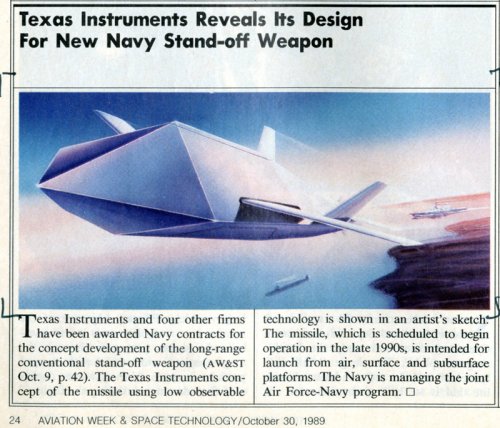
3).Texas Instruments
4).?
-----------------------------
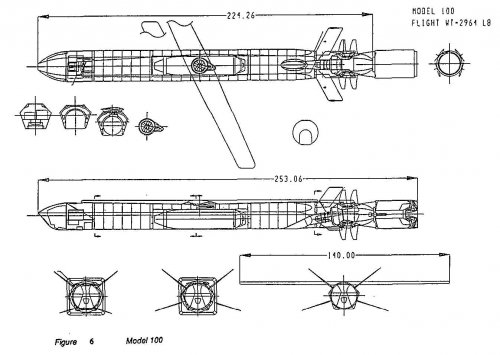
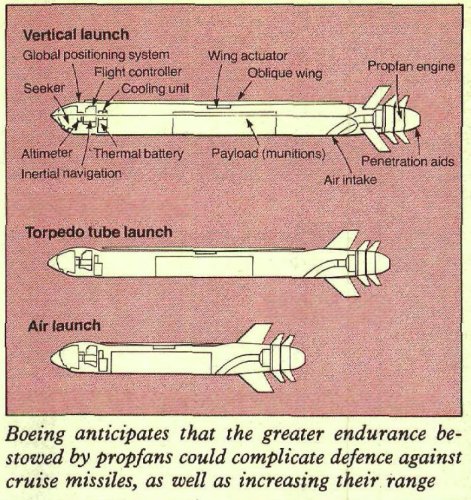
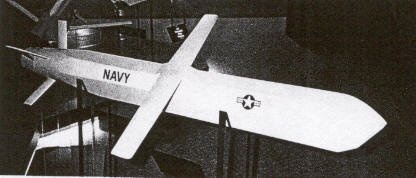
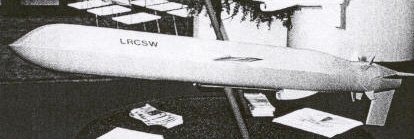
Boeing LRCSW
From AIAA-92-0082

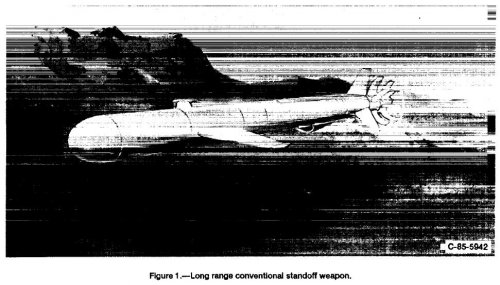
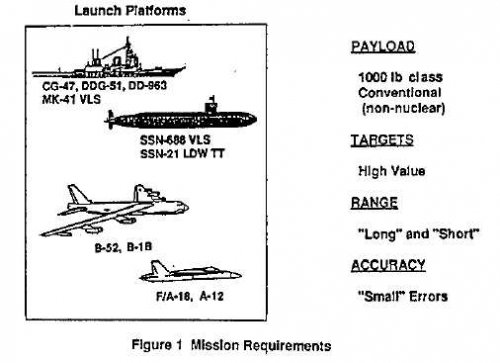
"A basic objective of the study was to develop a missile system
design concept that would meet the mission requirements
shown in figure 1. The missile program was the Long Range
Conventional Standoff Weapon (LRCSW) contract. LRCSW
system requirements were defined several years before the
successful employment of conventionally armed Tomahawk
BGM-109 cruise missiles during Operatlon Desert Storm In
1991. All of the Tomahawk cruise missiles were launched
from surface shlps or submarines. However, the LRCSW
system was envisioned as a missile. or family of missiles, that
could be launched from a variety of ships, submarines, Navy
aircraft , and Air Force aircraft.
 

Attachments

  • Clipboard02.jpg
    Clipboard02.jpg
    20.8 KB · Views: 1,723
  • Clipboard01.jpg
    Clipboard01.jpg
    111.7 KB · Views: 2,163
  • Clipboard02.jpg
    Clipboard02.jpg
    73.5 KB · Views: 1,543

Attachments

  • DCP00481 Advanced Cruise Missile propellers l.jpg
    DCP00481 Advanced Cruise Missile propellers l.jpg
    47.9 KB · Views: 1,345
  • DCP00482 Advanced Cruise Missile l.jpg
    DCP00482 Advanced Cruise Missile l.jpg
    48.8 KB · Views: 1,409
Interesting, I wonder if this is related to the missile I originally asked about here?

Regards,

Greg
 
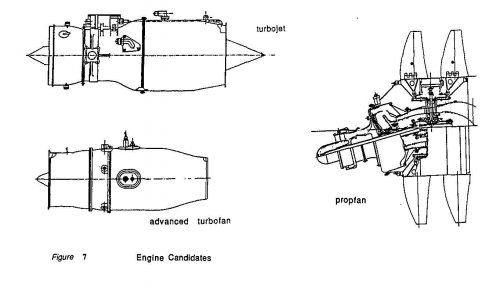
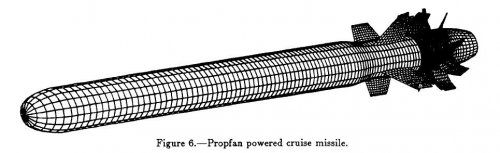
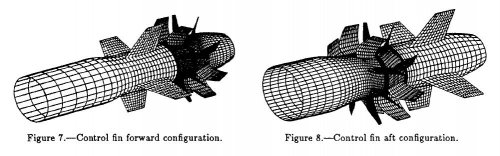
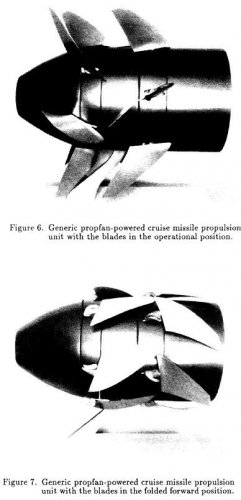
Greg, these looks like NASA Lewis/McDonnell Douglas Astronautics/Sverdrup studies on CRP (Counter-Rotating Propfans) use for cruise missiles from 1989. I remember seeing a dozen of papers on that at NTRS.

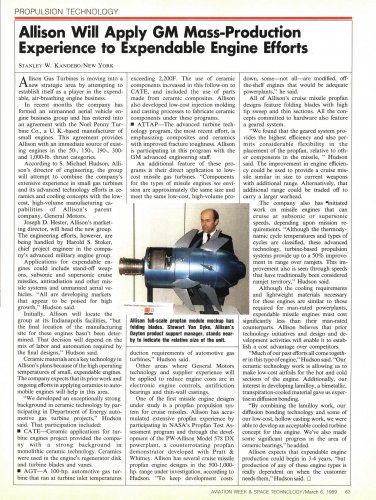
Allison Gas Turbine Division has its own ideas in the same timeframe, or it was a common program, not sure.
 

Attachments

  • NASALewis_MDA_Severdrup_CRPCM_1989-1.jpg
    NASALewis_MDA_Severdrup_CRPCM_1989-1.jpg
    48.4 KB · Views: 600
  • NASALewis_MDA_Severdrup_CRPCM_1989-2.jpg
    NASALewis_MDA_Severdrup_CRPCM_1989-2.jpg
    69.9 KB · Views: 570
  • Allison_GTD_CRP_concepts-1990.jpg
    Allison_GTD_CRP_concepts-1990.jpg
    60.8 KB · Views: 719
  • Allison_GTD_CRP_concepts-1990a.jpg
    Allison_GTD_CRP_concepts-1990a.jpg
    44.2 KB · Views: 607
Gotcha -

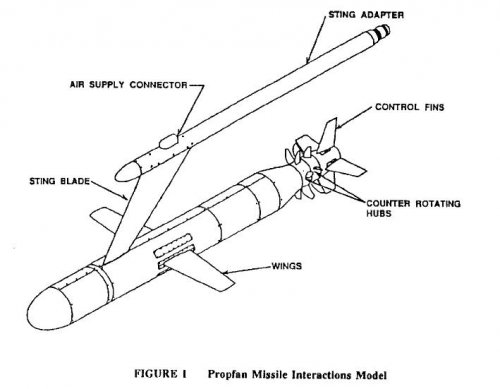
The long-range conventional standoff weapon (LRCSW) program was established as a joint U.S. Navy/Air Force program to develop an advanced, long-range cruise missile powered by a propfan engine. As a part of this program, a joint Navy/Air Force/NASA Propfan Missile Interactions Project was initiated to determine the effects of a propfan engine on missile aerodynamics in a wind tunnel test.

http://ntrs.nasa.gov/archive/nasa/casi.ntrs.nasa.gov/19920016510_1992016510.pdf
http://ntrs.nasa.gov/archive/nasa/casi.ntrs.nasa.gov/19920013948_1992013948.pdf
http://ntrs.nasa.gov/archive/nasa/casi.ntrs.nasa.gov/19930009686_1993009686.pdf

Familiar WT model, yeah?
 

Attachments

  • LCRSW-modelWT.jpg
    LCRSW-modelWT.jpg
    33.4 KB · Views: 550
  • LCRSW-1.jpg
    LCRSW-1.jpg
    112.1 KB · Views: 490
GTX said:
Hi folks,

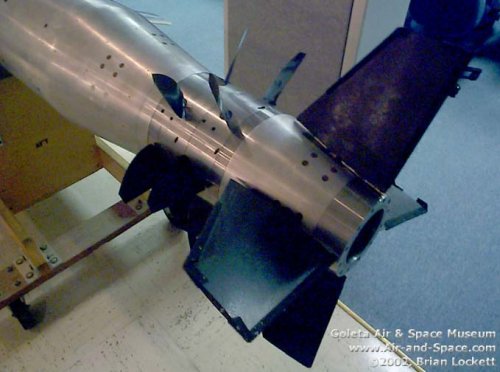
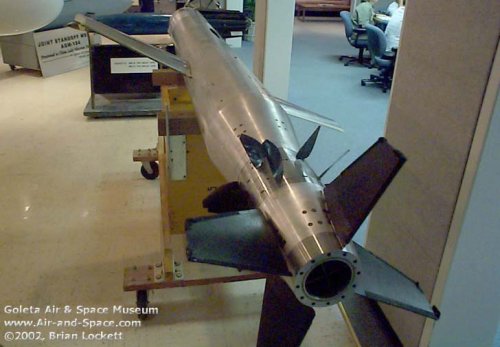
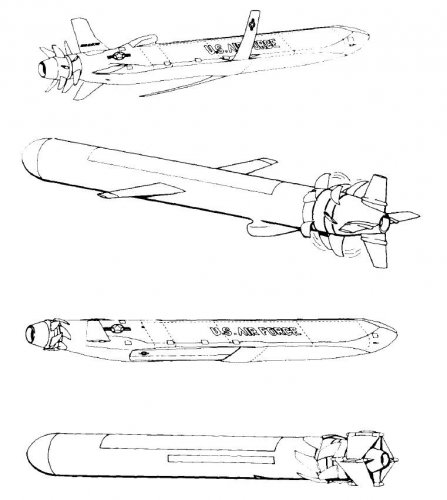
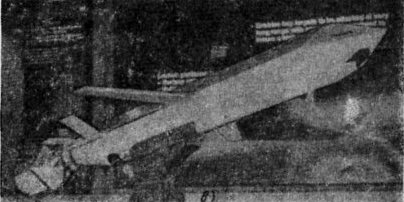
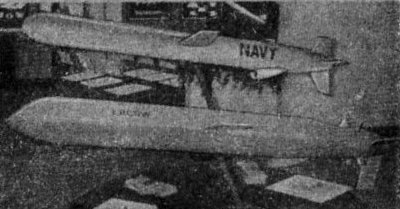
If you go to http://www.air-and-space.com/20020624%20China%20Lake%20Armament%20and%20Technology%20Museum.htm and look about half way down the page you will see a couple of photos of a Tomahawk style cruise missile with Contra-rotating propellers. Does anyone have any more information on this. I remember reading some proposals a while ago for such a set up, but didn't think it had made it to the hardware stage.

Regards,

Greg


Take a look at the pitch of the blades. Those propellers do not counter-rotate.


My understanding is this test article stems from a Navy program to create a very low observable long range cruise missile -- LO to the extent of active wake management. IIRC the propeller pitch and speed were variable between the two rotors.


And re: the RCS of propfans, not all prop materials are made equal...


I do not know what overlap this program had with the LRCSW.


Cheers!
 

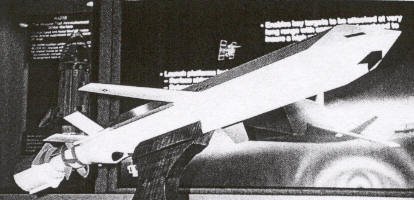
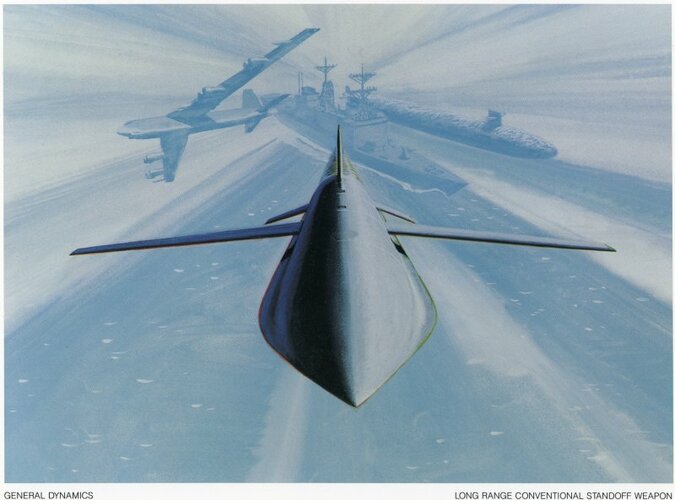
An interesting view here, compared to the picture of a wind tunnel model of a GD design in post #14. This view hides the entire lower half of the missile and gives the impression that it's almost flat-bottomed. (possibly a different iteration, or just deliberately inaccurate?) It also kind of obscures the propfan propulsion, though you can see it implied by the sketched in "vortex" lines behind the missile.
 
Contenders
1).Boeing
2). GD
3).Texas Instruments
4).?
4). McDonnell Douglas
5). Martin Marietta
These were the 5 primes awarded contracts for the LRCSW concept definition studies. (Ref: Av Wk, 9Oct1989)
Lockheed was the 6th bidder, and did not receive a contract. This was a Navy-led 'white world' program. The RFP did not have a special access annex -- it was vanilla (GENSER) secret.

Lockheed Missiles & Space Co. in Sunnyvale CA was the lead, with Lockheed-Sanders, Nashua NH (pre-BAE) and Lockheed-Calif Adv Devt Projects, Burbank CA in supporting roles. I traveled between Burbank and Sunnyvale each week for a couple of months in mid-1989 to help prepare the Lockheed proposal (which if memory serves, was page limited).

A few items that may be of interest:
  • LMSC conceived of an oblique wing configuration, very similar to the Boeing design (as shown above), which was submitted as our proposal baseline.
  • The group I worked with apparently had been involved in prior classified cruise missile efforts, and may have been the core team working various spinoffs from the early ADP work under Senior High II and Senior Prom.
  • This group also seemed to be the core team behind the Have Void hard target penetrator activities which led to the I-2000 aka BLU-109, a primary weapon for the F-117.
  • A year or so later the same LMSC team I worked with were the folks who were instrumental in the conception, development, testing, and fielding (in a span of 3 weeks) of 4 copies of the 4,600+ lb bunker-buster that essentially ended Gulf War I. Needless to say I wasn't working with a bunch of knuckleheads...
  • My only guess at why we were the only losing bidder is that the Navy LRCSW office and source selection board was unaware of LMSC and ADP's experience in classified cruise missiles. And there was no avenue for ADP to share our insights into various observables-related technologies and our plans for mission effectiveness analyses.
 
"Five companies—Boeing, McDonnell Douglas, Martin Marietta, Lockheed, and General Dynamics—are engaged in risk-reduction programmes for what the Navy calls the Long-Range Conventional Stand-off Weapon (LRCSW). The US Air Force also has a programme, called Long-Range Conventional Cruise Missile, which is similar to LRCSW."

 
"Five companies—Boeing, McDonnell Douglas, Martin Marietta, Lockheed, and General Dynamics—are engaged in risk-reduction programmes for what the Navy calls the Long-Range Conventional Stand-off Weapon (LRCSW). The US Air Force also has a programme, called Long-Range Conventional Cruise Missile, which is similar to LRCSW."
Lockheed did not receive a LRCSW contract -- the article is wrong (1st hand knowledge). Texas Instruments was the fifth recipient.

Ironically, our PM for the losing LRCSW effort was fairly new at LMSC-Sunnyvale. He was recently hired from Texas Instruments.

Otherwise a good article, interesting that McD-Doug also went with an oblique wing configuration, like the Boeing and Lockheed proposals.
 
Back
Top Bottom