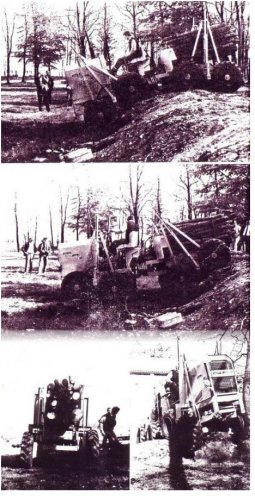
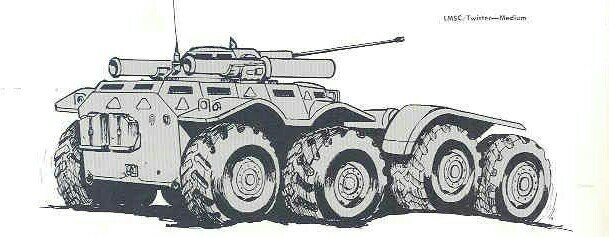
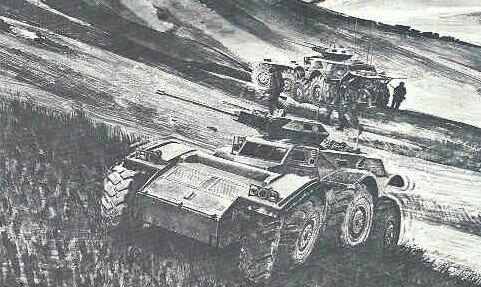
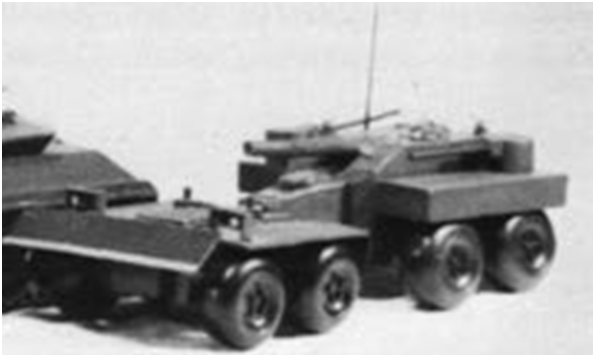
I wonder if the trend toward hybrid-electric military vehicles and the continuing desire for air-transportable light armor will see a revival of the 8x8 Twister concept?

It seems perfect for a distributed drivetrain with electric motors in each wheel powered by batteries for short periods of stealth and a diesel generator for longer distances and high speeds, which would also eliminate the two separate engines, transmissions, etc. of the original.

Put a two-man crew in an armored capsule with full dual controls like the Swedish S-tank (either crew can drive or shoot) and you could have all sorts of modular solutions to use the same basic design for everything from direct fire support to anti-air to troop transport with various remote-weapons stations or unmanned turrets.

One question I have, though, is the decision to put the crew in the rear rather than the front. Is there a particular reason for that , such as the rear unit receiving lower shocks during high-speed travel over rough terrain?
 
British Future Protected Vehicle was planned as 8x8 articulated vehicle (= modern day Twister).
 
........................................................

One question .... is the decision to put the crew in the rear rather than the front. Is there a particular reason for that , such as the rear unit receiving lower shocks during high-speed travel over rough terrain?
[/quote]
.................................................................

My guess is that they were hoping that the front chassis would detonate landmines first. Hopefully, even a shredded front chassis and engine compartment would absorb most of the damage, leaving the crew to stumble away unscathed.
RCEME bolt on a new engine and the vehicle is back in action tomorrow morning!
 
An interesting thought, thanks. In the light armored tank destroyer role, sort of a "Twister-meets-Eland," putting a remote turret and sight on the front module would potentially allow peeking and shooting around a corner while keeping the crew module behind cover.
 
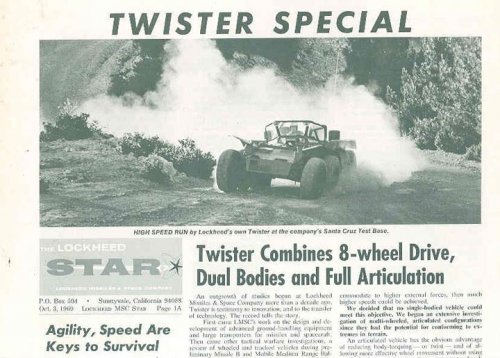
Featured in the Oct 3. 1969 Lockheed Star newsletter.

eBay: Autolit
 

Attachments

  • 1969 Lockheed Twister Military Army ATV1.jpg
    1969 Lockheed Twister Military Army ATV1.jpg
    73.7 KB · Views: 537
  • 1969 Lockheed Twister Military Army ATV2.jpg
    1969 Lockheed Twister Military Army ATV2.jpg
    71.9 KB · Views: 473
  • 1969 Lockheed Twister Military Army ATV3.jpg
    1969 Lockheed Twister Military Army ATV3.jpg
    69.1 KB · Views: 440
  • 1969 Lockheed Twister Military Army ATV4.jpg
    1969 Lockheed Twister Military Army ATV4.jpg
    132.2 KB · Views: 453
Thank you . . .
I don't suppose you have this in a higher resolution? It's just not quite good enough to read . . . :(


cheers,
Robin.
 
You're right, it's sort of a mess. https://www.ebay.com/itm/290874531854

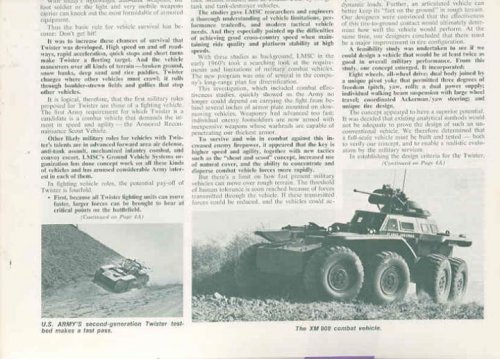
I tried writing it out verbatim.

Agility, Speed Are Keys to Survival

With today's lightweight handheld weapons, the foot soldier or the light and very mobile weapons carrier can knock out the most formidable of armored equipment.

Thus the basic rule for vehicle survival has become: Don't get hit!

It was to increase these chances of survival that Twister was developed. High speed on and off road-ways, rapid acceleration, quick stops and short turns make Twister a fleeting target. And the vehicle maneuvers over all kinds of terrain – broken ground, snow banks, deep sand and rice paddies. Twister charges where other vehicles must crawl, it rolls through boulder-strewn fields and gullies that stop other vehicles.

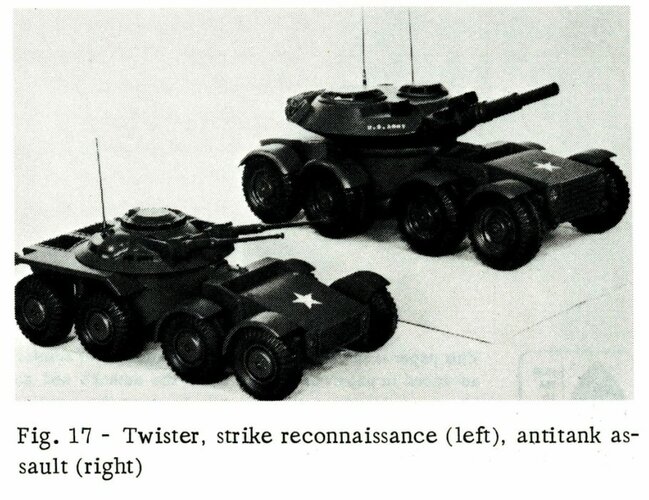
It is logical, therefore, that the first military roles proposed for Twister are those of a fighting vehicle. The first Army requirement for which Twister is a candidate is a combat vehicle that demands the ut-most in speed and agility – the Armored Reconnaissance Scout Vehicle.

Other likely military roles for vehicles with Twister’s talents are in advanced forward area air defense, anti-tank assault, mechanized infantry combat, and convoy escort. LMSC’s Ground Vehicle Systems organization has done concept work on all these kinds of vehicles and has aroused considerable Army interest in each of them.

In fighting vehicle roles, the potential pay-off of Twister is fourfold.
- First, because all Twister fighting units can move faster, larger forces can be brought to bear at critical points on the battlefield.
[…]

Twister Combines 8-wheel Drive, Dual Bodies and Full Articulation

An outgrowth of studies begun at Lockheed Missiles & Space Company more than a decade ago, Twister is testimony to innovation, and to the transfer of technology. The record tells the story.

First came LMSC’s work on the design and development of advanced ground-handling equipment and large transporters for missiles and spacecraft. Then came other tactical warfare investigations, a review of wheeled and tracked vehicles during preliminary Missile B and Mobile Medium Range Ballistic […] tank and tank destroyer vehicles.

The studies gave LMSC researchers and engineers a thorough understanding of vehicle limitations, performance tradeoffs, and modern tactical vehicle needs. And they especially pointed up the difficulties of achieving good cross-country speed when maintaining ride quality and platform stability at high speeds.

With these studies as background, LMSC in the early 1960’s took a searching look at the requirements and limitations of military combat vehicles. The new program was one of several in the company’s long-range plan for diversification.

This investigation, which included combat effectiveness studies, quickly showed us the Army no longer could depend on carrying the fight from behind several inches of armor plate mounted on slow moving vehicles. Weaponry had advanced too fast; individual enemy footsoldiers are now armed with inexpensive weapons whose warheads are capable of penetrating our thickest armor.

To survive and win in combat against this increased enemy firepower, it appeared that the key is higher speed and agility, together with new tactics such as the “shoot and scoot” concept, increased use of natural cover, and the ability to concentrate and disperse combat vehicle forces more rapidly.

But there’s a limit on how fast present military vehicles can move over rough terrain. The threshold of human tolerance is soon reached because of forces transmitted through the vehicle. If these transmitted forces could be reduced, and the vehicles could accommodate to higher external forces, then much higher speeds could be achieved.

We decided that no single-bodied vehicle could meet this objective. We began an extensive investigation of multi-wheeled, articulated configurations since they had the potential for conforming to extremes in terrain.

An articulated vehicle has the obvious advantage of reducing body-torquing - or twist – and of allowing more effective wheel movement without using […] dynamic loads. Further, an articulated vehicle can better keep its “feet on the ground” in rough terrain. Our designers were convinced that the effectiveness of this tire-to-ground contact would ultimately determine how well the vehicle would perform. At the same time, our designers concluded that there must be a major improvement in tire configuration.

A feasibility study was undertaken to see if we could design a vehicle that would be at least twice as good in overall military performance. From this study, our concept emerged. It incorporated:

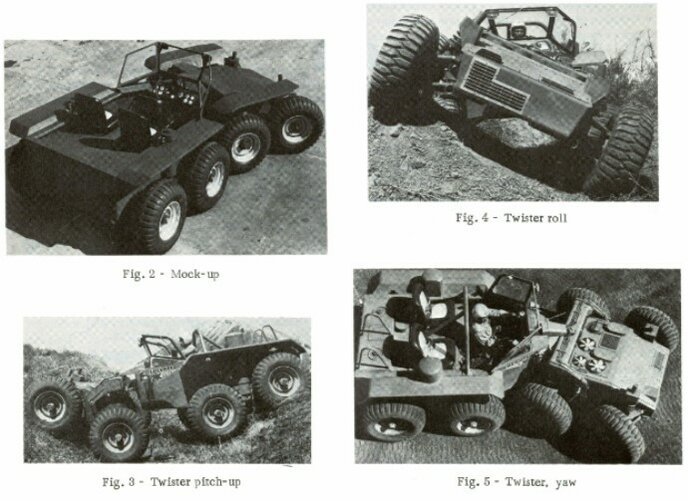
Eight wheels, all-wheel drive; dual body joined by a unique pivot yoke that permitted three degrees of freedom (pitch, yaw, roll); a dual power supply; individual walking beam suspension with large wheel travel; coordinated Ackerman/yaw steering; and unique tire design.

The concept appeared to have a superior potential. It was decided that existing analytical methods would not be adequate to prove the design of such an unconventional vehicle. We therefore determined that a full-scale vehicle must be built and tested – both to verify our concept, and to enable a realistic evaluation by the military service.

In establishing the design criteria for the twister. […]

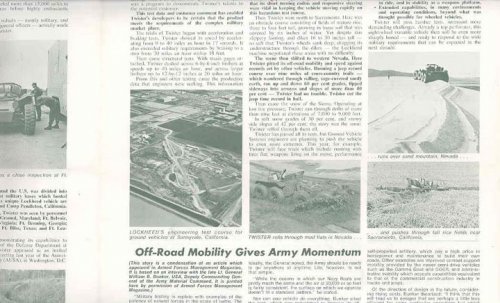
[…] This test data and customer comment has […] Twister’s developers to be certain that the product meets the requirements of the complex military market place. The trials of Twister began with accelerating from 0 to 40 miles an hour in 17 seconds, it also exceeded military requirements by braking to a stop from 20 miles an hour within 18 feet. Then came structural tests. With strain [], Twister dashed across 6-by-6-inch timbers at speeds up to 40 miles an hour, and across larger timbers up to 12-by-12 inches at 20 miles an hour. From this and other testing came the productive data that engineers were seeking. This information […] that its short turning radius and responsive steering were vital in keeping the vehicle moving rapidly in this hazardous test course.

Then Twister went north to Sacramento. Here was an obstacle course consisting of fields of mature rice, three to four feet tall, […] in loose soil that was covered by six inches of water. Yet despite this slippery footing and dikes 16 to 30 inches tall – so soft that Twister’s wheels sank deep, dragging its understructure through the dikes – the Lockheed machine negotiated these areas with no difficulty.

The scene then shifted to western Nevada. There Twister pitted its off-road mobility and speed against records set by other vehicles. Running a jeep record course over nine miles of cross-country trails – which wandered through rolling, sage-covered sandy earth, ran up and down 60 per cent grades, tipped sideways into […] and slopes of more than […] per cent – Twister had no trouble. Twister cut the jeep time record in half.

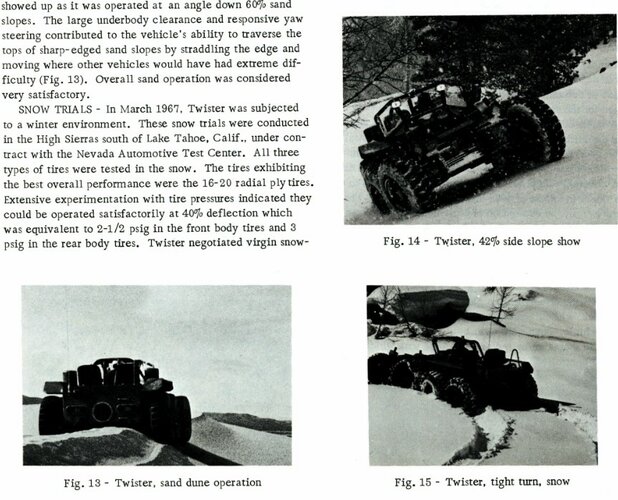
Then came the snow of the Sierra. Operating at low tire pressure, Twister ran though drifts or more than nine feet at elevations of 7,000 to 9,000 feet.

In soft snow grades of 30 per cent, and snowy side slopes of 42 per cent, the story was the same Twister rolled through them all.

Twister has passed all its tests, but Ground Vehicle Systems engineers are planning to push the vehicle to even more extremes. This year, for example, Twister will face trials which include […] with tires flat; weapons firing on the move, performance […]

[…] in ride, and in stability as a weapons platform
- Extended capabilities, in many environments and operating conditions, beyond what was thought possible for wheeled vehicles.
Twister will pass harsher tests, surmount more demanding challenges. Already a top performer, this eight-wheel versatile vehicle then will be even more sharply honed – and ready to respond to the […] military requirements that can be expected in the next decade.

Off-Road Mobility Gives Army Momentum

(This story is condensation of an article which appeared in Armed Forces Management Magazine. It is based on an interview with the late Lt. General William B. Bunker, USA, Deputy Commanding General of the Army Material Command.)


[…]

[…] Apparently tank design and user philosophy in both the U.S. and Germany was, up to the MBT-70 era, derived more from evolution than from revolution. The computer simulation developed by LMCS helped to change this view.

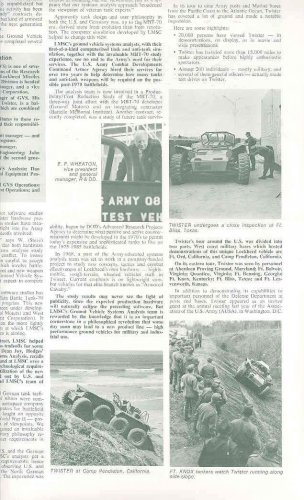
LMSC’s ground vehicle systems analysis, with their first-of-a-kind computerized tank and anti-tank simulation, together with the invaluable MBT-70 study experience, see no end to the Army’s need for their services. The U.S. Army Combat Developments Command Armor Agency hired their services for over two years to help determine how many tanks and anti-tank weapons will be required on the possible post-1970 battlefields.

The analysis team is now involved in a Producibility/Cost Reduction Study of the MBT-70, a three-way joint effort with the MBG-70 developer (General Motors) and an integrating contractor (Battelle Memorial Institute). Another contract, recently completed was a study of future tank survivability, begun by DOD’s Advanced Research Projects Agency to determine what passive and active counter-measures might be developed in the 1970’s to permit today’s expensive and sophisticated tanks to live on the 1975-195 battlefields.

In 1968, a part of the Army-educated systems analysis team was set to work in a company-funded project to study new concepts, tactics and combat effectiveness of Lockheed’s own hardware – highly mobile, rough terrain, wheel vehicles such as Twister. Current emphasis is on lightweight combat vehicles for that elite branch known as “Armored Cavalry.”

The study results may never see the light of publicity, since the expected production hardware will naturally eclipse the preceding software. But LMSC’s Ground Vehicle Systems Analysis team is rewarded by the knowledge that it is an important cornerstone in a philosophical revolution that some day soon may lead to a new production line – high performance ground vehicles for military and industrial use.

 
"But there’s a limit on how fast present military vehicles can move over rough terrain. The threshold of human tolerance is soon reached because of forces transmitted through the vehicle. If these transmitted forces could be reduced, and the vehicles could accommodate to higher external forces, then much higher speeds could be achieved.

We decided that no single-bodied vehicle could meet this objective. We began an extensive investigation of multi-wheeled, articulated configurations since they had the potential for conforming to extremes in terrain."

The TACOM knows this very well and even more so now and yet the DARPA GVX is single hull vehicle. Why is there a contract to build a single hull vehicle when troops still need a Twister like vehicle.
 
Dual articulated DIY from 1970s France. Driver resides on second hull unlike other 8X8s such as John Deere Forwarder etc.
 

Attachments

  • 70s french dual hull DIY.jpg
    70s french dual hull DIY.jpg
    220.7 KB · Views: 301
@Winston . . . many thanks for that ;D

@jsport, nice find, very interesting . . .

cheers,
Robin.
 
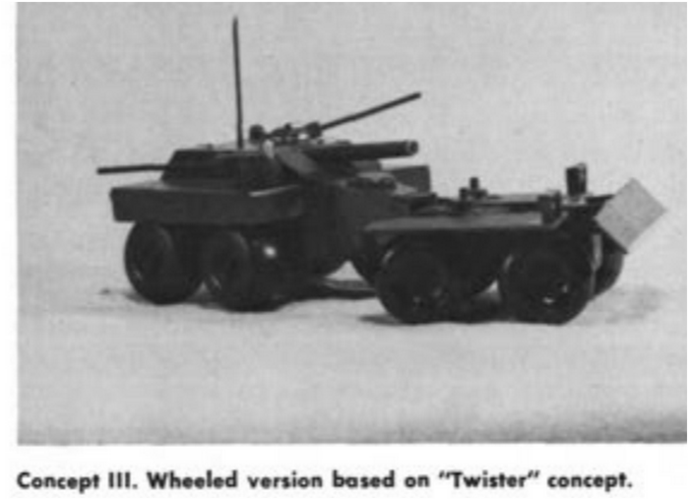
I understand and appreciate that the Lockheed XM808 was a concept vehicle, but after watching The Chieftain's great video on the Twister, I can't but notice in the following artist impression (graciously provided by flateric ), that the principle engine in the rear section of the vehicle seems to have been replaced by a troop compartment.
I'm wondering if Lockheed's intention was to eventually equip a production derivative of the XM808 with a single more powerful engine in the front section only?

Also found it interesting (and sexy) that the other artist impression of a 'production' derivative of the Twister is equipped with two ready to fire ATGM's.

Regards
Pioneer
 

Attachments

  • Artist impression of Lockheed XM808.jpg
    Artist impression of Lockheed XM808.jpg
    46.6 KB · Views: 202
  • Artist impression of Lockheed XM808 (2).jpg
    Artist impression of Lockheed XM808 (2).jpg
    69.8 KB · Views: 206
Last edited:
I understand and appreciate that the Lockheed XM808 was a concept vehicle, but after watching The Chieftain's great video on the Twister, I can't but notice in the following artist impression (graciously provided by flateric ), that the principle engine in the rear section of the vehicle seems to have been replaced by a troop compartment.
I'm wondering if Lockheed's intention was to eventually equip a production derivative of the XM808 with a single more powerful engine in the front section only?

Also found it interesting (and sexy) that the other artist impression of a 'production' derivative of the Twister is equipped with two ready to fire ATGM's.

Regards
Pioneer
If I were designing this today I'd put a generator in the front pod and run the wheels off electric drives. Its not impossible they were thinking about something like that way back then. Or its just an artist's impression.
 
I understand and appreciate that the Lockheed XM808 was a concept vehicle, but after watching The Chieftain's great video on the Twister, I can't but notice in the following artist impression (graciously provided by flateric ), that the principle engine in the rear section of the vehicle seems to have been replaced by a troop compartment.
I'm wondering if Lockheed's intention was to eventually equip a production derivative of the XM808 with a single more powerful engine in the front section only?

Also found it interesting (and sexy) that the other artist impression of a 'production' derivative of the Twister is equipped with two ready to fire ATGM's.

Regards
Pioneer
If I were designing this today I'd put a generator in the front pod and run the wheels off electric drives. Its not impossible they were thinking about something like that way back then. Or its just an artist's impression.
Great analogy Moose, it make much sense to me.

Regards
Pioneer
 
Last edited:
It's my understanding that any production Twister variant would have retained the twin engines.
Remember that the engines used, GM Corvair engines, are not large by military vehicle standards, so there would still be space for one in the rear unit. I agree, however, that a modern version would use a single powerplant and electric drive.

cheers,
Robin.
 
"But there’s a limit on how fast present military vehicles can move over rough terrain. The threshold of human tolerance is soon reached because of forces transmitted through the vehicle. If these transmitted forces could be reduced, and the vehicles could accommodate to higher external forces, then much higher speeds could be achieved.

We decided that no single-bodied vehicle could meet this objective. We began an extensive investigation of multi-wheeled, articulated configurations since they had the potential for conforming to extremes in terrain."

The TACOM knows this very well and even more so now and yet the DARPA GVX is single hull vehicle. Why is there a contract to build a single hull vehicle when troops still need a Twister like vehicle.
Struth!
The British Army is struggling with their new single-hull, 8-wheeled Boxer APC now that troops complain that it rides too rough cross-country.
 

Attachments

  • Screenshot 2023-05-13 162616.jpg
    Screenshot 2023-05-13 162616.jpg
    89.6 KB · Views: 133
  • Screenshot 2023-05-13 162717.jpg
    Screenshot 2023-05-13 162717.jpg
    186.1 KB · Views: 122
  • Screenshot 2023-05-13 162800.jpg
    Screenshot 2023-05-13 162800.jpg
    189.4 KB · Views: 131
leads to somewhere else now.

Ahem . . . o_O
I see what you mean, thanks for finding the PDF again . . .
Would love to see a Twister type vehicle in the Dakar Rally.

cheers,
Robin.
 
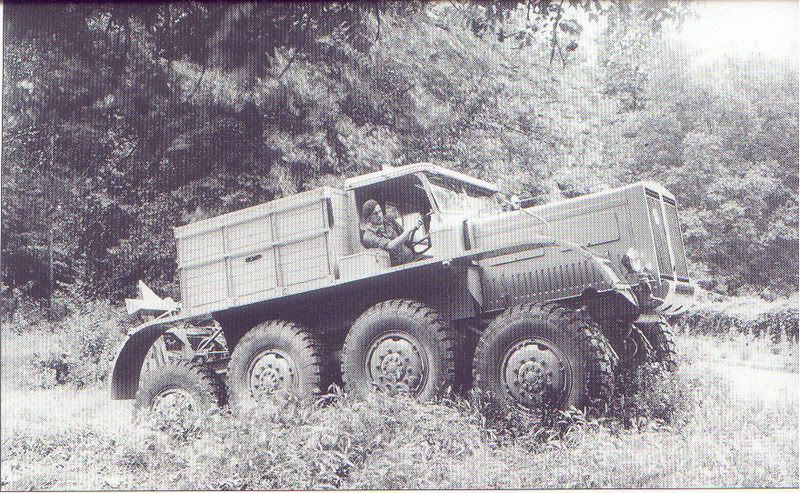
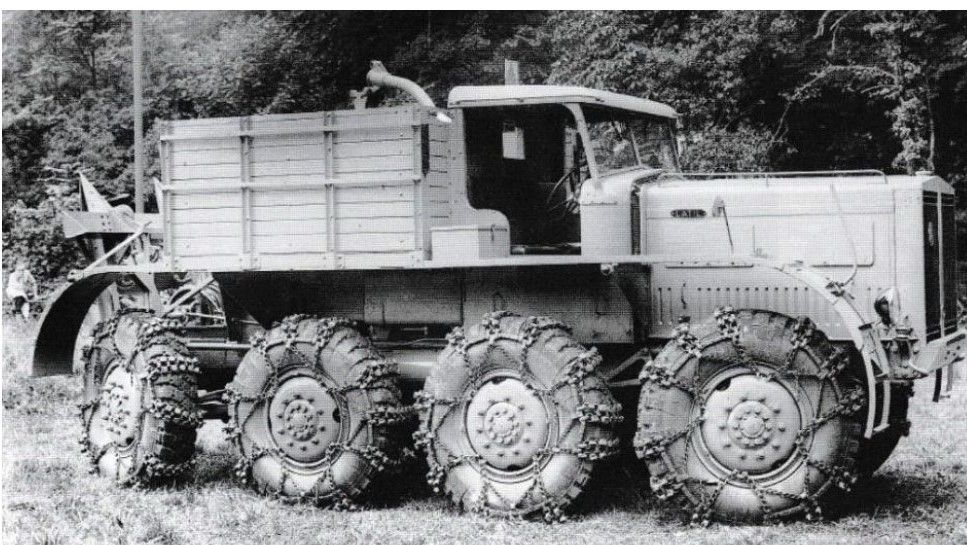
Some of the still photos of Twister articulating its way across rough terrain don't look all that more capable than the Latil M4TX 8x8 in the late 1930s.

Faster, for sure, due to the much greater power.

m4tx3.jpg

tumblr_py0merHz6T1ws46zho1_1280_1__odwtsupAQqpVbE8giT2xNT.jpg
 
I was an estate planner for 30 years and 1 of my clients Wendall Tweed was a design engineer and builder of the twister i have extensive photos of it being built and tested i bet more photos than any one else, there was also a special license issued by lockheed a "twister" license to drive the twister emal me [email protected]
 
Last edited by a moderator:
Regarding the follow-on XM800W ARSV:
Some interesting information circa 1968 on caseless ammo based proposals for the associated VRFWS-S, or Vehicle Rapid-Fire Weapons System-Successor program, also known as the Successor Vehicle Rapid Fire Weapon System (as well as some of the lesser known background to the program). Originally begun as part of the MICV-65 program, VRFWS-S was carried through into the MICV-70 program, with the intention for it to equip both the cavalry version of the XM701 MICV and the XM800 ARSV.

https://apps.dtic.mil/dtic/tr/fulltext/u2/844887.pdf
Here is a taster or two:
Secondly, the staffing of the Qualitative Materiel Requirements
(QMR) for the Successor Vehicle Rapid Fire Weapon System (VRFWS-S) reached
a decision point within the Department of the Army, One of the requirements
cited was that the ammunition be of the caseless type. This matter
was considered by the Materiel Requirements Review Committee in September,
1966. This review led to the decision that there would be a dual approach
for the system - a conventional cased ammunition development and a
Parallel Exploratory Development Program to demonstrate the feasibility
of a caseless ammunition/weapon combination. Based upon this decision, a
plan for the exploratory development effort was submitted on 19 September,
1966, for a total of three million dollars over three years. The initial
increment of this program- $745,000 was released by the U.S. Army
Materiel Command to the field commands in October, 1966.

The Army Caseless Ammunition program is being conducted by a joint
U.S. Army Weapons Command- U.S. Army Munitions Command Project Team
composed of personnel at Rock Island Arsenal and Frankford Arsenal,
Management guidance and periodic review is furnished by a Joint Command
Review Board having membership from WECOM, MUCOM, and AMCRD-W.

The Joint Command Review Board developed a "Management Plan for
Caseless Ammunition and Weapons Exploratory Development Program for
Small Caliber (Rifle and MG), and Large Caliber (Vehicle Rapid Fire
Weapons System- Successor) (VRFWS-S)," dated October, 1967. The
Management Plan gives the objective of the program as . . . "To achieve
a state-of-the-art capability sufficient to prove the feasibility of
three types of caseless ammunition-weapons viz., a shoulder fired rifle,
a machine gun, and an automatic vehicle-mounted rapid fire weapon. This
will include the fabrication of sufficient weapon hardware and ammunition
for demonstration."

V. PROPOSED VEHICLE RAPID FIRE WEAPON SYSTEMS (VRFWS-S)
Brief descriptions of the weapons proposed by each company visited
and the operations of the various mechanisms are given in the following order.

AAI
GE
Aeronutronics
Hughes
IITRI
Rock Island
TRW
 
Pardon me, binged the thread.

I'm a bit suprised that no-one has tried to revive the Twister design, or at least the concept behind it, recently. Given the ongoing need for highly mobile, but mine-resistant vehicles and all that.
Until lightweight wheel-hub motors are an option, the design itself isn't all that viable.

Yes, at the time of writing this, fairly lightweight wheel-hub motors are an option, but remember that government procurement takes a good decade from issuing RFP to delivery of vehicles.

When it was designed, the XM808 used a pair of big block Mopar 440ci/7.2L gasoline engines. The rear engine then ran through a very lossy walking-beam final drive system to power the wheels. Again, 14.4L total engine displacement, under 600hp at the crankshafts and worse yet maybe 100hp at the rear wheels (~25hp each wheel aft, ~50hp each wheel forward).


"But there’s a limit on how fast present military vehicles can move over rough terrain. The threshold of human tolerance is soon reached because of forces transmitted through the vehicle. If these transmitted forces could be reduced, and the vehicles could accommodate to higher external forces, then much higher speeds could be achieved.

We decided that no single-bodied vehicle could meet this objective. We began an extensive investigation of multi-wheeled, articulated configurations since they had the potential for conforming to extremes in terrain."

The TACOM knows this very well and even more so now and yet the DARPA GVX is single hull vehicle. Why is there a contract to build a single hull vehicle when troops still need a Twister like vehicle.
Because the twister-type vehicle has very little room inside. The entire front module is nothing but unusable volume for hauling people or cargo. It's all engine and fuel/oil/hydraulics tankage. The rear module loses half its volume to the engine needed to drive the rear wheels (using tech of the time, today we can be a little better using a diesel-electric drive and lightweight wheel-hub motors).

The middle articulation point is highly vulnerable to damage, as well. Just ask any heavy-equipment type how well an articulated loader likes falling off a drop-off.

The GVX is using a very long-travel suspension setup to wheel-hub motors, which gives you almost all the advantages of the twister without the killer lack of room inside.


I understand and appreciate that the Lockheed XM808 was a concept vehicle, but after watching The Chieftain's great video on the Twister, I can't but notice in the following artist impression (graciously provided by flateric ), that the principle engine in the rear section of the vehicle seems to have been replaced by a troop compartment.
I'm wondering if Lockheed's intention was to eventually equip a production derivative of the XM808 with a single more powerful engine in the front section only?
It could have been done back then with a hydraulic drive system. Today we'd use electric motors instead of hydraulic motors in the hubs.

Today's version would likely have a ~600-850hp diesel (or turbine) engine spinning a generator, and a mid-sized battery pack buffering that to the 8x 100-150hp motors in the wheel hubs. For normal cruising it probably only takes ~20hp per wheel, you'd need 100+hp for climbing weird things and running like hell.
 
Photograph of Lockheed Twister racing over the sand of Sand Mountain at the Nevada Automotive Test Center circa 1968. It can go through sand, snow, or mud, on its eight big flotation tires. The vehicle is powered by two Corvair engines.

Source: "New 8-Wheel Vehicle Has Plenty of Oomph for Any Terrain" Popular Science August 1968.
I believe by 1968 they had replaced the engines with 2 Chrysler 440's.....(for almost 600hp on the vehicle).
 

Similar threads

Back
Top Bottom