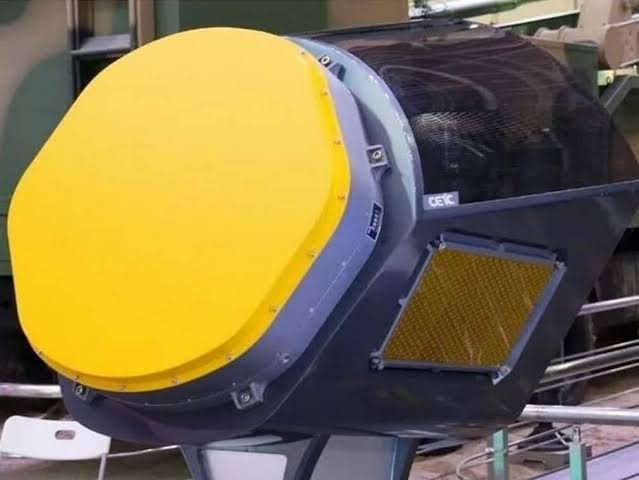
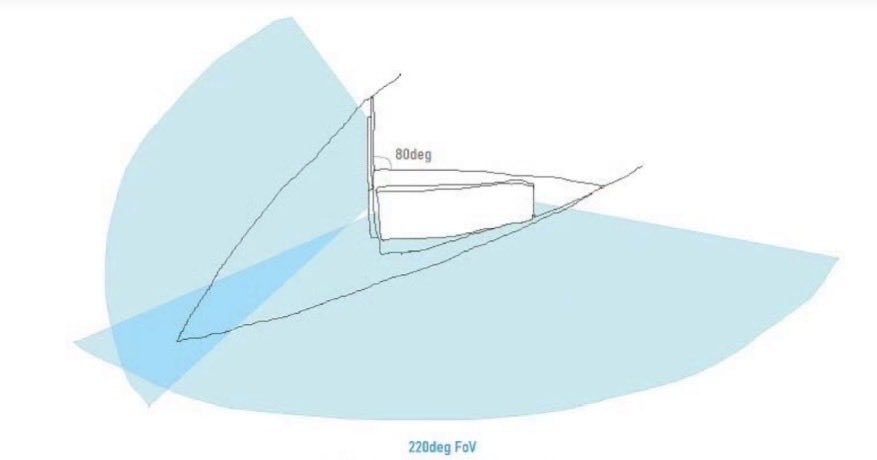
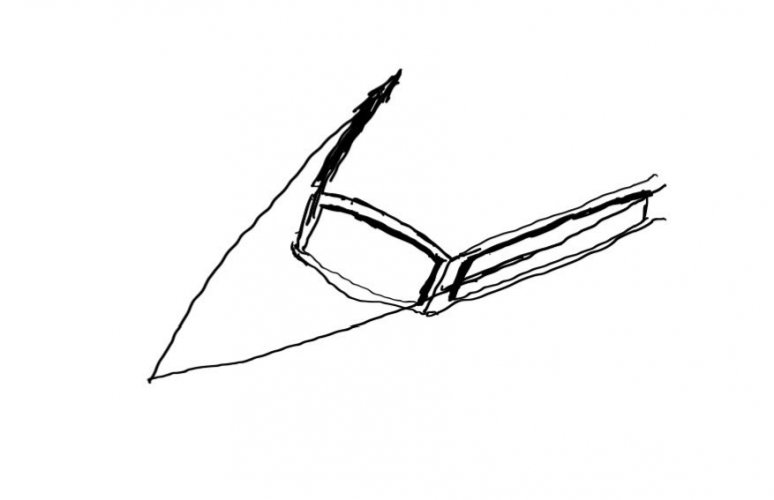
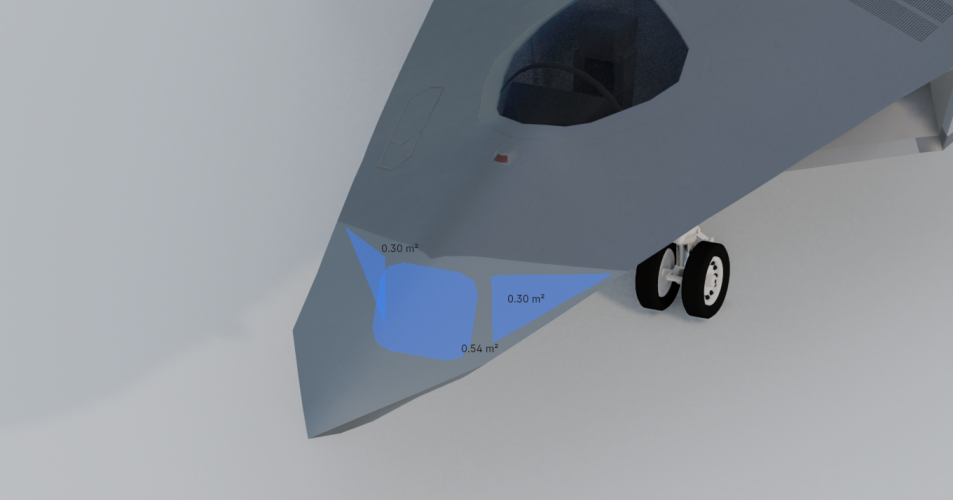
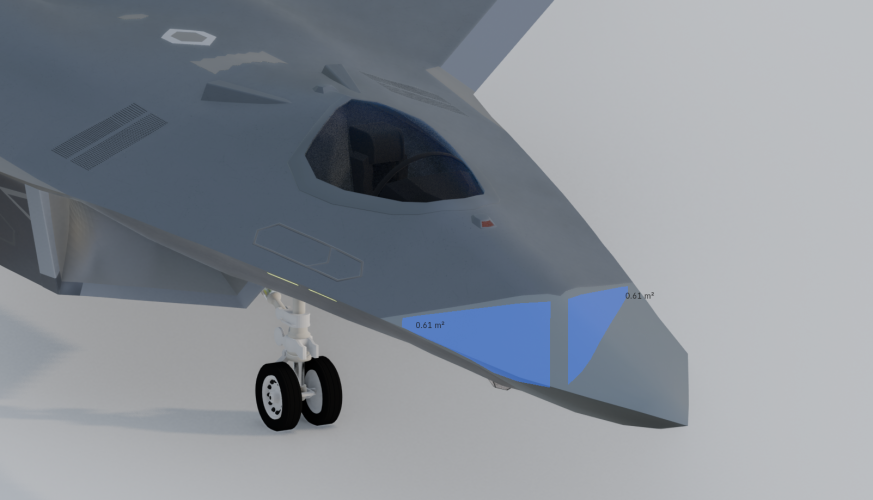
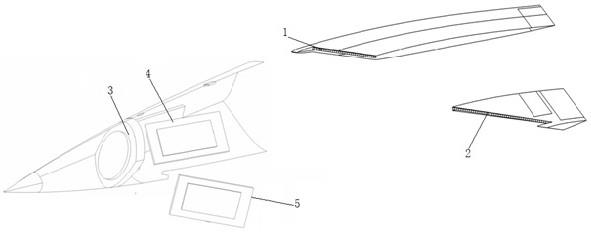
A radar patent filed around the same time as the J-XDS nose design patent by SAC, and figure shows a very slender nose and a three-sided radar array.
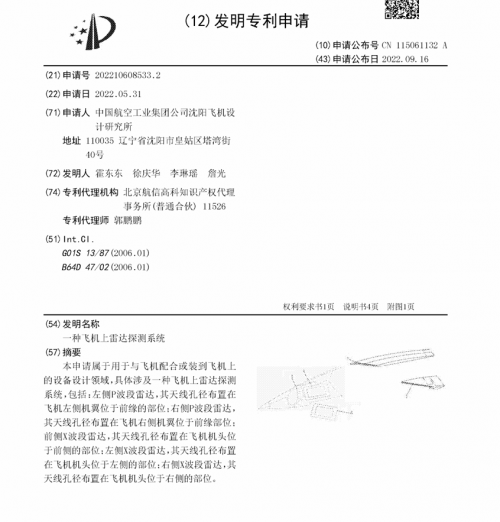
A Radar Detection System on an Aircraft
China National Intellectual Property Administration
Invention Patent Application
Application Publication No. CN115061132A (43) Date of Publication 2022.09.16
Application No. 202210608533.2
Date of Filing 2022.05.31
Applicant: Shenyang Aircraft Design and Research Institute of Aviation Industry Corporation of China (AVIC)
Address: No. 40 Tawan Street, Huanggu District, Shenyang, Liaoning 110035, China
Inventors: Huo Dongdong, Xu Qinghua, Li Linyao, Zhan Guang
Patent Agency: Beijing Hangxin Gaoke Intellectual Property Agency (General Partnership) 11526
Patent Attorney: Guo Pengpeng
Int. Cl.: G01S13/87 (2006.01); B64D47/02 (2006.01)
Abstract:
The present application belongs to the field of design of equipment for use with or mounted on aircraft, and specifically relates to a radar detection system on an aircraft, comprising: a left P-band radar, whose antenna aperture is arranged at a leading-edge portion of the left wing of the aircraft; a right P-band radar, whose antenna aperture is arranged at a leading-edge portion of the right wing of the aircraft; a front X-band radar, whose antenna aperture is arranged at a front portion of the nose of the aircraft; a left X-band radar, whose antenna aperture is arranged at a left portion of the nose of the aircraft; and a right X-band radar, whose antenna aperture is arranged at a right portion of the nose of the aircraft.
Claims:
- A radar detection system on an aircraft, characterized in that it comprises:
a left P-band radar (1), whose antenna aperture is arranged at a leading-edge portion of the left wing of the aircraft;
a right P-band radar (2), whose antenna aperture is arranged at a leading-edge portion of the right wing of the aircraft;
a front X-band radar (3), whose antenna aperture is arranged at a front portion of the nose of the aircraft;
a left X-band radar (4), whose antenna aperture is arranged at a left portion of the nose of the aircraft;
a right X-band radar (5), whose antenna aperture is arranged at a right portion of the nose of the aircraft.
- The radar detection system on an aircraft according to claim 1, wherein the antenna apertures of the front X-band radar (3), the left X-band radar (4), and the right X-band radar (5) are distributed on the top side and two lateral sides of a trapezoid.
- The radar detection system on an aircraft according to claim 1, wherein among the left P-band radar (1), the right P-band radar (2), the front X-band radar (3), the left X-band radar (4), and the right X-band radar (5), signal processing modules are configured separately according to the P band and the X band.
- The radar detection system on an aircraft according to claim 1, wherein the left P-band radar (1), the right P-band radar (2), the front X-band radar (3), the left X-band radar (4), and the right X-band radar (5) share one broadband signal processing module.
- The radar detection system on an aircraft according to claim 3 or 4, wherein the left P-band radar (1), the right P-band radar (2), the front X-band radar (3), the left X-band radar (4), and the right X-band radar (5) share one digital signal processing module.
......
[0020] For the radar detection system on an aircraft disclosed in the above embodiment, a person skilled in the art can understand that the radar detection system on an aircraft is designed to comprise a left P-band radar 1, a right P-band radar 2, a front X-band radar 3, a left X-band radar 4, and a right X-band radar 5, i.e., P-band radar and X-band radar are simultaneously integrated on an aircraft. When the aircraft executes a mission, the P-band radar thereon can perform long-range position detection of a mission target, and after approaching the mission target, the X-band radar thereon performs short-range high-precision detection of the mission target. There is no need for formation cooperation with other aircraft, which can reduce the number and types of aircraft required to perform the mission, facilitate support and maintenance, and does not require complex cooperation strategies between aircraft, is easy to operate, has no problem of flight performance matching, has relatively high mission execution efficiency, and communication is limited to the interior of the aircraft, reducing the possibility of communication being interfered with.
[0021] For the radar detection system on an aircraft disclosed in the above embodiment, a person skilled in the art can also understand that the space required for arranging the antenna aperture of a P-band radar is relatively large, and generally only the leading-edge portion of the left wing and the leading-edge portion of the right wing on an aircraft have sufficient space for arrangement. The P-band radar is designed to comprise a left P-band radar 1 whose antenna aperture is arranged at the leading-edge portion of the left wing and a right P-band radar 2 whose antenna aperture is arranged at the leading-edge portion of the right wing, fully considering the space on the aircraft and enabling a relatively large angular difference therebetween, so that long-range detection in a relatively large angular range can be achieved.
[0022] For the radar detection system on an aircraft disclosed in the above embodiment, a person skilled in the art can also understand that arranging the antenna apertures of the front X-band radar 3, the left X-band radar 4, and the right X-band radar 5 at the nose of the aircraft can reduce the possibility and intensity of electromagnetic interference, and helps ensure the accuracy of short-range detection.