Shenyang / Chengdu "6th Gen" Aircraft - General Discussion and Speculation

Looking back at the whole topic, you'll notice that a lot of people are discussing the usage of sixth-generation fighters using the combat style of fourth-generation jets and the design of fifth-generation jets.
Yep. This whole forum inevitably falls back to the fly high fly fast paradigm and that always ends up becoming a comparison of engines, planforms and payload. Just not the only things or even the most important things that matter anymore.
Additionally, I lean toward the idea that the drones accompanying the J36 would be AI-autonomous fighters. They might be able to identify and attack enemy aircraft on their own, and work with other drones to autonomously choose the best attack strategy based on the movement of enemy planes, then relay it back to the J36's co-pilot commander for real-time adjustments.
Being able to coordinate, respond and actively plan and execute a collaborative task is trivial if one were ready to allow it. While teaming technology continues to be studied, there is sufficient tech there already for it to happen.

As it stands, no one is making CCAs that are semi-autonomous either. Truly semi-autonomous control is used for the purpose of dev and verification. Otherwise It completely defeats the purpose of collaborative combat if every paired cca itself cannot decide how to execute an attack on a target and requires the human to micromanage it. Especially in an extremely dense and complex environment, the pilot should simply be designating targets and assigning / directing attack groups when needed. The 6th gen pilot is more of an AWACS controller than a drone mission planner.

What isnt trivial though is how your AI system reacts when the information being gathered is sparse, theres plenty of jamming and deceptive signals, and what targets you pick up are of varying quality and then having to build awareness and execute plan of actions based off that.

The problem imo is also a matter of how that information flows to the processor, who is doing the processing, and how do you process it well enough to build the required situational awareness to act accordingly. That means each individual unit must be able to take action alone as well as in a group and that gets complex really quick. How complex a model you use depends now on how much electric generation your main processing node has. How much autonomy now depends on how much power generation your drones have too.

Then theres also the problem of how the human affects and is affected by the fight under this framework, because when your teaming AI is taking over, are you, the pilot in the 6th gen still retaining control or are you yourself being commanded by the AI in order to win the fight?

So autonomy and teaming itself is easy, and no CCA user is not going to have this capability. Its when you add in the rest of these problems that its no longer easy. differences in 6th gen fighters and CCAs will be in the quality of the onboard solutions to these problems.

I should also add especially for readers notoriously concerned about kinematic and physical requirements of aircraft - given the likely density of flying targets in a future air war, awareness and appropriate cordination is increasingly more important than having range or kinematics. Id even venture enough to say that kinematics quite frankly take second seat to awareness and reaction.

Even if you can shoot to kill at 300 miles, you need to engage and send to defensive all the opposing enemies that are engaging your force at that 300 mile mark in order to keep them at 300 miles. You also have to have these targets fixed by someone across the missiles flight profile and up until pitbull. Otherwise you wont be able to stop an opposing force from closing in and, if close enough, obtaining a firing solution on you esp with the amount of targets both LO and VLO flying around. Being able to fly faster and higher means absolutely nothing when you with the more exquisite and less numerous force simply cant cover all the required geometries to prevent leakers. Hell being able toshoot first isnt even all that valuable anymore when theres something you havent engaged yet already pushing your position. This is why an appropriate level of sophistication and amassability is far more valuable than increased kinetic and kinematic capability with regards to CCAs.
 
Last edited:
There are a lot of problems, but there are also quite a few solutions. And since the main sixth-generation fighter manufacturing countries are pretty secretive about this, I don't think we'll have answers to these issues right now. But there's no doubt that once they've decided to build these fighters, they definitely have concrete solutions in mind. No doubt, future air battles are going to get even bloodier.
 
This video argues that the triple-engine layout may be to provide power generation for onboard systems while it also operates with loyal wingmen (images are the usual collection of AI slop and more serious renders that are uncredited).
While I'm sure that a 3rd engine helps with electrical power, I'm equally sure that the primary reason for the 3rd engine was power-to-weight at 50% fuel.

J-36 is a hecking big plane, I'm guesstimating 125klbs MTOW (Su34 is 100k, FB-111 is 105k). But China doesn't have 45klb class engines, at least not openly demonstrated. They do have a couple of 32-35klb engines, though, and 3x32>2x45. So the monster plane has ~96-105klbs of thrust. So, after burning 20,000lbs of fuel, the plane has a T:W of 1.0. It could burn another 20klbs of fuel and still have 10-20klbs for weapons.

If the J-36 was not intended as a fighter, instead if it were a "stealthy F-111", it would only need 2 engines for straightline speed.
 
J-36 is a hecking big plane, I'm guesstimating 125klbs MTOW (Su34 is 100k, FB-111 is 105k). But China doesn't have 45klb class engines, at least not openly demonstrated. They do have a couple of 32-35klb engines, though, and 3x32>2x45. So the monster plane has ~96-105klbs of thrust. So, after burning 20,000lbs of fuel, the plane has a T:W of 1.0. It could burn another 20klbs of fuel and still have 10-20klbs for weapons.
WS-15 is a 40 klbs thrust class engine. It wouldn’t be too hard to upgrade it to 45 klbs by raising the bypass ratio and making other tweaks. I don’t think twin 45 klbs engines can satisfy the needs of the J-36, especially since it has relatively small forebody sweep and leading edge sweep angles.

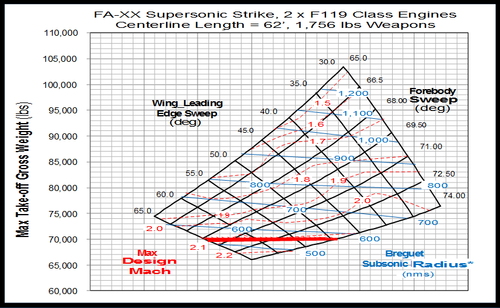
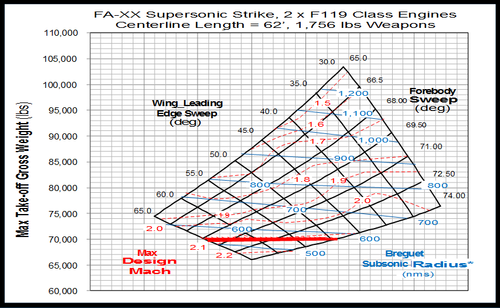
We can use this chart for reference. A forebody sweep angle between 65 and 68 degrees, paired with a 50 degree wing leading edge sweep angle, corresponds to a takeoff weight of 85000lbs to 90000 lbs. With a thrust to weight ratio in this range, the top speed will end up being pretty underwhelming.
 

Attachments

  • 图:诺斯罗普·格鲁曼FA-XX的可能.png
    图:诺斯罗普·格鲁曼FA-XX的可能.png
    171.5 KB · Views: 160
Last edited:
3).The propulsion system needs to balance specific fuel consumption (SFC) and supersonic thrust. If optimal values for both cannot be achieved simultaneously, prioritize lowering SFC and moderately relax the requirement for intermediate thrust.
Three adaptive cycle engines represent the fully mature configuration for the J-36. Prior to this engine swap, the J-36 is tailored to prioritize long range capabilities. Taking into account past rumors surrounding the J-XDS focusing on supersonic performance, alongside papers detailing its intake optimized for 1.8 Mach, the J-36 and J-XDS clearly follow divergent design priorities. I suspect they will utilise distinct variants of the WS-15 during their early service phases.

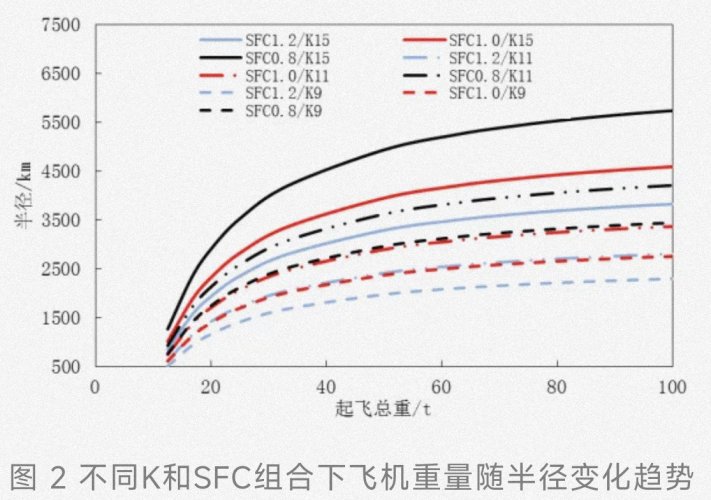
As shown in Figure 2, the longer the mission leg distance, the greater the impact of lift to drag ratio and SFC on aircraft weight. For fighters with a combat radius of around 1000 km, even if we moderately relax the lift to drag ratio and SFC targets to meet demands such as high angle of attack maneuvering and steep climb rate, the aircraft weight will still fall within a viable design window of roughly 20 tonnes. By contrast, for designs targeting a far longer combat radius (for instance, the 2200 km sought by Japan), varying combinations of lift coefficient K and SFC can lead to weight differences of up to 10 tonnes or even dozens of tonnes, exerting a disruptive, make or break effect on the viability of the overall design scheme.
With SFC set to 1 and K set to 15, 55 tonnes gives a combat radius of 3700 km on this chart
 

Attachments

  • 7DCDA549B12FA32E7D1A35F4A81FEF5D.jpg
    7DCDA549B12FA32E7D1A35F4A81FEF5D.jpg
    596.9 KB · Views: 85
WS-15 is a 40 klbs thrust class engine. It wouldn’t be too hard to upgrade it to 45 klbs by raising the bypass ratio and making other tweaks. I don’t think twin 45 klbs engines can satisfy the needs of the J-36, especially since it has relatively small forebody sweep and leading edge sweep angles.

We can use this chart for reference. A forebody sweep angle between 65 and 68 degrees, paired with a 50 degree wing leading edge sweep angle, corresponds to a takeoff weight of 85000lbs to 90000 lbs.
That's quite a bit lighter than I was expecting.


With a thrust to weight ratio in this range, the top speed will end up being pretty underwhelming.
Not necessarily. Blackbird has an in-flight TWR of about 0.58. A-5 has a TWR of about 0.79 (both at roughly half fuel)
 
That's quite a bit lighter than I was expecting.


Not necessarily. Blackbird has an in-flight TWR of about 0.58. A-5 has a TWR of about 0.79 (both at roughly half fuel)
Northrop once developed a concept for the F/A-XX supersonic strike fighter featuring a double-swept wing configuration and engines analogous to the F119. To achieve a combat radius of 1,200 nautical miles (2,222 kilometres) and a maximum take-off weight approaching 100,000 pounds (45.4 tonnes), the design required a leading-edge wing sweep angle of roughly 35° to boost lift-to-drag ratio, which capped the aircraft’s top speed at approximately Mach 1.5. Evidently, the performance limits of existing low-bypass-ratio turbofan engines are insufficient to meet the operational requirements of next-generation high-performance fighter jets.
The 85000‑90000 number I mentioned is the weight from this chart for a twin sweep fighter powered by two F119 class engines. It has TWR close to the J‑36, with roughly matching forebody sweep and leading‑edge sweep angles. Perhaps you haven’t seen this chart?

Edit: Maximum speed is indeed mainly determined by the sweep angles,my earlier wording was not precise ,2 × 45000 ÷ 125000 = 0.72. At this point, the maximum takeoff weight corresponding to two F119 engines should be 97000 lbs, and this value falls off‑scale on this chart so we cannot read it. My conclusion remains the same. At this sweep angle, this low TWR leaves little practical design value for the configuration.

Anybody got relatively solid figures for J‑36 forebody sweep angle? My current estimate is just within the 65‑70 degrees range.
 

Attachments

  • 图:诺斯罗普·格鲁曼FA-XX的可能.png
    图:诺斯罗普·格鲁曼FA-XX的可能.png
    171.5 KB · Views: 85
Last edited:
While I'm sure that a 3rd engine helps with electrical power, I'm equally sure that the primary reason for the 3rd engine was power-to-weight at 50% fuel.

J-36 is a hecking big plane, I'm guesstimating 125klbs MTOW (Su34 is 100k, FB-111 is 105k). But China doesn't have 45klb class engines, at least not openly demonstrated. They do have a couple of 32-35klb engines, though, and 3x32>2x45. So the monster plane has ~96-105klbs of thrust. So, after burning 20,000lbs of fuel, the plane has a T:W of 1.0. It could burn another 20klbs of fuel and still have 10-20klbs for weapons.

If the J-36 was not intended as a fighter, instead if it were a "stealthy F-111", it would only need 2 engines for straightline speed.
Also could be for altitude. The higher you fly the further you can see. Giant wing and lots of power you can still turn decently at higher altitudes.
 
The 85000‑90000 number I mentioned is the weight from this chart for a twin sweep fighter powered by two F119 class engines. It has TWR close to the J‑36, with roughly matching forebody sweep and leading‑edge sweep angles. Perhaps you haven’t seen this chart?
No, I hadn't seen that before you posted it yesterday


Anybody got relatively solid figures for J‑36 forebody sweep angle? My current estimate is just within the 65‑70 degrees range.
@Deino ? Weren't you working on a CAD model of the J36?
 
Also could be for altitude. The higher you fly the further you can see. Giant wing and lots of power you can still turn decently at higher altitudes.

Indeed... and at high speed the angle of attack should be within limits for a dorsal air intake. It is likely that its supersonic turn performance is determined mainly by whether the airframe can handle 7g.

P.S. Anyone reading this should realise that supersonic turns are not very sharp to begin with.
 
(Via ACuriousPLAFan/SDF)
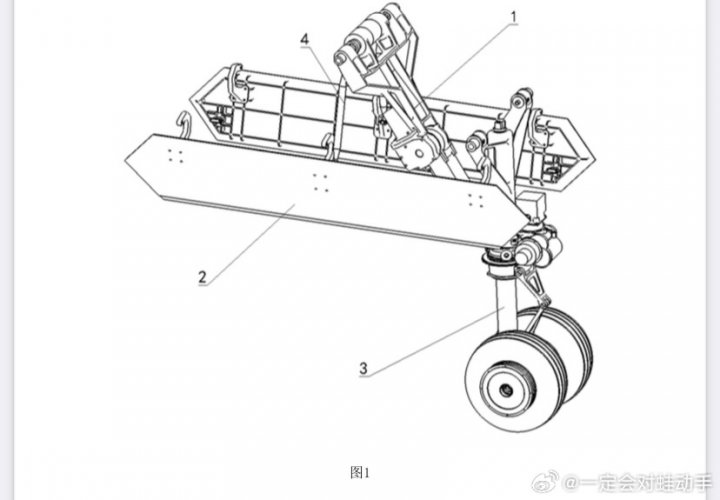
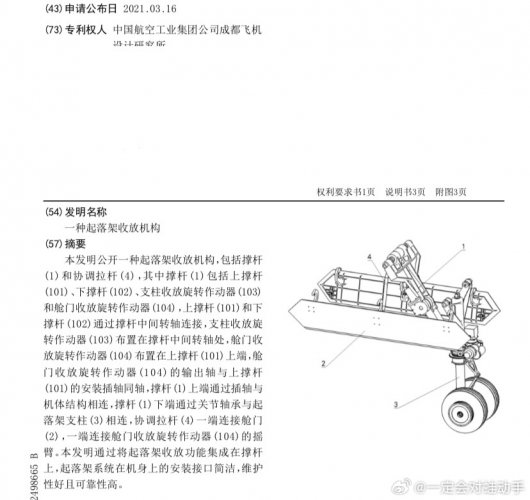
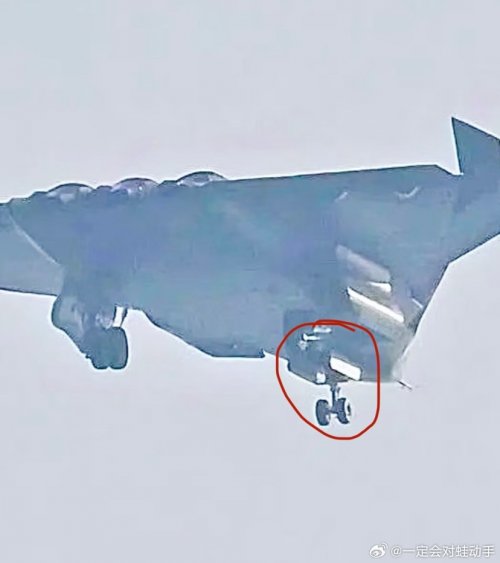
Excerpts from a patent document on a forward landing gear setup, published by Chengdu AC and could be related to the J-36. Posted by @一定会对蛙动手 on Weibo.
 

Attachments

  • 1000108152.jpg
    1000108152.jpg
    57.6 KB · Views: 138
  • 1000108153.jpg
    1000108153.jpg
    124.1 KB · Views: 148
  • 1000108154.jpg
    1000108154.jpg
    79.2 KB · Views: 191
Last edited by a moderator:
The reason it has three engines is they used an existing engine instead of having to design a larger engine, which takes a long time to develop. Also, by using an existing engine it aids with spare parts commonality with the other aircraft using the same engine. It's not as complicated as they want to make it. It's like asking why the Vulcan bomber had four engines instead of two.
 
The reason it has three engines is they used an existing engine instead of having to design a larger engine, which takes a long time to develop. Also, by using an existing engine it aids with spare parts commonality with the other aircraft using the same engine. It's not as complicated as they want to make it. It's like asking why the Vulcan bomber had four engines instead of two.

Also, I think I said this before but if there is a notional 350 J-XDS and 150 J-36 then the number of engines (by having a three engine J-36) goes from 1000 engines to 1150 engines... which is only a 15% increase in procurement - and economies of scale as well as logistics commonality reduce that cost further... so one gets a significant increase in capability for a small increase in cost.

It is also worth noting that it might be possible to extract a lot more power from a three engine setup (e.g. for radars and jammers).
 
So, the F-35B taps something like 28MW from the engine for the lift fan. What are the odds (assuming this story is true) that the 3rd engine in the middle has a similar drive shaft going to a generator for the laser? Use it for flight, power, or both.
 
Depends on how much power the third engine generates Sferrin if it is anything like the other two engines then I would probably say that it would get away with powering both for flight and the laser, we just do not know at this point in time about what it could be used for.
 
https://mp.weixin.qq.com/s?__biz=Mz...ecaf15be635c44154a596135d989c6b97043&scene=27
Chapter 6 of the 2024 paper authored by the J‑36 chief designer contains a detailed treatment of engine‑borne electrical‑power systems. Both the aircraft‑side accessory gearbox and engine‑mounted accessory gearbox are eliminated. Instead, embedded starter‑generators integrated inside the engine are adopted. The concept is broadly similar to that of the GCAP engine,although the peak output of the GCAP demonstrator is relatively limited at 1 MW.

IMO there is no reason to expect any exceptional electrical generation function from the third engine.
 
Is this thing retractable? Otherwise I think it is gonna be a pretty big contributor to frontal RCS. Personally I think a faceted solution like the EOTS on J-20 is probably superior. Then again, this could just be a concept video, not the final product.
 
This is very much giving the vibes of 'We have a laser - it could be integrated on your new fighter' marketing pitch (as opposed to anything remotely official regarding the actual capabilities of the new fighter).

Is this thing retractable? Otherwise I think it is gonna be a pretty big contributor to frontal RCS. Personally I think a faceted solution like the EOTS on J-20 is probably superior. Then again, this could just be a concept video, not the final product.

Yes, it makes me think that the render isn't done by someone who actually works on these combat aircraft.
 
https://mp.weixin.qq.com/s?__biz=Mz...ecaf15be635c44154a596135d989c6b97043&scene=27
Chapter 6 of the 2024 paper authored by the J‑36 chief designer contains a detailed treatment of engine‑borne electrical‑power systems. Both the aircraft‑side accessory gearbox and engine‑mounted accessory gearbox are eliminated. Instead, embedded starter‑generators integrated inside the engine are adopted. The concept is broadly similar to that of the GCAP engine,although the peak output of the GCAP demonstrator is relatively limited at 1 MW.

IMO there is no reason to expect any exceptional electrical generation function from the third engine.

Isn't GCAP supposed to have exceptional electric power generation as a core requirement?

Also, isn't 1 MW a tremendous amount of power for a fighter aircraft? Isn't the power usage of the Mig-31's notoriously thirsty radar something like 1/4 of that?
 
This is very much giving the vibes of 'We have a laser - it could be integrated on your new fighter' marketing pitch (as opposed to anything remotely official regarding the actual capabilities of the new fighter).


Yes, it makes me think that the render isn't done by someone who actually works on these combat aircraft.
From what I’ve read it is in AVIC’s display area so there is a degree of official support as in it is something they have in development, but take the illustrations with a grain of salt. The focus is on the targeting/fire control for the laser anyway.
 
Isn't GCAP supposed to have exceptional electric power generation as a core requirement?

Also, isn't 1 MW a tremendous amount of power for a fighter aircraft? Isn't the power usage of the Mig-31's notoriously thirsty radar something like 1/4 of that?
Yes, the GCAP features substantially improved power generation capability compared to previous generation fighter aircraft. Nevertheless, my personal assessment is that a peak generating capacity of 1 MW is still too conservative for the J‑36, considering that according to leaks, the J‑36 places heavy emphasis on electronic warfare. Both its large airframe and two‑seat configuration are tied to its EW requirements.
 
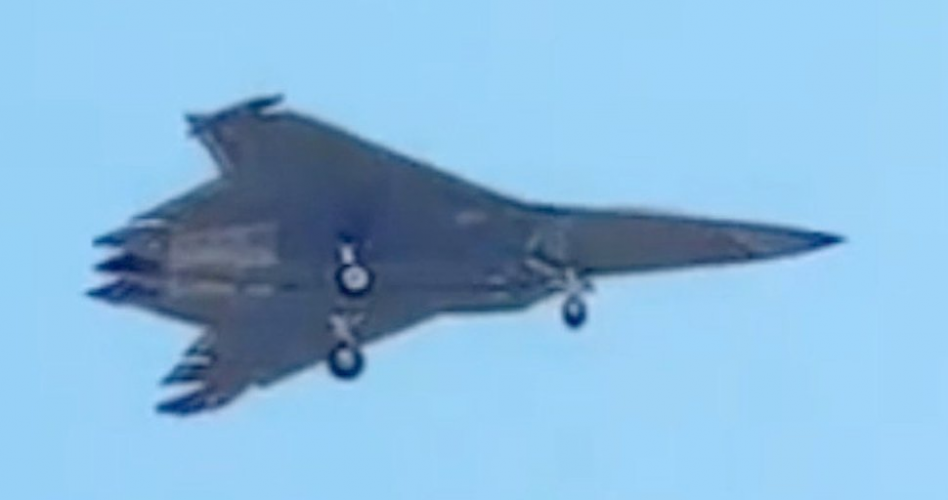
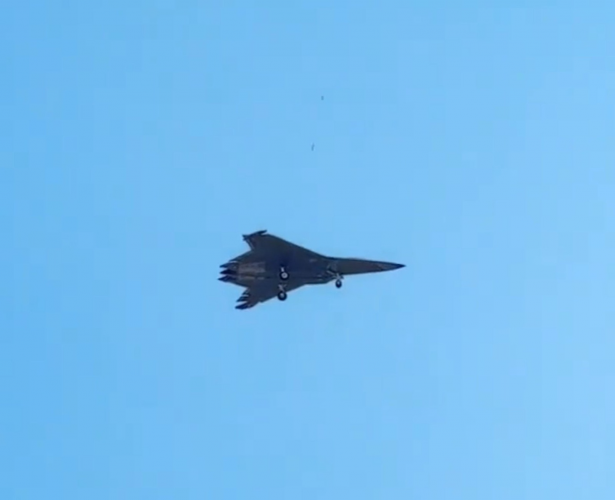
Another image via Hurin on X

As it seems again the prototype with the revised larger nozzles (highly likely WS-15 IMO!) Do we have any concrete information on how many prototypes are already flying? I won't be surprised if there already at least three.
 

Attachments

  • 1789662196318.png
    1789662196318.png
    201.4 KB · Views: 108
  • 1789662211765.png
    1789662211765.png
    293 KB · Views: 110
Last edited by a moderator:
Another image via Hurin on X

As it seems again the prototype with the revised larger nozzles (highly likely WS-15 IMO!) Do we have any concrete information on how many prototypes are already flying? I won't be surprised if there already at least three.

View attachment 824040
View attachment 824041
It does looks like they swapped out the engines for something since the paint job in the under carriage looks different.
 
From what I’ve read it is in AVIC’s display area so there is a degree of official support as in it is something they have in development, but take the illustrations with a grain of salt. The focus is on the targeting/fire control for the laser anyway.
Still, if they really intend to put lasers (hkW level according to the label) on the J-36 it's not surprised why its design just looked like Chengdu simply throwed the whole idea of dogfighting out of window.
 
What you think about the seemingly extreme nose radome canting? Is some kind of V-shaped array possible?
Like the face of the radar antenna is V-shaped? What benefit can you get from such a design? Better utilization of the radome volume and ability to get sideway views?
 
Like the face of the radar antenna is V-shaped? What benefit can you get from such a design? Better utilization of the radome volume and ability to get sideway views?
Iirc, there were discussions about non-traditional arrays back when the 6th gen were unveiled, so i imagine such designs, either V-shaped, or maybe some kind of multi-facet configuration means more TRMs can be crammed in the same radome space, while eliminating the need for swashplate designs and still offering extended side FOV.
 
Chapter 6 of the 2024 paper authored by the J‑36 chief designer contains a detailed treatment of engine‑borne electrical‑power systems. Both the aircraft‑side accessory gearbox and engine‑mounted accessory gearbox are eliminated. Instead, embedded starter‑generators integrated inside the engine are adopted. The concept is broadly similar to that of the GCAP engine,although the peak output of the GCAP demonstrator is relatively limited at 1 MW.
Not sure I like starter-generators inside the spools, that's going to greatly suck for maintenance.

The classic "starter-generator in the inlet bolted onto the front of the compressor" like J34 and J79 may be a better option (not sure how well or even if that works with a multi-spool engine). @F119Doctor can you start a multi-spool engine by starting the LP compressor?


Like the face of the radar antenna is V-shaped? What benefit can you get from such a design? Better utilization of the radome volume and ability to get sideway views?
Well, first it gets the radar away from glinting directly forward.

ESAs of both types have been demonstrated with 90deg between arrays (45deg "sweep") and seamless tracking as an object moves around them. One of the SPY6 versions (v3?) can handle 120deg between arrays (60deg "sweep") but apparently has some loss of data fidelity at the edges, 90deg is much preferred there.

But it'd be possible to have two arrays in there matching the ~50deg sweep of the main leading edges with no trouble. So now your nose radar is covering +-100deg across the front of the plane. Able to track a target abeam(!).
 
What you think about the seemingly extreme nose radome canting? Is some kind of V-shaped array possible?
Glad I'm not the only one that saw it this way, although I would still want to see clearer images first. One of the features that stuck out to me from the start was how wide and flat the nose was. I wondered about the prospect of one very wide array, but having it occupied by two angled arrays sounds much better.
 
Not sure I like starter-generators inside the spools, that's going to greatly suck for maintenance.

The classic "starter-generator in the inlet bolted onto the front of the compressor" like J34 and J79 may be a better option (not sure how well or even if that works with a multi-spool engine). @F119Doctor can you start a multi-spool engine by starting the LP compressor?


Well, first it gets the radar away from glinting directly forward.

ESAs of both types have been demonstrated with 90deg between arrays (45deg "sweep") and seamless tracking as an object moves around them. One of the SPY6 versions (v3?) can handle 120deg between arrays (60deg "sweep") but apparently has some loss of data fidelity at the edges, 90deg is much preferred there.

But it'd be possible to have two arrays in there matching the ~50deg sweep of the main leading edges with no trouble. So now your nose radar is covering +-100deg across the front of the plane. Able to track a target abeam(!).
Doesn’t the beam attenuate towards the edges of the radar? I’d imagine there will be some tradeoff form looking at head on targets.
 

Similar threads

Back
Top Bottom