Hardrada55

ACCESS: Confidential
Joined
31 May 2008
Messages
111
Reaction score
94
As we know, Dedalo was a German merchant ship confiscated during WW1 and converted by the Spanish into a seaplane tender in 1922. Dedalo well demonstrated the utility of an aircraft capable ship by supporting the Spanish-French landings at Alhucemas during the Rif War in Morrocco in 1925. In 1934, the Spanish were the first to land and take off in an autogyro from Dedalo. I believe the Spanish Armada’s “portahidroavion” Dedalo was laid up by the time of the Spanish Civil War. Did the Spanish have any plans on replacing Dedalo with any other kind of seaplane tender or aircraft carrier or aircraft carrying ship between the time they laid up Dedalo in 1934 and the time they got Cabot (i.e. Dedalo 2) in 1967?
 
As we know, Dedalo was a German merchant ship confiscated during WW1 and converted by the Spanish into a seaplane tender in 1922. Dedalo well demonstrated the utility of an aircraft capable ship by supporting the Spanish-French landings at Alhucemas during the Rif War in Morrocco in 1925. In 1934, the Spanish were the first to land and take off in an autogyro from Dedalo. I believe the Spanish Armada’s “portahidroavion” Dedalo was laid up by the time of the Spanish Civil War. Did the Spanish have any plans on replacing Dedalo with any other kind of seaplane tender or aircraft carrier or aircraft carrying ship between the time they laid up Dedalo in 1934 and the time they got Cabot (i.e. Dedalo 2) in 1967?
The Salvador Carvia Plan Naval of 1930 provided, among others, for the construction of two light aircraft carriers of 15,000t and 30 aircraft.
 
Los portaaviones españoles by Busquets/Campanera/Coello. Aldaba Ediciones 1994 starting from page 67 to 79

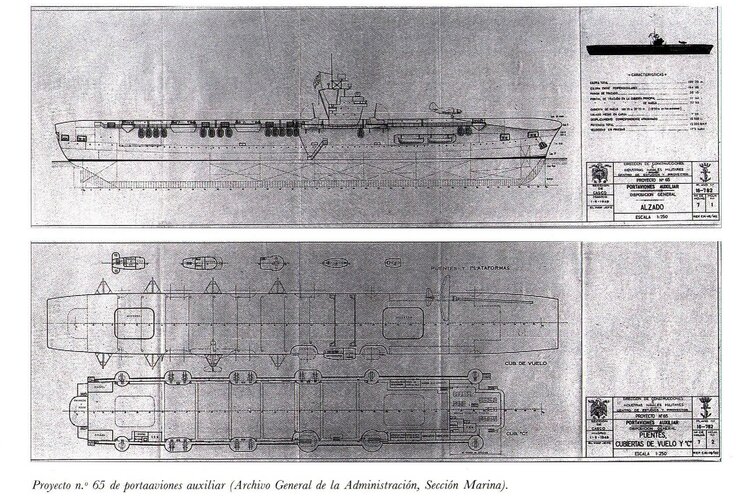
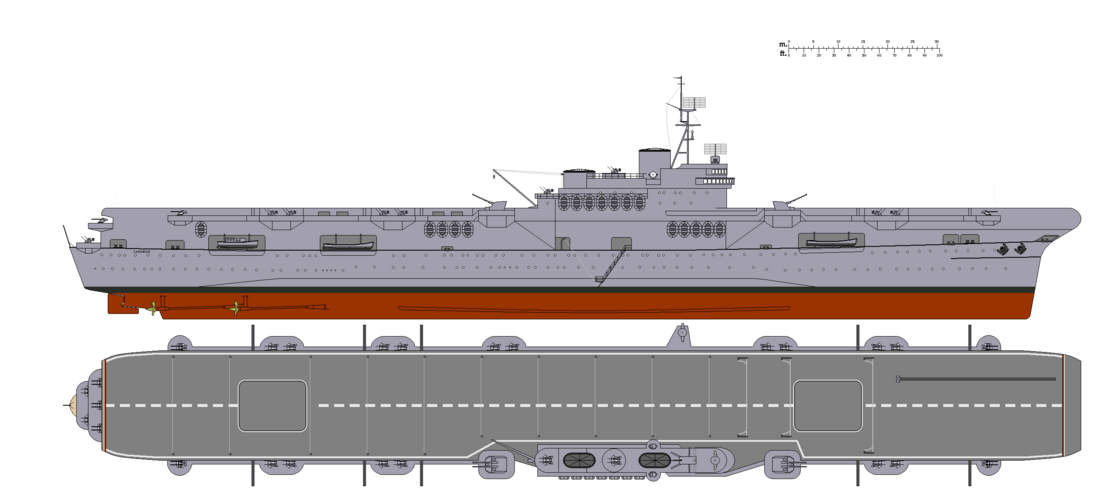
Proyecto nº59 (1947) Conversion of a Empresa Nacional Elcano G tanker design into an auxiliary aircraft carrier. That finally evolved into Proyecto nº65 from 1949

During 1947 interest into the acquisition of a WWII surplus CVE resulted in a commercial proposal from a Dutch company which was the the owner of the HMS Nabob. But the amount of work and probable political issues of converting it again into an active warship prevented the sale.

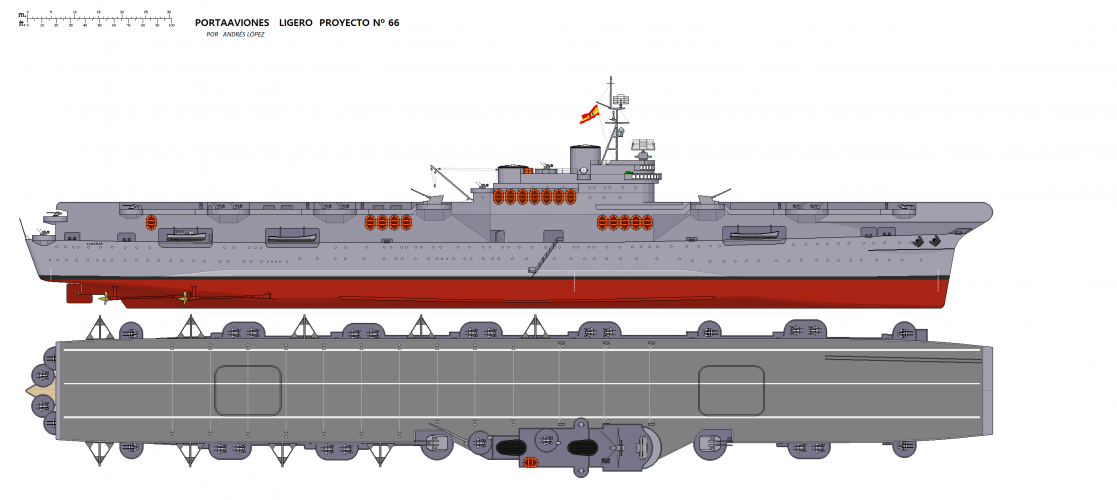
Proyecto nº66 conversion of heavy cruiser Canarias into a CVL (1950)

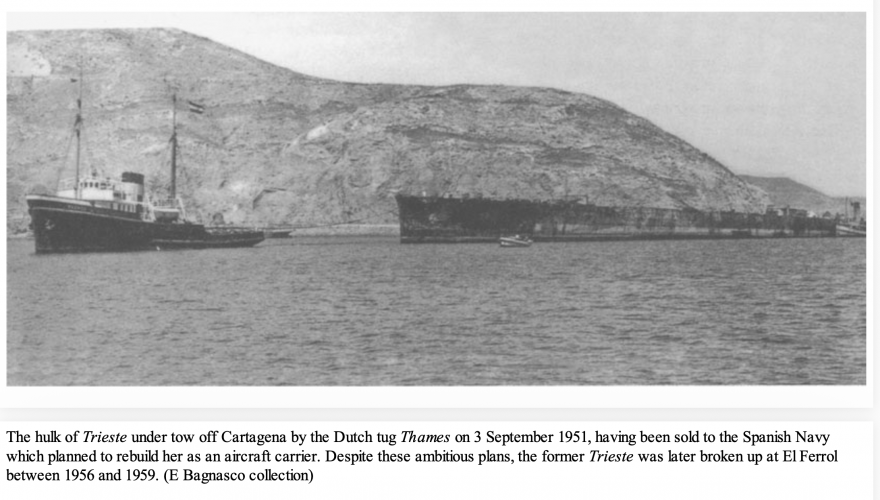
Trieste "affair" : The Regia Marina heavy cruiser Trieste remained sunken since 1943 at shallow waters in Sardegna. It was recovered in 1950 and offered by its owners to the Spanish Navy where it was found as a candidate for rebuilding into a CVL. To avoid political issues, the operation was carried out under cover (the wreck declared to be bought from a civilian company for scrapping and payment was done in minerals) Once the hull was carefully inspected in Cartagena Naval Station during 1951 it was found that it was in such a bad condition that it better should send it to the scrapping yard. And so was done at Ferrol.

Finally, in 1965, US Government allowed the Spanish Armada to choose from the following USN surplus units:

USS Thetis Bay CVH-1 ( an ex- Casablanca CVE class): rejected by bad condition and little capacity
USS Lake Champlain CV-39 : discarded because it was over ambitious and unaffordable :) Who doesn't love the Essex class?
USS San Jacinto/USS Cabot ( both Independence class CVL) : the second one was in better condition thus it was selected to be "Dédalo" (the second) with The Armada.
 
Proyecto nº66 conversion of heavy cruiser Canarias into a CVL (1950)

Trieste "affair" : The Regia Marina heavy cruiser Trieste remained sunken since 1943 at shallow waters in Sardegna. It was recovered in 1950 and offered by its owners to the Spanish Navy where it was found as a candidate for rebuilding into a CVL. To avoid political issues, the operation was carried out under cover (the wreck declared to be bought from a civilian company for scrapping and payment was done in minerals) Once the hull was carefully inspected in Cartagena Naval Station during 1951 it was found that it was in such a bad condition that it better should send it to the scrapping yard. And so was done at Ferrol.
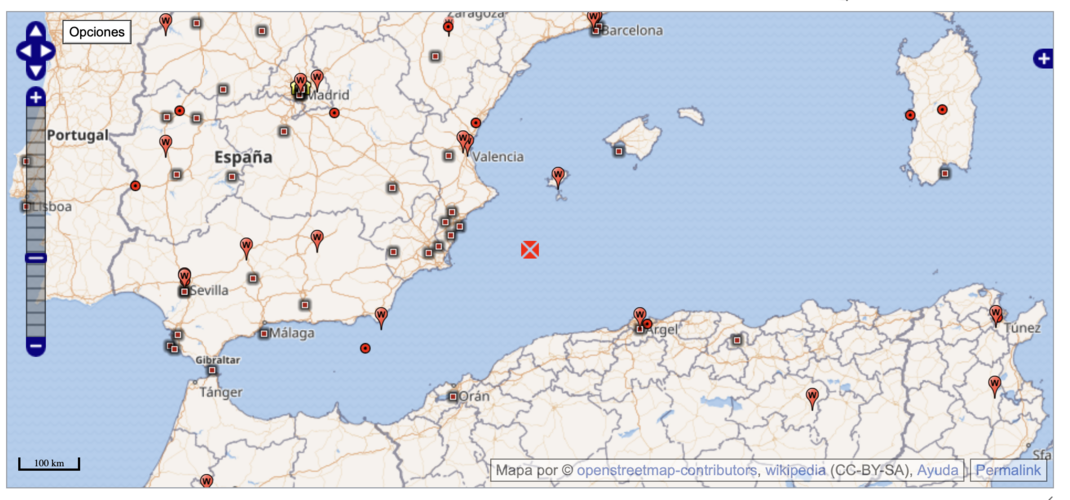
Are you sure it was Trieste and not Canarias or Baleares?
 
Are you sure it was Trieste and not Canarias or Baleares?
Absolutely,
The text of the book is clear, there's even a foto of the hull at Cartagena Naval Station.
The idea came because at that time existed the plan to convert the Canarias


About the contemporary plan for Canarias, please read Proyecto nº65 at post#5.

Baleares, Canarias sistership was sunk in a naval battle in 1938 (Spanish Civil War)
https://en.wikipedia.org/wiki/Spanish_cruiser_Baleareshttps://en.wikipedia.org/wiki/Battle_of_Cape_Palos_(1938)I don't know how deep she rests but still remains there
 

Attachments

  • cruiser Baleares location.png
    cruiser Baleares location.png
    1.1 MB · Views: 344
Last edited:
The silly joke with Dedalo: it was nicknamed Pedalo... paddle boat. (I'll get my coat)
It was an old ship as the destroyers escorting her. It wasn’t a credible force operatimg outside NATO in
front of modern Soviet submarines. I see them more as training ships filling the gap while waiting for better times. Anyway, not a bad service she gave because Dedalo operated Harriers from her original wood deck. The same from which Hellcats operated in the Pacific War. A respectable lady, a piece of history.
 
Last edited:
When I was thirteen years old, the school where I studied was chosen for a guided tour of the Canarias “heavy” cruise ship, they had told us about that ship in such grandiose terms that the reality disappointed me. I found the guns small and the deck too narrow. At that time I had already developed the bad habit of saying what I think and I won three failures in the subjects of urbanity, religion and the formation of the national spirit.:)
 
Got the joke from former French navy sailors on discussion forums. French and spanish carriers trained together back in the Clemenceau days.

What the french conveniently forgot was that before the Clems IOC in the 1960's France had not one but two pedalo... Dedalo sisterships: Lafayette and Bois Belleau. All three were Independance class CVL.

It was an old ship as the destroyers escorting her. It wasn’t a credible force operatimg outside NATO in
front of modern Soviet submarines. I see them more as training ships filling the gap while waiting for better times. Anyway, not a bad service she gave because Dedalo operated Harriers from her original wood deck. The same from which Hellcats operated in the Pacific War. A respectable lady, a piece of history.
France flew F4U Corsairs out of Lafayette in Suez, 1956 and beyond (1964 !) as the Sea Venoms could not safely fly out of any carriers before the Clems.
 
Last edited:
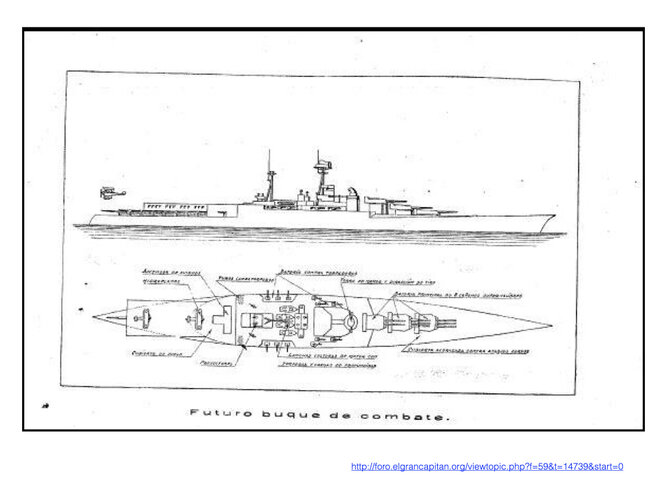
Found an old collected file about an air capable hybrid battleship design for the Armada. Seems a British design from 20s or early 30s. The link points to a thread from 2008 where no mention about this design is found. A mystery to be solved, maybe I should consider sign in there.
 

Attachments

  • Hybrid BB for Spain.jpeg
    Hybrid BB for Spain.jpeg
    225.4 KB · Views: 320
Los portaaviones españoles by Busquets/Campanera/Coello. Aldaba Ediciones 1994 page 67

Official plans from Proyecto 65 CVE

Probably available one day form the link at post #12
 

Attachments

  • Proyecto 65 CVE.jpeg
    Proyecto 65 CVE.jpeg
    496.2 KB · Views: 324
Found an old collected file about an air capable hybrid battleship design for the Armada. Seems a British design from 20s or early 30s. The link points to a thread from 2008 where no mention about this design is found. A mystery to be solved, maybe I should consider sign in there.
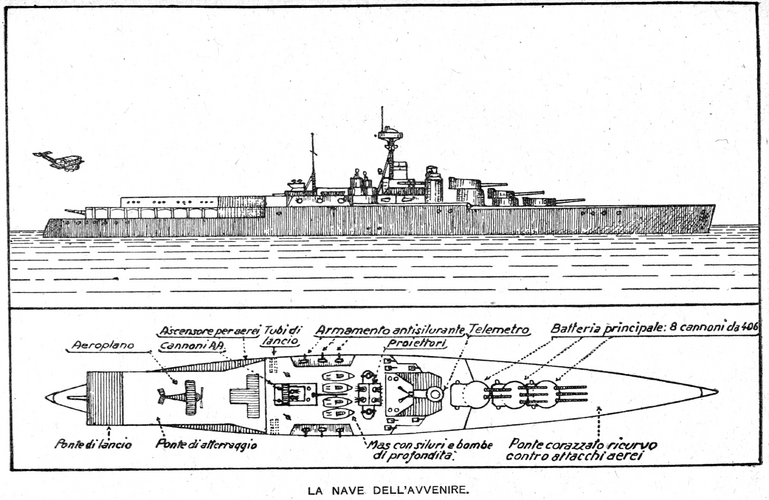
No, that was an Italian proposal for Italy, nothing to do with Spain. The late Stefano Sappino shared it with me but apart from the info on the drawing no other data was available.
It was a mix of Battleship, carrier and torpedo-boat carrier (MAS - Motoscafo Armato Silurante - torpedo-armed motorboat)
Here it is with the original high resolution:
Italian BBCV.png
 

Attachments

  • CVL Nº-66.PNG
    CVL Nº-66.PNG
    127.3 KB · Views: 251
I stumbled across this image and caption while skimming through Maurizio Brescia's book 'Mussolini's Navy', A reference guide to the Regia Marina 1930-1945.
Does anyone have anymore details/images, in fact, information in general on this 'project'?
Tks
 

Attachments

  • Screenshot 2026-05-20 at 16.58.18.png
    Screenshot 2026-05-20 at 16.58.18.png
    1.5 MB · Views: 148
Not much time ago I posted information about that in this forum.
To the moment I've tried to find it without success. I'll keep trying it.
 
Thanks, and my apologies. When I tried the search function I only saw references to Canairias and didn't drill down further.:oops:
 
In addition to the above projects, the 1938 naval armament plan proposed the construction of two aircraft carriers with a displacement of 23,000 tons and a capacity of 40-50 aircraft, but public information on these carriers is very limited. I have already submitted a request to AGA for more information, wish me luck!
 
Before AGA responds, I plan to share my own guess. Based on the international relations and design specifications at that time, I believe the most likely form of this aircraft carrier is a Spanish version of the Graf Zeppelin-class carrier.
My conjecture is based on the following: The standard displacement of a Graf Zeppelin-class aircraft carrier is 24,500 tons, and its designed aircraft capacity in 1939 was 42 planes, which is quite close to the figures for Spain's 1938 aircraft carrier project. Moreover, Franco's Spain did have military cooperation with Nazi Germany, which was also one of the few countries at the time that could provide Spain with aircraft carrier design schemes.And by 1938, the Graf Zeppelin had already been launched, although she was not yet completed.
According to the Spain-Italy joint battleship project, I think the Spanish version will have the following changes:
1. Replace the German-designed 105mm anti-aircraft gun with the 120mm anti-aircraft gun independently produced by Spain, and it may be a twin-gun mount version.
2.If possible, use Spain's locally produced 50-caliber twin 40mm 'pom-pom' instead of the German 37mm anti-aircraft gun (I made this speculation based on ammunition compatibility, but I'm not sure about the performance difference between these two anti-aircraft guns)
3.Remove the 150mm secondary guns, because Spain does not have the need to deploy aircraft carriers for long-distance independent operations, and it is unlikely to have carriers engage in surface combat.
4.If possible, reduce the requirements for aircraft carrier armor protection, for the same reasons as above.
5.It may adopt a closed bow and stern and a British-style superstructure layout, which is inferred from the design plans of the No. 66 aircraft carrier.
 
Alright, things have gotten a bit messy. The Spanish did not create a detailed and complete electronic inventory, which means I will most likely have to go to the site in person to check the information.But I don't live in Spain now, and it's unlikely that I will go to Spain in the foreseeable future. I can only hope that they will be able to provide a better solution in their next reply :(
 
I'm not really sure if I should put this thing here, maybe I should just put it out for now.
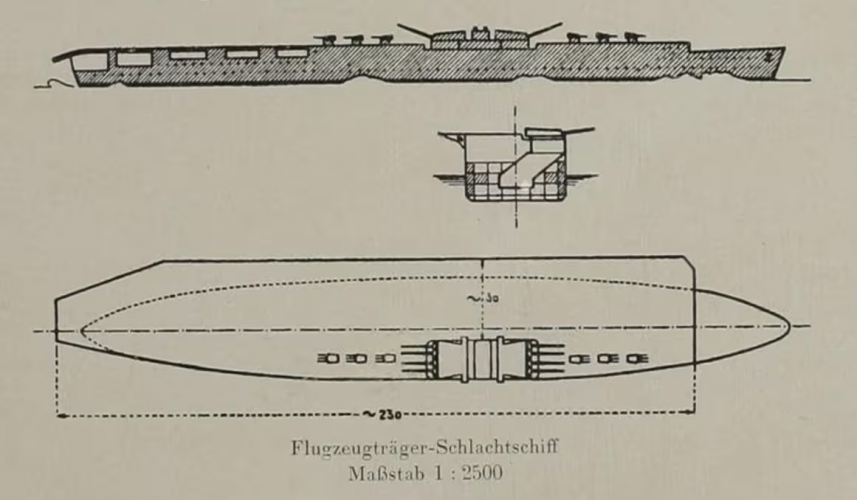
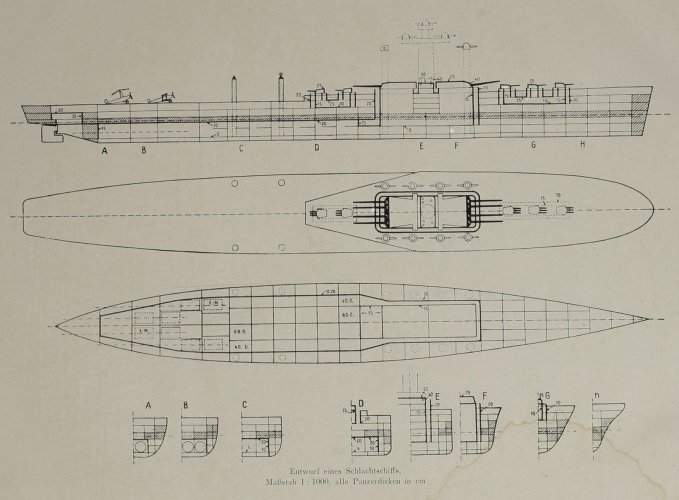
A hybrid battleship design by Colonel Arturo Génova of the Spanish Navy General Staff, published in the November 1942 issue of Revista General de Marina:
the deck is 30 meters wide and 230 meters long. The weapon system was moved to the starboard side, and to balance the center of gravity, the flight deck was extended significantly to the port side. The estimated displacement is about 40,000 tons, and it could carry 70-80 various aircraft. The main guns are two quadruple 406mm turrets; the secondary guns are five triple 120mm high-angle dual-purpose guns; a large number of small-caliber machine guns were not specified.
There are 24 engine rooms, with 12 of them equipped with 4 diesel engines each and the other 12 with 6 diesel engines each, making a total of 120 diesel engines at 1000 horsepower each. The goal is to improve fault tolerance in case of a torpedo attack. The speed is about 30 knots.
Try to remove as much of the superstructure as possible. During peacetime, you can set up a small temporary bridge, only installing the necessary command equipment, similar to a submarine conning tower.
Engine exhaust is expelled from the sides of the hull, so no smokestacks are needed.
 

Attachments

  • BEB06DAE0FBB6220BC9C5FE75A38C338.png
    BEB06DAE0FBB6220BC9C5FE75A38C338.png
    427.7 KB · Views: 84
Besides the 23,000-ton aircraft carrier I mentioned earlier, I recently came across something really interesting: Franco seems to be planning to acquire the Vichy French carrier Joffre. You can read more about it here:
Franco tried to buy the aircraft carrier Joffrey
Not a very good deal as Joffre and Painlevé were not very advanced (or not at all) by June 1940. There was preciously little to be salvaged, really. Plus Spain after the civil war was in shape not much better than Vichy France.

https://en.wikipedia.org/wiki/Joffre-class_aircraft_carrier#Ships

Somewhat inevitably in 1944-45 France considered restarting Joffre where it had stopped by June 1940 only to find it would not save much compared to starting from scratch, for two reasons a) not much had been built, Wiki says 20%; and b) obviously the design was utterly obsolete.
 
No bridge for flight operations and for rangefinders?
That is Plan B. Plan A uses several retractable fire control towers, with towers on the opposite side raised when firing. The wide aft deck of this plan can be used for aviation purposes. Although it cannot support carrier-based aircraft take-off and landing (except helicopters), it can launch 20 fighter planes in a short time using catapults to fend off enemy bombers and torpedo planes. In contrast, Plan B has full aviation capabilities, and the absence of an island or other facilities might be for the same reason, or maybe they just weren’t drawn.
 

Attachments

  • 3E94231ABDA0F2FFD00C6F9F62DC63EC.jpg
    3E94231ABDA0F2FFD00C6F9F62DC63EC.jpg
    198.9 KB · Views: 70
Not a very good deal as Joffre and Painlevé were not very advanced (or not at all) by June 1940. There was preciously little to be salvaged, really. Plus Spain after the civil war was in shape not much better than Vichy France.

https://en.wikipedia.org/wiki/Joffre-class_aircraft_carrier#Ships

Somewhat inevitably in 1944-45 France considered restarting Joffre where it had stopped by June 1940 only to find it would not save much compared to starting from scratch, for two reasons a) not much had been built, Wiki says 20%; and b) obviously the design was utterly obsolete.
Maybe it was just an empty promise Hitler made offhand, you know, Hitler didn't really like Spain under Franco's rule, he thought Spain wanted too much and could give too little to Germany
 
Hell yes, after their Hendaye meeting in October 1940 Hitler said something like "I'd rather go to my dentist than to bargain again with Franco".
 
No bridge for flight operations and for rangefinders?
Maybe it will have an elevating bridge similar to the HMS Furious, which only rises when needed for fire control and aviation operations.
 
I'm not really sure if I should put this thing here, maybe I should just put it out for now.
A hybrid battleship design by Colonel Arturo Génova of the Spanish Navy General Staff, published in the November 1942 issue of Revista General de Marina:
the deck is 30 meters wide and 230 meters long. The weapon system was moved to the starboard side, and to balance the center of gravity, the flight deck was extended significantly to the port side. The estimated displacement is about 40,000 tons, and it could carry 70-80 various aircraft. The main guns are two quadruple 406mm turrets; the secondary guns are five triple 120mm high-angle dual-purpose guns; a large number of small-caliber machine guns were not specified.
There are 24 engine rooms, with 12 of them equipped with 4 diesel engines each and the other 12 with 6 diesel engines each, making a total of 120 diesel engines at 1000 horsepower each. The goal is to improve fault tolerance in case of a torpedo attack. The speed is about 30 knots.
Try to remove as much of the superstructure as possible. During peacetime, you can set up a small temporary bridge, only installing the necessary command equipment, similar to a submarine conning tower.
Engine exhaust is expelled from the sides of the hull, so no smokestacks are needed.
A very rapid repost.:)The focus of this study is to propose a novel configuration to enhance the defense of battleships, with the flight deck being merely an add-on. The author did not conduct an in-depth study of aviation capabilities.
 
A very rapid repost.:)The focus of this study is to propose a novel configuration to enhance the defense of battleships, with the flight deck being merely an add-on. The author did not conduct an in-depth study of aviation capabilities.
Yes, you're right, more research is still needed on the development of the Spanish Navy. I once sent an email to the relevant department, but they told me that since there was no systematic registration or electronic archiving during the compilation, I would need to do research in person if I wanted to study it more deeply. Besides that, the Barcelona Library also gave me another contact, but unfortunately, the department replied at the time that services wouldn’t resume until September. I’ll probably try reaching out again in a few days.
 

Similar threads

Back
Top Bottom