
You are using an out of date browser. It may not display this or other websites correctly.
You should upgrade or use an alternative browser.
You should upgrade or use an alternative browser.
Chinese UCAV/UAV/CCA - news & technology
- Thread starter Forest Green
- Start date


- Joined
- 1 April 2006
- Messages
- 12,285
- Reaction score
- 15,110
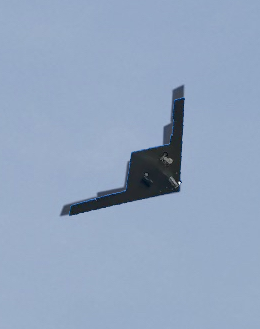
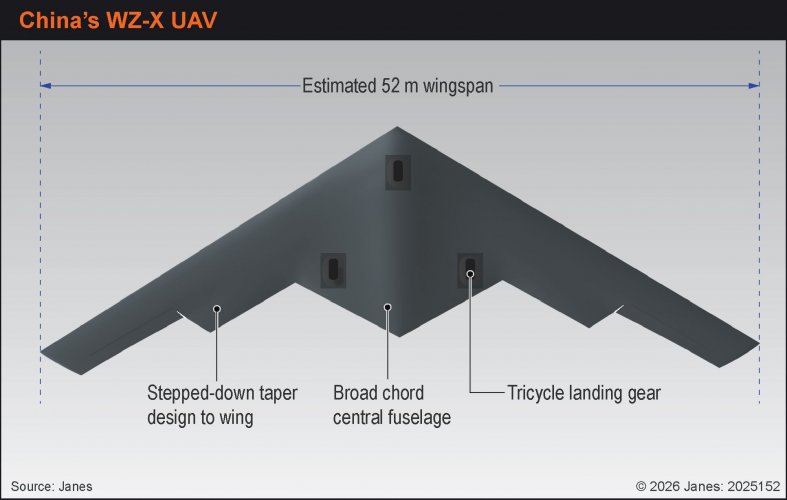
Makes you think if NG succeed with active flutter control on RQ-180 long thin wings and someone did not.Could be extra structure to keep the wing flex down. That's a pretty high aspect wing and would want to flap.
Last edited:

Tomboy
ACCESS: Top Secret
- Joined
- 4 January 2025
- Messages
- 543
- Reaction score
- 1,972
RQ-180 is too big in this picture, this makes it seem like it have a wingspan of 48m while it's more like 40m.WZ-X overlaid with RQ-180 (via: dom146352/SDF)
Tomboy
ACCESS: Top Secret
- Joined
- 4 January 2025
- Messages
- 543
- Reaction score
- 1,972
Could just be supports for very long wings, the outer section is about as wide as RQ-180's but overall span is significantly longer.Makes you think if NG succeed with active flutter control on RQ-180 long thin wings and someone did not.
Tomboy
ACCESS: Top Secret
- Joined
- 4 January 2025
- Messages
- 543
- Reaction score
- 1,972
How so? Anyhow active flutter control should be a well researched area in China, so it's unlikely they won't apply it here. There must be another reason then.Aircraft structures don't work like that.
Tomboy
ACCESS: Top Secret
- Joined
- 4 January 2025
- Messages
- 543
- Reaction score
- 1,972
Go on CNKI, search up active flutter control and see for yourself. It's pretty hilarious to suggest a Chinese design in the 2020s is behind that of equivalent American ones.Should be and unlikely are powerful arguments...

- Joined
- 3 June 2011
- Messages
- 20,986
- Reaction score
- 19,254
If it was using active flutter control it wouldn't need those extra chunks of structure compromising its RCS.Go on CNKI, search up active flutter control and see for yourself. It's pretty hilarious to suggest a Chinese design in the 2020s is behind that of equivalent American ones.


Avimimus
ACCESS: Top Secret
- Joined
- 15 December 2007
- Messages
- 2,719
- Reaction score
- 1,416
How so?
I often wish Flateric would spend an extra two sentences of effort to explain why people are wrong.
My guess is that aircraft are under aerodynamic loads which increase with the size of the part. So, simply scaling up a surface doesn't solve the issue, as the forces on the surface grow as well (and in some circumstances grow more rapidly),
Avimimus
ACCESS: Top Secret
- Joined
- 15 December 2007
- Messages
- 2,719
- Reaction score
- 1,416
Makes you think if NG succeed with active flutter control on RQ-180 long thin wings and someone did not.
It is worth considering. I do suspect that there might be other criteria driving this design choice though.
- Joined
- 3 June 2011
- Messages
- 20,986
- Reaction score
- 19,254
Such as? The B-2 did it to increase stiffness during low-level flight.It is worth considering. I do suspect that there might be other criteria driving this design choice though.
Avimimus
ACCESS: Top Secret
- Joined
- 15 December 2007
- Messages
- 2,719
- Reaction score
- 1,416
Such as? The B-2 did it to increase stiffness during low-level flight.
Well, it is more a matter of expressing some humility.
But let's say you were very committed to a sweep angle for reasons related to RCS, but you also had your wingspan limited to 52 metres, and you needed a certain lifting area to optimise for a specific cruise s[eed, but you couldn't allow your centre of lift to move too far backwards... it might be structurally lighter way to achieve this? That said, there may well be a better way (e.g. redesigning the central component).
But, truth is, I don't really know (as I said, regarding humility).
I just know that there are usually multiple design trade-offs for any choice - so there is usually also more than one set of reasons one could use to attempt to justify a design choice.
- Joined
- 28 January 2008
- Messages
- 1,669
- Reaction score
- 4,263
Plus the GLAS for B-2. You can see this new Chinese wing not for low-level flight. Larger inboard elevons for more pitch authority possibly but all surfaces would be involved with and contribute to gust load alleviation. Depends on the flight regime and where their critical structural bending nodes are.Such as? The B-2 did it to increase stiffness during low-level flight.
- Joined
- 1 April 2006
- Messages
- 12,285
- Reaction score
- 15,110
Increase stiffness where fast moving large control surfaces went to control gust loads at low altitude flight I'd add.Such as? The B-2 did it to increase stiffness during low-level flight.

- Joined
- 6 August 2007
- Messages
- 4,539
- Reaction score
- 10,261
I often wish Flateric would spend an extra two sentences of effort to explain why people are wrong.
My guess is that aircraft are under aerodynamic loads which increase with the size of the part. So, simply scaling up a surface doesn't solve the issue, as the forces on the surface grow as well (and in some circumstances grow more rapidly),
https://www.secretprojects.co.uk/th...utility-technology-testbed.14417/#post-190476
https://www.secretprojects.co.uk/th...tier-systems-w570-arrow-shadow.511/#post-3732
https://www.secretprojects.co.uk/threads/northrop-grumman-rq-180.20900/page-22#post-891319
Similar threads
-

-
'Neuron 2.0' - New Dassault UCAS launched at Saint-Dizier, 8 October 2024
- Started by Jackonicko
- Replies: 20
-

-
-
