hesham

ACCESS: USAP
Senior Member
Joined
26 May 2006
Messages
38,285
Reaction score
20,422
Hi,


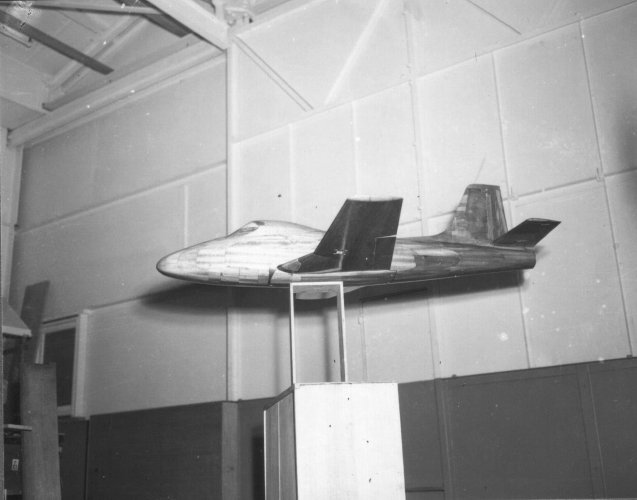
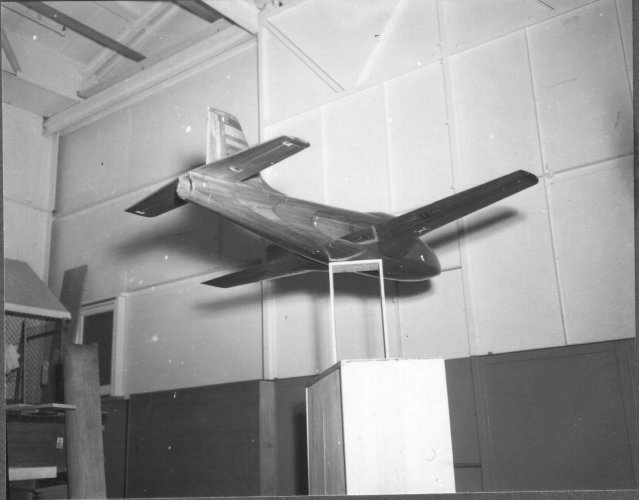
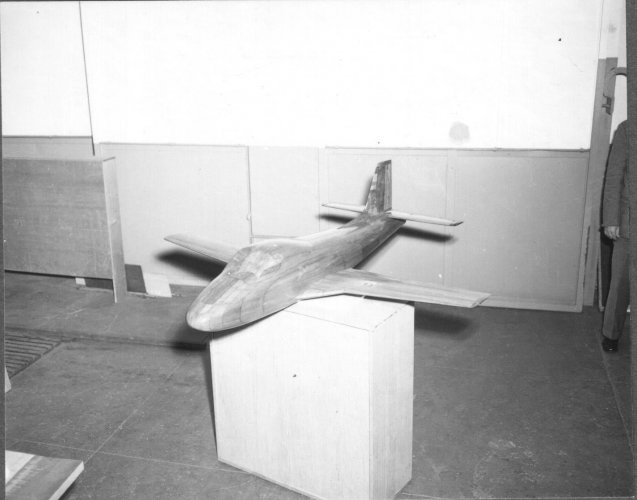
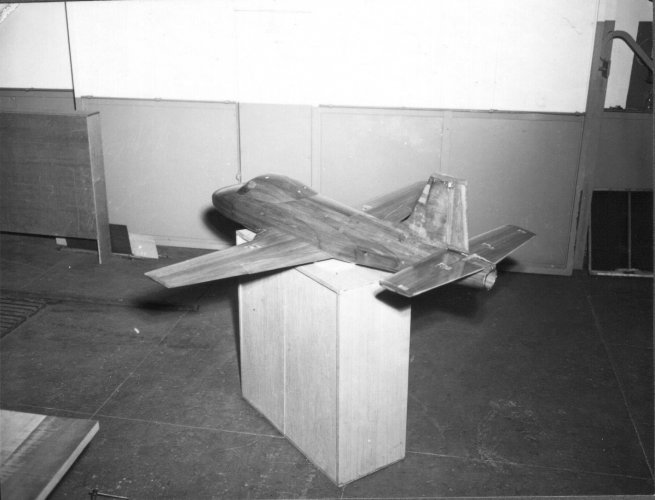
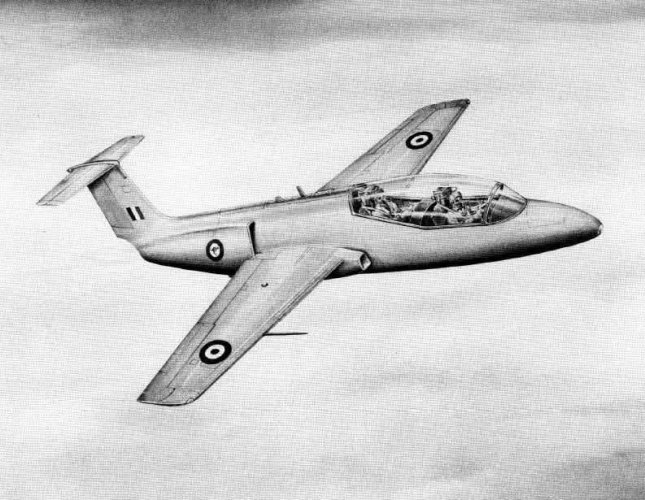
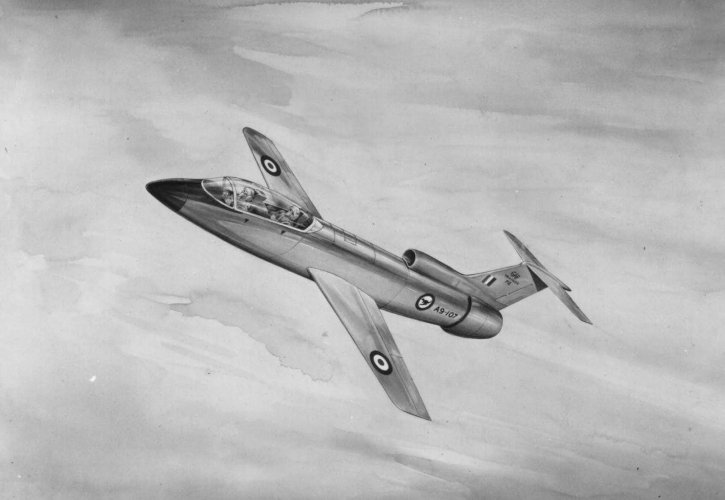
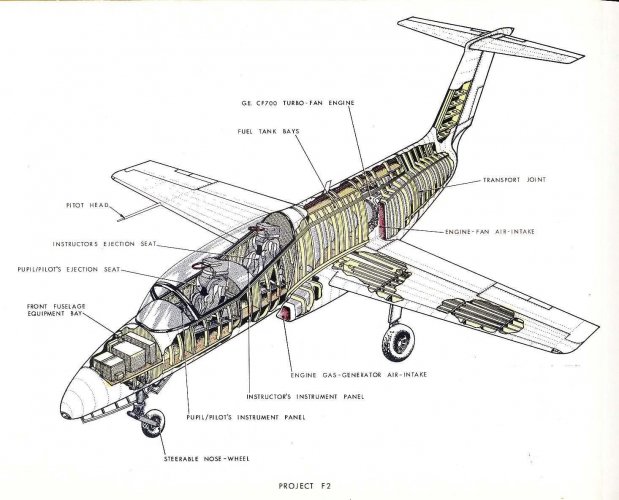
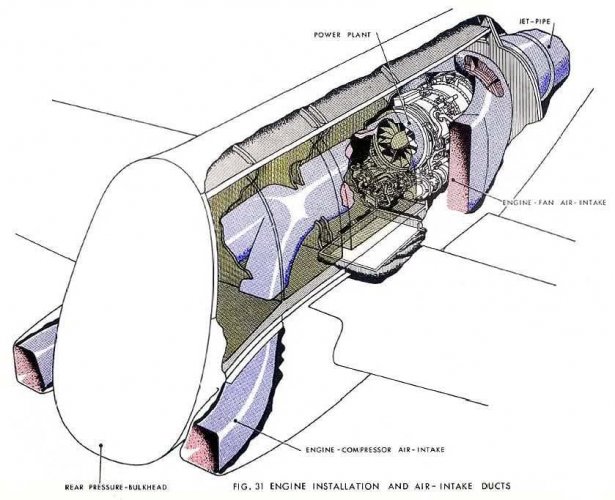
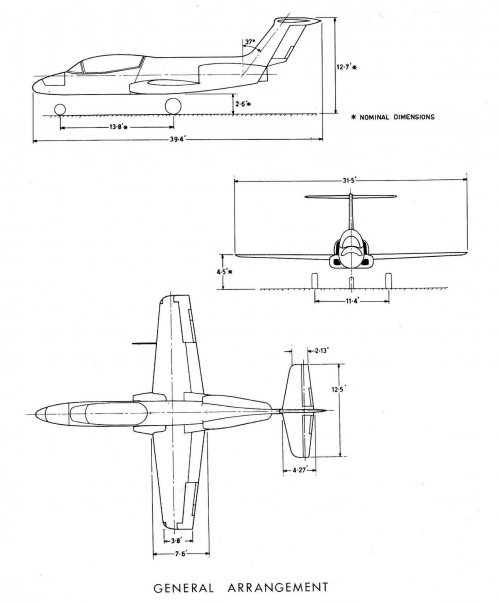
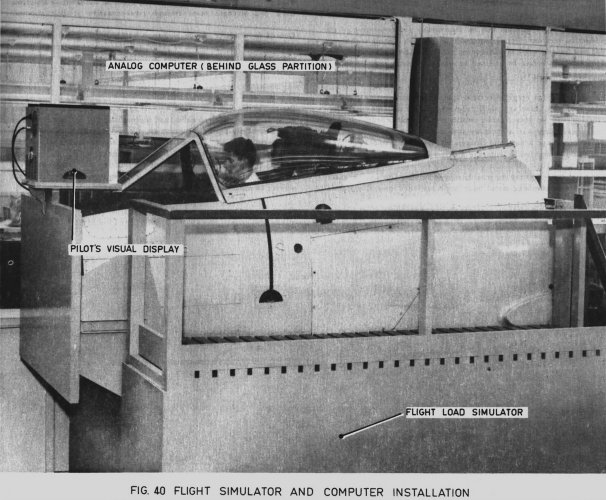
I repeat sending the Australian GAF F2,which was two seat jet trainer project,until
we search about it,and if it related to CAC CA.31 or not.


http://en.wikipedia.org/wiki/De_Havilland_Australia


The end of the Vampire programme marked the beginning of an extended period when no complete aircraft were produced, although there was work for the company in various modification (see DHA-3 Drover) and repair and overhaul programmes, including repairing RAAF ]DHC-4 Caribous damaged on active service during the Vietnam War and major servicing of the RAAF Caribou fleet. One design project pursued during this time was for a military jet trainer for the RAAF. HdH offered its P17 indigenous design derived from the Vampire and was also involved in the Government Aircraft Factory (GAF) ]F2 project, which would have seen HdH undertaking production work on this aircraft with GAF and the Commonwealth Aircraft Corporation (CAC). The CAC-built version of the Aermacchi MB-326 was selected for production in 1965 and neither project proceeded. However all was not lost as CAC subcontracted to HdH the manufacture of the wings and wingtip fuel tanks, ]tailplanes,ailerons,]flaps, hydraulic system components and landing gear for the Macchi, as well as parts of the Macchi's Viper engines built by CAC./quote]
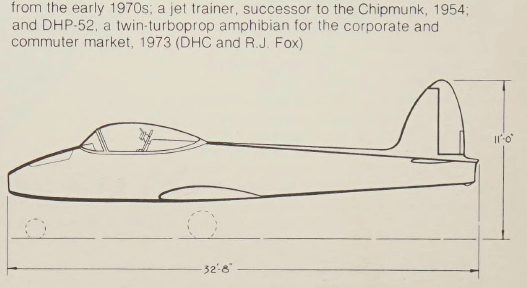
 
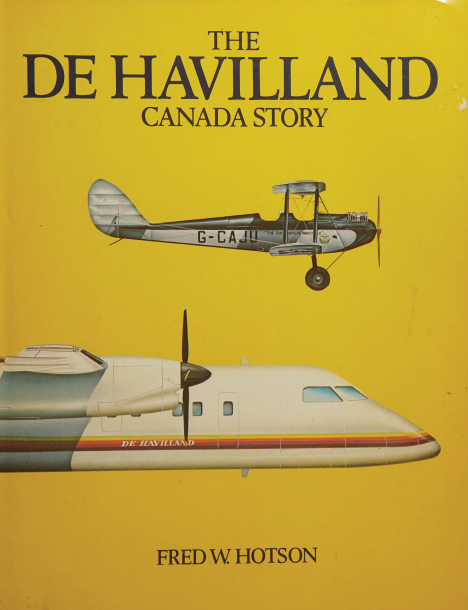
From this book,

may that DHC project was intended to the same competition ?.
 

Attachments

  • 6.png
    6.png
    130 KB · Views: 71
  • 7.png
    7.png
    373.1 KB · Views: 63
... may that DHC project was intended to the same competition ?.

No. It was the Canadair Tutor being considered, not DHC's notional 'Jet Chipmunk'.

Six aircraft were selected for detailed examination: the British BAC-167; the Canadian CL-41; the Italian Macchi MB-326H; the Swedish SAAB 105; the Japanese TIF-3; and the French Potez 94. A proposal by the Government Aircraft Factory to design and build an Australian jet trainer, nominally titled the GAF-F2, received a sympathetic hearing from the RAAF but lacked substance; while another Australian proposal from de Havilland to re-engine the Vampire was rejected at the outset as the airframe fatigue life of 4000 hours quoted by the company was 1000 less than required.

Source: Going Solo: The Royal Australian Air Force 1946-1971, Alan Stephens, AGSP Press, Canberra, 1995, pp 161-162.
 
Many thanks to you my dear Apophenia,

and please,what was Japanese TIF-3 ?,from which company ?.
 
...and please,what was Japanese TIF-3 ?,from which company ?.

Apologies. I was quoting directly from Alan Stephens' book (which introduced that "I").

The correct form was, of course, Fuji T1F3 - based on T1F1 and T1F2, the original JASDF development designations for the Fuji T-1. I'm not sure if T1F3 was ever applied to the production model Fuji T-1A [1] or if this designation was specific to the proposed RAAF variant.
_______________________

[1] If T1F3 was applied to the JASDF T-1A, does anyone know if the Fuji T-1B has its own development designation?
 
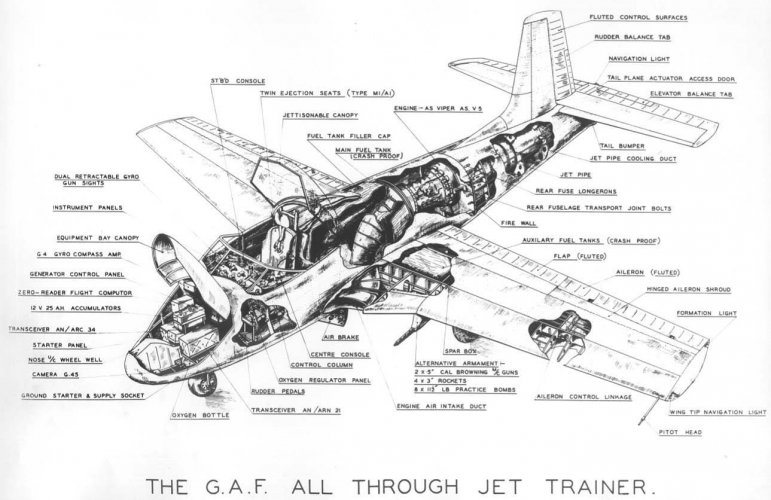
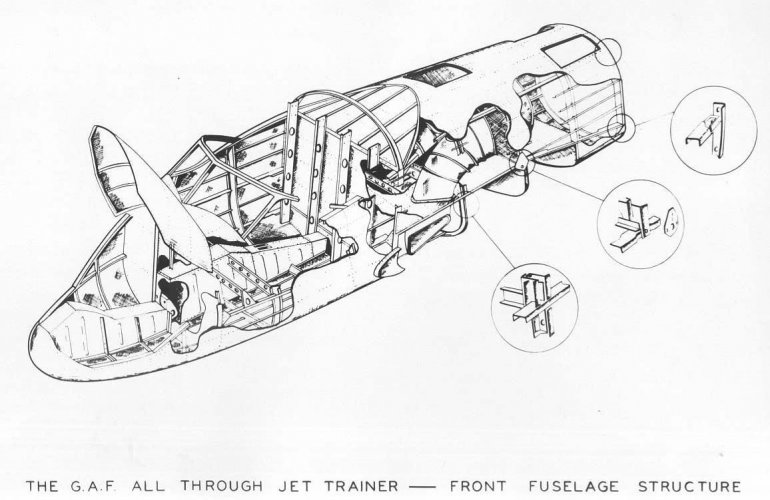
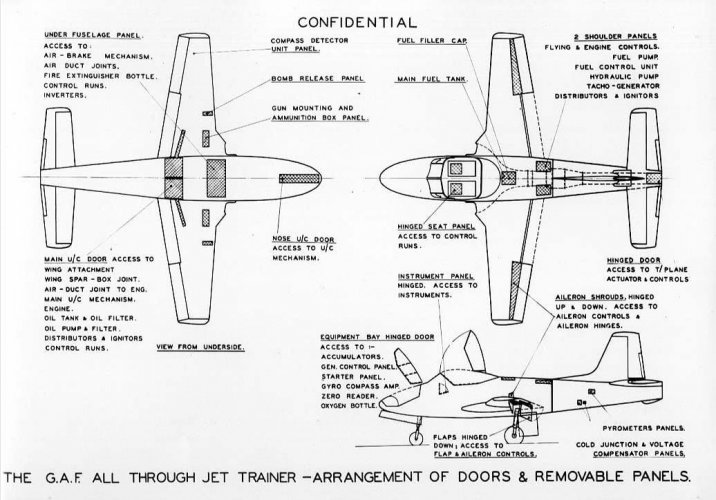
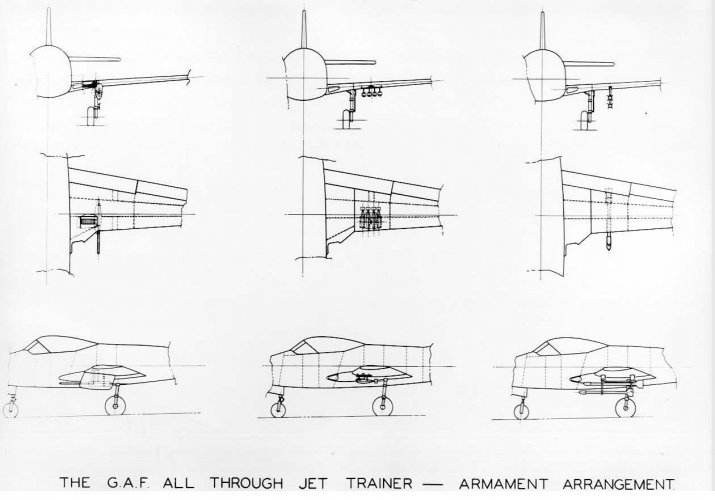
GAF. Australia F1 All Through Jet Trainer ... https://www.facebook.com/share/p/1DEShdiM9P/

Amazing find dear Joe,and we can save them here,

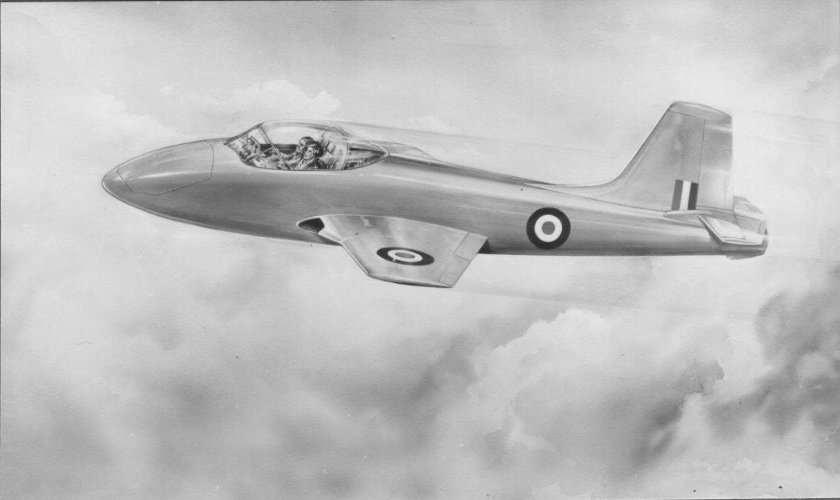
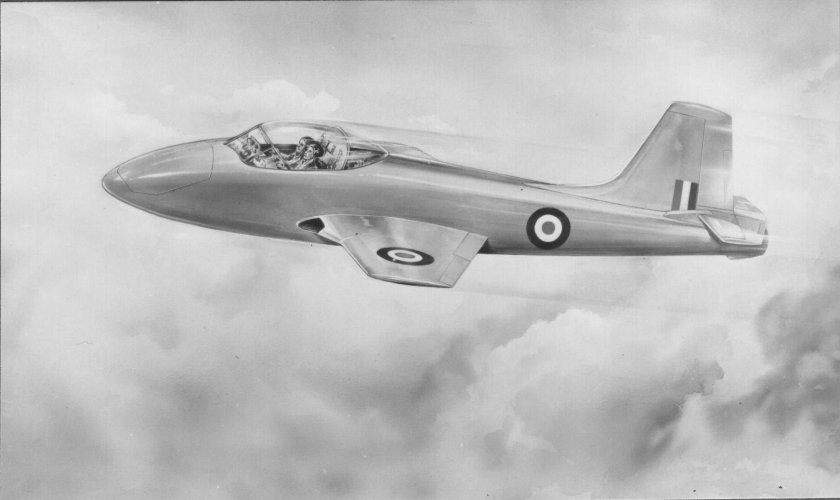
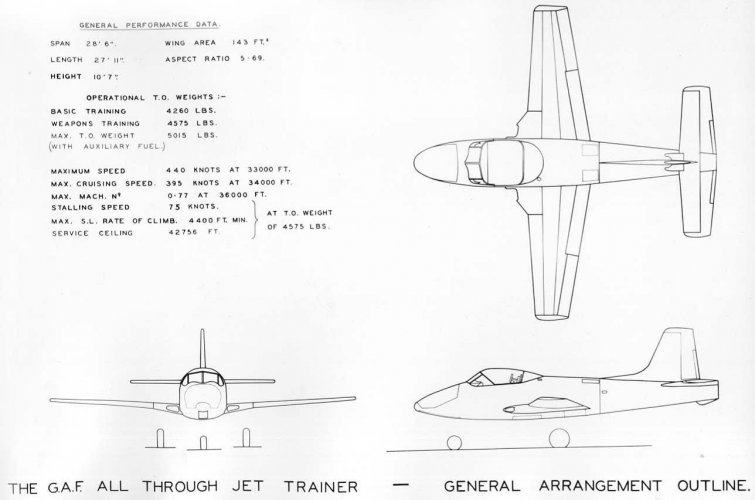
F1 Trainer of 1954 (Not to be confused with the F2 trainer of 1964)
This was the first of several trainer aircraft proposals by GAF for the RAAF. This one was in response to RAAF Specification AC 94. The opening paragraph of the report states that “By drawing freely on our considerable experience in the design of small jet aircraft and by incorporating the production and maintenance qualities contributing to the success of Jindivik, we feel confident that we can provide the service with a training aircraft, which while offering the utmost in overall economy, satisfies all pre-operational training requirements.” The following description of the aircraft is provided:
“The trainer is a low-wing design, powered by a single Armstrong Siddeley Viper engine aspirated through wing root entry ducts. The crew are seated side by side on ejection seats in a fully pressurised and refrigerated cabin, forward of the wing, and have an all-round view. All removable equipment has been concentrated in a bay at the front of the fuselage, and each item is individually accessible and removable through an upward hinging door. All fuel tanks are of the fully crash proof bag type. The main tanks are in the fuselage directly over the wing and the auxiliary tanks are in the main wing spar box.
A fully retractable tricycle undercarriage with low pressure tyres ensures satisfactory operation from all types of aerodrome surface. Hydraulic nose wheel steering operated via the rudder pedals and selected by a push button on the stick has been incorporated to give a lock of 70 degrees to port or starboard.”
I don’t know what other aircraft contended for the requirement, but GAF didn’t get the gig
 

Attachments

  • 3.jpg
    3.jpg
    90.4 KB · Views: 35
  • 4.jpg
    4.jpg
    65.1 KB · Views: 39
  • 5.jpg
    5.jpg
    122.6 KB · Views: 31
  • 6.jpg
    6.jpg
    95 KB · Views: 30
  • 7.jpg
    7.jpg
    99.3 KB · Views: 30
  • 8.jpg
    8.jpg
    71.8 KB · Views: 27
  • 9.jpg
    9.jpg
    100.4 KB · Views: 25
  • 10.jpg
    10.jpg
    112.3 KB · Views: 19
  • 11.jpg
    11.jpg
    105.6 KB · Views: 23
  • 12.jpg
    12.jpg
    117.4 KB · Views: 29

Similar threads

Back
Top Bottom