
You are using an out of date browser. It may not display this or other websites correctly.
You should upgrade or use an alternative browser.
You should upgrade or use an alternative browser.
Replacement of Australia's Collins Class Submarines
- Thread starter GTX
- Start date
Scott Kenny
ACCESS: USAP
- Joined
- 15 May 2023
- Messages
- 19,517
- Reaction score
- 27,964
I'd argue fine nets for the underwater protection. Shockwaves can pass through solid doors and you're going to get some weird effects with different shockwave speeds in air and in water on one-piece doors.You would need to add some massive (floating) doors. An under water accsess would also be very cool (Thunderbird style) but this would need sone protection too.
Fine enough that any drones that could fit through the net would not pack a usable explosive payload even in a swarm.
Now you gotta send combat divers, and that raises the stakes of the mission immensely.

jeffb
ACCESS: Top Secret
- Joined
- 7 October 2012
- Messages
- 1,591
- Reaction score
- 3,150
Rex Patrick's submission to the Public AUKUS inquiry (public enquiry because the Australian government refuses to discuss the AUKUS treaty in any meaningful way or even allow a parliamentary debate, obfuscating and hiding information especially about the processing and storage of nuclear waste that will be generated by the program).
View: https://youtu.be/STBMoBSFN_c?si=D4fFkfflVhSZDBcu
Scott Kenny
ACCESS: USAP
- Joined
- 15 May 2023
- Messages
- 19,517
- Reaction score
- 27,964
Well, the US has stated that the Virginias will go back to the US to be scrapped (and reactor vessels buried at Hanford).Rex Patrick's submission to the Public AUKUS inquiry (public enquiry because the Australian government refuses to discuss the AUKUS treaty in any meaningful way or even allow a parliamentary debate, obfuscating and hiding information especially about the processing and storage of nuclear waste that will be generated by the program).
At worst Oz will have some low-level waste that can be incinerated and vitrified.
Yall have about 40-50 years before the AUKUS ships will be getting scrapped. I'm sure there's some hard-rock salt mines you can use for geological repository.
jeffb
ACCESS: Top Secret
- Joined
- 7 October 2012
- Messages
- 1,591
- Reaction score
- 3,150
Well, the US has stated that the Virginias will go back to the US to be scrapped (and reactor vessels buried at Hanford).
No, Australia's responsible for the lot.
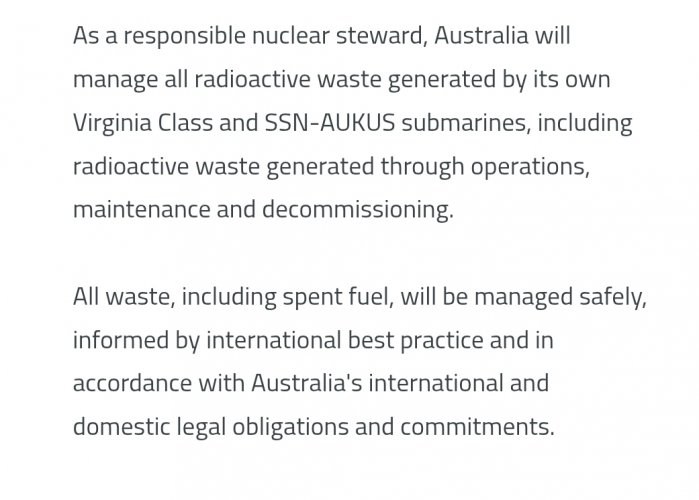
https://www.asa.gov.au/aukus/nuclear-stewardship-and-waste
Last edited:
WatcherZero
ACCESS: Top Secret
- Joined
- 22 May 2023
- Messages
- 1,146
- Reaction score
- 2,974
This 'public inquiry' is being funded by an anti-nuclear lobby group.
I mean just read their submission to Parliament. China is too strong so bend over and stop resisting them, don't bother trying to defend Taiwan or Australia.
https://committees.parliament.uk/writtenevidence/142266/html/
Meanwhile AUKUS nuclear submarines remains popular in Australia with 68% in favour or strongly in favour and only 29% somewhat against or strongly against with 2% undecided and 1% don't care. That amount in favour is up from 28% in favour, 20% opposed, 32% don't care, and 20% don't know in 2023. It suggests almost all Australians now feel informed enough to have an opinion and the debate has led 3/4's of the don't know or don't care to now be in favour of it.
https://www.lowyinstitute.org/publi...aukus-support-holds-firm-for-the-defence-deal
I mean just read their submission to Parliament. China is too strong so bend over and stop resisting them, don't bother trying to defend Taiwan or Australia.
Although the US remains by far the predominant military power in the world, it has not demonstrated a credible track record of success in its many interventions and conflicts. Successive US war games have consistently shown that the US and its allies are most unlikely to be able to defeat China should hostilities occur in China’s region. Today, China has three aircraft carriers along the western Pacific coast, with more to come. China also possesses Dongfeng-31AG intercontinental ballistic missiles with a range of 12,000 kilometres, sixth-generation aircraft and more than 70% of the world’s drone production capacity. The US and its allies have no realistic possibility of defeating China (short of mutually assured nuclear annihilation).
https://committees.parliament.uk/writtenevidence/142266/html/
Meanwhile AUKUS nuclear submarines remains popular in Australia with 68% in favour or strongly in favour and only 29% somewhat against or strongly against with 2% undecided and 1% don't care. That amount in favour is up from 28% in favour, 20% opposed, 32% don't care, and 20% don't know in 2023. It suggests almost all Australians now feel informed enough to have an opinion and the debate has led 3/4's of the don't know or don't care to now be in favour of it.
https://www.lowyinstitute.org/publi...aukus-support-holds-firm-for-the-defence-deal
Last edited:
Scott Kenny
ACCESS: USAP
- Joined
- 15 May 2023
- Messages
- 19,517
- Reaction score
- 27,964
That is not what was said at the start of the process.No, Australia's responsible for the lot.
[img deleted for space]
WatcherZero
ACCESS: Top Secret
- Joined
- 22 May 2023
- Messages
- 1,146
- Reaction score
- 2,974
The reactor cores are sealed with Australia not having access, Australia is responsible for the low level waste it generates in service (e.g. tools, clothing, filters) as well as the waste from dismantling the subs at the end of their life and the Intermediate-Level Waste of the reactor compartments when scrapped to comply with non-proliferation treaties including undertaking that they will not seek to reprocess any acquired nuclear material either for fresh submarine fuel or weapons. Australia will not be responsible for storing and disposing of the waste of the Virginia class submarines it acquires from the US or any visiting British or American submarines.
The current nuclear waste inventory of Australia as of 2024 produced to comply with IAEA regulations was:
1,310 m3 of Intermediate, 3,672 m3 of low level waste.
The amount of waste expected to be generated over the next 50 years from the lifetime of AUKUS as well as civilian reactor programs, hospital waste, etc is 1,193 m3 of Intermediate, 4,991 m3 of low level waste
This compares to the 2021 inventory where Australia had 2,062 m3 of Intermediate and 2,487 m3 of low level waste in storage.
https://www.industry.gov.au/publica...tory-radioactive-waste-2024/summary-inventory
The current nuclear waste inventory of Australia as of 2024 produced to comply with IAEA regulations was:
1,310 m3 of Intermediate, 3,672 m3 of low level waste.
The amount of waste expected to be generated over the next 50 years from the lifetime of AUKUS as well as civilian reactor programs, hospital waste, etc is 1,193 m3 of Intermediate, 4,991 m3 of low level waste
This compares to the 2021 inventory where Australia had 2,062 m3 of Intermediate and 2,487 m3 of low level waste in storage.
https://www.industry.gov.au/publica...tory-radioactive-waste-2024/summary-inventory
jeffb
ACCESS: Top Secret
- Joined
- 7 October 2012
- Messages
- 1,591
- Reaction score
- 3,150
Which is one of the reasons why a growing number of people here want a proper parliamentary debate.That is not what was said at the start of the process.
But since the government refuses to hold a proper enquiry or be forthcoming about what's actually going on, concerned citizens are being forced to hold their own public enquiry in order to increase public awareness of how badly they're being misled on this boondoggle.
https://aukuspublicinquiry.com/#about
Last edited:

Gessler
ACCESS: Confidential
- Joined
- 30 June 2026
- Messages
- 54
- Reaction score
- 194
This five square meters of low level and intermediate waste shouldn't be a hughe problem in coutry of that size...
In reality, no it shouldn't be a problem even for a small island state like UK, let alone continent-sized Australia. And that's even when talking about actual high-level waste.
But a lot of the anti-nuclear hysteria surrounding these programs (whether military or civilian) has rarely if ever concerned itself with reality. I'm willing to bet the majority of them still imagine nuclear waste as green goop oozing out of a barrel.
The last sentence is incorrect. Australia is responsible for the high level nuclear waste from the spent reactor fuel and reactor compartment.Australia is responsible for the low level waste it generates in service (e.g. tools, clothing, filters) as well as the waste from dismantling the subs at the end of their life and the Intermediate-Level Waste of the reactor compartments when scrapped to comply with non-proliferation treaties including undertaking that they will not seek to reprocess any acquired nuclear material either for fresh submarine fuel or weapons. Australia will not be responsible for storing and disposing of the waste of the Virginia class submarines it acquires from the US
There is a report on how this waste will be handled which the Australian gov has been ordered by courts to release under the FOI act. However the gov is refusing to release the report and is appealing the FOI decision.
Scott Kenny
ACCESS: USAP
- Joined
- 15 May 2023
- Messages
- 19,517
- Reaction score
- 27,964
That is literally not what was announced, the USN was quite clear about maintaining US control of the reactors post-retirement.The last sentence is incorrect. Australia is responsible for the high level nuclear waste from the spent reactor fuel and reactor compartment.
WatcherZero
ACCESS: Top Secret
- Joined
- 22 May 2023
- Messages
- 1,146
- Reaction score
- 2,974
The IAEA submission on proliferation by Australia said it will not retain nuclear material from any submarine not built in Australia.
No the document does NOT say that. www.asa.gov.au/sites/default/files/documents/2024-10/NonProliferation-Factsheet.pdfThe IAEA submission on proliferation by Australia said it will not retain nuclear material from any submarine not built in Australia.
Moreover, the AUKUS Atomic energy agreement signed by Australia and the United States explicitly states that "Australia shall be responsible for the management, disposition, storage, and disposal of any spent nuclear fuel and radioactive waste resulting from the operation of Naval Nuclear Propulsion Plants transferred"
https://www.state.gov/wp-content/uploads/2025/05/25-117.2-AUKUS-Defense-Atomic-Energy.pdf
Finally, the Australian Naval Nuclear Power Act clearly states that spent fuel from Australian operated submarines will be disposed of in Australia, whereas spent fuel from US and UK operated submarines cannot be disposed there. This is to close a potential loophole where the US/UK might try to ask Australia to handle spent fuel from USN or RAN submarines forward based in Australia. https://www.legislation.gov.au/C2024A00091/asmade/text
So please re-read what these documents say. What Australia has committed to is that it won't produce, reprocess or enrich nuclear fuel, and the fuel will stay in the sealed reactors provided by the US & UK for the life of the submarines. After that disposal and storage will be done in Australia, according to IAEA Article 14 rules which are still being negotiated in order to comply with non-proliferation obligations.
Last edited:
Scott Kenny
ACCESS: USAP
- Joined
- 15 May 2023
- Messages
- 19,517
- Reaction score
- 27,964
When originally announced, the Oz Virginias were going to be hauled to Bremerton to be taken apart and have their reactor compartments (or reactor vessels, I'm not clear on that detail) cut out and sent to Hanford with the rest of the scrap reactors.
"I have altered the deal. Pray I do not altered it further."
"I have altered the deal. Pray I do not altered it further."
IIRC that just speculation by people who were wondering how they planned on meeting non-proliferation obligations. I haven't found any official statements anywhere that the US would take back the Virginia reactors.When originally announced, the Oz Virginias were going to be hauled to Bremerton to be taken apart and have their reactor compartments (or reactor vessels, I'm not clear on that detail) cut out and sent to Hanford with the rest of the scrap reactors.
jeffb
ACCESS: Top Secret
- Joined
- 7 October 2012
- Messages
- 1,591
- Reaction score
- 3,150
The image I posted above declaring Australia is responsible for any waste produced decommissioning the submarines is taken directly from the Australian Submarine Authority website, I really don't understand the confusion.The last sentence is incorrect. Australia is responsible for the high level nuclear waste from the spent reactor fuel and reactor compartment.
jeffb
ACCESS: Top Secret
- Joined
- 7 October 2012
- Messages
- 1,591
- Reaction score
- 3,150
Well worth a read. Peter Briggs has extensive experience in the Australian Submarine industry.
In the first of a two-part series, Peter Briggs examines the technical and security risks of relying on highly enriched uranium and an unproven British reactor design for AUKUS submarines.
https://johnmenadue.com/post/2026/0...ctor-fuel-selection-and-integration-sequence/
In the first of a two-part series, Peter Briggs examines the technical and security risks of relying on highly enriched uranium and an unproven British reactor design for AUKUS submarines.
https://johnmenadue.com/post/2026/0...ctor-fuel-selection-and-integration-sequence/
Last edited:
jeffb
ACCESS: Top Secret
- Joined
- 7 October 2012
- Messages
- 1,591
- Reaction score
- 3,150
Peter Briggs, who has considerable industry experience, lays out some of the issues facing AUKUS decommissioning.
In the second of a two-part series, Peter Briggs examines the decommissioning, dismantling and waste-disposal risks Australia will inherit from AUKUS reactors.
https://johnmenadue.com/post/2026/07/more-than-meets-the-eye-the-high-cost-of-the-long-goodbye/
In the second of a two-part series, Peter Briggs examines the decommissioning, dismantling and waste-disposal risks Australia will inherit from AUKUS reactors.
https://johnmenadue.com/post/2026/07/more-than-meets-the-eye-the-high-cost-of-the-long-goodbye/
jeffb
ACCESS: Top Secret
- Joined
- 7 October 2012
- Messages
- 1,591
- Reaction score
- 3,150
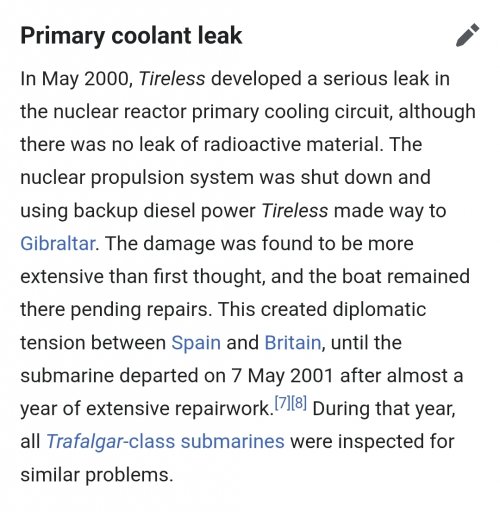
Since Stirling will handle intermediate level support for submarines rotating through, do we know what will happen if we have a HMS Tireless situation and what the status of hazardous waste arising from such a situation would be?This is to close a potential loophole where the US/UK might try to ask Australia to handle spent fuel from USN or RAN submarines forward based in Australia.
Last edited:
Scott Kenny
ACCESS: USAP
- Joined
- 15 May 2023
- Messages
- 19,517
- Reaction score
- 27,964
Primary loop is rarely radioactive for long, the typical activated isotopes are safe within minutes of reactor shutdown.Since Stirling will handle intermediate level support for submarines rotating through, do we know what will happen if we have a HMS Tireless situation and what the status of hazardous waste arising from such a situation would be?
View attachment 818542
You still check the stuff, since it's possible that the water has grabbed some fuel materials. And if it has you have bigger problems than a leaking primary. Like ruptured fuel cladding!
jeffb
ACCESS: Top Secret
- Joined
- 7 October 2012
- Messages
- 1,591
- Reaction score
- 3,150
The question is, what happens to that material? If for example an Astute experiences a major fault and limps into Stirling, what then? Will the UK be expected to pack up the mess and take it all home?Primary loop is rarely radioactive for long, the typical activated isotopes are safe within minutes of reactor shutdown.
You still check the stuff, since it's possible that the water has grabbed some fuel materials. And if it has you have bigger problems than a leaking primary. Like ruptured fuel cladding!
Briggs point about sealed HEU reactors hits hard here too:
The Tireless incident underscores the fact that a sealed reactor is an asset only as long as its internal systems remain completely defect free. Should a sealed, life-of-type core suffer a premature internal cladding failure or primary circuit defect on our shores, it would be a long, high-risk transfer back to the United Kingdom for a warranty claim.
Last edited:
Scott Kenny
ACCESS: USAP
- Joined
- 15 May 2023
- Messages
- 19,517
- Reaction score
- 27,964
If it's not radioactive anymore from a primary leak? who cares?The question is, what happens to that material? If for example an Astute experiences a major fault and limps into Stirling, what then? Will the UK be expected to pack up the mess and take it all home?
Else it's low-grade radwaste and you throw it in an incinerator, IIRC.
So you load the sub onto a lift ship like USS Cole.Briggs point about sealed HEU reactors hits hard here too:
jeffb
ACCESS: Top Secret
- Joined
- 7 October 2012
- Messages
- 1,591
- Reaction score
- 3,150

Titus K
ACCESS: Top Secret
- Joined
- 6 September 2025
- Messages
- 817
- Reaction score
- 2,777
NUCLEAR STEWARDSHIP AND WASTE
https://www.asa.gov.au/sites/default/files/documents/2025-10/Stewardship_Waste_Fact_Sheet.pdf
How will Australia manageradioactive waste?
As a responsible nuclear steward, Australia willmanage all radioactive waste from its nuclearpowered submarines domestically. This includesradioactive waste with lower levels of radioactivitygenerated by day-to-day submarine operations andmaintenance. And radioactive waste with higherlevels of radioactivity, including spent fuel, which isproduced when submarines are decommissionedat the end of their service life. Australia has safelyand securely managed radioactive waste fordecades, including 70 years of experience managingwaste from facilities like its multi-purpose nuclearreactors at Lucas Heights. Australia will continueto ensure the highest standards of safety, securityand non-proliferation safeguards are applied to thismaterial, in accordance with Australia’s domesticand international obligations, including the Treatyof Rarotonga. All radioactive waste will be managedwithin the framework of Australia’s ComprehensiveSafeguards Agreement and Additional Protocol.
Where will Australia store anddispose of radioactive waste?
No decision has been made on a location withinAustralia for the disposal of radioactive waste fromnuclear-powered submarines. Further technical workand consultation is required to determine preferreddisposal pathways. Operational radioactive waste willbe stored on Defence sites in Australia.
https://www.asa.gov.au/sites/default/files/documents/2025-10/Stewardship_Waste_Fact_Sheet.pdf
How will Australia manageradioactive waste?
As a responsible nuclear steward, Australia willmanage all radioactive waste from its nuclearpowered submarines domestically. This includesradioactive waste with lower levels of radioactivitygenerated by day-to-day submarine operations andmaintenance. And radioactive waste with higherlevels of radioactivity, including spent fuel, which isproduced when submarines are decommissionedat the end of their service life. Australia has safelyand securely managed radioactive waste fordecades, including 70 years of experience managingwaste from facilities like its multi-purpose nuclearreactors at Lucas Heights. Australia will continueto ensure the highest standards of safety, securityand non-proliferation safeguards are applied to thismaterial, in accordance with Australia’s domesticand international obligations, including the Treatyof Rarotonga. All radioactive waste will be managedwithin the framework of Australia’s ComprehensiveSafeguards Agreement and Additional Protocol.
Where will Australia store anddispose of radioactive waste?
No decision has been made on a location withinAustralia for the disposal of radioactive waste fromnuclear-powered submarines. Further technical workand consultation is required to determine preferreddisposal pathways. Operational radioactive waste willbe stored on Defence sites in Australia.


