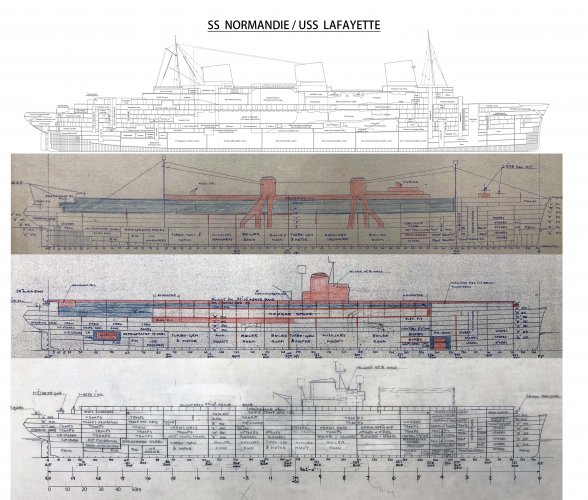
I recently had the opportunity to visit NARA's College Park campus this past weekend, which contained four preliminary designs regarding SS Normandie conversions into a troopship or carrier (or both) in the series Preliminary Design Drawings, 1929–1964 (RG 19) that I had the privilege of looking at. I only took photos of the plans with my phone, so apologies for the fragmentary nature and quality of the photos. All the photos I took are here in this drive folder, as HEIC images, with a few embedded in this post: https://drive.google.com/drive/folders/1sO6bfkgxvBqqfTWe60hwy1Y_oMd0m2L-?usp=sharing
All four preliminaries are dated to February/March 1943, which would be after the Normandie caught fire and capsized at its berth, but prior to its salvage later that year.
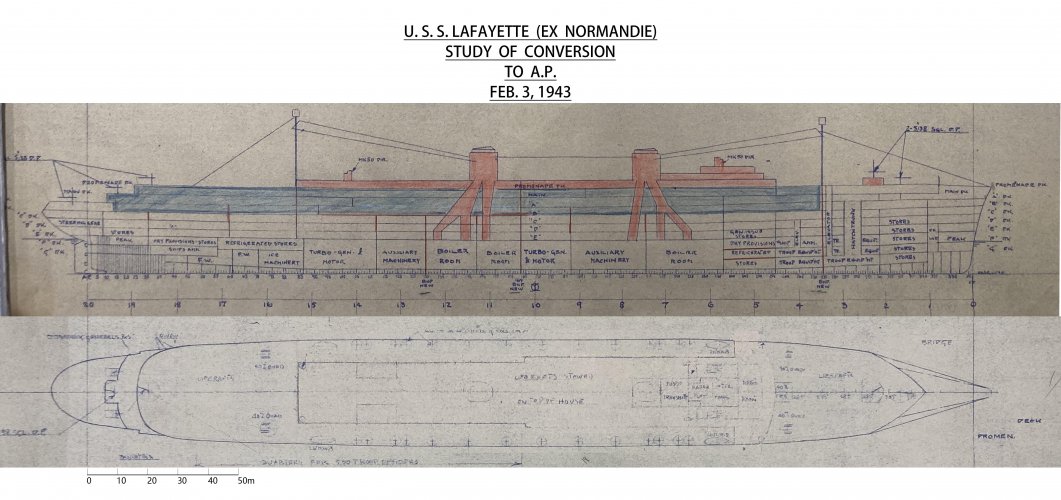
PD-0978:
 The first of these plans is the most conventional, namely just converting the refloated Normandie into a troop transport.
Stats are as follows:
Length: 962’
Beam: 117’
Draft: 37’
Full Load Displacement: 68850 tons
Speed (design): 24 knots @ 80000 shp
Crew Complement: 150 officers & 2000 total crew
Passenger Complement: 500 officers & 12000 total crew
Troop Equipment: 1100 tons
Armament: 5 - 5”/38 D.P. mounts
4 - 40mm quad Mounts
40 - 20mm AA guns
Of note is that Normandie's turbo-electric engines originally could do 160,000 shp at design speed, and 200,000 shp at overload to achieve 32 knots under trial conditions, but I assume designers are accounting for the damage sustained to Normandie's power plant in the 1942 fire, or even assuming they might have to outright replace the ship's powerplant.
PD-0979 & PD-0980:
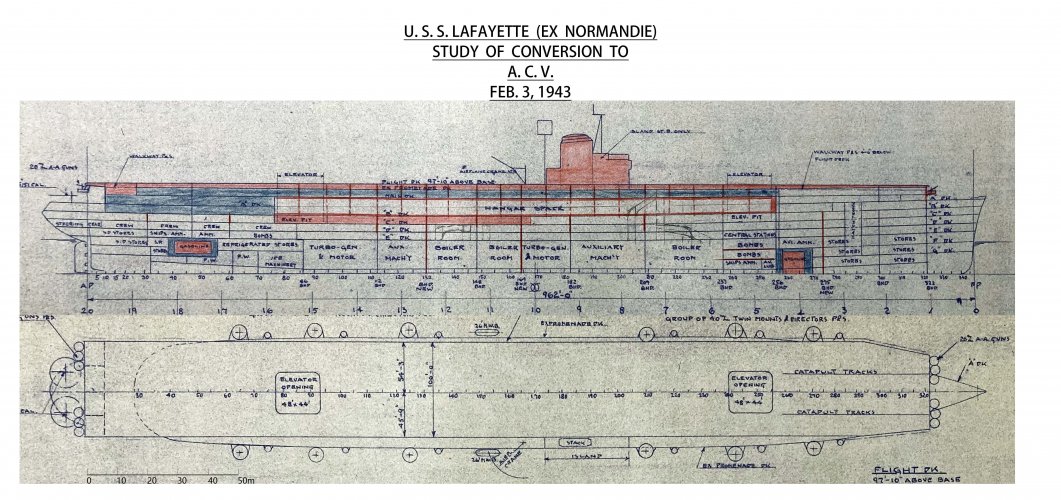
As far as I can tell, PD-0979 and PD-0980 are effectively the same design for converting the Normandie into a fleet carrier. My guess would be that PD-0980 is a black & white copy of PD-0979 that also made its way to the archives, but maybe more perceptive eyes can identify substantive differences between the two.
 Stats are as follows:
Length: 962’
Beam: 117’
Draft: 37’
Displacement (Full): 68650
Speed: Same as other designs
Flight deck: 905’ x 100’, 60’ above waterline (full load)
Hangar: 550’ x 80’
Elevators: 2x 48’x44’ fore & aft, in the middle of the flight deck
Catapults: 2x
Aircraft: 36x fighters, 37x dive bombers, 18x torpedo bombers
Gasoline storage: 183,000 gallons fore, 73,200 gallons aft
Armament: 2x 5”/51 or 5”/38
12x 40mm twin mounts
50 x 20mm
Protection: Splinter protection only
Effectively, these proposals would have turned the Normandie into a slower and unarmored Essex. Considering that the Normandie would be righted until August 1943, by which point 5 Essexes and a couple dozen escort and light carriers would have commissioned already, let alone by the time Normandie could be recommissioned, it's little wonder that the Normandie never saw this conversion through.
PD-1001:
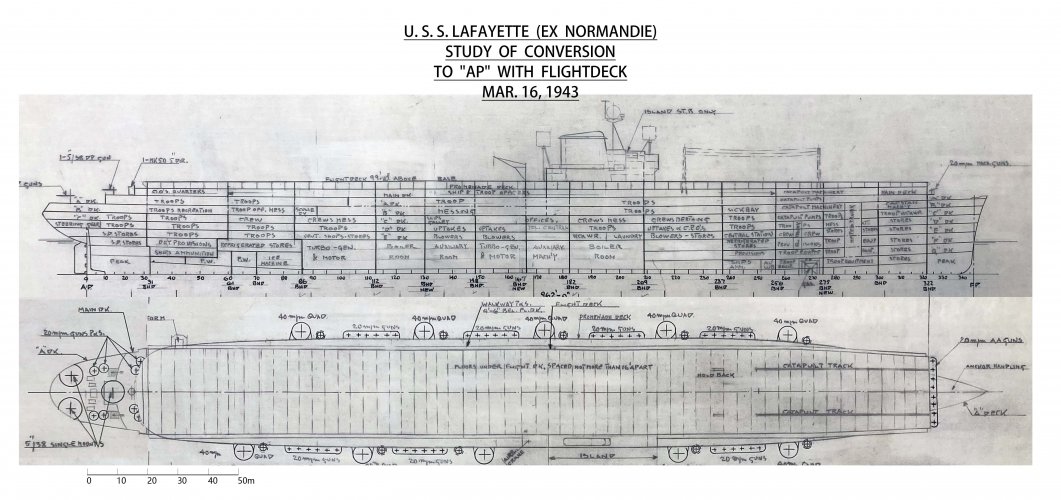
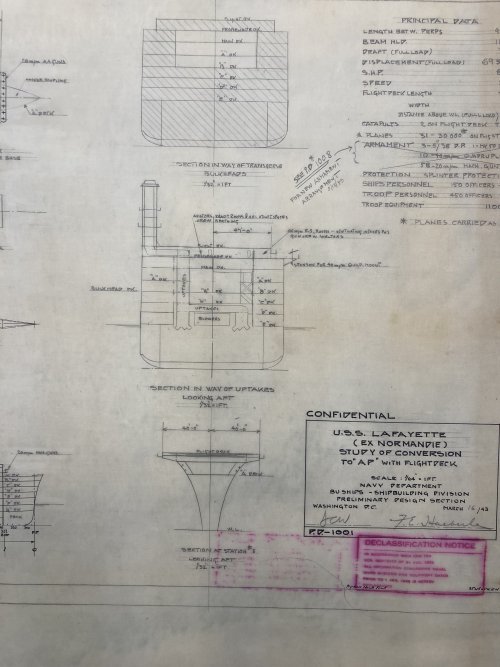
Finally, what I consider the most interesting of the four preliminaries, is a proposal to convert the Normandie into a troop transport with a large flying-off deck at the top for ferrying aircraft, similar to some IJA landing craft carriers (albeit without the same amphibious capabilities).
Stats are as follows:
Length: 962’
Beam: 117’
Draft: 38.5'
Full Load Displacement: 72000 tons
SHP: 80,000
Speed: 24 knots
Flight deck: 848’ x 94’, 2x H-41 catapults, island on starboard
Aircraft: 31 aircraft up to 30,000 lbs.
Crew: 150 officers & 2000 men
Troop Capacity: 450 officers & 10,000 men
Equipment: 1100 tons
Protection: Splinter Protection
Armament (initial): 3 x 5”/38 DP
10 x 40mm quad mounts
58 x 20mm
There's a reference to a PD-1008 design which presumably had a different AA suite for the Normandie/Lafayette, but that design was not present in the National Archives. Had this design been completed, it would have out-displaced the Yamatos when fully loaded, and all four designs would have been the largest commissioned warships in the USN until the Forrestal-class.
Nonetheless, these proposals showed that the Normandie, even after salvage, likely suffered severe damage to its machinery which constrained the ship to 80,000 shp and 24 knots, and would have suffered from pretty bad inefficiencies due to her origins as a liner instead of a purpose-built warship, as shown in the nonexistent protection and limited armament she could carry relative to an Essex half her displacement. By the time the Normandie was righted in late 1943, the USN had plenty of warships and merchant tonnage which could do the job of all four proposals, so it made little sense to invest resources into such an inefficient conversion of an already-damaged ship.
I am curious as to whether conversion proposals for the Normandie predating the ship's fire still survive, either at NARA or in secondary sources, as maybe those could have shown the true capability of a Normandie conversion, with these four proposals having to work around all the damage suffered to the ship during the fire and the subsequent capsizing.
All four preliminaries are dated to February/March 1943, which would be after the Normandie caught fire and capsized at its berth, but prior to its salvage later that year.
PD-0978:
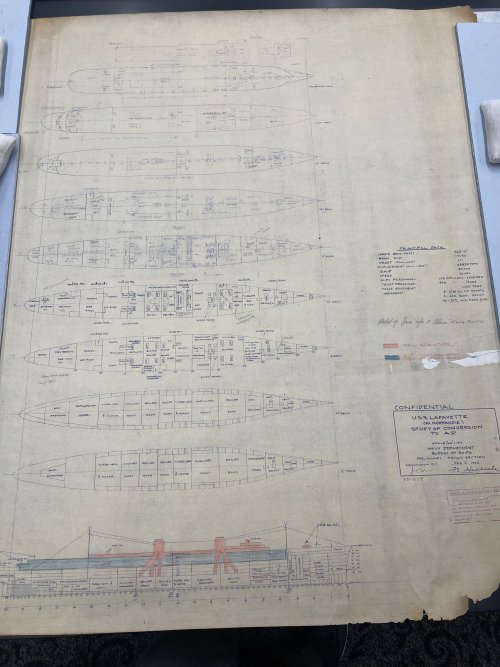
Stats are as follows:
Length: 962’
Beam: 117’
Draft: 37’
Full Load Displacement: 68850 tons
Speed (design): 24 knots @ 80000 shp
Crew Complement: 150 officers & 2000 total crew
Passenger Complement: 500 officers & 12000 total crew
Troop Equipment: 1100 tons
Armament: 5 - 5”/38 D.P. mounts
4 - 40mm quad Mounts
40 - 20mm AA guns
Of note is that Normandie's turbo-electric engines originally could do 160,000 shp at design speed, and 200,000 shp at overload to achieve 32 knots under trial conditions, but I assume designers are accounting for the damage sustained to Normandie's power plant in the 1942 fire, or even assuming they might have to outright replace the ship's powerplant.
PD-0979 & PD-0980:
As far as I can tell, PD-0979 and PD-0980 are effectively the same design for converting the Normandie into a fleet carrier. My guess would be that PD-0980 is a black & white copy of PD-0979 that also made its way to the archives, but maybe more perceptive eyes can identify substantive differences between the two.
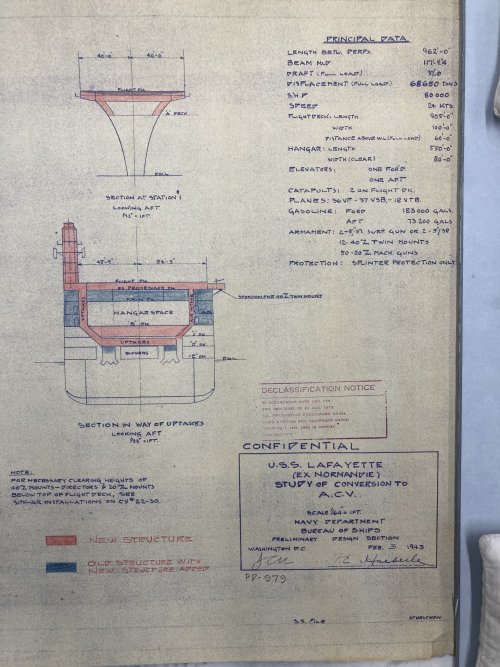
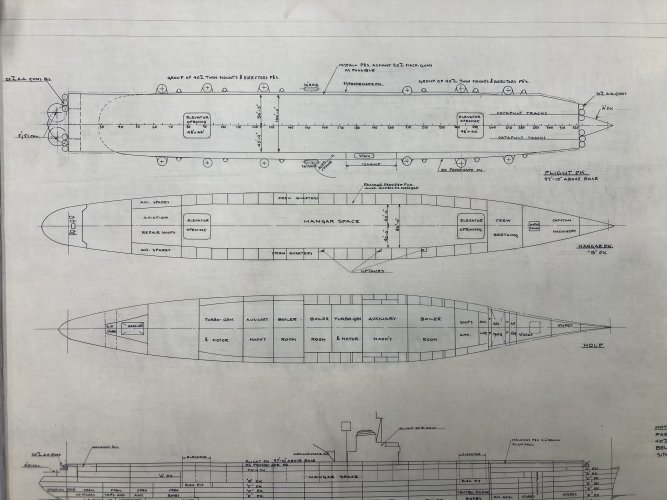
Length: 962’
Beam: 117’
Draft: 37’
Displacement (Full): 68650
Speed: Same as other designs
Flight deck: 905’ x 100’, 60’ above waterline (full load)
Hangar: 550’ x 80’
Elevators: 2x 48’x44’ fore & aft, in the middle of the flight deck
Catapults: 2x
Aircraft: 36x fighters, 37x dive bombers, 18x torpedo bombers
Gasoline storage: 183,000 gallons fore, 73,200 gallons aft
Armament: 2x 5”/51 or 5”/38
12x 40mm twin mounts
50 x 20mm
Protection: Splinter protection only
Effectively, these proposals would have turned the Normandie into a slower and unarmored Essex. Considering that the Normandie would be righted until August 1943, by which point 5 Essexes and a couple dozen escort and light carriers would have commissioned already, let alone by the time Normandie could be recommissioned, it's little wonder that the Normandie never saw this conversion through.
PD-1001:
Finally, what I consider the most interesting of the four preliminaries, is a proposal to convert the Normandie into a troop transport with a large flying-off deck at the top for ferrying aircraft, similar to some IJA landing craft carriers (albeit without the same amphibious capabilities).
Stats are as follows:
Length: 962’
Beam: 117’
Draft: 38.5'
Full Load Displacement: 72000 tons
SHP: 80,000
Speed: 24 knots
Flight deck: 848’ x 94’, 2x H-41 catapults, island on starboard
Aircraft: 31 aircraft up to 30,000 lbs.
Crew: 150 officers & 2000 men
Troop Capacity: 450 officers & 10,000 men
Equipment: 1100 tons
Protection: Splinter Protection
Armament (initial): 3 x 5”/38 DP
10 x 40mm quad mounts
58 x 20mm
There's a reference to a PD-1008 design which presumably had a different AA suite for the Normandie/Lafayette, but that design was not present in the National Archives. Had this design been completed, it would have out-displaced the Yamatos when fully loaded, and all four designs would have been the largest commissioned warships in the USN until the Forrestal-class.
Nonetheless, these proposals showed that the Normandie, even after salvage, likely suffered severe damage to its machinery which constrained the ship to 80,000 shp and 24 knots, and would have suffered from pretty bad inefficiencies due to her origins as a liner instead of a purpose-built warship, as shown in the nonexistent protection and limited armament she could carry relative to an Essex half her displacement. By the time the Normandie was righted in late 1943, the USN had plenty of warships and merchant tonnage which could do the job of all four proposals, so it made little sense to invest resources into such an inefficient conversion of an already-damaged ship.
I am curious as to whether conversion proposals for the Normandie predating the ship's fire still survive, either at NARA or in secondary sources, as maybe those could have shown the true capability of a Normandie conversion, with these four proposals having to work around all the damage suffered to the ship during the fire and the subsequent capsizing.