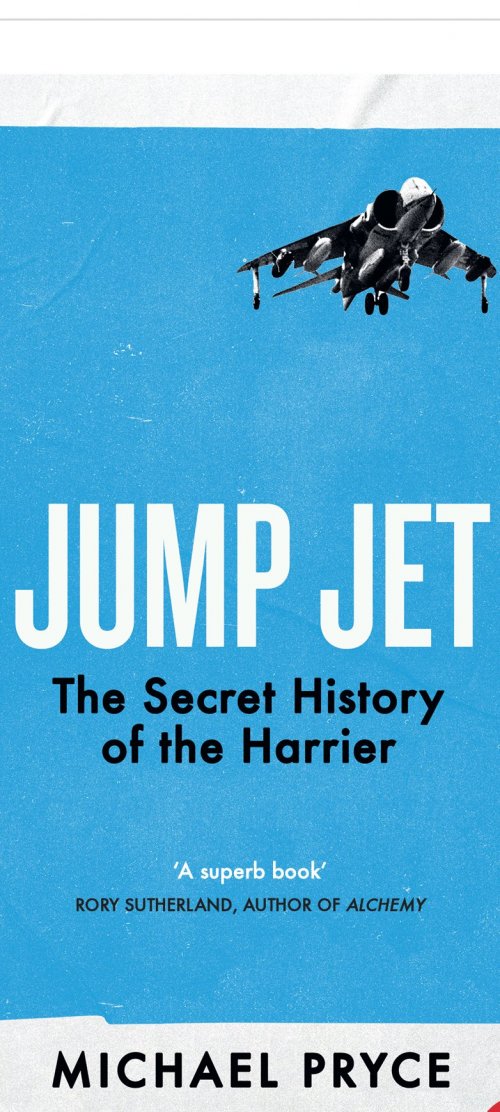
Jump Jet: The Secret History of the Harrier

I think we're more talking about percolation of ideas, influence and some quite specific design approaches/maths.

e.g. Swept wing Vs Straight wing. Deltas? How much sweep? Thick or Thin LEs? Tailplane for pitch control Vs trim?

Some of these influence configuration layout in concept design. But there's also a whole bunch of further work to do the detailed design. And other people have ideas / scepticism / influence as well.

The RAE work wasn't really to "design" an aeroplane directly at the end. The concept work they did was for research in order to drive other bits of research e.g. For (sustained) Mach 2 flight then straight wing has lower drag hence lots of research on sharp low swept wing aerodynamics and structures. They were exploring a range of ideas and then providing this basic research to Industry to inform their application into concepts, use of maths/methods etc. It was a fairly academic approach.

The RAE "concepts".also ended up being used in early Operational Research to make decisions and develop requirements e.g. guns Vs missiles for interceptors
Yes, the later twin (188 like) was set against the P1/Lightning layout and the 'OR' work placed it ahead. It was things like this that made Warton get into what became OA, to refute such findings.

The RAE's role changed 1945-55. Cripps really did want national design. Trimmed this from the book but think I should post the older drafts online about all this.
 
Trimmed this from the book but think I should post the older drafts online about all this.
Agreed, would be interesting to read. The relationship between the industry and the RAE seems to have been very mixed over that period and into the 1960s.
 
It was things like this that made Warton get into what became OA, to refute such findings.
Provide alternative facts to encourage the government to give them lots of money? ;)

I think it's also instructive to look at the similar contemporary interceptor concepts from other countries design teams.
 
Küchemann was certainly asked for advice about the Jaguar's intake configuration for the Adour.

I believe there is a bit more to say on Küchemann's career in the UK than has been widely reported. There's quite a gap in his CV between when he arrived here and when he switched - for reasons unknown AFAIK - from intakes to wings.

Multhopp seemed very much 'I am right'. He hated deltas and Lippisch with a passion as he thought work should be mathematically rigorous. He had been Prandtl's star pupil at Gottingen.

So once he had what he saw as the best design he did not seem to want to change his mind. My way or the highway. Tank saw Multhopp as the true strength of Focke-Wulf, at least that is what he told the British (please take him away?), but yes, he seemed to favour the twin boom jet in 1944-45 over Multhopp's.

Again, spoilers re the full story of what passed between them, but nothing indicates Multhopp was anything but difficult, if gifted. Tank's respect can be shown,though, in the early versions of the Pulqui II, e.g. the glider

I do wonder if the name Huckebein, a difficult crow who got killed by his own folly, was given because of the man.

Stacking engines was an RAE thing. They wanted three AJ65s for the full fighter version but the Sapphire came along and saved them from that madness.

I believe one of Multhopp's first jobs at FW was to study flying wings. Presumably he grew to dislike them from that. Maybe just me but I don't find the postwar story of Multhopp and Tank particularly enthralling. Both were in the spotlight as 'names' but neither seems to have achieved anything spectacular. Tank, in particular, was a facilitator and a businessman more than anything else.

As @Hood suggests, I think Küchemann's the interesting one of the three (and Weber, of course).
 
I believe there is a bit more to say on Küchemann's career in the UK than has been widely reported. There's quite a gap in his CV between when he arrived here and when he switched - for reasons unknown AFAIK - from intakes to wings.

Quite possibly. There was clearly more going on 1946-48 at Farnborough than has been talked about before. Equally, it was clear that Farnborough were getting German reports (inc. those written by Multhopp) during the war.
I believe one of Multhopp's first jobs at FW was to study flying wings. Presumably he grew to dislike them from that. Maybe just me but I don't find the postwar story of Multhopp and Tank particularly enthralling. Both were in the spotlight as 'names' but neither seems to have achieved anything spectacular. Tank, in particular, was a facilitator and a businessman more than anything else.

As @Hood suggests, I think Küchemann's the interesting one of the three (and Weber, of course).
Hopefully the book clarifies Multhopp's role, and Tank's. It has been hidden a bit, and was at the time. Perhaps because he did no further civil work in the UK. From various day jobs I have had I have found Multhopp's work being used at Farnborough well into the 2000s, and he had dedicated acolytes at Farnborough into the 1970s who were busy extending his work.

At FW he also developed the Multhopp-Klappe, which suffered from flutter, too. Interesting how it anticipated some issues with his swept wing's structural issues that EE had to deal with.

I totally agree with you on Tank and say so in the book. That said, I think his support for e.g. 'Flitzer' was not simply that of a manager - he flew and had designed things so that carried additional weight with some engineers under him. Not Multhopp though, perhaps.
 
Quite possibly. There was clearly more going on 1946-48 at Farnborough than has been talked about before. Equally, it was clear that Farnborough were getting German reports (inc. those written by Multhopp) during the war.

During the war as in April 1945 - yes. The British got their hands on Bad Eilsen about a month before the war ended - including FW's entire technical library (which also included a lot of non-FW material), intact.
At FW he also developed the Multhopp-Klappe, which suffered from flutter, too. Interesting how it anticipated some issues with his swept wing's structural issues that EE had to deal with.

Multhopp's career at FW appears to have had a number of phases, like anyone's career anywhere I suppose! The Multhopp-Klappe were early on - 1940. So maybe superseded by his later work?

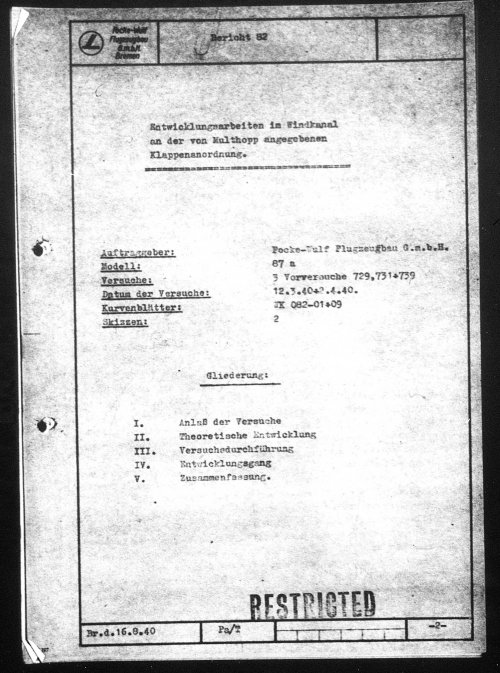
Scan_0400.jpg

He then seems to have switched to studying fuselage aerodynamics (reporting Aug 1940), then swept wings at supersonic speeds (Apr 1941). Then on measures to obtain the shortest possible take-off distance (Oct 1941). Then... turbojets (this document also confirms what 'PTL' stood for, in case anyone was in any doubt!)?

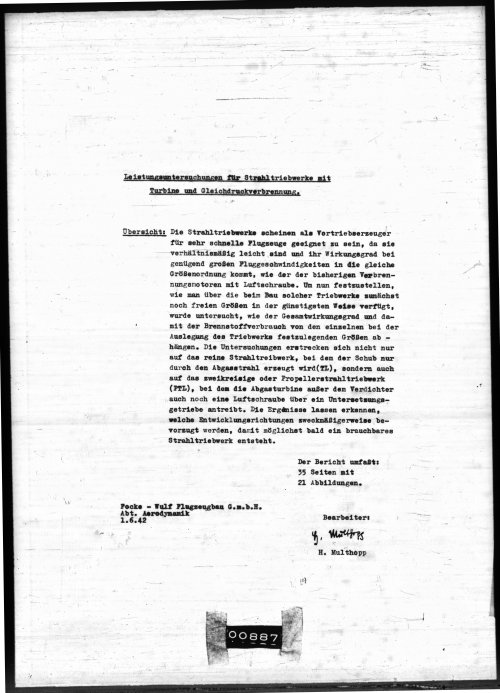
Scan_0884.jpg

Then he worked on propeller aerodynamics, then 'observations on the tailless aircraft' (Aug 42), then 'theory to obtain true air speed and practical applications' (Nov 1942), then 'influence of acceleration along the flight path in climb and gliding'). It's in 1943 when he seems to become more directly involved in aircraft design.

Tank was evidently quite the inspirational leader, as you say, and much was made in company publicity - photoshoots, magazine articles, etc. - of the fact that he was a pilot perfectly capable of flying even his company's most advanced products. Unlike, say, Messerschmitt, Heinkel, Hertel, Vogt or Blume (some of whom may have been able to fly - I don't know - but if they did it wasn't subjected to anything like the same degree of publicity). But he did spend most of his time in board meetings, on business trips etc. rather than agonising over the technical nitty gritty like Messerschmitt did.

What's the connection of Multhopp and Tank to the Harrier anyway? I think I missed that!
 
Last edited:
Great stuff Dan.

Presumably the problems with the Multhopp-Klappe became clear in 1942 with Fw191 testing. So his star may have shone for a bit first. His papers that the RAE had are from 1942 IIRC. Will need to dig out.

In all cases, his work seems to be highly mathematical, and that is his contribution to the Harrier - an approach to design widely adopted in the UK that Ralph Hooper did not follow. So Multhopp's story sets the scene, along with some others.
 
Great stuff Dan.

Presumably the problems with the Multhopp-Klappe became clear in 1942 with Fw191 testing. So his star may have shone for a bit first. His papers that the RAE had are from 1942 IIRC. Will need to dig out.

In all cases, his work seems to be highly mathematical, and that is his contribution to the Harrier - an approach to design widely adopted in the UK that Ralph Hooper did not follow. So Multhopp's story sets the scene, along with some others.

It would be utterly astonishing if the RAE had Multhopp's 1942 papers in, say, 1943. I've never seen any evidence of German research documents of that nature making their way out of company technical libraries and into the hands of British intelligence... at least not before April 1945. Mostly the AI2(g) stuff is extremely sketchy on technical developments. It often wasn't that much better on types actually in service - unless a physical example had been captured intact.

The million pages of captured German aeronautical research data I mentioned previous contained A LOT of highly mathematical work from numerous different engineers and scientists. Presumably there was something about the specific mathematical formulas that Multhopp developed which made him special. Maybe it was just his physical presence and ability to explain it in person which made the difference?
 
I think it was 1944. I'll check. It's not in the book but I have it recorded in notes from years ago.

It was his method of calculating l.e. suction behind a shockwave that mattered.
 
I think it was 1944. I'll check. It's not in the book but I have it recorded in notes from years ago.

It was his method of calculating l.e. suction behind a shockwave that mattered.

It could've come from France, of course... but the Germans, as far as I can tell, remained suspicious of the French to the extent that they never allowed them to work on any of their projects which involved swept wings.

Thinking about it, Focke-Wulf did employ a sizable cadre of French designers at its facilities in German - but I don't think they were allowed to leave. In all seriousness, maybe one managed to escape and make his way home with a Multhopp report under his jacket?
 
It could've come from France, of course... but the Germans, as far as I can tell, remained suspicious of the French to the extent that they never allowed them to work on any of their projects which involved swept wings.

Thinking about it, Focke-Wulf did employ a sizable cadre of French designers at its facilities in German - but I don't think they were allowed to leave. In all seriousness, maybe one managed to escape and make his way home with a Multhopp report under his jacket?
No idea, but two things (not in the book) made me think. 1. Focke-Wulf was part American-owned throughout the war, and 2. Teddy Petter reportedly travelled to Switzerland during the war.

I had a section on Petter leading up to his time at English Electric but even his latest biography indicates he went to Switzerland while, I think, the Welkin was being designed. Can't see how myself, but apparently he did. Perhaps he, or others in another neutral country, managed to pick new things up?

Maybe aeronautical knowledge was not as sealed off as we think, and, of course, aeronautical engineers had contacts across borders pre-war. Perhaps some old friends stayed in touch somehow? Did Nazi Germany open every letter to neutral countries?

All murky, so largely left out of the book, but intriguing. One of those rabbit holes I had no time to go down. Of course, there may be a really simple explanation at the bottom of it (e.g. a typo in a date).

EDIT: A friend of Calum's who kindly read the pre-proofed book said one thing he wanted after reading it was another book, on Multhopp!

WW2 is not my bag, and I only have one year of schoolboy German so can't do that side of things. That said, I am happy to help anyone who might be, after my book is out. Hermione Giffard and Andrew Nahum left some threads dangling about just how, and how much, German knowledge benefitted the Allies. Lots of books on Paperclip and rockets etc, but at the working level of designers and planes I think something more might be possible.
 
Last edited:

Attachments

  • FB_IMG_1781860794771.jpg
    FB_IMG_1781860794771.jpg
    30.6 KB · Views: 44
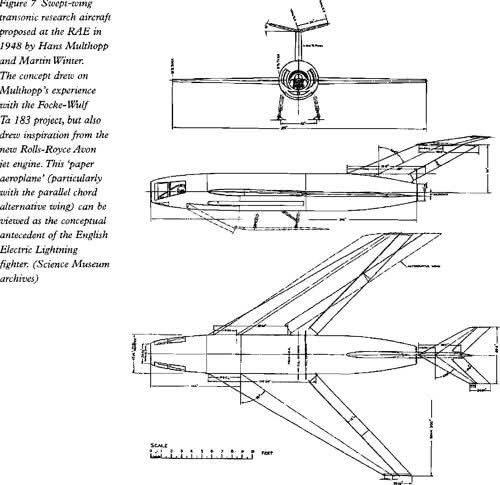
During your researches did you uncover anything more on the RAE. (Multhopp/Winter) Transonic Research Aircraft studies ? ... https://www.semanticscholar.org/pap...ahum/7687b66e87e0e97e1da40349c2bc3704b64a047f

https://www.secretprojects.co.uk/th...zAqGuPbXHa8duG92jA_aem_KplNeQhgAma23oXPJsPnDQ
Yes, the original design report from the RAE and his associated civil service records.

He states in the report it is based on his own Fw183 design from 1944-45 (he does not call it the Ta183).

That design is the start of the Lightning. In the picture you post you can even see the untapered wing platform eventually used, as the caption points out.
 
No idea, but two things (not in the book) made me think. 1. Focke-Wulf was part American-owned throughout the war, and 2. Teddy Petter reportedly travelled to Switzerland during the war.

I had a section on Petter leading up to his time at English Electric but even his latest biography indicates he went to Switzerland while, I think, the Welkin was being designed. Can't see how myself, but apparently he did. Perhaps he, or others in another neutral country, managed to pick new things up?

Maybe aeronautical knowledge was not as sealed off as we think, and, of course, aeronautical engineers had contacts across borders pre-war. Perhaps some old friends stayed in touch somehow? Did Nazi Germany open every letter to neutral countries?

All murky, so largely left out of the book, but intriguing. One of those rabbit holes I had no time to go down. Of course, there may be a really simple explanation at the bottom of it (e.g. a typo in a date).

EDIT: A friend of Calum's who kindly read the pre-proofed book said one thing he wanted after reading it was another book, on Multhopp!

WW2 is not my bag, and I only have one year of schoolboy German so can't do that side of things. That said, I am happy to help anyone who might be, after my book is out. Hermione Giffard and Andrew Nahum left some threads dangling about just how, and how much, German knowledge benefitted the Allies. Lots of books on Paperclip and rockets etc, but at the working level of designers and planes I think something more might be possible.

So probably no French designer escaping Focke-Wulf with a Multhopp report under his jacket.

Was Focke-Wulf part American-owned? Key stakeholders in the firm during the war appear to have been AEG (controlling interest), Roselius/HAG group (the decaff coffee people) and C. Lorenz AG - all German. I guess a small share might've been held by some Americans? Or bits of those three companies might have been held by Americans? But I'm not sure there's much mileage in that unless you know otherwise.

When you say Calum, do you mean Calum Douglas? I was the editor of The Secret Horsepower Race, so I'm quite familiar with everything in it. Hermione Giffard was helpful in my researches and shared a lot of material with me - and I shared a lot with her in return.

Most of the currently available material on Paperclip, rockets etc. is patchy, inaccurate, one-sided, has an axe to grind etc. etc. But that's not too surprising. As I mentioned before, it is extremely difficult to pin down the precise degree of influence captured wartime papers and ex German wartime industry figures had on postwar designs. Everyone who's tried has come unstuck.

Looking at the Lightning and Hunter, for example, I just don't think it's possible to say that this bit came from there and that bit came from there. As you've already pointed out, the picture is way too complex for that. And presupposes, to a degree, that the British designers and engineers were incapable of iterating on the old German work or having their own original ideas.
 
So probably no French designer escaping Focke-Wulf with a Multhopp report under his jacket.

Was Focke-Wulf part American-owned? Key stakeholders in the firm during the war appear to have been AEG (controlling interest), Roselius/HAG group (the decaff coffee people) and C. Lorenz AG - all German. I guess a small share might've been held by some Americans? Or bits of those three companies might have been held by Americans? But I'm not sure there's much mileage in that unless you know otherwise.

When you say Calum, do you mean Calum Douglas? I was the editor of The Secret Horsepower Race, so I'm quite familiar with everything in it. Hermione Giffard was helpful in my researches and shared a lot of material with me - and I shared a lot with her in return.

Most of the currently available material on Paperclip, rockets etc. is patchy, inaccurate, one-sided, has an axe to grind etc. etc. But that's not too surprising. As I mentioned before, it is extremely difficult to pin down the precise degree of influence captured wartime papers and ex German wartime industry figures had on postwar designs. Everyone who's tried has come unstuck.

Looking at the Lightning and Hunter, for example, I just don't think it's possible to say that this bit came from there and that bit came from there. As you've already pointed out, the picture is way too complex for that. And presupposes, to a degree, that the British designers and engineers were incapable of iterating on the old German work or having their own original ideas.
I hope I don't come unstuck. I saw Multhopp's design in Project Cancelled and thought it an anomaly. Andrew Nahum put me onto the idea of it being the basic for the Lightning, but I believed the stories of Warton coming up with it and all the other claims that the Ta183 became the Tunnan and MiG 15 etc seemed shonky. I dug away on Paperclip etc. to check, until I got the civil service files, read Multhopp's full technical report and simply looked at the drawings. Even Freddie Page says the idea came from 'a German at Farnborough'.

The extreme wing sweep was beyond structural design abilities at the time so I think no UK design team would have pursued it unless Farnborough insisted, which they did.

Multhopp himself was not aware of everything. There are reasons for that in the book too.

All of this is only background for the interesting stuff to me - Warton using Alan Turing's first computer design to make the swept wing structure work. Hawker took a different approach. These different approaches persisted in their jump jet work. That's the start of the book basically.

ITT corporation owned around a quarter of FW during the war. See https://www.thecrimson.com/article/1973/9/1/the-itt-affair-pbrbemember-milo-minderbinder/

The Catch-22 link runs to the Harrier too. See the pic of Bill Chapman here https://www.twz.com/air/the-hidden-history-of-americas-harrier-jump-jets His daughter has checked the text and wrote her own book about it https://www.amazon.co.uk/True-Story-Catch-22-Missions-ebook/dp/B009H22UXW

Digging in archives turns up some unexpected stuff.
 
Last edited:

So C. Lorenz AG, who I mentioned previously as a minority FW stakeholder, was owned by Standard Elektrizitaetsgesellschaft (SEG), which was a subsidiary of ITT. But C. Lorenz operated independently of SEG. And evidently the Nazis basically cut off all American involvement in their German holdings during the war (this appears to be the crucial part of the story - the US authorities having to restore American parent companies' control once the war was over).

So although ITT owned SEG, and SEG owned C. Lorenz, and C. Lorenz owned a minority stake in FW (in fact, The Sovereign State of ITT, makes it sound even more attenuated than this - and doesn't seem to address AEG's holding), it might be a slight stretch to suggest that this meant ITT could access documents in FW's top secret technical library during the war.

Stuck/unstuck - I suppose I was referring to the common practice of showing drawings of German designs and drawings of British/American/Soviet designs and going: 'look how similar this bit is!'. Your book is obviously going far beyond that.
 
Last edited:
So C. Lorenz AG, who I mentioned previously as a minority FW stakeholder, was owned by Standard Elektrizitaetsgesellschaft (SEG), which was a subsidiary of ITT. But C. Lorenz operated independently of SEG. And evidently the Nazis basically cut off all American involvement in their German holdings during the war (this appears to be the crucial part of the story - the US authorities having to restore American parent companies' control once the war was over).

So although ITT owned SEG, and SEG owned C. Lorenz, and C. Lorenz owned a minority stake in FW (in fact, The Sovereign State of ITT, makes it sound even more attenuated even than this - and doesn't seem to address AEG's holding), it might be a slight stretch to suggest that this meant ITT could access documents in FW's top secret technical library during the war.

Stuck/unstuck - I suppose I was referring to the common practice of showing drawings of German designs and drawings of British/American/Soviet designs and going: 'look how similar this bit is!'. Your book is obviously going far beyond that.
Yes, a pretty extreme stretch, hence not in the book. Still, it was news to me, and seemed something more interesting and odd than the old story of Coca-Cola and Fanta.

I've written what I know and have evidence for, but think there may well be more. The fact that the Lightning stemmed from the design of a 'Nazi' *, but was made possible by Turing's computer (and there's a story there about just how EE got access to it) was utterly fascinating.

* At least Multhopp's dad seems to be pretty hard core, and Prandtl, his teacher, was that way inclined too, though I don't label Hans M as one as I have no direct evidence.
 
Will there be any mention of the Harrier IIID (BAe Warton P.140) from your “Improving the Harrier” SAE paper?
 
Will there be any mention of the Harrier IIID (BAe Warton P.140) from your “Improving the Harrier” SAE paper?
Not specifically of that version. I think it was just a drawing. Harrier III gets mentioned mainly for the later versions, contemporary with the JSF programme (the fallback option in case JSF failed) from the later 1990s.
 
Front and back cover blurbs and audiobook image.
 

Attachments

  • HLVhVuHWcAAR4V6.jpeg
    HLVhVuHWcAAR4V6.jpeg
    316.7 KB · Views: 28
  • HLVhQVxWoAA1uPo.jpeg
    HLVhQVxWoAA1uPo.jpeg
    203.6 KB · Views: 21
  • HLWg_kcXAAACCFh.jpeg
    HLWg_kcXAAACCFh.jpeg
    116.6 KB · Views: 17
  • 9781405985468-jacket-large.jpg
    9781405985468-jacket-large.jpg
    251 KB · Views: 23
Last edited:
Looking forward to it. Amazon is claiming a July 9 delivery date here in the US. Not exactly cast in stone, but fingers crossed.
 
Amazon is claiming a July 9 delivery date here in the US. Not exactly cast in stone, but fingers crossed.
The publisher website gives a release date of August 27, availability at amazon.com is usually later than that.
 
Waterstones UK is giving a published date of 27 August. but I suppose they may release it quicker.
 
Looking forward to it. Amazon is claiming a July 9 delivery date here in the US. Not exactly cast in stone, but fingers crossed.
I release date is 27 August. There won't be any physically printed copies by July 9 that is the old pub date. I'll let Penguin know.
 
Thanks for the clarification. Amazon is notoriously bad on release dates for anything not published in the US.
 
Thanks for the clarification. Amazon is notoriously bad on release dates for anything not published in the US.
I passed this on to Penguin and they will see if the updated date can appear on Amazon.com - it is correct on Amazon.co.uk

Oddly, such things used to be my job in the late 90s, when I worked for the company contracted to support setting up the UK side of Amazon. Turns out even an 'e business' doesn't run on pure data!
 
Hi folks, sorry for the stupid question but, is there an e-book version planned ? Other than that, which option would be best to order a paper copy for France ? (our postal system is hideously stupid and inefficient I hate La Poste with a vengeance)
 
Hi folks, sorry for the stupid question but, is there an e-book version planned ? Other than that, which option would be best to order a paper copy for France ? (our postal system is hideously stupid and inefficient I hate La Poste with a vengeance)
Yes, there will be an ebook and an audio book.

As for postal systems, I cannot say, as I don't understand the parcel postages issues post-Brexit. I see Amazon.fr say delivery is early September, a week or so after the pub date. I assume they would deliver using an Amazon truck?
 
I passed this on to Penguin and they will see if the updated date can appear on Amazon.com - it is correct on Amazon.co.uk

Oddly, such things used to be my job in the late 90s, when I worked for the company contracted to support setting up the UK side of Amazon. Turns out even an 'e business' doesn't run on pure data!

Well, something happened. Amazon US now says the release date is November 24.
 
Well, something happened. Amazon US now says the release date is November 24.
Wow. Sorry to hear that.

I've never been told of a US release date. On Amazon.ca it says Canadian delivery is 7 or 8 October for the print version.

Perhaps the book has now got a formal US release date, or the November one assumes some crazy UK-sourced slow surface mail delivery?

I'll ask Penguin, though of course ebook and audiobook should not suffer from such a delay.
 
Wow. Sorry to hear that.

I've never been told of a US release date. On Amazon.ca it says Canadian delivery is 7 or 8 October for the print version.

Perhaps the book has now got a formal US release date, or the November one assumes some crazy UK-sourced slow surface mail delivery?

I'll ask Penguin, though of course ebook and audiobook should not suffer from such a delay.

My guess is they add a couple of months to the UK release for shipping and I might actually get it sooner -- I've had that happen before.

But I may reorder from a UK source and just suck up the shipping costs.
 
My guess is they add a couple of months to the UK release for shipping and I might actually get it sooner -- I've had that happen before.

But I may reorder from a UK source and just suck up the shipping costs.
Hopefully I'll get an answer from Penguin early next week.
 
Last edited:
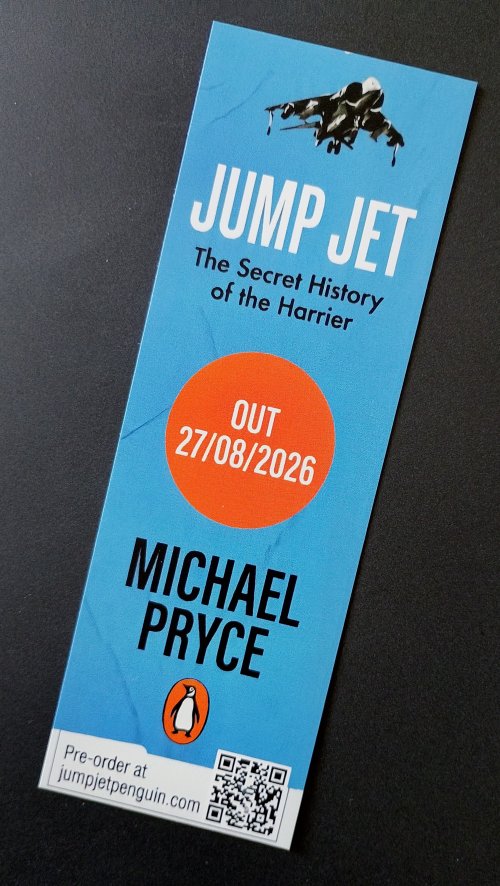
Promo bookmarks arrived from Penguin.

I hope to be at Duxford tomorrow if anyone wants to talk about the book. You will know me by my T-shirt!
 

Attachments

  • IMG_20260702_105400~2.jpg
    IMG_20260702_105400~2.jpg
    2.8 MB · Views: 11
Promo bookmarks arrived from Penguin. I hope to be at Duxford tomorrow if anyone wants to talk about the book. You will know me by my T-shirt!

Last month the United States Marine Corps officially retired the last of its AV-8B Harrier jump jets, which (including the earlier AV-8A) had been in service since 1971. A good run. Italy's naval aviation is replacing its remaining Harriers with V/STOL F-35Bs, like the USMC did. Spain's navy will retain its handful of Harriers for carrier Juan Carlos I for some time, so they will be the last Harrier operator (unless Indonesia obtains a few jump jets with their purchase of the Italian carrier Giuseppe Garibaldi).
 
I really have to order that book.

The UK had retired all its Harriers and Sea Harriers as an economy measure by 2010, which some believe was lamentably premature.

The noted Bill Gunston regretted that something like the Hawker Siddeley P.1154 never entered UK service, whose plenum chamber burning would have allowed supersonic speeds, unlike the strictly subsonic Harrier. Like Archibald and others, I look forward to reading Mike Pryce's forthcoming book for an in-depth history of the jump jet program.
 
The UK had retired all its Harriers and Sea Harriers as an economy measure by 2010, which some believe was lamentably premature.

The noted Bill Gunston regretted that something like the Hawker Siddeley P.1154 never entered UK service, whose plenum chamber burning would have allowed supersonic speeds, unlike the strictly subsonic Harrier. Like Archibald and others, I look forward to reading Mike Pryce's forthcoming book for an in-depth history of the jump jet program.
The Harriers designer, Ralph Hooper, thought the P1154 could be made to work, but PCB would have needed some sorting out.

His later P1216 would too, but his belief was that if you wait to prove things will work before you try them you will never achieve anything.

All of this is in the book, and lots more!
 
Last month the United States Marine Corps officially retired the last of its AV-8B Harrier jump jets, which (including the earlier AV-8A) had been in service since 1971. A good run. Italy's naval aviation is replacing its remaining Harriers with V/STOL F-35Bs, like the USMC did. Spain's navy will retain its handful of Harriers for carrier Juan Carlos I for some time, so they will be the last Harrier operator (unless Indonesia obtains a few jump jets with their purchase of the Italian carrier Giuseppe Garibaldi).
Sounds like an utterly deserved good operational run to me.
 

Similar threads

Back
Top Bottom