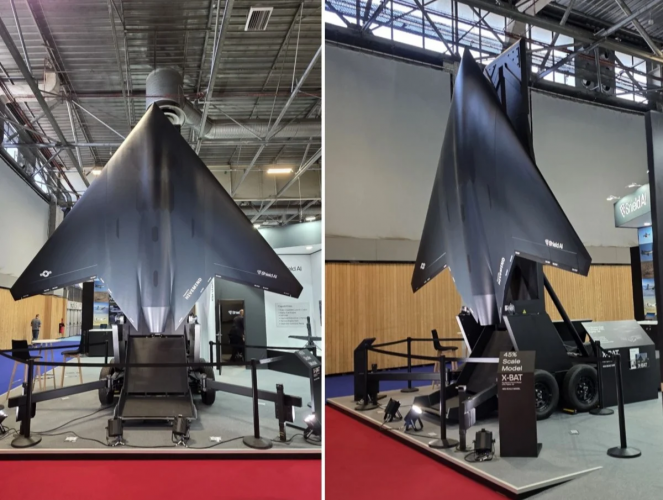
Shield AI X-BAT multirole UCAV

  • S-shaped inlet ducts aren't an option due to the short fuselage length, so stealth will require screens inside the ducts which will add weight and impact performance
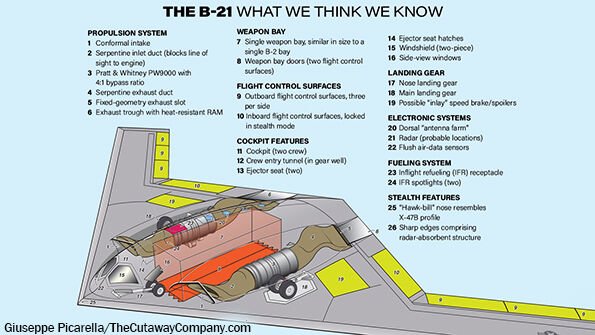
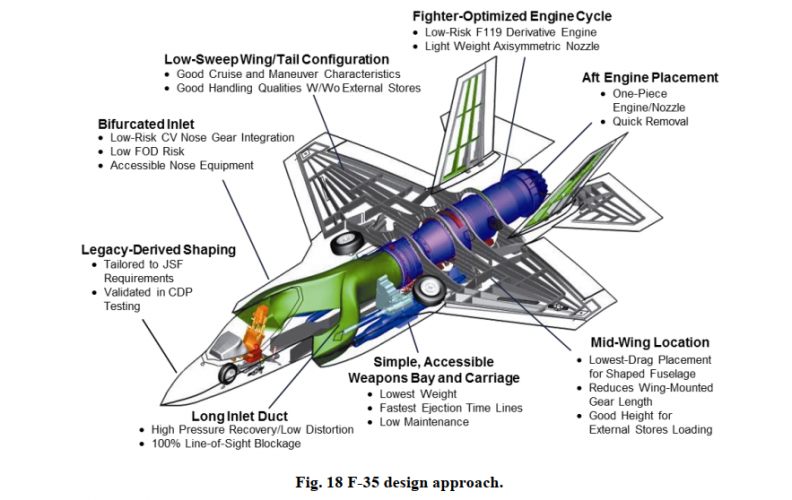
Subsonic S ducting could allow for more curved S ducting. Theres some images of F-35 ducting that you can compare with F-22 ducting. You can also take a look at this diagram of a possible B-21 configuration:

1697049062827.jpg

Or

f-35-engine-inlet.png

  • Obtaining maximum thrust & performance for VTOL will likely require auxiliary air intakes to achieve required air flow. This will add complexity and the moving panels will be hard to seal for stealth.
Like mentioned above, the launch and recovery technique may not be identical to that of a rocket.
  • Yaw control: 2D thrust vectoring will be required, particularly in supersonic flight. This will add complexity and make all aspect stealth difficult (both radar cross section and infrared due to short exhaust ducting)
It doesnt have to have 2 vectoring. Split ailerons can also produce yaw effect. This is a drone. Its probably not going to have fighter like agility.
  • No radar in the nose due to air intake location... how will it detect air targets for its primary mission?
Do we actually know that? Maybe its time for me to draw up another 3d model ....

Id be cautious to call this startup vaporware. They've been long time partners of DARPA for autonomy software and in that respect they look quite competitive. They have some heavyweights in autonomy research who have been on their R&D team since the beginning
 
Last edited:
The engines aren't vapourware but the rest of the X-Bat design still is.

According to this well-reasoned critique by an experienced Dassault engineer... given the likely design constraints making it cheap, simple and stealthy is going to be almost impossible:
  • Launching in full afterburner will cause massive constraints (heat impact + flying debris)... a well known issue from prior tail-sitter and VTOL studies. Doing so from a grass clearing (as shown in the video) is probably not realistic.
Granted.


  • S-shaped inlet ducts aren't an option due to the short fuselage length, so stealth will require screens inside the ducts which will add weight and impact performance
Doesn't appear to be a problem, the airframe is longer than you think it is.


  • Obtaining maximum thrust & performance for VTOL will likely require auxiliary air intakes to achieve required air flow. This will add complexity and the moving panels will be hard to seal for stealth.
The B-2 and B-21 don't seem to have an issue. I'm sure that if they're really hating life trying to get their design to work they can request assistance from Northrop.


  • Fuel can't be stored inside the wings due to the need to fold. This means a short fat fuselage to accommodate the required fuel for the advertised 2,000nm range... not good for transonic/supersonic drag
You can put fuel outboard the fold, it's not like flexible fuel lines are unknown. Crud, there's enough flex in a loop of titanium that you can even do it with hard lines!


  • Internal weapons bay on such a short aircraft is going to further exacerbate the transonic/supersonic drag issue
Granted.


  • Wind constraints on landing likely to be quite severe due to the required precision... so no all weather operations
That's true of a lot of VTOLs. Helicopters even have wind limits for engine startup that are lower than what they can fly in.


  • Yaw control: 2D thrust vectoring will be required, particularly in supersonic flight. This will add complexity and make all aspect stealth difficult (both radar cross section and infrared due to short exhaust ducting)
  • Roll control: How will this be achieved on landing? Typically requires roll posts at the wingtips using bleed air from the engine... more complexity and challenging for the stealth signature.
F-35 is still reasonably stealthy and just has radar blockers up the tailpipe, and has roll posts.


  • No radar in the nose due to air intake location... how will it detect air targets for its primary mission?
Leading edge arrays like the Super Bug, B-2, B-21. And that's just the birds with LE arrays that I know off the top of my head.


  • Weight gain will be almost impossible during service life due to the choice of legacy engines (F110 engines can't be uprated over time).
It's a UCAV engine, and IIRC this one is supposed to be relatively attritable. You can add a few percent power at the cost of longevity.
 
@Scott Kenny Of course all these design challenges can be individually addressed. The overall point however remains that fixing each of them adds weight, cost, and maintenance complexity. All of which collectively are very bad news for a UCAV that is weight constrained (VTOL) and supposed to be affordable/attritable.

If you compare to other loyal wingman designs out there, the level of sophistication and complexity in this one is increased by an order of magnitude because of the combination of VTOL, supersonic and stealth requirements. These historically have been very hard to achieve together… now add low cost / small size to the mix and the result is a unicorn. Why should we believe a company with very little track record in critical design areas such as flight sciences, aerodynamics and aircraft engineering?
 
No pilot or landing gear frees up significant volume inside fuselage. Length from intake to exhaust nozzle looks longer than F-35. Shield AI has stated it will have bleed air roll control nozzles.

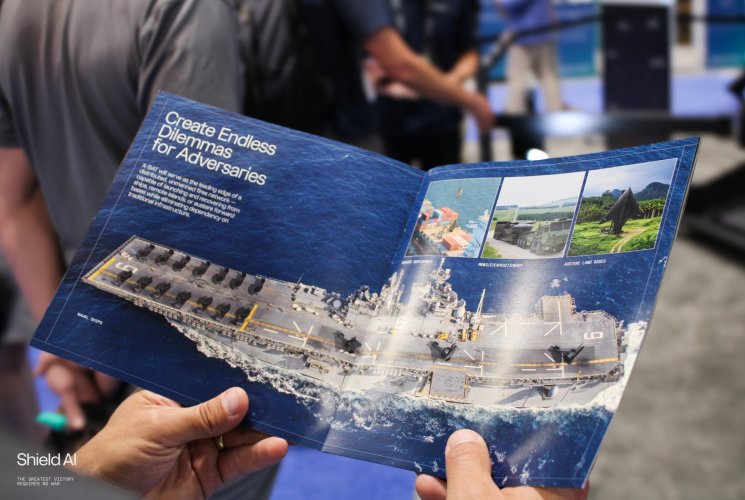
I'm interested in seeing this operate from ships. Type 26 mission bay could probably hold four of these on retractable launch/recovery gantries extending out the side mission bay doors. Maybe another 4-6 hung from the ceiling as well. Weapon storage might be an issue though. Imagine a frigate with four fighters on alert-5 able to launch at a few minutes notice.
I wouldnt want to have to attempt landing these things back on a ship in anything other than the calmest of conditions.
 
also worth mentioning that unless your airforce is 100% X-BAT only, you still got your regular CTOL manned fighter jet, which largely neutralizes the marketed benefit of runway-indepedence of X-BAT, as you aren't getting rid of your airbase infrastructure in the first place
Or F-35B. Also keep in mind that CTOL aircraft have to launch from a carrier that could be 500km or more away from somewhere a VTOL can launch from, and therefore would generally need more tanking.
No pilot or landing gear frees up significant volume inside fuselage. Length from intake to exhaust nozzle looks longer than F-35. Shield AI has stated it will have bleed air roll control nozzles.
That would make sense, bypass nozzles like the harrier to compensate for winds while landing etc. Could have a yaw nozzle as well.
I'm interested in seeing this operate from ships. Type 26 mission bay could probably hold four of these on retractable launch/recovery gantries extending out the side mission bay doors. Maybe another 4-6 hung from the ceiling as well. Weapon storage might be an issue though. Imagine a frigate with four fighters on alert-5 able to launch at a few minutes notice.
I suspect would be extremely challenging!
 
I wouldnt want to have to attempt landing these things back on a ship in anything other than the calmest of conditions.

Some stabilization could be built into the recovery system if needed. The stabilized part doesn't need to support the full weight of the aircraft, just grab it and guide it into alignment while the engine still holds most of the weight.
 
Apparently it also has an auxilary intake near back of the aircraft that opens in VTOL mode.

It would be nice to see something derived from the scale model aircraft as well, could be a handy CCA. No need to carry the full payload of the big one, maybe just couple of missiles.
 
It’s pretty great Shield is investing in this concept - I wish them success and hope x-bat proves me wrong on the following: I’d rather have the dollar of equivalent of an x-bat in ground launched LongShots, LUCASs and MALDs from an offensive perspective.
 
That's the most hilarious thing given to see since (not so) long from them. So, the entire ship is devoid and restricted to X-Bat?! No place left for anything else.

Well, it's new to me that Bats enter the invasive species list.
 
Shield AI brings its runway-free autonomous fighter jet to Eurosatory
https://defence-blog.com/shield-ai-brings-its-runway-free-autonomous-fighter-jet-to-eurosatory/
Key Points
  • Shield AI is showcasing the X-BAT autonomous VTOL combat jet at Eurosatory 2026 in Paris, June 15-19, with first VTOL flights scheduled for 2026 and mission capability targeted for 2028.
  • X-BAT is powered by a GE Aerospace F110-GE-129 turbofan with thrust vectoring, has a claimed range exceeding 3,700 km (2,000 nautical miles), and operates autonomously without GPS or communications.
Shield AI says the aircraft has a range exceeding 3,700 km (2,000 nautical miles) with a full mission payload, a service ceiling of 15,240 m (50,000 ft), and the ability to take off vertically from ships, remote islands, or austere forward bases, eliminating the dependency on traditional runway infrastructure that makes conventional air power vulnerable to attack. Shield AI says three X-BATs can fit in the deck space of one legacy fighter, which means a ship or forward operating base that previously supported one crewed combat aircraft could potentially support three autonomous ones. The aircraft takes off vertically using its main jet engine and thrust-vectoring nozzle, transitions to horizontal flight for its mission, and returns to land vertically engine-down, descending tail-first back onto its launch rail.
1781526641390.png
 
The whole take off and landing procedure seems far more unnecessarily complex than just exploiting TVC for STOL capability.

Recovery, in this case proposing to actually attach to the rail again (lol), is always where these concepts have been falling apart since the early cold war, in some sense even before.
 
The whole take off and landing procedure seems far more unnecessarily complex than just exploiting TVC for STOL capability.

Recovery, in this case proposing to actually attach to the rail again (lol), is always where these concepts have been falling apart since the early cold war, in some sense even before.
Not that simple. Simply pointing the nozzle at the rear downwards does not a VTOL make.* You would need downwards thrust at the front too to balance the moments - and that requires either a forwards lift fan like the F-35B or separate thrust nozzles like Harrier, which would increase cost and complexity... and operating costs.

*Nose in ground is what it makes.
 
Not that simple. Simply pointing the nozzle at the rear downwards does not a VTOL make.* You would need downwards thrust at the front too to balance the moments - and that requires either a forwards lift fan like the F-35B or separate thrust nozzles like Harrier, which would increase cost and complexity... and operating costs.

*Nose in ground is what it makes.

I think VTOL off a gantry like XBat is doing it will prove to be the lightest, simplest, and cheapest method of launching and recovering unmanned fixed winged aircraft. Even just the landing gear on a conventional jet is likely more complex and expensive than the thrust vectoring needed to make an autonomous jet do this, much less all the stuff needed for F-35 style STOVL. Deleting the gear, the internal volume needed to house it, and the structural reinforcement needed to support it will result in a significantly smaller, lighter, and less expensive aircraft. Any savings in mass/volume snowballs into even less mass/volume needed in engine, fuel, and structure to carry it. This is IMO the most practical way to achieve true VTOL with a useful payload. Everything else that has been tried still needed some runway.
 
I think VTOL off a gantry like XBat is doing it will prove to be the lightest, simplest, and cheapest method of launching and recovering unmanned fixed winged aircraft. Even just the landing gear on a conventional jet is likely more complex and expensive than the thrust vectoring needed to make an autonomous jet do this, much less all the stuff needed for F-35 style STOVL. Deleting the gear, the internal volume needed to house it, and the structural reinforcement needed to support it will result in a significantly smaller, lighter, and less expensive aircraft. Any savings in mass/volume snowballs into even less mass/volume needed in engine, fuel, and structure to carry it. This is IMO the most practical way to achieve true VTOL with a useful payload. Everything else that has been tried still needed some runway.
Yes, I forgot to mention 'heavier'. With X-Bat, all the mechanicals have been transitioned to software that allows a nearly impossible landing.
 
Not that simple. Simply pointing the nozzle at the rear downwards does not a VTOL make.* You would need downwards thrust at the front too to balance the moments - and that requires either a forwards lift fan like the F-35B or separate thrust nozzles like Harrier, which would increase cost and complexity... and operating costs.

*Nose in ground is what it makes.
I said STOL, not VTOL (which is unnecessary for non-naval fixed wing aircraft).
 
https://aviationweek.com/defense/aircraft-propulsion/shield-ai-distances-x-bat-cca-market-segment
The X-Bat is also not a collaborative combat aircraft (CCA), Tseng said in an interview with Aviation Week on June 15 at Eurosatory.

“I would say that X-Bat is probably, or is, the world's first autonomous combat aircraft, as opposed to collaborative combat aircraft,” Tseng said.

The distinction is not trivial. It means Shield AI is positioning the X-Bat apart from the tactical CCA market, which is producing smaller, mostly runway-dependent aircraft to serve as adjuncts to fighters and other tactical aircraft.
After unveiling the X-Bat last October, Shield AI expects to fly the self-funded prototype by the end of this year.
 
It seems to me RATO and drag chutes could give you a very short strip capability with far less effort.
But at a lot more cost. Kratos XQ-58 is upwards of 300k per launch and one of the reasons they are now developing a CTOL variant.
 
I said STOL, not VTOL (which is unnecessary for non-naval fixed wing aircraft).
Still wouldn't really work too well without balance of the thrust moment, plus you still need a runway then, whereas this can land anywhere a heli can and places it can't, but has jet speed.
 
Still wouldn't really work too well without balance of the thrust moment, plus you still need a runway then, whereas this can land anywhere a heli can and places it can't, but has jet speed.
STOL is certainly easier to implement with conventional control surfaces on top of TVC. Meanwhile trying to get this thing to land back on it's rail vertically requires vastly more effort. You know what can also take off vertically from a launcher, deliver a payload and has jet speed or even greater speed? A missile. Just that with the missile you don't have to worry about itself whacking you and bursting into a fireball upon landing because the missile doesn't come back.

The lack of a proper recovery system is why this whole concept is deeply flawed. But as already said, that concept has been deeply flawed since decades which is why it has been always abandoned over and over again just for the next sucker to come up with that "novel" idea.

Also the idea of wasting space on ships for this they presented was quite hilarious.
 
But at a lot more cost. Kratos XQ-58 is upwards of 300k per launch and one of the reasons they are now developing a CTOL variant.
RATO bottles are that expensive?

But I was more thinking a CTOL solution with a rolling RATO take off during combat conditions when necessary. My thought was that this would take fewer boosters than a completely vertical take off and allow for normal take offs when the option was available.
 
The lack of a proper recovery system is why this whole concept is deeply flawed. But as already said, that concept has been deeply flawed since decades which is why it has been always abandoned over and over again just for the next sucker to come up with that "novel" idea.
This is true and its not a trivial problem per se, but how bad can it be when we are already landing rockets using those chopstick grabber arms?
 
This is true and its not a trivial problem per se, but how bad can it be when we are already landing rockets using those chopstick grabber arms?
Difference being that rockets previously had no reliable and cheap landing options whatsoever, so through decades of trials and errors a solution has been brought up to reuse these previously single-use extremely high cost assets.

Your fixed wing unmanned aircraft has various tried and true ways of landing reliably and cheaply. If you're concerned about space and concealment, then get an SRBM TEL instead. If you want something reusable and reliable however, then don't rely on an extremely strange and hard to execute way of retrieving the craft with no Plan B.

Not that it solves the problem it's meant to addressed anyway. There's no difference between "oh no, the enemy destroyed my airfield, I can't take off and land safely!" and "oh no, the enemy destroyed my launch rails, I can't take off and land safely!".

It's an unnecessarily complicated white elephant of a concept, similar to the forum favorite, the stealth strategic airlift. Some things are better left on the drawing board, because the real world belongs to the pragmatists and the solutions that are simple and just work.
 
Not that it solves the problem it's meant to addressed anyway. There's no difference between "oh no, the enemy destroyed my airfield, I can't take off and land safely!" and "oh no, the enemy destroyed my launch rails, I can't take off and land safely!".
It is significantly harder to hunt down a TEL than it is to wreck an airfield.
 
It is significantly harder to hunt down a TEL than it is to wreck an airfield.
A TEL with missiles carried inside containers, yes. Because it's easy to disguise.

A TEL that carries a sizeable fixed wing aircraft on it's back? That's the most easily recognizeable shape you'll ever see from ISR assets.

I know there's an obsession with "containerized" BS, just how there is an obsession with "networked" and "AI driven" solutions. But good look folding up your launch rail and fixed wing UCAV (plus payload and fuel) that it fits in an easily hidden container transported via TEL. Also good luck hiding the refueling and maintenance vehicles.

That rolling circus (literally here) would not be any harder to find than a prepared airstrip, let alone an austere airfield.
 
A TEL with missiles carried inside containers, yes. Because it's easy to disguise.

A TEL that carries a sizeable fixed wing aircraft on it's back? That's the most easily recognizeable shape you'll ever see from ISR assets.
As if the Grumman StoWing doesn't exist...

How stealthy it is may be debatable, so pass a beer and let's get to it.

@stealthflanker can your model handle a linear discontinuity on the wings for a fold line?
 
It is significantly harder to hunt down a TEL than it is to wreck an airfield.
Maybe they will come up with an emergency recovery system. But forcing the enemy to both wreck airfields and hunt for mobile TEL trailers may improve your chances.

I wish they would make a smaller CCA sized one that can be more easily hidden, but maybe they are aiming for a niche that doesn't compete with CCA too closely.
 
This is true and its not a trivial problem per se, but how bad can it be when we are already landing rockets using those chopstick grabber arms?
Substantially harder with a jet engine than a rocket engine. You get instant throttle response that is independent from external factors with a rocket engine. The throttle response of a jet engine is significantly slower relative to a rocket and its performance is tied to engine inlet distortion. Engine inlet distortion is affected by things like wind gust and your exhaust response to its surroundings. Worst still for many VTOL situations the engine inlet/exhaust dynamics are unstable leading to a situation where a disturbance induce distortion that reduce thrust, that leads to commanding increase in throttle which exasperates the engine inlet distortion that leads to even less thrust and a crash.

Make no mistake it is far harder to do VTOL takeoff and land on a post with a jet engine than it is to do it with rockets.
 
I refer you to my Post #145 . . .

cheers ,
Robin .
 
U.S. Navy Rapid Capability Office and PAE Aviation: Investing $50 million (DON RCO + PAE Aviation + DIU) to accelerate X-BAT’s “Runway Independent Maritime Expeditionary Strike (RIMES)” capability.
 

Attachments

  • Screenshot_2026_0814_155144_com.android.chrome.png
    Screenshot_2026_0814_155144_com.android.chrome.png
    195.3 KB · Views: 18
So what type of support structure will you need to service a VTOL drone. Would you will need a crane of some sort to move the drone in an horizontal position to load the drone or would it be done upright ?
 
So what type of support structure will you need to service a VTOL drone. Would you will need a crane of some sort to move the drone in an horizontal position to load the drone or would it be done upright ?
Maybe have a TEL type system to erect it?

Will it be able to launch from and land on STOVL carriers?
 

Similar threads

Back
Top Bottom