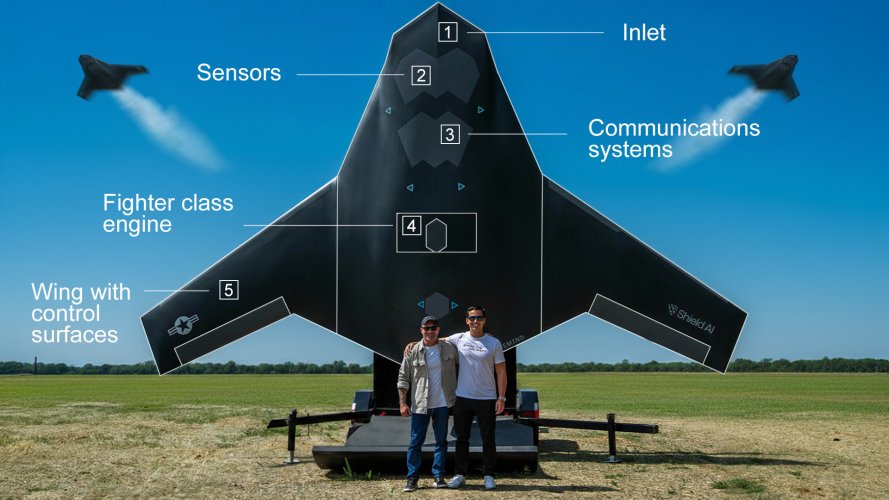
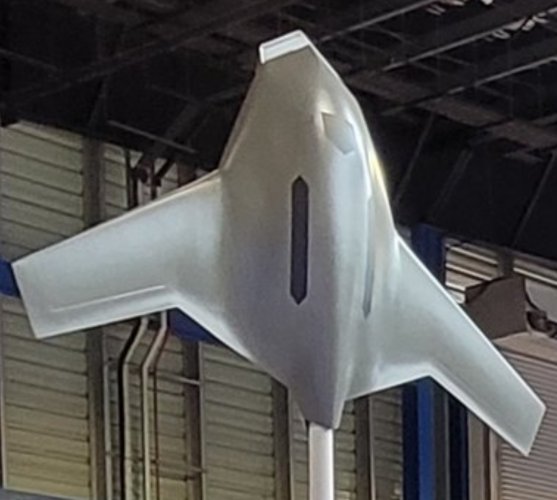
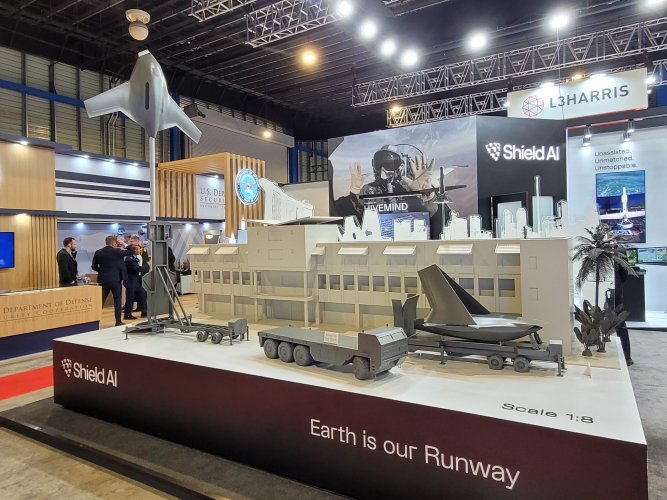
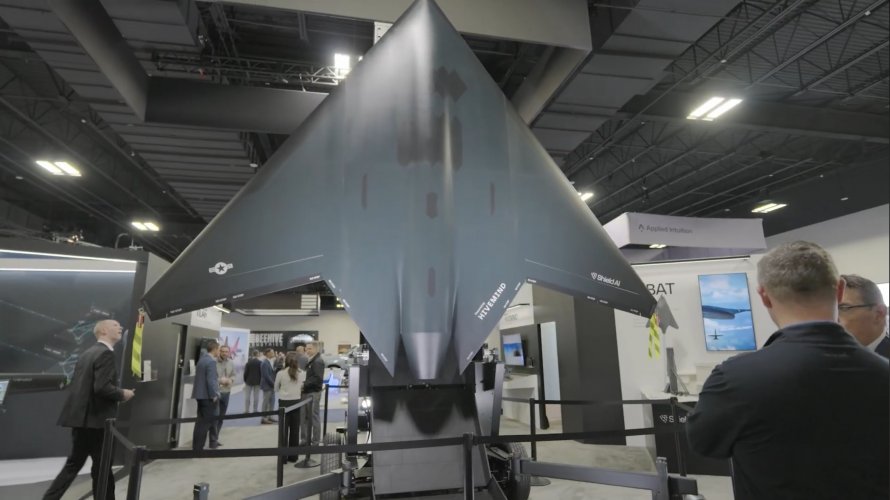
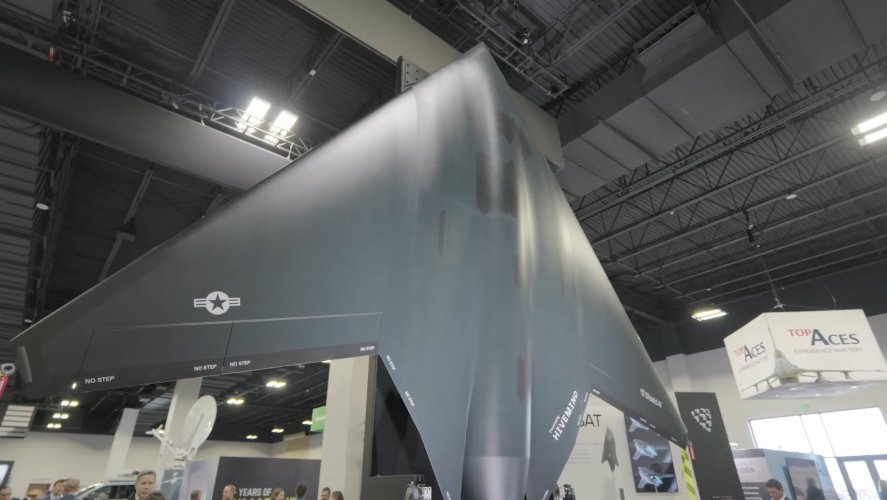
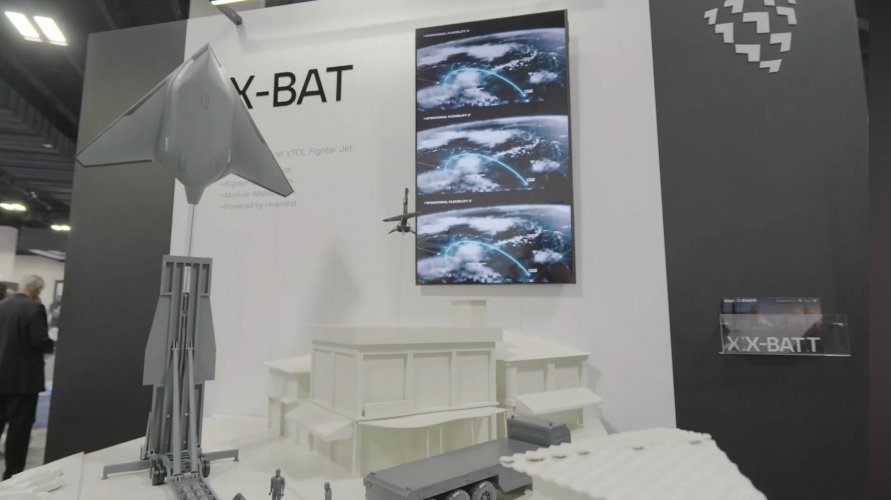
Shield AI X-BAT multirole UCAV

But I suspect it likely fills too small of a bespoke niche between rocket launch/parachute recovery (eg XQ-58) and a FQ-42/44 RATO assisted runway launch equipped with a drag chute.
My anime-influenced-brain demands that this goes into a submarine!

Otherwise you usually have enough space for a more traditional launch and landing mechanism. Just think about how much payload you are giving up....
 
It’s an interesting concept, but it seems like it would expensive for what it is. Worth watching if they can actually make it work reliably and if so, what the price point is. But I suspect it likely fills too small of a bespoke niche between rocket launch/parachute recovery (eg XQ-58) and a FQ-42/44 RATO assisted runway launch equipped with a drag chute.

XQ-58 averages about 2 weeks or more per flight recovery and turnaround. This thing should be a daily flyer and no reason to believe that it won't be able to generate multiple sorties a day. If they can build this thing at under $20-25 Million or so (same cost as the T-7A for example) then this would do well - as long as the autonomy is reliable to accomplish the type of missions advertised. That's easier said than done given they are mainly an AI focused firm with just one HW product that I can point to so this is a huge leap for them.
 

A New Kind of CCA? Meet the Supersonic, Vertical Takeoff and Landing X-BAT​


Kingshark
View: https://www.youtube.com/watch?v=i8awJAaIGic
 
Brandon Tseng, Co-Founder of Shield AI, unveils the real X-BAT autonomous fighter jet with former Navy SEAL Shawn Ryan, the host of
podcast "Shawn Ryan Show".
He breaks down its game-changing features including vertical takeoff and landing, long-range strike capabilities, electronic warfare functions, and AI piloting technology. The X-BAT can carry payloads comparable to modern fighter jets like the F-35, while launching from almost anywhere without the need for a runway. This moment marks a historic look at the future of air warfare and the cutting edge of AI-driven defense. [...]
Video:
View: https://www.youtube.com/watch?v=bD6g2JiuoTE

Link:
Code:
https://www.youtube.com/watch?v=bD6g2JiuoTE
 
Intends as a business case...
Notice that while they are mentioning in length a first flight social event, no date or schedule are discussed.

Interestingly, there was confirmation of a 3D TVC "multi-plan thrust vectoring".

Also in their last video:

Screenshot 2025-10-24 135208.png

IMOHO, the front intake will be a major source of risk during the transition from slow speed to vertical landing and back.

But they seems to be addressing the problem with an apparent active flow ctrl solution(?) and very low surface area inducing diverging Beta angle:

Screenshot 2025-10-24 135012.png

Landing is directly inspired by the Ryan X-13 Vertijet with the hooking arrangement.

Screenshot 2025-10-24 135635.png

da66fbdfbfaccf50.jpg


View: https://youtu.be/OnpuNlE3UxU
 
Last edited:
Notice that while they are mentioning in length a first flight social event, no date or schedule are discussed.
I think they discussed this in the TWZ interview. A full-scale version will fly sometime in 2028 which is quite a bit out for the defense tech / startup world but consistent with the three months they spent teasing this thing out.
 
Shouldn't we expect a scaled down demo vehicle before? I know the usage of flying mockups has been largely abused by the Startups industry, but it would sound like a great idea to ensure the transition modes are fully mastered.
 
On Shawn Ryan's show, Tseng confirmed 4 ARAAMs internally. Now we are talking. Low obserable, range, and with a tactically significant payload and cost in line with Incr I CCAs.

If the motivation for Incr I was to provide more magazine depth for the F-22, why not just build it around two or four AMRAAMs? I am guessing they saved space and weight by not having landing gears, which may present operational issues as you will always need launchers, which is why Tseng mentioned having more than one launcher per X-Bat.

One thing I am not crazy about is that rear nozzle. It looks like a Chipanzee's anus.
 
XQ-58 averages about 2 weeks or more per flight recovery and turnaround. This thing should be a daily flyer and no reason to believe that it won't be able to generate multiple sorties a day. If they can build this thing at under $20-25 Million or so (same cost as the T-7A for example) then this would do well - as long as the autonomy is reliable to accomplish the type of missions advertised. That's easier said than done given they are mainly an AI focused firm with just one HW product that I can point to so this is a huge leap for them.
I had never heard that the turn around time was that long. What causes that to be such a long winded process? I can see it being annoying to left the whole aircraft off the ground and place it on a trailer, but surely repacking/replacing the balloons, parachutes, and rockets is not that time consuming?
 
I had never heard that the turn around time was that long. What causes that to be such a long winded process? I can see it being annoying to left the whole aircraft off the ground and place it on a trailer, but surely repacking/replacing the balloons, parachutes, and rockets is not that time consuming?
Just because something is flying every couple of weeks doesn't mean it is incapable of flying more often. In a flight test campaign you want to analyse all the data thoroughly and account for your findings in planning the next mission and each individual test item within it. Fast turnaround isn't necessarily good.

Claiming daily flights from something three years away from flying is rather optimistic.
 
I had never heard that the turn around time was that long. What causes that to be such a long winded process? I can see it being annoying to left the whole aircraft off the ground and place it on a trailer, but surely repacking/replacing the balloons, parachutes, and rockets is not that time consuming?
I am not sure what the reason is. The 2 weeks or worst turn-around is what the US Air Force and the Marines are seeing with systems they have/have had that leverage some mix of service and contractor support. You can probably do better if you invested in operationalizing it but still sub-optimal compared to something that can land using landing gear or something like what X-bat is using.
 
I am not sure what the reason is. The 2 weeks or worst turn-around is what the US Air Force and the Marines are seeing with systems they have/have had that leverage some mix of service and contractor support. You can probably do better if you invested in operationalizing it but still sub-optimal compared to something that can land using landing gear or something like what X-bat is using.
Two weeks would be nearly useless in combat unless you envisioned it primarily as a throw away system with a low possibility of returning. I figured sortie rate was a big part of the reason XQ-58 never even entered the competition for Incr1 and the reason for a new version with landing gear. But two weeks would make it functionally almost useless. I can see that being fine for Kratos target drones; they only fly occasionally on scheduled flights. But are you sure this applies to XQ-58? I cannot see anyone having any interest in it (Marines, Europeans) unless you could at least have it ready to fly the next day.
 
But are you sure this applies to XQ-58? I cannot see anyone having any interest in it (Marines, Europeans) unless you could at least have it ready to fly the next day.

I'm referring to what the drones do supporting the DAF and Marines. Not any company aircraft, and or flight test of the system. Of course they do not intend to operationalize this with a 2 week turn around time but they have not yet demonstrated daily flights which they can do tomorrow if they so choose to do using assets they presently have in the field or owned by the company.

XQ-58's main strength lay in its runway independence. Since that was not a requirement, it stood little chance on Increment 1 CCAs and I'm not even sure that Kratos bid that variant.
 
Kratos did not bid; I assume none of their aircraft fit the requirements.
There were three ACP air vehicle efforts DOD pursued (1 gen 1 and two gen 2) leading up to the PoR transition program (CCA). Two of them made their way into CCA Inc 1. The other was the XQ-58.
 
Last edited:

Under a memorandum of understanding signed by the firms, GE will provide its F110-GE-129 powerplant and integrate a thrust vectoring nozzle critical for the X-BAT platform’s vertical takeoff and landing (VTOL) operations. GE will also assist Shield AI with joining the F110 with the X-BAT itself, the first partnership the engine maker has announced for a specific drone wingman platform.

The F110 “provides the performance that we need” to operate the X-BAT particularly in its vertical setup, Armor Harris, senior vice president and general manager of aircraft at Shield AI, told Breaking Defense ahead of the engine announcement. Harris identified some key distinguishing criteria for the engine, which is actively used by the US Air Force today, as sufficient thrust, a thrust vectoring nozzle and a hot production line that can be scaled up.

Harris said Shield AI has been working on the X-BAT for about the last 18 months, with GE coming aboard about six months ago to refine the aircraft’s propulsion. He added that “engine development is now beginning in earnest” to achieve a first vertical takeoff and landing demonstrator flight by the second half of next year. Production is then expected to follow in the 2029 timeframe.
The thrust vectoring nozzle is integral to the X-BAT’s VTOL concept because the nozzle helps balance the aircraft by changing the angle of its thrust, with Harris likening it to keeping an upside down broom steady in the palm of one’s hand. The nozzle for the X-BAT is being adapted from the Axisymmetric Vectoring Exhaust Nozzle, which was developed in the 1990s and demonstrated on an F-16.

“So there may be some modifications” to the nozzle to integrate it with the X-BAT vehicle, Mark Rettig, vice president and general manager of advanced programs at GE’s Edison Works, said during the call. “Integrating the nozzle and the control of the nozzle with the vehicle will be part of the first thing that the teams will be working to do. But, relative to our experience with the nozzle on the F-16, [we] don’t anticipate any challenges with being able to provide the level of control that the vehicle needs.”
 
Odd choice of having the wing folding upward for them. Isn't a trailer design meant to be roadable? Now the wing span is going to be a limitation to balance against the ability to be deployed.
Folding the wing using one of Grumman or Lockheed geometry for example could have prevented this.
 
Last edited:
Odd choice of having the wing folding upward for them. Isn't a trailer design meant to be roadable? Now the wing span is going to be a limitation to balance against the ability to be deployed.
Folding the wing using one of Grumman or Lockheed geometry for example could have prevented this.
They are still claiming it will fit inside a 40ft container so assume there is either some jiggy going on or perhaps additional assembly of the aircraft before the wing position illustrated.
 
so they were not vapourware.
The engines aren't vapourware but the rest of the X-Bat design still is.

According to this well-reasoned critique by an experienced Dassault engineer... given the likely design constraints making it cheap, simple and stealthy is going to be almost impossible:
  • Launching in full afterburner will cause massive constraints (heat impact + flying debris)... a well known issue from prior tail-sitter and VTOL studies. Doing so from a grass clearing (as shown in the video) is probably not realistic.
  • S-shaped inlet ducts aren't an option due to the short fuselage length, so stealth will require screens inside the ducts which will add weight and impact performance
  • Obtaining maximum thrust & performance for VTOL will likely require auxiliary air intakes to achieve required air flow. This will add complexity and the moving panels will be hard to seal for stealth.
  • Fuel can't be stored inside the wings due to the need to fold. This means a short fat fuselage to accommodate the required fuel for the advertised 2,000nm range... not good for transonic/supersonic drag
  • Internal weapons bay on such a short aircraft is going to further exacerbate the transonic/supersonic drag issue
  • Wind constraints on landing likely to be quite severe due to the required precision... so no all weather operations
  • Yaw control: 2D thrust vectoring will be required, particularly in supersonic flight. This will add complexity and make all aspect stealth difficult (both radar cross section and infrared due to short exhaust ducting)
  • Roll control: How will this be achieved on landing? Typically requires roll posts at the wingtips using bleed air from the engine... more complexity and challenging for the stealth signature.
  • No radar in the nose due to air intake location... how will it detect air targets for its primary mission?
  • Weight gain will be almost impossible during service life due to the choice of legacy engines (F110 engines can't be uprated over time).
View: https://www.youtube.com/watch?v=w9sBpvxn1Iw
 

Similar threads

Back
Top Bottom