- Joined
- 15 January 2021
- Messages
- 661
- Reaction score
- 2,923
F100, F110, F404, F414, EJ200, M88, F119, and F135 are all of this 3 stage Fan / HPC configuration. Very normal….That feels very weird to me, with no separate LP compressor.

F100, F110, F404, F414, EJ200, M88, F119, and F135 are all of this 3 stage Fan / HPC configuration. Very normal….That feels very weird to me, with no separate LP compressor.
I must spend too much time looking at civvie fans...F100, F110, F404, F414, EJ200, M88, F119, and F135 are all of this 3 stage Fan / HPC configuration. Very normal….

Yes, and they're very different to the Izd.177 - think YF120.Btw, is there any photo of the Izd. 30's IGV so far ?

Wow. Even the F-104 needed 3/4 AB to do that.Most afterburners have some pressure loss due to flow blockage from the spray ring and flame holders. Perhaps they are turning the flame holders to reduce blockage during non-AB operation, then turning them across the flow during AB.
Cruising in minimum AB can be normal
operation at mid supersonic speeds. Per the JB Brown talk, the F-22 cruises at M2 using approximately 1/3 AB power. The SR-71 could cruise at M3.2 at minimum AB if the ambient temperature was well below standard for 80K altitude.

Yes, and they're very different to the Izd.177 - think YF120.


When Russian engine, for example Iz-177 is quoted with 108/157 KN dry/wet thrust. Are there values from testing at STP in a chamber or in Russian cold climate? What about US & EU engines?
Tagging works with "@"Those are values from the static tests on the 'test bed' with the standard parameters: H=0,V=0 ,t=15°C. I think they are the same for all. ''F119Doctor'' can confirm or deny this.
Typically, engines are rated at standard day conditions - sea level, zero speed, 15C, zero loss bellmouth inlet, no horsepower extraction or bleed air takeoff.I thin tag
Tagging works with "@"
@F119Doctor
By STP i mean ISA (International Standard Atmosphere) of 1 atm & 15C temp.
USA has diversified geography, EU is cooler, Russia is mostly cold but all their jets & engines have been exported globally.
So if working area reaches ISA+30C temp resulting in 20-30% loss of dry thrust, then afterburner + longer takeoff distance should easily compensate, right?
And at higher altitude the differences in air density & thrust due to geography/climate also decrease, right?
And the Siberian winter can get some crazy density altitudes going.Typically, engines are rated at standard day conditions - sea level, zero speed, 15C, zero loss bellmouth inlet, no horsepower extraction or bleed air takeoff.
Typically, engines are rated at standard day conditions - sea level, zero speed, 15C, zero loss bellmouth inlet, no horsepower extraction or bleed air takeoff.
How it performs in the aircraft at various conditions is a whole ‘nother thing. The aircraft inlet is a restriction at low speed, reducing the inlet pressure to the engine and reducing thrust. But a high speed, ram recovery increases the inlet pressure, increasing total thrust. Altitude reduces atmospheric and inlet pressure, reducing thrust. But it also reduces inlet temperature, which usually doesn’t increase thrust above the standard day inlet temperature, unless you are going fast, which increases inlet temperature above standard day, which reduces thrust when you are above the flat rated temperature of the engine. Horsepower extraction increases EGT and the operating line of the HPC, with a bigger effect as the altitude increases and inlet pressure decreases. Bleed air extraction also increases EGT, but usually reduces the operating line, also with a greater effect as the inlet pressure decreases. At low altitude high Q conditions, the burst pressure of the combustion case can limit thrust as the control system lowers fuel flow to protect the system, and AB screech is often a limiting factor in the lower right corner. It is complicated.
Before brake release afterburners are lit.

If you turn on afterburners before brake release, you will certainly discover the limitations of your brakes.As far as I know, AB mode will be turned on after brakes are released.Usually it is at 80% rpm.
That's not how it works.Yes, Brayton cycle, Thermodynamics & Isentropic equations can be tough to understand.
So in easy language, Su-57 when needed is quoted to t/o with MTOW 38 tons or certain load using afterburner, i guess this is quoted in ISA condition.
Then Russians operating in cooler & denser air will get advantage of some more natural thrust,
while their engines exported to hotter nations would suffer loss in dry & wet thrust but compensated by longer t/o distance.
Before brake release afterburners are lit.
Please correct where worng, i was average in physics, maths in school.
F= M.a = A.V.D.a = intake area X intae air velocity X air density X acceleration towards exhaust
So if intake area, intake air velocity, acceleration of air are constant, but density drops by say 20% then wet thrust also decreases by 20%.
However, as the jet starts accelerating, to get same AMF or Air Mass Flow by law of conservation of mass it would need 25% more velocity.
M = A.V.D
If D becomes 0.8 D, then V should increase by 1/0.8 = 1.25 times.
When air density decreases by N% (20%)
V should increase by 100/(100-N) times or [{100/(100-N)}-1]*100 % (25%)
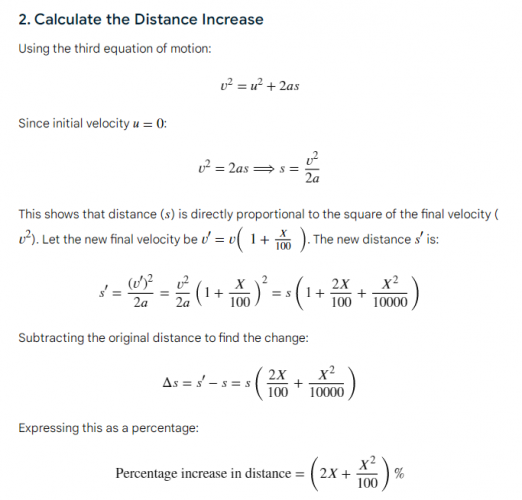
If V increases by Y% then by linear motion equation, takeoff distance increases by (2Y + Y^2/100)% (56.25%)
So Su-57 can still t/o with MTOW or certain load with 56.25% more takeoff distance on 20% less dense air runway, right?
As far as I know, AB mode will be turned on after brakes are released.Usually it is at 80% rpm.
AB is 40-60% of dry thust & the nozzle usually open up full for AB, but if that doesn't compensate 20% loss of dry thrust then yes the nozzle might squeeze a bit.That's not how it works.
There will be a drop in thrust of 20% which will lower pressure in the afterburner section and cause the nozzle to tighten to keep pressure and thrust efficiency. In rocket theory, increasing the pressure would increase v_e but this does not apply to jet engines. Jet engines rely on bypass pool to makeup the needed air mass. This does not apply in this case. So v_e cannot be increased.
Ofcourse, t/o is not just about speed, distance, time but also lift, drag, weight.Lower air density means you need a higher takeoff speed than usual (1.25 x) for the wing to generate the same lift force.
But i'm measuring distance, not time.So the acceleration time would be about t = 1.25 x 1.25 longer.
S = ut + 1/2 at^2, not 1/2 vt^2.This means the takeoff distance D = 1/2 v t^2 is now 2.44140625 longer.
At the beginning of the takeoff roll, the intake is usually a flow restriction due to the air being pulled in from all directions, having to turn around the relatively sharp lips of the intake. Blow-in doors or other auxiliary inlets can at least partially compensate. This lowers the inlet pressure at the front face of the fan and in the exhaust proportionally, reducing thrust. The nozzle will not close to increase the exhaust pressure, since you are controlling the pressure ratio across the fan, which will stall if the pressure ratio is too high. You accept the reduction in thrust at the beginning of the takeoff roll to optimize inlet performance and drag in the up and away envelope.
The engine airflow (corrected to standard day pressure and temperature) is set by the fan design, with the design flow maximized at a specific corrected maximum rotor speed. This usually is set at standard day conditions (15C). When the inlet temperature goes down from standard day, physical fan speed is reduced while the temperature corrected speed stays the same, keeping airflow and thrust constant. When the inlet temperature goes up, the physical speed of the fan stays constant, while the temperature corrected rotor speed and airflow decreases, reducing thrust. If an engine is flat rated, it has sufficient rotor speed and turbine temperature margin to increase the physical fan speed to keep the temperature corrected speed at the full airflow level, maintaining full thrust up to the flat rated temperature. You might see an engine with a flat rating thrust to +15C, which indicates it can maintain full thrust up to 30C inlet temperature.
FYI - fan and compressor speed is corrected by the square root of the absolute inlet temperature divided by the standard day absolute temperature. This is the same calculation used to determine the speed of sound. You can think of corrected rotor speed as the same as the Mach number of the blade tip. When the inlet temperature goes up, the speed of sound goes up, so the blade tip Mach number goes down at a constant rotor speed. Lower blade tip Mach number, less airflow.

Surprised they're still using drawings. I'd have thought MBD for sure.Btw, petals of the convergent-divergent nozzle are made from ceramic-composite material ,not from Titanium Alloy. One of the reason why is Izd 117/AL-41F-1 lighter than older AL-31F (by 150 kg in total).
From various videos globally we can see both - brake-less rolling t/o as well as release after AB, especially with Su-3X.
Some pilots love AB's kick after brake release, what they call as kick-ass ride.
I’m not going to try to work thru your math, just a couple of general comments:> Ok, i got most things except few things'll take time to understand Su-57's internal complex handling of air in the duct & engine.
I just wanted to know T/o performance in ISA Vs less dense runways.
> As per "Velocity Triangle" the horizontal air speed before fan has to be <=Mach 0.4
> How can rotor & fan speed be different? There're 2 spools of high & low pressure, Fan/LPC+LPT & HPC+HPT.
But bcoz AMF or Air Mass Flow is common in & out, it'll stay constant due to law of conservation of mass, so on the outside it's simpler to understand. I'll put what i got.
Make corrections where needed.
> Su-57 got mesh grills on bottom & side of intakes. Are these aux intake or excess air bleed vents or both functions? IDK.
View attachment 815347
> Considering AL-41, AL-51, Iz-177 & other Russian engines quoted dry/wet thrust, AMF are at ISA in chamber on ramp with bellmouth hence "uninstalled" thrust.
> "Installed" thrust on a jet at ISA will be lower by 2-5%.
> SU-57 MTOW 35 tons is also quoted at ISA i guess.
> Many Russian jets exported globally to hot, tropical areas. So all jets adjust their payload (fuel+weapons) as per runway's altitude, real-time climate, length, inclination, wind, etc.
> So if Su-57 is used in an area with hotter/thinner air say ISA+25-30C = 40-45C, then let's consider total thrust reduction from ISA by installation + climate to be 20%.
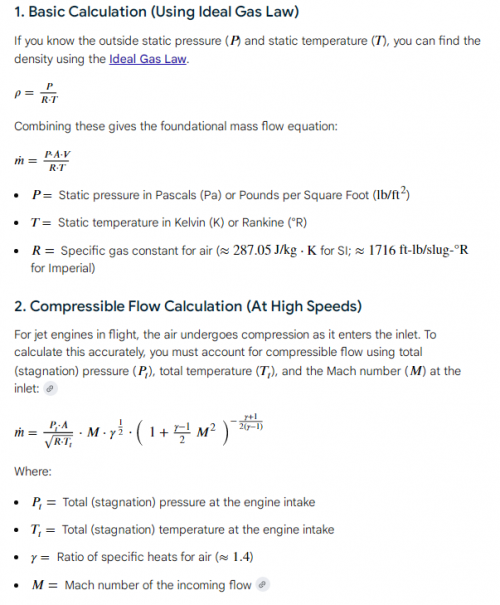
> Ultimately it's the air mass + fuel & air mass can be calculated as per pressure & temperature by simple Ideal Gas Law formula or more precisely by Isentropic formula [ see ATTACHMENT].
> Then in simple way by general thrust equation, thrust = F = M.acc = M.(Ve - Vi) if Pe = Pi,
If Pe <> Pi then F = M.(Ve - Vi) + (Pe - Pi).Ae, considering acceleration from fan to exhaust constant.
> On the outside we can consider AMF need for T/o to be imaginary container of air, so AMF/sec = Intake air Velocity/s X Intake area X air density outside.
> On runway with 20% loss of thrust, when jet is stationary & spools up to 100% mil power with brakes, the density, mass, dry thrust also reduce by 20% unless there're aux intake to restore that 20% loss AMF. IDK if Su-57's intakes will restore AMF & dry thrust or how much.
> Kinetic Energy has Mass & Velocity components. When max possible mass is ingested & max dry thrust is extracted from it, then AB can put fuel directly to further increase V producing wet thrust 30-70% more than dry by direct fuel injection. Again IDK which engine (AL-41F1/Iz-117, AL-51/Iz-30, Iz-177) will compensate dry thrust loss by how much.
> Considering Iz-177 engine dry/wet "uninstalled" thrust 108/157 KN at ISA in chamber on ramp with bellmouth.
> "Installed" thrust at ISA+25-30 would be 20% lower, so 86.4 KN dry unless Su-57 intakes & spools RPM restore AMF fully/partially.
> When AB lit with brakes, then 20% lower wet thrust 125.6 KN, if no AMF restored by intakes, spools & no extra AB fuel injection.
> Let's assume that no loss restoration. When brake release with AB, jet rolls with 20% less AMF & wet thrust. But when A/c speed reaches 25% more than T/o V at ISA, the T/o distance increases by 56.25%, the air volume is 25% more reaching 100% of ISA value, so AMF is restored & the jet can T/o with MTOW or STOW or intermediate load.
> Assuming at ISA, Su-57 with Iz-77 would push "installed" wet thrust 0.95 X 157 X 2 = 298.3 KN. Then -
- wet T/MTOW = 298.3/9.8 /35 = 0.87,- with 10.3 tons internal fuel + 4x 190 Kg R-77M + 2x 10⁵ Kg R-74M2, STOW = 29.27 tons, wet T/STOW = 298.3/9.8 /29.27 = 1.04
> Comparing with F-22 at ISA, "installed" thrust of 0.95 X 156 X 2 = 296.4 KN, then -
- wet T/MTOW = 296.4/9.8 /38 = 0.79- with 8.2 tons internal fuel + 6x 162 kg AIM-120 + 2x 85 Kg AIM-9X, STOW = 29.04 tons, wet T/STOW = 296.4/9.8 /29.04 = 1.04
> Both jets config look equal at ISA with STOW. But if Su-57 has higher lift then its T/o distance will be shorter.
> Google search says that under ideal conditions F-22 with MTOW can t/o in 500m & Su-57 in 350-400m.
> On YT videos, F-22 with 2 EFTs have been seen to t/o in 8-10 sec, for example at RAF Lakenheath, quite near ISA conditions. So Su-57 with 2 EFTs at identical airfield could do it slightly better if more lift.
Coeficient of friction for rolling tyre & runway = 0.03
Assumed Drag coefficient Cd = 0.035
Assumed cross section area = 5m2
Air density at ISA = 1.225 Kg/m3
Assumed T/o V=165 knots = 85 m/s, U = 0
Thrust - ground friction force - air dragforce = M.a
T- u.M.g - 1/2 p.v^2.Cd.A = M.a
312 KN - (0.03*38,000*9.8) - (0.5*1.225*85^2*0.035*5) = 38*a
38,000.a = 312,000 - 11,172 - 774.43
a = 7.9 m/s/s in ISA.
t = V/a = 10.76 seconds in ISA.
S = 1/2 at^2 = 457.32 m in ISA.
> So if no thrust loss compensation by intakes, spools RPM, AB then in 20% less dense air -
- F-22 would t/o with MTOW in 1.5625*457 = 714.5m
- Su-57 with Iz-177 engines would t/o with MTOW within 1.5625*400 = 625m.
But if loss compensation is there then T/o distance will reduce, probably around ISA distance.
Ok, when the throttle in opened from idle to full AB & then front landing gear gets pushed down, the engine takes few sec to spool up, brake released, the nozzle open out with AB. This happens very fast & might create illusion to viewers that AB opened 1st. I'll check some night t/o videos.It is certain that pilot must release brakes before engaging AB mode or in the same time but not after the AB mode is turned on. ''Overscan'' explained what is happening on the aircraft carrier.
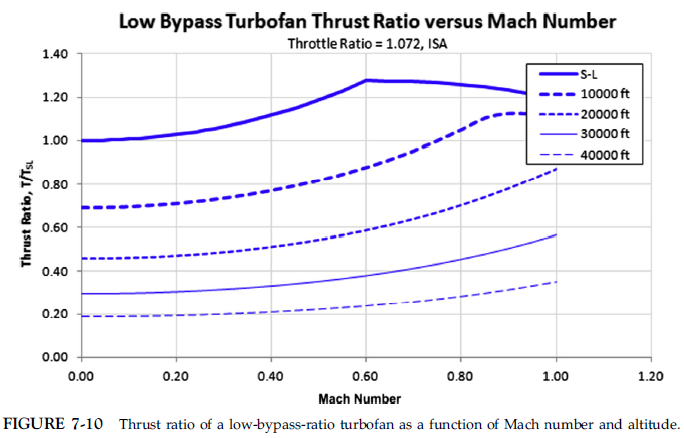
I guess this is due ram effect. Google search shows that dry & wet thrust at altitude & supersonic speed can be 50% more than uninstalled baseline thrust.To note one detail, you must keep in mind that difference between the static and the dynamic thrust can be big, sometimes very big.Example, MiG-29's engine RD-33 has max static thrust on the Full AB mode of 8300kgf but during the take off and climbing to 1000m ( cold weather) ,dynamic thrust can be even 11000kgf.
I’m not going to try to work thru your math, just a couple of general comments:
1. Don’t be hung up on M=0.4 at the engine face. A reasonable assumption, but it could be anywhere from 0.4 to 0.8, depending on the design of the inlet and engine fan. Definitely subsonic.
2. Fan/LPT and HPC/HPT rotor speeds are definitely different, with the HPC/HPT faster. They are mechanically independent, aerodynamically linked. Set by the mass flow thru the turbines and the pressure drop thru each turbine. The HPC has its own corrected rotor speed, corrected to the fan discharge temperature. As the inlet temp goes down at rated airflow, both Fan and HPC mechanical rotor speed decrease, while the airflow and corrected rotor speed stays constant.
3. Cold day performance of the engine does not go up once you have reached the design airflow inlet temperature. But the increased density does allow the wing to generate more lift, so you can take off at a lower true airspeed.
4. Hot day definitely reduces engine performance. At Luke AFB in the late 1980s, both F-15 and F-16 with a centerline tank had a requirement for Max AB on takeoff if the temperature was above 90-95F. Below that, Mil power takeoff was OK if it fit the mission requirements. Different takeoff thrust requirements based on different stores, ambient temperature, and local runway/airfield requirements.
5. AB increases thrust by increasing the temperature of the exhaust flow, plus some additional fuel mass flow. Exhaust pressure stays the same, pressure drop of approx 2:1 in the convergent nozzle gets the flow to M1, pressure in excess of that increases exhaust velocity supersonic in the divergent nozzle. But M1 in the exhaust increases velocity by the square root of the absolute temperature increase ratio from Mil to Max AB.
Admin - if you want to move this discussion into Propulsion, there is a existing thread related to the SU-57 and Supercruise requirements.
Depending on the engine control system, some engines can “light on the fly” - the engine can light and sequence the AB at the same time as the main engine is spooling up to Mil power. The F100-229 can get from ground Idle to 90% of Max AB thrust in 2.9 seconds by doing this.Ok, when the throttle in opened from idle to full AB & then front landing gear gets pushed down, the engine takes few sec to spool up, brake released, the nozzle open out with AB. This happens very fast & might create illusion to viewers that AB opened 1st. I'll check some night t/o videos.
I guess this is due ram effect. Google search shows that dry & wet thrust at altitude & supersonic speed can be 50% more than uninstalled baseline thrust.
Your analysis is in the right direction. Any secondary inlet path has the potential to reduce the static aircraft inlet penalty, but the lower density condition will be a penalty throughout the takeoff roll. The engine will not be able to compensate, unless you compare AB takeoff in low density vs Mil takeoff a high density.Thanks for the points.
But these are related to internal complex working of engine.
But i'm trying to understand things on the outside in terms of AMF bcoz that's what creates thrust with fuel mix.
And specifically to Su-57 with Iz-77 as example, but applicable in general.
So let me put my understanding in short points & questions -
> Quoted baseline uninstalled thrust at ISA on ramp with bellmouth considered 100%.
> Installed brake-release thrust lower by say 5% at ISA.
> Moving to 20% lower air density lowers thrust by say 15% further, total 20% loss at brake-release.
> Jet rolls down runway, ram effect & 25% increased velocity by law of conservation of mass help in restoring the needed thrust, with increased t/o distance by 56.25%.
You can correct the above 4 points if inaccurate.
Q) Will Su-57 intakes + engine RPM + afterburner + ram effect compensate for 20% thrust loss on less dense runway so that T/o can happen in same distance as in ISA condition runway OR longer T/o distance needed?
So i'm comparing AB T/o in low density with regular T/o in ISA.The engine will not be able to compensate, unless you compare AB takeoff in low density vs Mil takeoff a high density.
I already showd by law of conservation of mass,Don’t forget that the low density is also a lift penalty, requiring a higher true airspeed. You have to reach a higher speed for liftoff, and have less thrust available to get there, significantly increasing the required runway length, and double penalized if you consider runway needed for a successful aborted takeoff - higher speed, less effective drag parachute, more energy into the brakes.
The hook is for emergencies and not regular use like a parachute.BTW, F-22 doesn't have 2 wheels & parachute, but retractable arrestor hook.
Yes, everybody knows that from videos. I should have added that line.The hook is for emergencies and not regular use like a parachute.
IIRC they don't typically have a cable strung across the end of the runway just in case an aircraft needs to abort its takeoff. Also 100% certain F119 Doctor knows about the F-22s hook.Yes, everybody knows that from videos. I should have added that line.
Most USAF airfields have a barrier cable, either at the both ends of the runway, or at midfield on a short runway. This is raised under command from the tower under emergency conditions where the arresting hook is deployed to stop the jet. The air force hooks are not stressed to Navy carrier arrestment standards since their barrier cable do not stop the aircraft as quickly.IIRC they don't typically have a cable strung across the end of the runway just in case an aircraft needs to abort its takeoff. Also 100% certain F119 Doctor knows about the F-22s hook.
I knew the hooks are much less robust than the USN but didn't know about the underground cable thing. Have only seen the portable systems.Most USAF airfields have a barrier cable, either at the both ends of the runway, or at midfield on a short runway. This is raised under command from the tower under emergency conditions where the arresting hook is deployed to stop the jet. The air force hooks are not stressed to Navy carrier arrestment standards since their barrier cable do not stop the aircraft as quickly.
F-22 has excellent hot day performance as a result of the F119 being designed for supercruise performance at M1.5+ at 40K+ ft altitude. You seldom see them take off in AB unless loaded with external tanks, even at 110F at Nellis AFB.
However, even the F-22 can be impacted by density altitude. There was the mishap at Fallon NAS (4000 ft altitude) where a visiting Elmendorf AFB (sea level) F-22 didn’t properly calculate his takeoff performance at the Fallon ambient conditions and lifted off the runway behind the power curve, retracted his landing gear, and proceeded to settle back down onto the runway for a long slide to a stop on his belly. High and hot reduced the takeoff performance from what he was used to at Elmendorf, resulting in the mishap.
AB will definitely get your 1.25x exhaust velocity increase. If the AB increases absolute exhaust temp by 2x, velocity would increase approximately 1.4x. If the absolute temp increase is 4x, exhaust velocity approximately doubles. (Speed of sound increases by the square root of the absolute temp increase ratio).
what type of the casing treatment?Those photos confirm the new LPC is a wide-chord blisk and the presence of casing treatment.